Description
Initial trials of worksheet subscription universal level for 1 person for 60 days
$20.00
Initial trials of worksheet subscription universal level for 1 person for 60 days
After becoming fluent with subtraction facts the best way for students to retain the knowledge of those facts is by doing subtraction computation. If students have not been taught subtraction computation, Subtraction–Learning Computation breaks it down into 18 small, easy-to-learn steps that are numbered in a teaching sequence that leaves nothing to chance. Even better the instructional materials include an assessment of all the skills in subtraction computation in order, so you can test the knowledge of the student(s) before beginning instruction to see where to start. You can use this assessment to find very specific “holes” in student skills and then have the exact problems and explanation to fill that hole.
Note that the number for each skill gives the grade level as well as indicating the teaching sequence. Skill 3b is a 3rd grade skill and after skill 3g is learned the next in the sequence, skill 4a is best taught in fourth grade. Minor changes have been made, but for the most part, the sequence of skills is drawn from M. Stein, D. Kinder, J. Silbert, and D. W. Carnine, (2006) Designing Effective Mathematics Instruction: A Direct Instruction Approach (4th Edition) Pearson Education: Columbus, OH.
(1b) Subtract from 2 digits; no renaming.
(2a) Subtract from 2digits; renaming required.
(2b) Subtract from 3 digits; borrow from 10s.
(3a) Subtract from 3 digits; borrow from 100s.
(3b) Subtract from 3 digits; borrow either place.
(3c) Subtract tens minus one facts.
(3d) Subtract from 3 digits; zero in 10s; borrow 10s or 100s.
(3e) Read and write thousands numbers, use commas.
(3f) Subtract from 4 digits; borrow from 1000s.
(3g) Subtract from 4 digits; borrow once or more.
(4a) Subtract from 4 digits; zero in 10s or 100s column
(4b) Subtract from 4 digits; zero in 10s column, 1 in 100s.
(4c) Subtract hundreds minus one facts.
(4d) Subtract from 4 digits; zero in 10s and 100s column.
(4e) Subtract 1, 2, or 3 digits from 1,000.
(4f) Subtract 5 and 6 digits with borrowing.
(5a) Subtract thousands minus one facts.
(5b) Subtract from a number with four zeroes.
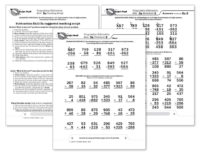
For each skill there is a suggested Teaching Script giving the teacher/tutor/parent consistent (across all the skills we use the same explanation) language of instruction on how to do the skill. My favorite part is the rule students are taught for when to borrow (often confusing for students): Bigger bottom borrows. Simple, easy-to-remember and consistently correct. The script helps walk the student through the computation process. For the teacher, in addition to the script, there are answer keys for the five worksheets provided for each skill.
Each worksheet is composed of two parts. The top has examples of the skill being learned that can be worked by following the script. After working through those examples with the teacher the student is then asked to work some review problems of addition problems that are already known. The student is asked to do as many as possible in 3 minutes—a kind of sprint. If all is well the student should be able to do all the problems or nearly all of them, but finishing is not required. Three minutes of review is sufficient for one day.
There are five worksheets for each skill. Gradually as the student learns the skill the teacher/tutor/parent can provide progressively less help and the student should be able to do the problems without any guidance by the end of the five worksheets. There are suggestions for how to give less help in the teaching scripts.
[otw_shortcode_button href=”https://www.rocketmath.com/worksheet-program-subscription-levels-comparison/ ” size=”medium” bgcolor=”#06427f” icon_type=”general foundicon-left-arrow” icon_position=”left” shape=”radius” color_class=”otw-blue”]Back to Comparison[/otw_shortcode_button] [otw_shortcode_button href=”https://www.rocketmath.com/members/signupuniversal-subscription-options” size=”medium” bgcolor=”#F9BF00″ icon_type=”general foundicon-right-arrow” icon_position=”right” shape=”radius” color_class=”otw-blue”]Continue to Checkout[/otw_shortcode_button]

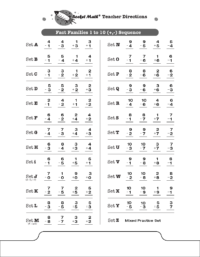
A fact family includes both addition and subtraction facts. You can see to the left the 25 examples of fact families taught in this program starting with Set A; 3+1, 1+3, 4-1 & 4-3. The sheet shows the sequence of learning facts in the new Rocket Math program Fact Families 1s-10s (+, -). Each set that students learn from A to Y adds just one fact family to be learned, so it isn’t too hard to remember. (That’s the Rocket Math secret ingredient!)
Learning math facts in families, is gaining in popularity these days. Logic suggests that this would be an easier way to learn. However, the research is not definitive that this is easier or a faster way to learn facts than separating the operations and learning all addition facts first and then learning all subtraction facts. But learning in fact families is a viable option, and I wanted to have it available for Rocket Math customers.
Best fit for first grade. I separated out the 1s through 10s facts from the 11s-18s, because these 25 families are just enough for one Rocket Math program. It is a good and sufficient accomplishment for first grade. I have heard that some first grades prefer to keep the numbers small but to learn both addition and subtraction–so this program accomplishes that.
I added Fact Families 1s-10s (+, -) to the Universal subscription in April of 2017 bringing the total number of programs in the Universal subscription to 14 (the basic four operations and ten more!). By the fall of the 2017 school year I should have the rest of the Fact Familes in addition and subtraction available. The rest of the addition and subtraction fact families, which students could learn in 2nd grade, would be the Fact Families 11s-18s (+, -). As always, new programs are added to the Universal subscription without additional cost as soon as they are available.
I most sincerely want students to be successful and to enjoy (as much as possible) the necessary chore of learning math facts to automaticity. Please give me feedback when you use this new program, Fact Families 1s-10s (+, -), as to how it goes for the students.
[otw_shortcode_button href=”https://www.rocketmath.com/worksheet-program-subscription-levels-comparison/ ” size=”medium” bgcolor=”#06427f” icon_type=”general foundicon-left-arrow” icon_position=”left” shape=”radius” color_class=”otw-blue”]Back to Comparison[/otw_shortcode_button] [otw_shortcode_button href=”https://www.rocketmath.com/members/signupuniversal-subscription-options” size=”medium” bgcolor=”#F9BF00″ icon_type=”general foundicon-right-arrow” icon_position=”right” shape=”radius” color_class=”otw-blue”]Continue to Checkout[/otw_shortcode_button]
Students need to know that six-eighths is equivalent to three-fourths and that four-twelfths is equivalent to one-third. While they can calculate these, it is very helpful to know the most common equivalent fractions by memory. One of the most common problems students have in fractions is not “reducing their answers to simplest form.”
Here’s a 5 minute Educreations lessons on How the Equivalent Fractions program works.
Part of the Universal subscription package.
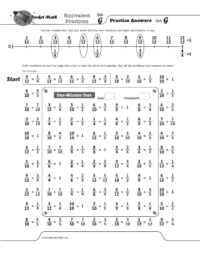
Equivalent fractions will help students commit 100 common equivalent fractions to memory. Each set (A through Z) has four fractions which are displayed on a fraction number line. Students frequently learn fractions equivalent to one,such as ten-tenths, as well as fractions that can’t be reduced, for example three-fourths is equivalent to three-fourths. Using the fraction number line will help with student understanding of why those fractions are equivalent.
Click here for the full sequence of 100 Equivalent fractions that students will learn in this program.
Equivalent fractions, Factors, and Integers, are all pre-algebra programs that are appropriate for middle school students who already know the basic facts.
[otw_shortcode_button href=”https://www.rocketmath.com/worksheet-program-subscription-levels-comparison/ ” size=”medium” bgcolor=”#06427f” icon_type=”general foundicon-left-arrow” icon_position=”left” shape=”radius” color_class=”otw-blue”]Back to Comparison[/otw_shortcode_button] [otw_shortcode_button href=”https://www.rocketmath.com/members/signupuniversal-subscription-options” size=”medium” bgcolor=”#F9BF00″ icon_type=”general foundicon-right-arrow” icon_position=”right” shape=”radius” color_class=”otw-blue”]Continue to Checkout[/otw_shortcode_button]
We include 4 removable, and reusable Goal Arrows with each Wall Chart. These stick to the Wall Chart to set motivating goals for your students. If your school needs Goal Arrows or additional Goal Arrows, here’s how to get them. Order Item 2008 and we will send you 48 additional arrows–enough for 16 teachers.