
• LOGIN CENTRAL
    • Worksheet Program
    • Online Game–admin
    • Online Game–play
    • Shopping/ordering
    • login
Search
  • $0.00 (0 items)
    • No products in the cart.
Rocket Math
  • Worksheet Program
    • Pre-tests (Do you need this?)
    • Subscription Comparison
    • Subscription Preview
    • Sign Up
    • Worksheet Samples
    • HELP teaching Worksheet Program
    • HELP managing Worksheet subscription
    • Video Training
  • Online Game
    • How It Works?
    • Get started video walk-throughs
    • Test Drive Demo student account!
    • HELP — FAQs
    • Basic Training for Players
    • iOS App
  • About
    • About Rocket Math
    • Sample worksheets show how Rocket Math works
    • Studies and Results
    • Testimonials
    • Privacy Policy
    • Contact
    • Blog
  • Resources
    • Pre-tests (Do you need this?)
    • Purchase Order Info
    • Catalog & Price List
    • Parent resources
    • Educator Resources
    • Dr. Don’s Hints and Tips
    • Flashcards (Print-Yourself)
    • FAQs on How to implement Worksheet Program: teaching directions
    • Directions for products
    • Fluency Tests
    • How to access (get into) my subscription?
    • Add Subusers
  • Rocket Math Store
    • WORKSHEET PROGRAM
    • ONLINE GAME ONLY
    • FLASHCARDS
    • BRAG TAGS
    • RACE FOR THE STARS GAMES
    • POSTERS AND MOTIVATION
    • ORGANIZATION AND TRAINING
    • HARD PRODUCTS PACKAGES
    • Rocket Math iOS App
  • $0.00 (0 items)
    • No products in the cart.
Rocket Math
  • Worksheet Program
    • Pre-tests (Do you need this?)
    • Subscription Comparison
    • Subscription Preview
    • Sign Up
    • Worksheet Samples
    • HELP teaching Worksheet Program
    • HELP managing Worksheet subscription
    • Video Training
  • Online Game
    • How It Works?
    • Get started video walk-throughs
    • Test Drive Demo student account!
    • HELP — FAQs
    • Basic Training for Players
    • iOS App
  • About
    • About Rocket Math
    • Sample worksheets show how Rocket Math works
    • Studies and Results
    • Testimonials
    • Privacy Policy
    • Contact
    • Blog
  • Resources
    • Pre-tests (Do you need this?)
    • Purchase Order Info
    • Catalog & Price List
    • Parent resources
    • Educator Resources
    • Dr. Don’s Hints and Tips
    • Flashcards (Print-Yourself)
    • FAQs on How to implement Worksheet Program: teaching directions
    • Directions for products
    • Fluency Tests
    • How to access (get into) my subscription?
    • Add Subusers
  • Rocket Math Store
    • WORKSHEET PROGRAM
    • ONLINE GAME ONLY
    • FLASHCARDS
    • BRAG TAGS
    • RACE FOR THE STARS GAMES
    • POSTERS AND MOTIVATION
    • ORGANIZATION AND TRAINING
    • HARD PRODUCTS PACKAGES
    • Rocket Math iOS App
Skip to content
  • Worksheet Program
    • Pre-tests (Do you need this?)
    • Subscription Comparison
    • Subscription Preview
    • Sign Up
    • Worksheet Samples
    • HELP teaching Worksheet Program
    • HELP managing Worksheet subscription
    • Video Training
  • Online Game
    • How It Works?
    • Get started video walk-throughs
    • Test Drive Demo student account!
    • HELP — FAQs
    • Basic Training for Players
    • iOS App
  • About
    • About Rocket Math
    • Sample worksheets show how Rocket Math works
    • Studies and Results
    • Testimonials
    • Privacy Policy
    • Contact
    • Blog
  • Resources
    • Pre-tests (Do you need this?)
    • Purchase Order Info
    • Catalog & Price List
    • Parent resources
    • Educator Resources
    • Dr. Don’s Hints and Tips
    • Flashcards (Print-Yourself)
    • FAQs on How to implement Worksheet Program: teaching directions
    • Directions for products
    • Fluency Tests
    • How to access (get into) my subscription?
    • Add Subusers
  • Rocket Math Store
    • WORKSHEET PROGRAM
    • ONLINE GAME ONLY
    • FLASHCARDS
    • BRAG TAGS
    • RACE FOR THE STARS GAMES
    • POSTERS AND MOTIVATION
    • ORGANIZATION AND TRAINING
    • HARD PRODUCTS PACKAGES
    • Rocket Math iOS App
Home Uncategorized extras Division–Learning Computation

Division–Learning Computation

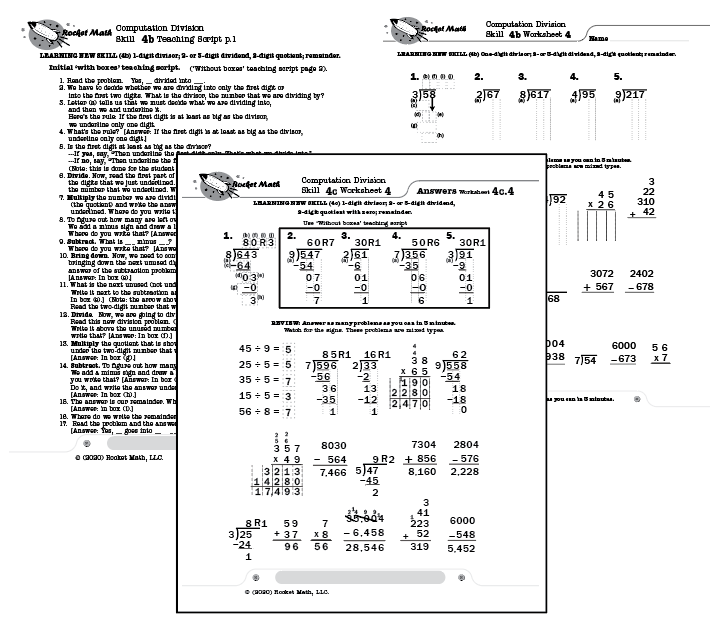
After becoming fluent with division facts the best way for students to retain the knowledge of those facts is by doing division computation.  If students have not been taught division computation, this program breaks it down into small, easy-to-learn steps that are numbered in a teaching sequence that leaves nothing to chance.

Note that the number for each skill gives the grade level as well as indicating the teaching sequence.  Skill 3b is a 3rd grade skill and after skill 3c is learned the next in the sequence is skill 4a.  The sequence of skills is drawn from M. Stein, D. Kinder, J. Silbert, and D. W. Carnine, (2006) Designing Effective Mathematics Instruction: A Direct Instruction Approach (4th Edition) Pearson Education: Columbus, OH.

(3b) Dividing 1-digit divisor and quotient with remainder.

(3c) Division equation with ÷ sign; facts with no remainder

(4a) 1-digit divisor; 2- or 3-digit dividend, 2-digit quotient; no remainder.

(4b) 1-digit divisor; 2- or 3-digit dividend, 2-digit quotient; remainder.

(4c) 1-digit divisor; 2- or 3-digit dividend, 2-digit quotient with zero; remainder.

not yet completed levels–coming soon

(4d) 1-digit divisor; 3- or 4-digit dividend, 3-digit quotient.

(4e) 1-digit divisor; 3- or 4-digit dividend, 3-digit quotient with zero.

(4f) 1-digit divisor; 4- or 5-digit dividend, 4-digit quotient.

(4g) Rounding to the nearest ten.

(4h) 2-digit divisor; 1- or 2-digit quotient, all estimation yields correct quotient.

(4i) 2-digit divisor with incorrect estimated quotients.


For each skill there is a suggested Teaching Script giving the teacher/tutor/parent consistent (across all the skills we use the same explanation) language of instruction on how to do the skill.  The script helps walk the student through the computation process.  For the teacher, in addition to the script, there are answer keys for the five worksheets provided for each skill.

Each worksheet is composed of two parts.  The top has examples of the skill being learned that can be worked by following the script.  After working through those examples with the teacher the student is then asked to work some review problems that are already known.  The student is asked to do as many as possible in 3 minutes—a kind of sprint.  If all is well the student should be able to do all the problems or nearly all of them, but finishing is not required.  Three minutes of review is sufficient for one day.

There are five worksheets for each skill.  Gradually as the student learns the skill the teacher/tutor/parent can provide progressively less help and the student should be able to do the problems without any guidance by the end of the five worksheets.  There are suggestions for how to give less help in the teaching scripts.
[otw_shortcode_button href=”https://www.rocketmath.com/worksheet-program-subscription-levels-comparison/ ” size=”medium” bgcolor=”#06427f” icon_type=”general foundicon-left-arrow” icon_position=”left” shape=”radius” color_class=”otw-blue”]Back to Comparison[/otw_shortcode_button] [otw_shortcode_button href=”https://www.rocketmath.com/members/signupuniversal-subscription-options” size=”medium” bgcolor=”#F9BF00″ icon_type=”general foundicon-right-arrow” icon_position=”right” shape=”radius” color_class=”otw-blue”]Continue to Checkout[/otw_shortcode_button]

Category: Uncategorized extras.
  • Description
  • Delivery and Returns Information

Description

After becoming fluent with division facts the best way for students to retain the knowledge of those facts is by doing division computation.  If students have not been taught division computation, this program breaks it down into small, easy-to-learn steps that are numbered in a teaching sequence that leaves nothing to chance.

Note that the number for each skill gives the grade level as well as indicating the teaching sequence.  Skill 3b is a 3rd grade skill and after skill 3c is learned the next in the sequence is skill 4a.  The sequence of skills is drawn from M. Stein, D. Kinder, J. Silbert, and D. W. Carnine, (2006) Designing Effective Mathematics Instruction: A Direct Instruction Approach (4th Edition) Pearson Education: Columbus, OH.

(3b) Dividing 1-digit divisor and quotient with remainder.

(3c) Division equation with ÷ sign; facts with no remainder

(4a) 1-digit divisor; 2- or 3-digit dividend, 2-digit quotient; no remainder.

(4b) 1-digit divisor; 2- or 3-digit dividend, 2-digit quotient; remainder.

(4c) 1-digit divisor; 2- or 3-digit dividend, 2-digit quotient with zero; remainder.

not yet completed levels–coming soon

(4d) 1-digit divisor; 3- or 4-digit dividend, 3-digit quotient.

(4e) 1-digit divisor; 3- or 4-digit dividend, 3-digit quotient with zero.

(4f) 1-digit divisor; 4- or 5-digit dividend, 4-digit quotient.

(4g) Rounding to the nearest ten.

(4h) 2-digit divisor; 1- or 2-digit quotient, all estimation yields correct quotient.

(4i) 2-digit divisor with incorrect estimated quotients.


For each skill there is a suggested Teaching Script giving the teacher/tutor/parent consistent (across all the skills we use the same explanation) language of instruction on how to do the skill.  The script helps walk the student through the computation process.  For the teacher, in addition to the script, there are answer keys for the five worksheets provided for each skill.

Each worksheet is composed of two parts.  The top has examples of the skill being learned that can be worked by following the script.  After working through those examples with the teacher the student is then asked to work some review problems that are already known.  The student is asked to do as many as possible in 3 minutes—a kind of sprint.  If all is well the student should be able to do all the problems or nearly all of them, but finishing is not required.  Three minutes of review is sufficient for one day.

There are five worksheets for each skill.  Gradually as the student learns the skill the teacher/tutor/parent can provide progressively less help and the student should be able to do the problems without any guidance by the end of the five worksheets.  There are suggestions for how to give less help in the teaching scripts.
Delivery and Returns Content description.

Related Products

  • Read more
    Uncategorized extras Identifying Fractions

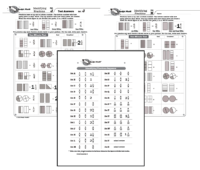
    This is a program to ensure that students have a firm and correct understanding of fractions.  This will prepare them well for all subsequent work in fractions.  They will learn the essential rule about what the numerator and denominator mean, although they won’t be working with those terms.  They just learn through examples, practiced over and over.

    The number on the top tells how many parts are shaded.  The number on the bottom indicates the number of parts in a whole.  If a whole is not divided into parts, it is a whole number.

    Right from the beginning of Set A students will encounter improper fractions and mixed numbers.  They will see examples of every fraction first at the top of the page before they are asked to identify it on their own. You see that students see the fraction, see the words for how we say it and they see the fraction they are to write.

    Unlike other Rocket Math programs, the test and the practice items are the same.  Of course the students have a page without the answers, while their partner holds the answer key. Students practice by saying aloud to their partner the fractions shown in the test.  Then they take the test on those same items, but write the answer.

    [otw_shortcode_button href=”https://www.rocketmath.com/worksheet-program-subscription-levels-comparison/ ” size=”medium” bgcolor=”#06427f” icon_type=”general foundicon-left-arrow” icon_position=”left” shape=”radius” color_class=”otw-blue”]Back to Comparison[/otw_shortcode_button] [otw_shortcode_button href=”https://www.rocketmath.com/members/signupuniversal-subscription-options” size=”medium” bgcolor=”#F9BF00″ icon_type=”general foundicon-right-arrow” icon_position=”right” shape=”radius” color_class=”otw-blue”]Continue to Checkout[/otw_shortcode_button]

  • Read more
    Uncategorized extras Fact Families Part Two 11-18 (+, -)

    A number of math programs around the country introduce math facts in families.  Now Rocket Math does too!

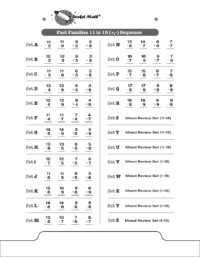
    A fact family includes both addition and subtraction facts. This program is Part 2 of Fact Families, coming after Fact Families 1 to 10. You can see to the left the 18 examples of fact families taught in this program starting with Set A; 11-2, 11-9, 9+2, & 2+9.  The sheet shows the sequence of learning facts in the new Rocket Math  program Fact Families Part Two 11 to 18 (+, -).  Each set that students learn from A to R adds just one fact family to be learned, so it isn’t too hard to remember.  (That’s the Rocket Math secret ingredient!) 

    Learning math facts in families, is gaining in popularity these days.  Logic suggests that this would be an easier way to learn.  However, the research is not definitive that this is easier or a faster way to learn facts than separating the operations and learning all addition facts first and then learning all subtraction facts.  But learning in fact families is a viable option, and I wanted to have it available for Rocket Math customers.

    Part Two is a Best fit for second grade.  These facts come after the facts in 1 to 10, typically learned in first grade, so these are best for second grade.  The 25 fact families in 1s through 10s facts are just enough for one Rocket Math program.  It is a good and sufficient accomplishment for first grade.  With the 11 to 18 in Par Two for second grade there will be a lot of review.  In fact sets S through Z are all review. I have heard that some first grades prefer to keep the numbers small but to learn both addition and subtraction–so this program accomplishes that.

    I added Fact Families Part Two 11 to 18 (+, -) to the Universal subscription in August of 2018 bringing the total number of programs in the Universal subscription to 19 (the basic four operations and 15 more!).  As always, new programs are added to the Universal subscription without additional cost as soon as they are available.

    I most sincerely want students to be successful and to enjoy (as much as possible) the necessary chore of learning math facts to automaticity. Please give me feedback when you use this new program, Fact Families 11 to 18 (+, -),  as to how it goes for the students.


    [otw_shortcode_button href=”https://www.rocketmath.com/worksheet-program-subscription-levels-comparison/ ” size=”medium” bgcolor=”#06427f” icon_type=”general foundicon-left-arrow” icon_position=”left” shape=”radius” color_class=”otw-blue”]Back to Comparison[/otw_shortcode_button] [otw_shortcode_button href=”https://www.rocketmath.com/members/signupuniversal-subscription-options” size=”medium” bgcolor=”#F9BF00″ icon_type=”general foundicon-right-arrow” icon_position=”right” shape=”radius” color_class=”otw-blue”]Continue to Checkout[/otw_shortcode_button]

  • Read more
    Uncategorized extras Multiplication–Learning Computation

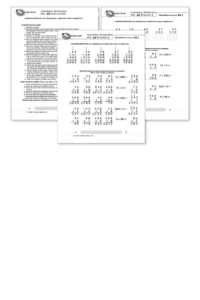
    After becoming fluent with multiplication facts the best way for students to retain the knowledge of those facts is by doing multiplication computation.  If students have not been taught multiplication computation, this program breaks it down into small, easy-to-learn steps that are numbered in a teaching sequence that leaves nothing to chance.

    Note that the number for each skill gives the grade level as well as indicating the teaching sequence.  Skill 3b is a 3rd grade skill and after skill 3e is learned the next in the sequence is skill 4a.  The sequence of skills is drawn from M. Stein, D. Kinder, J. Silbert, and D. W. Carnine, (2006) Designing Effective Mathematics Instruction: A Direct Instruction Approach (4th Edition) Pearson Education: Columbus, OH.

    (3b) Multiplying 1-digit times 2-digit; no renaming

    (3c) Multiplying 1-digit times 2-digit; carrying

    (3d) Multiplying 1-digit times 2-digit, written horizontally.

    (3e) Reading and writing thousands numbers, using commas.

    (4a) Multiplying 1-digit times 3-digit

    (4b) Multiplying 1-digit times 3-digit; zero in tens column

    (4c) Multiplying 1 digit times 3 digit, written horizontally

    (4d) Multiplying 2-digits times 2-digits.

    (4e) Multiplying 2-digits times 3-digits.

    (5a) Multiplying 3-digits times 3-digits.

    (5b) Multiplying 3-digits times 3-digits; zero in tens column of multiplier.


    For each skill there is a suggested Teaching Script giving the teacher/tutor/parent consistent (across all the skills we use the same explanation) language of instruction on how to do the skill.  The script helps walk the student through the computation process.  For the teacher, in addition to the script, there are answer keys for the five worksheets provided for each skill.

    Each worksheet is composed of two parts.  The top has examples of the skill being learned that can be worked by following the script.  After working through those examples with the teacher the student is then asked to work some review problems of addition problems that are already known.  The student is asked to do as many as possible in 3 minutes—a kind of sprint.  If all is well the student should be able to do all the problems or nearly all of them, but finishing is not required.  Three minutes of review is sufficient for one day.

    There are five worksheets for each skill.  Gradually as the student learns the skill the teacher/tutor/parent can provide progressively less help and the student should be able to do the problems without any guidance by the end of the five worksheets.  There are suggestions for how to give less help in the teaching scripts.
    [otw_shortcode_button href=”https://www.rocketmath.com/worksheet-program-subscription-levels-comparison/ ” size=”medium” bgcolor=”#06427f” icon_type=”general foundicon-left-arrow” icon_position=”left” shape=”radius” color_class=”otw-blue”]Back to Comparison[/otw_shortcode_button] [otw_shortcode_button href=”https://www.rocketmath.com/members/signupuniversal-subscription-options” size=”medium” bgcolor=”#F9BF00″ icon_type=”general foundicon-right-arrow” icon_position=”right” shape=”radius” color_class=”otw-blue”]Continue to Checkout[/otw_shortcode_button]

  • Read more
    Uncategorized extras Addition–Learning Computation

    Addition—Learning Computation

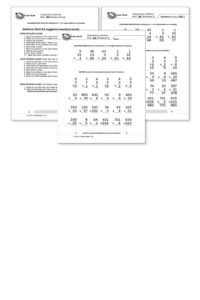
    After becoming fluent with addition facts the best way for students to retain the knowledge of those facts is by doing addition computation.  If students have not been taught addition computation, this program breaks it down into small, easy-to-learn steps that are numbered in a teaching sequence that leaves nothing to chance.

    Note that the number for each skill gives the grade level as well as indicating the teaching sequence.  Skill 2a is a 2nd grade skill and after skill 2f is learned the next in the sequence is skill 3a.  The sequence of skills is drawn from M. Stein, D. Kinder, J. Silbert, and D. W. Carnine, (2006) Designing Effective Mathematics Instruction: A Direct Instruction Approach (4th Edition) Pearson Education: Columbus, OH.

    (1b) Adding 1-, or 2-digit numbers; no renaming

    (2a) Adding three single-digit numbers

    (2b-c) Adding 3-digit numbers; no renaming

    (2c) Adding 3-digits to 1 or more digits; no renaming

    (2d) Adding three 1- or 2-digit numbers; no renaming

    (2e) Adding two 2-digit numbers, renaming 1s to 10s

    (2f) Adding 3-digit numbers, renaming 1s to 10s

    (3a) Adding a 1-digit number to a teen number, under 20

    (3b) Adding two 2- or 3-digit numbers; renaming 10s to 100s

    (3c) Adding 3-digit numbers; renaming twice

    (3d) Adding three 2-digit numbers; renaming sums under 20

    (3e) Adding four multi-digit numbers; renaming, sums under 20

    (4a) Adding a 1-digit number to a teen number, over 20

    (4b) Adding three 2-digit numbers, sums over 20

    (4c) Adding four or five multi-digit numbers, sums over 20

    For each skill there is a suggested Teaching Script giving the teacher/tutor/parent consistent (across all the skills we use the same explanation) language of instruction on how to do the skill.  The script helps walk the student through the computation process.  For the teacher, in addition to the script, there are answer keys for the five worksheets provided for each skill.

    Each worksheet is composed of two parts.  The top has examples of the skill being learned that can be worked by following the script.  After working through those examples with the teacher the student is then asked to work some review problems of addition problems that are already known.  The student is asked to do as many as possible in 3 minutes—a kind of sprint.  If all is well the student should be able to do all the problems or nearly all of them, but finishing is not required.  Three minutes of review is sufficient for one day.

    There are five worksheets for each skill.  Gradually as the student learns the skill the teacher/tutor/parent can provide progressively less help and the student should be able to do the problems without any guidance by the end of the five worksheets.  There are suggestions for how to give less help in the teaching scripts.
    [otw_shortcode_button href=”https://www.rocketmath.com/worksheet-program-subscription-levels-comparison/ ” size=”medium” bgcolor=”#06427f” icon_type=”general foundicon-left-arrow” icon_position=”left” shape=”radius” color_class=”otw-blue”]Back to Comparison[/otw_shortcode_button] [otw_shortcode_button href=”https://www.rocketmath.com/members/signupuniversal-subscription-options” size=”medium” bgcolor=”#F9BF00″ icon_type=”general foundicon-right-arrow” icon_position=”right” shape=”radius” color_class=”otw-blue”]Continue to Checkout[/otw_shortcode_button]

Get Started Today With

Rocket Math

Game Subscription Worksheet Subscription

Contact Rocket Math

(We’re open during school hours!)

14435 SE Donatello Loop
Happy Valley, OR 97086
Toll-Free: 888-488-4854
Fax: 866-960-4700

email: don (at) rocketmath (dot) com

Satisfaction Guaranteed or your money back

Worksheet Subscriptions

  • SUBSCRIPTION COMPARISON
  • ACCESS MY SUBSCRIPTION
  • RESET ACCESS
  • EXPIRED SUBSCRIPTION?

Game Subscription

  • HOW IT WORKS?
  • REGISTER
  • PLAY THE GAME
  • MANAGE ACCOUNT – PLAYERS
  • FAQs and DIRECTIONS
  • iOS APP
Subscribe for Email Updates

Add a descriptive message telling what your visitor is signing up for here.

© 2009–2019 Rocket Math. All rights reserved. Terms & Conditions | Privacy Policy | Home

v.1.1.2