5 easy ways to get help running Rocket Math.

Here are 5 ways to get help with the procedures for successful Rocket Math implementation.

1.) Use the ***NEW*** search function.  At the upper left of the blue navigation bar is an icon of a magnifying glass.  Click on that and a search bar opens in the middle of the page.  Click within the search bar and you can type in whatever you are looking for.  It will bring up blogs, parts of the directions, basically anything I’ve written on the subject–which is a lot.  You can get pretty specific very fast, so try this first.  I’m very excited to have added this feature this week, which is why it is top of my list!

2)  FAQs.  Look at the Rocket Math FAQs page.  Click on the linked words to the left, or navigate to it.  The FAQs page is the third Rocket Math Filing cabinet on the webitem under ABOUT in navigation.  The FAQs page displays all of the questions from the teacher directions, and my answers, so you can scroll down to the topic you need quickly.   However, all the FAQs will show up in the search function as well.
2.5) The FAQs are also available in the Rocket Math filing cabinet.  They are in the top drawer, the “Forms and Information” drawer of the filing cabinet.  There are titles of the FAQs so you can open and print any one you wish.  Good for sharing with other staff.

3) Rocket Math YouTube channel. You can go to the Rocket Math YouTube channel.  Click on the linked words to the left, or search for Rocket Math in You Tube.  If you scroll down the page you can click on “View Full Playlist” and then you’ll be able to see all the topics that are available.  Right now there are 37 videos, but that could change if we add some more.

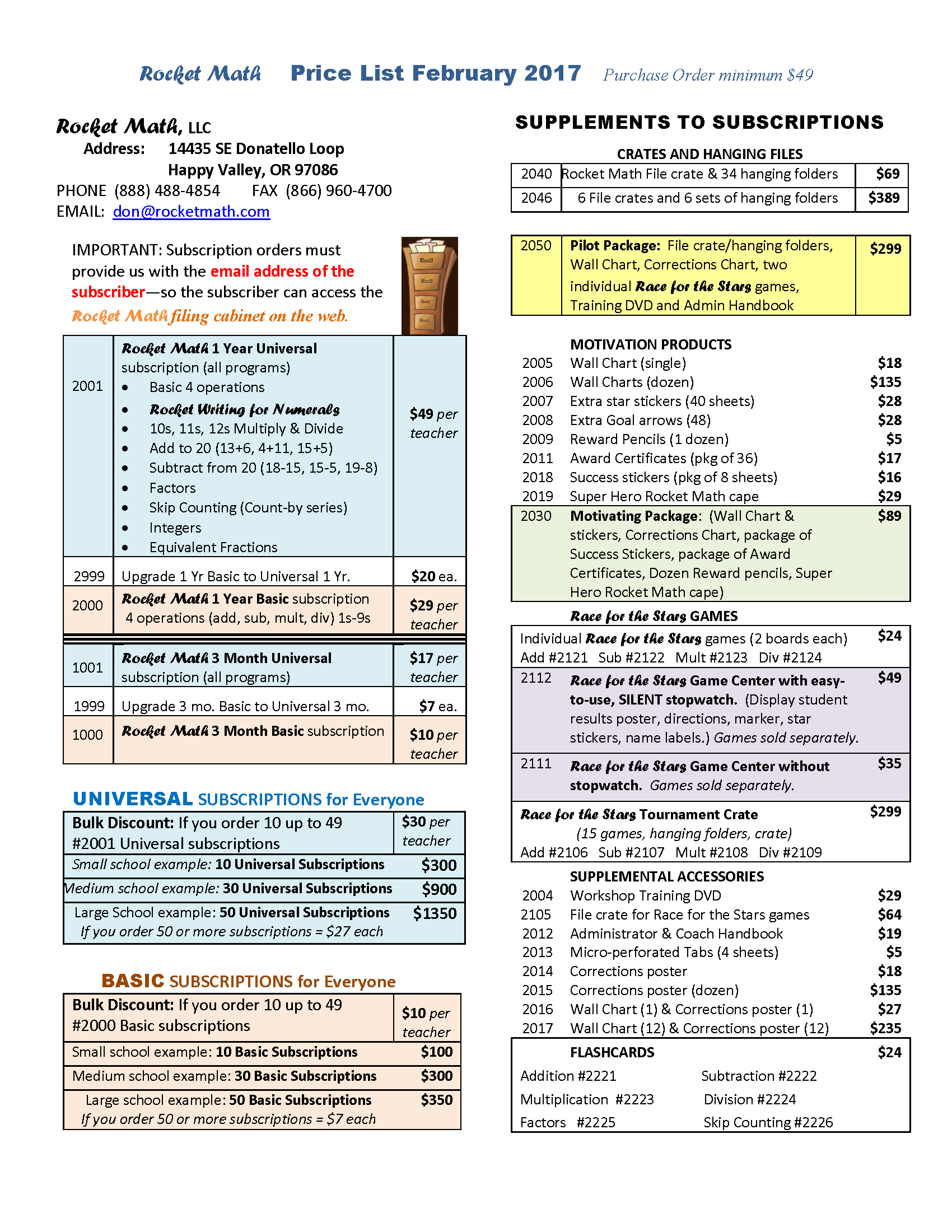
4) DVD training.  Order the Workshop Training DVD (#2004) for $29  This is the whole training from Dr. Don filmed and broken into chapters.  It is over 3 hours and gives a lot of rationale for the procedures we recommend.  Very helpful if Rocket Math is new for your staff.  Really important to do things as recommended.  Having coached this in many schools for many years, I can promise you it will go better if you follow the directions!

5) Contact Dr. Don.  Really.  You can call me (800) 488-4854 during west coast school hours and I’ll probably be able to answer the phone directly.  It’s a joy for me to talk about implementing Rocket Math with teachers, so don’t be shy.  But if you don’t reach me, please send an email to don@rocketmath.com rather than leave your phone number because during the school day teachers are very hard to reach.  I’d rather just write an answer in an email so we don’t miss each other.  And if it is a new question I’ll probably turn my answer into a blog that can be found through the search function.

How long should I allocate for Rocket Math daily?

Jessica asks:

As I am planning my daily schedule I am looking for how long I should set aside for Rocket Math each day.  What do you suggest?

Dr. Don answers: 

If you allocate 15 minutes a day for Rocket Math that will be enough.  You might have trouble meeting finishing that quickly in the beginning before the routine is established.  But once the routine is set there is no need to take more time than that–each partner of the pair is practicing for 2 to 3 minutes and the test takes only one minute.  Don’t try to have everyone correct their partners papers as that will take too long.  Making sure that students practice every day with their partner is critical to success, so anything that makes you feel “we don’t have time for Rocket Math today” is harmful to student learning.

The other key is to be sure to teach students how to practice with each other.  If you can train your students to correct hesitations you will accomplish a lot with your Rocket Math practicing time.  Please take a look at my video on “How to teach students how to practice.”   Take the time allocated to Rocket Math for the first several days of school and follow this teaching procedure.  It will pay off for you all year long in improved learning during Rocket Math time.

Learning Addition Computation quickly and easily

Rocket Math adds something new: Addition—Learning Computation

After becoming fluent with addition facts the best way for students to retain the knowledge of those facts is by doing addition computation. Rocket Math has added a new program to the Universal Subscription that teaches addition computation.  If students have not been taught addition computation, this program breaks it down into small, easy-to-learn steps that are numbered in a teaching sequence that leaves nothing to chance.  There is an placement assessment that can be given to figure out where the student should begin in the sequence.

Note that the number for each skill gives the grade level as well as indicating the teaching sequence.  Skill 2a is a 2nd grade skill and after skill 2f is learned the next in the sequence is skill 3a.  The sequence of skills is drawn from M. Stein, D. Kinder, J. Silbert, and D. W. Carnine, (2006) Designing Effective Mathematics Instruction: A Direct Instruction Approach (4th Edition) Pearson Education: Columbus, OH.

(1b) Adding 1-, or 2-digit numbers; no renaming

(2a) Adding three single-digit numbers

(2b-c) Adding 3-digit numbers; no renaming

(2c) Adding 3-digits to 1 or more digits; no renaming

(2d) Adding three 1- or 2-digit numbers; no renaming

(2e) Adding two 2-digit numbers, renaming 1s to 10s

(2f) Adding 3-digit numbers, renaming 1s to 10s

(3a) Adding a 1-digit number to a teen number, under 20

(3b) Adding two 2- or 3-digit numbers; renaming 10s to 100s

(3c) Adding 3-digit numbers; renaming twice

(3d) Adding three 2-digit numbers; renaming sums under 20

(3e) Adding four multi-digit numbers; renaming, sums under 20

(4a) Adding a 1-digit number to a teen number, over 20

(4b) Adding three 2-digit numbers, sums over 20

(4c) Adding four or five multi-digit numbers, sums over 20

For each skill there is a suggested Teaching Script giving the teacher/tutor/parent consistent (across all the skills we use the same explanation) language of instruction on how to do the skill.  The script helps walk the student through the computation process.  For the teacher, in addition to the script, there are answer keys for the five worksheets provided for each skill.

Each worksheet is composed of two parts.  The top has examples of the skill being learned that can be worked by following the script.  After working through those examples with the teacher the student is then asked to work some review problems of addition problems that are already known.  The student is asked to do as many as possible in 3 minutes—a kind of sprint.  If all is well the student should be able to do all the problems or nearly all of them, but finishing is not required.  Three minutes of review is sufficient for one day.

There are five worksheets for each skill.  Gradually as the student learns the skill the teacher/tutor/parent can provide progressively less help and the student should be able to do the problems without any guidance by the end of the five worksheets.  There are suggestions for how to give less help in the teaching scripts.  Thumbnail previews can be found here.

Learn to add and subtract in first grade with fact families

A number of math programs around the country introduce math facts in families.  Now Rocket Math does too!

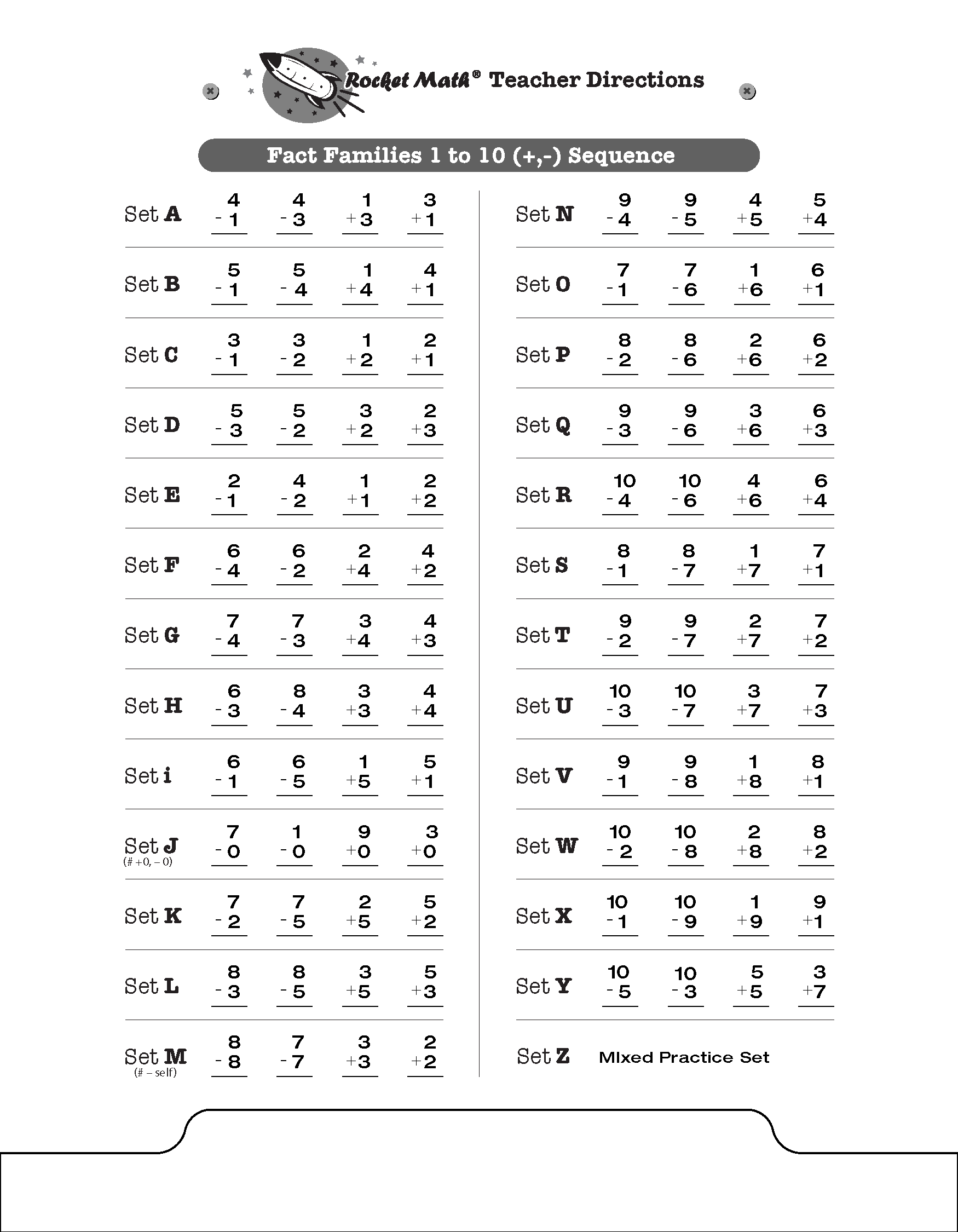
A fact family includes both addition and subtraction facts. You can see to the right 25 examples of fact families such as Set A; 3+1, 1+3, 4-1 & 4-3.  The sheet shows the sequence of learning facts in the new Rocket Math  program Fact Families 1s-10s (+, -).  Each set that students learn from A to Y adds just one fact family to be learned, so it isn’t too hard to remember.  (That’s the Rocket Math secret ingredient!) 

Learning math facts in families, is gaining in popularity these days.  Logic suggests that this would be an easier way to learn.  However, the research is not definitive that this is easier or a faster way to learn facts than separating the operations and learning all addition facts first and then learning all subtraction facts.  But learning in fact families is a viable option, and I wanted to have it available for Rocket Math customers.

Flash news!! Someone looking for a master’s or doctoral thesis could do a comparative study of students using the fact families vs. the separated facts in Rocket Math. This could easily be a gold standard research study because you could randomly assign students to conditions within classrooms–the routine is the same for both–just the materials in their hands is different!  Just sayin’…

I separated out the 1s through 10s facts from the 11s-18s, because this seemed enough for one program.  It would be a good and sufficient accomplishment for first grade.  I have heard that some first grades prefer to keep the numbers small but to learn both addition and subtraction–so this program accomplishes that.

I added Fact Families 1s-10s (+, -) to the Universal subscription in April of 2017 bringing the total number of programs in the Universal subscription to 14 (the basic four operations and ten more!).  By the fall of the 2017 school year I should have the rest of the Fact Familes in addition and subtraction available.  [In time for you to do that gold standard research study!]  The rest of the addition and subtraction fact families, which students could learn in 2nd grade, would be the Fact Families 11s-18s (+, -).  As always, new programs are added to the Universal subscription without additional cost as soon as they are available.

I most sincerely want students to be successful and to enjoy (as much as possible) the necessary chore of learning math facts to automaticity. Please give me feedback when you use this new program, Fact Families 1s-10s (+, -),  as to how it goes for the students.

Why is a gifted student having trouble with Rocket Math?

Question: Hi, Dr. Don! Just had a question recently from a parent of a gifted child whose son is having a lot of difficulty doing Rocket Math! He understands almost everything conceptually in math (in the 99% on national testing) but he is not being successful working with a partner on his math facts. Have you had this problem in other places? I’m not sure if the problem is he really can’t focus on the facts, he’s stubborn and doesn’t like details (big picture thinker), etc. He’s a very social kid so the partnering doesn’t seem to be the problem. I would greatly appreciate any suggestions you might have that I could give this mother. She says that he is fine at home doing his facts with her without a timer. But I don’t like the idea of excusing any student from doing this valuable practice. Thanks for your thoughts. Linda

Answer: I’ve blogged a bit on some of these issues elsewhere on the Rocket Math website, but let me try to be more specific here. First, gifted kids are stunned to find out that they have to work hard to memorize math facts. They probably need three or four days of practice—which to them seems like failure.  They are like an athletic kid who excels easily at every sport but finds he needs to work out with weights as much as a klutz to get to be able to lift heavy weights—his natural talent doesn’t help in this instance. So kids who’ve never had to work to learn things before, really are annoyed by having to practice several days in a row.  But it is really good for them!

How is mom practicing with him at home? Can she video him doing the test “untimed?”  If the child is “writing facts” and “without a timer” then he may be figuring out facts over and over—but is not getting to instant recall. That’s why the oral peer practice is so critical—if there is even a slight hesitation the child is to repeat the fact three times, back up three problems and come at it again—until the answer comes with no hesitation. There is a fundamental difference between instant recall of facts from memory and strategies to come to the answer by thinking it through. My parent letter addresses how to practice.  On the other hand, if the student is able to write the answers to math facts at a fast enough rate to complete 40 problems in a minute, but only when he thinks he is not being “timed” then he needs to learn how to do the same thing when he is being timed.

If he is not learning with the daily practice, we have to ask, “Why not?”  Social kids sometimes socialize instead of practicing. Social kids also can convince their partner not to do the correction procedure. Or they just say the answers instead of the whole problem and the answer. Any of those things would result in not successfully learning the facts. The teacher would need to monitor the quality of the practice. My experience has been that when students are “stuck” or “having difficulty” even just one session of practice done the right way rigorously (with me) and they suddenly improve enough to pass or to recognize they can pass the next day with another session of rigorous practice.

Last of all, sometimes the writing goals are off because of some glitch in how you gave the writing speed test.  So the student might know the facts well enough but not be able to write them fast enough to pass the tests.  If the student can answer 40 facts in a minute in the current set (just saying the answers without having to say the problems) then the facts are learned to automaticity—and the goal in writing should be lowered to whatever the student has done to this point.

Hope this helps. You are right not to excuse this student from learning math facts to automaticity. He might be a stellar mathematician someday if he learns his facts well enough that math computation is always easy for him. If math computation remains slow or laborious he won’t like it enough to pursue it as a career.

Without the directions you may get lost!

What happens when teachers don’t have a copy of the Rocket Math Teacher Directions?  Bad things!  

When teachers don’t have the written directions to Rocket Math, the essence of the program usually gets lost.  Procedures get modified and modified over the years until they are not even close to what should be occurring. Sometimes we have found schools that are not even providing daily oral practice.  Other schools don’t give the answer keys to the peer tutors.  Other schools don’t give the writing speed test and make up impossible-to-reach goals for students.  We often see teachers implementing the “Rocket Math” program incorrectly and wondering why it doesn’t work.  We ask them if they have read the teacher directions, and they say they didn’t know there were any.  When teachers have never seen the directions, is it any wonder they don’t know what they are supposed to be doing?  Hear-say directions handed down over the years from one teacher to another just don’t convey all the important details.  Teachers need the directions!

This is why I’d like you to have my complete directions for free. Even if you purchased Rocket Math ten years ago and haven’t gotten the updated versions since then, you can have these directions for free.  I have them in three places.  I have the directions broken out into FAQs on their own web page here.  That’s easy for quick reference.

The second place I have the Teacher Directions is as a downloadable booklet you can print out and distribute.  The Rocket Math Teacher Directions for the worksheet program booklet is here.   Please print this out and give to your teachers, especially in schools that began implementing several years back.  Read them and have a discussion at a professional development time.  You will be astounded at how much your implementation differs.

The third place I have the Teacher Directions is in the “filing cabinet on the web” for those of you who have the subscription. In the “Forms and Information” drawer we have the booklet and the FAQs which can be opened and printed out.

In school-wide implementations of Rocket Math, principals or math coaches need to take a leadership role.  The Administrator and Coach Handbook gives you forms with what to “look-for” in a Rocket Math implementation.  If you use that to observe Rocket Math in your classrooms you’ll quickly see whether or not things are going the way they should.   If you have a subscription to Rocket Math you’ll find all of the chapters of the Administrator and Coach Handbook in the “Forms and Information” drawer of our filing cabinet on the web.

Please take the time to see that you or your teachers are implementing Rocket Math according to the directions.  Trust me, it works SO MUCH BETTER if you do.  I wouldn’t steer you wrong!


Rush help to those who need it with an aimline

The sooner you provide extra help the easier it will be to catch them up.  

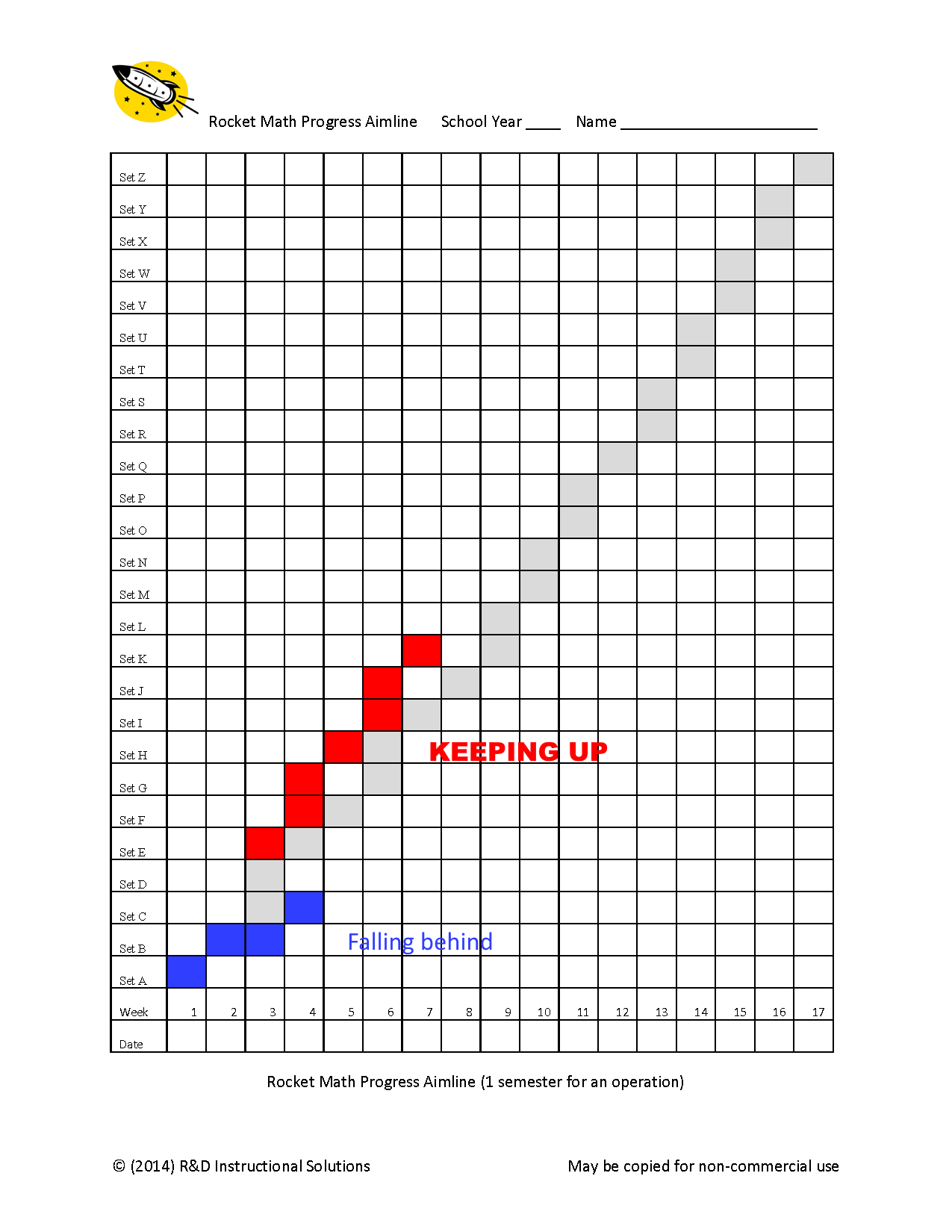
How can you know when students need help to meet expectations?  Use the graph above, which is available from the Educator’s Resources page or here: One Semester Aimline.  It is also available in the basic subscription site, Forms and Information Drawer as an optional form. It is an “aimline” for finishing an operation (Sets A-Z) in one semester.  Schools that don’t start Rocket Math in first grade need students to finish addition in the first semester of 2nd grade and subtraction in the second semester.  This means that students who get stuck on a level for even a week need to be helped.

If you indicate on this graph the week in which the student finishes each set in Rocket Math you can tell if the student is making enough progress, or if he/she needs to be getting extra practice sessions each day. If the student is working on a set above the line of gray boxes or on the line then progress is adequate–they are on track to finish the operation by the end of 18 weeks of the semester.  But if the student is working on a set that is below the line that means he/she needs intervention.

In the example above the student whose progress is shown in red is above the aimline.  That student has been passing at a rate that means he or she will finish the operation by completing Level Z by the end of the semester.  That student does not need any extra intervention.  In the example above the student in blue is falling behind.  By the fourth week that student has only passed Level C and so he needs to have extra help.

The first step would be to ensure this student has a good partner and is practicing the right way.  Sometimes students don’t stay on task or do not listen and correct their partner.  If hesitations are allowed (while the student figures out the answer) and not corrected the student will not improve.  Fix the practice in class first and see if the rate of passing improves and the student starts to get up to the aimline.

The second step is to include this student in a group of students who get a second practice session each day.  They would work in pairs and do another Rocket Math session each day.  Whether or not they take tests is unimportant.  What is important is that they do the oral practice with a partner who corrects their hesitations as well as their errors.  This could be done by a Title One teacher or assistant or a special education teacher or assistant.  It should only take ten minutes.

Another step is to involve parents if that’s possible.  Another practice session (or two) at home each evening would make a big difference.  Parents will need to know how to correct hesitations, but there’s a parent letter in the Forms and Information drawer for that.  Also note that siblings can do this practice as well, as long as they have an answer key.

You will be pleasantly surprised at how an extra few minutes a day of good quality practice can help students progress much faster at Rocket Math.  The sooner you intervene, the easier it will be for the student to catch up.

NOTE: There is an aimline for finishing one operation in a year.  It is also in the Forms and Information drawer and on the Educator’s Resources page of our website.  If you follow recommendations and do addition in first grade, subtraction in second, and multiplication in third you can use that aimline.  It won’t require intervening on so many students.


What about students who can’t pass in 6 tries?

A teacher writes:

Help! I’m feeling bogged down in Rocket Math. I have some students who have been working on the same sheet for over 10 times and are no closer to passing. What am I doing wrong?

Dr. Don answers:

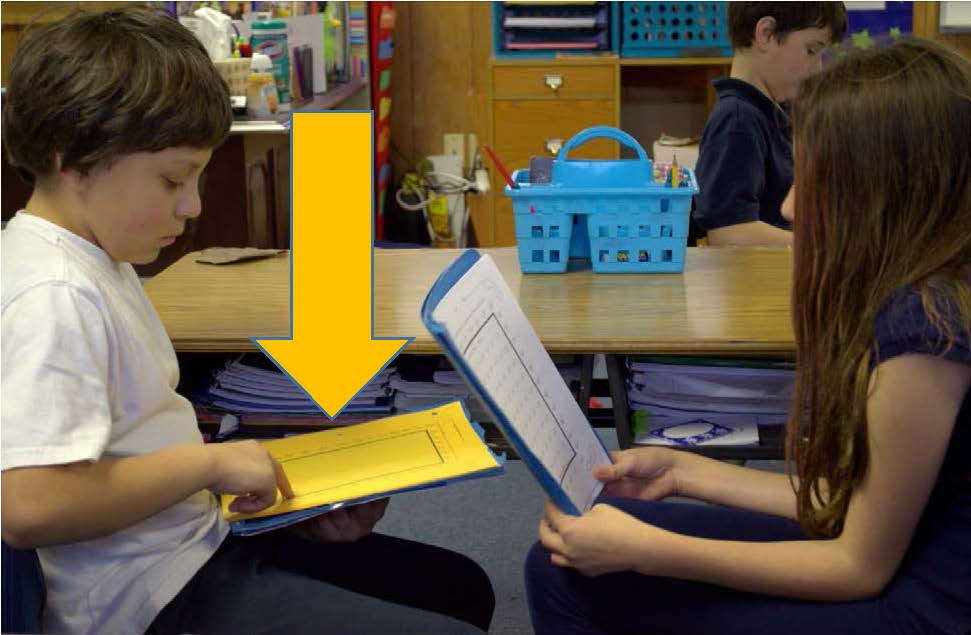
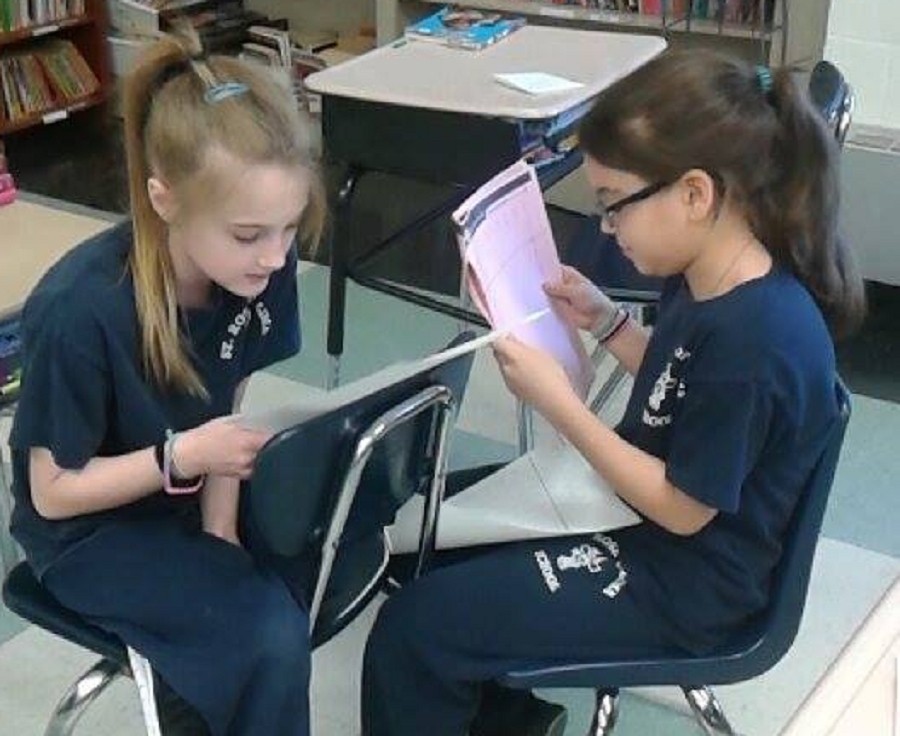
The problem could be one of several things.  You have to diagnose what it could be.  I am assuming you have students practicing orally in pairs, with answer keys, for at least two minutes per partner every day (as shown in the picture above).  I am assuming you already have students, who do not pass, take home the sheet on which they didn’t pass and finish it as homework and practice with someone at home.  The extra practice session at home each day can be a big help and the students should be motivated to do that.   If this is the case and you still have a problem, below are two possible things that may be needed.

(#1) Need to improve practicing procedures.  Pick one of the students who is stuck and be that student’s partner while they practice orally.  Make sure they are saying the whole problem and the answer aloud so you can hear what they are saying.  Correct even any hesitations, not just errors.  Correct the student by saying the correct problem and answer, having them repeat the correct problem and the answer three times, then back up three problems and move forward again.

Diagnosis.  If, after practicing with you, the student does much better on the one minute timing and passes or nearly passes (this is what I usually found) then you know the problem is poor practicing procedures.  If your work with the student makes no difference (they don’t do better on the one-minute timing) and they seem equally slow on all the problems then it is not practicing procedures at fault.  Try #2

Solution:  Monitor your students closely during oral practice to see if they are all following the correct practice procedures.  If you have quite a few students who aren’t practicing well you may need to re-teach your class how to practice.  [Note: Even if they know how to do it but aren’t doing it right, treat it as if they just don’t know how to to do it correctly.]  Stop them and re-do the modeling of how to practice and how to correct for several days before allowing them to practice again.  If your students haven’t been practicing the right way, they won’t be passing frequently, and they will be unmotivated.  You have to get them practicing the right way so they can be successful and so they can be motivated by their success.

Solution:  If you have poor practicing with only a handful of students you might assign them to more responsible partners and explain to them that they need to practice correctly. During oral practice monitor them more carefully the next few days to be sure they are practicing better and passing more frequently.

(#2) Need to review test problems also.  The problems practiced around the outside are the recently introduced facts.  The problems inside the test box are an even mix of all the problems taught so far.  If there has been a break for a week or more, or if the student has been stuck for a couple of weeks, the student may have forgotten some of the facts from earlier and may need a review of the test problems.

Diagnosis.  Have the student practice orally on the test problems inside the box with you.  If the student hesitates on several of the problems that aren’t on the outside practice, then the student needs to review the test items.

Solution. If you have this problem with quite a few students (for example after Christmas break) then have the whole class do this solution.  For the next three or four days, after practicing around the outside, instead of taking the 1 minute test in writing, have students practice the test problems orally with each other.  Use the same procedures as during the practice—two minutes with answer keys for the test, saying the problem and the answer aloud, correction procedures for hesitations, correct by saying the problem and answer three times, then going back—then switch roles.   Do this for three or four days and then give the one-minute test.   Just about everyone should pass at that point.

Solution.  If you have this problem with a handful of students, find a time during the day for them to practice the test problems orally in pairs.  If the practice occurs before doing Rocket Math so much the better, but it will work if done after as well.  They should keep doing this until they pass a couple of levels within six days.

If neither the first or the second solutions seem to work, write to me again and I’ll give you some more ideas.

How fast should students be with math facts?

Students should be automatic with the facts.  How fast is fast enough to be automatic?

Editor’s Note: “Direct retrieval” is when you automatically remember something without having to stop and think about it.

Some educational researchers consider facts to be automatic when a response comes in two or three seconds (Isaacs & Carroll, 1999; Rightsel & Thorton, 1985; Thorton & Smith, 1988).  However, performance is not automatic, direct retrieval when it occurs at rates that purposely “allow enough time for students to use efficient strategies or rules for some facts (Isaacs & Carroll, 1999, p. 513).”

Most of the psychological studies have looked at automatic response time as measured in milliseconds and found that automatic (direct retrieval) response times are usually in the ranges of 400 to 900 milliseconds (less than one second) from presentation of a visual stimulus to a keyboard or oral response (Ashcraft, 1982; Ashcraft, Fierman & Bartolotta, 1984; Campbell, 1987a; Campbell, 1987b; Geary & Brown, 1991; Logan, 1988).  Similarly, Hasselbring and colleagues felt students had automatized math facts when response times were “down to around 1 second” from presentation of a stimulus until a response was made (Hasselbring et al. 1987).”   If however, students are shown the fact and asked to read it aloud then a second has already passed in which case no delay should be expected after reading the fact.  “We consider mastery of a basic fact as the ability of students to respond immediately to the fact question. (Stein et al., 1997, p. 87).”

In most school situations students are tested on one-minute timings.  Expectations of automaticity vary somewhat.  Translating a one-second-response time directly into writing answers for one minute would produce 60 answers per minute.  However, some children, especially in the primary grades, cannot write that quickly.   “In establishing mastery rate levels for individuals, it is important to consider the learner’s characteristics (e.g., age, academic skill, motor ability).  For most students a rate of 40 to 60 correct digits per minute [25 to 35 problems per minute] with two or few errors is appropriate (Mercer & Miller, 1992, p.23).”   This rate of 35 problems per minute seems to be the lowest noted in the literature.

Other authors noted research which indicated that “students who are able to compute basic math facts at a rate of 30 to 40 problems correct per minute (or about 70 to 80 digits correct per minute) continue to accelerate their rates as tasks in the math curriculum become more complex….[however]…students whose correct rates were lower than 30 per minute showed progressively decelerating trends when more complex skills were introduced.  The minimum correct rate for basic facts should be set at 30 to 40 problems per minute, since this rate has been shown to be an indicator of success with more complex tasks (Miller & Heward, 1992, p. 100).”   Rates of 40 problems per minute seem more likely to continue to accelerate than the lower end at 30.

Another recommendation was that “the criterion be set at a rate [in digits per minute] that is about 2/3 of the rate at which the student is able to write digits (Stein et al., 1997, p. 87).”  For example a student who could write 100 digits per minute would be expected to write 67 digits per minute, which translates to between 30 and 40 problems per minute.    Howell and Nolet (2000) recommend an expectation of 40 correct facts per minute, with a modification for students who write at less than 100 digits per minute.  The number of digits per minute is a percentage of 100 and that percentage is multiplied by 40 problems to give the expected number of problems per minute; for example, a child who can only write 75 digits per minute would have an expectation of 75% of 40 or 30 facts per minute.

If measured individually, a response delay of about 1 second would be automatic.  In writing 40 seems to be the minimum, up to about 60 per minute for students who can write that quickly.  Teachers themselves range from 40 to 80 problems per minute.  Sadly, many school districts have expectations as low as 50 problems in 3 minutes or 100 problems in five minutes.  These translate to rates of 16 to 20 problems per minute.  At this rate answers can be counted on fingers.   So this “passes” children who have only developed procedural knowledge of how to figure out the facts, rather than the direct recall of automaticity.

References

Ashcraft, M. H. (1982).  The development of mental arithmetic: A chronometric approach.  Developmental Review, 2, 213-236.

Ashcraft, M. H. & Christy, K. S. (1995).  The frequency of arithmetic facts in elementary texts:  Addition and multiplication in grades 1 – 6.  Journal for Research in Mathematics Education, 25(5), 396-421.

Ashcraft, M. H., Fierman, B. A., & Bartolotta, R. (1984). The production and verification tasks in mental addition: An empirical comparison.  Developmental Review, 4, 157-170.

Ashcraft, M. H. (1985).  Is it farfetched that some of us remember our arithmetic facts?  Journal for Research in Mathematics Education, 16 (2), 99-105.

Campbell, J. I. D.  (1987a).  Network interference and mental multiplication.  Journal of Experimental Psychology: Learning, Memory, and Cognition, 13 (1), 109-123.

Campbell, J. I. D.  (1987b).  The role of associative interference in learning and retrieving arithmetic facts.  In J. A. Sloboda & D. Rogers (Eds.) Cognitive process in mathematics: Keele cognition seminars, Vol. 1.  (pp. 107-122). New York: Clarendon Press/Oxford University Press.

Geary, D. C. & Brown, S. C. (1991).  Cognitive addition: Strategy choice and speed-of-processing differences in gifted, normal, and mathematically disabled children.  Developmental Psychology, 27(3), 398-406.

Hasselbring, T. S., Goin, L. T., & Bransford, J. D. (1987).  Effective Math Instruction: Developing Automaticity.  Teaching Exceptional Children, 19(3) 30-33.

Howell, K. W., & Nolet, V.  (2000).  Curriculum-based evaluation: Teaching and decision making.  (3rd Ed.)  Belmont, CA: Wadsworth/Thomson Learning.

Isaacs, A. C. & Carroll, W. M. (1999).  Strategies for basic-facts instruction. Teaching Children Mathematics, 5(9), 508-515.

Logan, G. D. (1988).  Toward an instance theory of automatization.  Psychological Review, 95(4), 492-527.

Mercer, C. D. & Miller, S. P. (1992).  Teaching students with learning problems in math to acquire, understand, and apply  basic math facts.  Remedial and Special Education, 13(3) 19-35.

Miller, A. D. & Heward, W. L. (1992).  Do your students really know their math facts?  Using time trials to build fluency.  Intervention in School and Clinic, 28(2) 98-104.

Rightsel, P. S. & Thorton, C. A. (1985).  72 addition facts can be mastered by mid-grade 1.  Arithmetic Teacher, 33(3), 8-10.

Stein, M., Silbert, J., & Carnine, D.  (1997)  Designing Effective Mathematics Instruction: a direct instruction approach (3rd Ed).  Upper Saddle River, NJ: Prentice-Hall, Inc.

Thorton, C. A. & Smith, P. J. (1988).  Action research: Strategies for learning subtraction facts.  Arithmetic Teacher, 35(8), 8-12.