
Rocket Math: Can students really learn this way? (It seems too easy.)

At first, it may seem like the way Rocket Math presents the same simple facts over and over, is so easy it must be a waste of time.

       But like anything you learn, you have to start where it seems easy and then build up to where it is hard.  Rocket Math has been effective helping students learn their math facts for over 20 years.  It is designed according to scientifically designed learning principles, which is why it works, if students will work it.  Rocket Math carefully and slowly introduces facts to learn in such a way that students can achieve fluency with each set of facts as they progress through the alphabet A through Z.  Let me explain.
         Set A begins with two facts and their reverses, e.g., 2+1, 1+2, 3+1 and 1+3.  Dead simple, huh?  But in answering those the student learns what it is like to instantly “know” an answer rather than having to figure it out.  The student says to himself or herself, “Well, I know that one.”  The student learns he or she can answer a fact instantly with no hesitation every time based on recall and not figuring it out.  The game requires the student to answer the problems at a fast rate, proving that he or she knows those facts.  Once that level is passed the game adds two more facts and their reverses,.  The same process of answering them (and still remembering Set A) instantly with no hesitation every time.  When that is achieved, the game moves the student on to Set C, two more facts and their reverses.  Eventually, every student gets to a fact on which they hesitate (maybe one they have to count on their fingers), meaning they can’t answer within the 3 seconds allowed.  Mission Control then says the problem and the correct answer, has the student answer that problem, then gives two different facts to answer and goes back to check on the fact the student hesitated on again.  If the student answers within 3 seconds then the game moves on.
 
     In the Take-Off phase the student is introduced to the two new facts and their reverses.  That’s all the student has to answer.  But the student has to answer each one instantly.  If the student is hesitant on any of those facts (or makes an error) then they have to Start Over and do the Take-Off phase over again.  They have to do 12 in a row without an error or a hesitation.  Once the Take-Off phase is passed the student goes into the Orbit phase, where there is a mix of recently introduced facts along with the new facts.  The student has to answer up to 30 facts, and is allowed only two errors or hesitations. After the third error or hesitation the student has to Start Over on the Orbit Phase.  Once the Orbit phase is passed, the student goes on to the Universe phase, which mixes up all the facts learned so far and presents them randomly.  Again the student has to do up to 30 problems and can only hesitate on 2 or them or he or she has to start over.  But once the student proves that all of those facts can be answered without hesitation, the game moves on to the next level, introducing two more facts and their reverses.
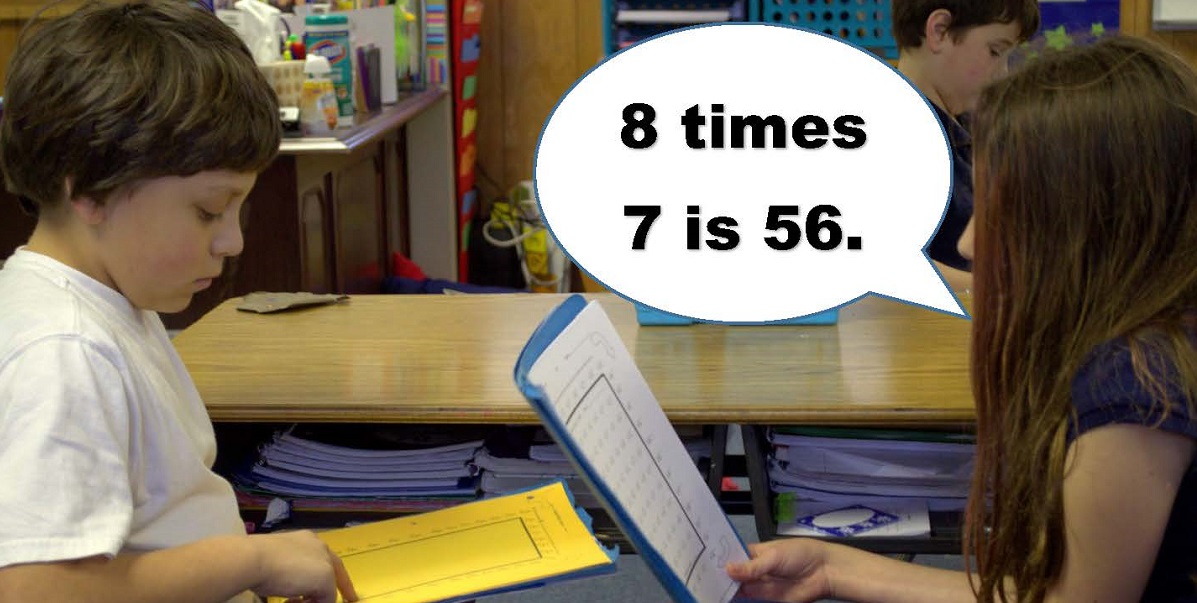
      In the Worksheet Program, students practice with a partner.  In the Online Game the student practices with the computer.  In both versions of Rocket Math the students follow the same careful sequence and slowly, but successfully build mastery of all of the facts in an operation.  It’s hard work and takes a while, but we try to make it fun along the way.  It will work for everybody, but not everybody is willing to do the work.  At least, now you understand how Rocket Math is designed so it can teach mastery of math facts.

Dictating Sentences, do students need automaticity in spelling too?

Few teachers realize how similar spelling and math facts are.

Both spelling and math facts are tool skills. Tool skills are things which one needs to do academic work, tools you use to do other things.  The tool skills of spelling and math facts (like decoding) need to become so automatic that students don’t have to think about them.

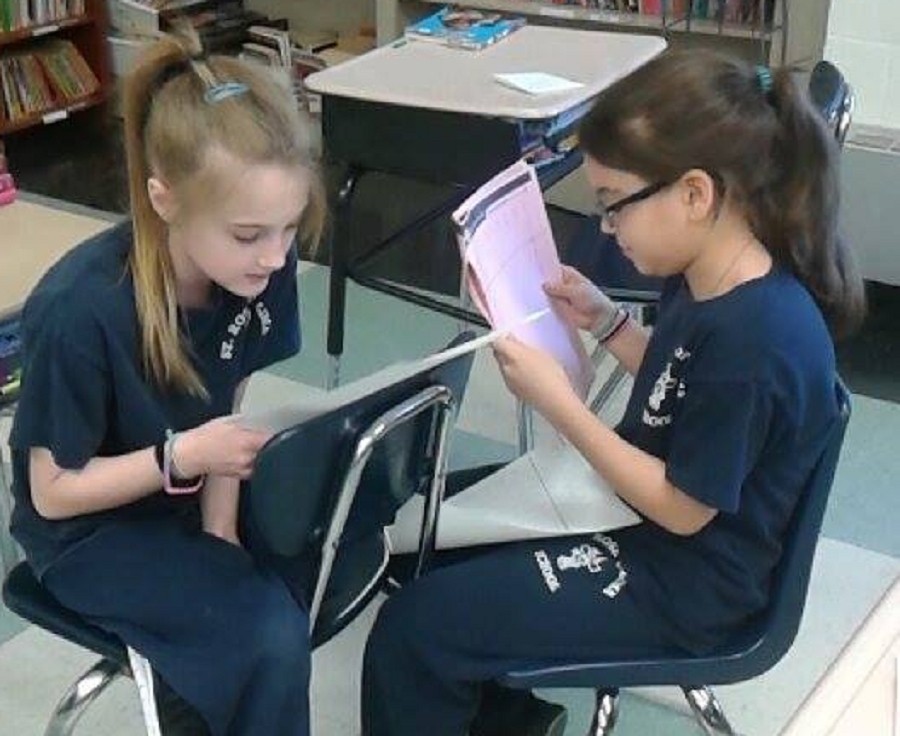
If students have to think up the answer to math facts, it makes doing computation harder.  The process of figuring out a math fact distracts from the mathematics being done.  Similarly, if you have to stop and think of the spelling of a word (like the boy pictured above) while you are trying to write, it distracts you from thinking about what you are trying to write.  Students are more successful and better able to show what they know and better able to focus on learning when their tool skills have developed to the level of automaticity.

Daily practice develops automaticity.  Developing automaticity with math facts and with spelling requires a lot of practice.  Daily practice is best and a few minutes a day is optimal.  That is why Rocket Math is designed the way it is–to provide that daily practice.  So Dictating Sentences gives each member of the pair ten minutes a day of practice writing sentences composed of words they know how to spell.

Dictating Sentences is spelling with a twist.  Instead of spelling one word at a time, in Dictating Sentences (now part of the Universal Level Rocket Math Worksheet Program) students are asked to write an entire sentence from memory.  They work in pairs and their tutor has the student repeat the sentence until it is learned.  Then the student has to write the whole sentence from memory.  It turns out this is considerably harder than writing words on a spelling test, so it is challenging practice, and does a lot to help students develop automaticity with spelling.

Working in pairs.  As you know from Rocket Math practice, students enjoy working in pairs.  And when one partner has an answer key the practice can be checked and corrected.  Sound research shows that immediate correction and editing of misspelled words is the fastest way to learn the correct spelling, so that’s what we have the student tutor do.  After each sentence is written every word is checked and practiced again until it is correct.

Mastery learning. The program is structure so that all the words are learned to the level of automaticy.  Students keep working on a sentence until it can be written without any errors.  They work on the same lesson for as many days as is needed for them to spelling every word perfectly in all three sentences.  Each sentence persists for two or three lessons, so that the student is required to write it from memory and spell every word perfectly for several days in a row.

Earning points by being correct and going fast.  Students earn two points for every word that is spelling correctly the first time.  Every word on which there is an error is worked on until it too can be spelled correctly, earning one point.  The faster students go during their ten minutes, the more points they can earn.  Students graph the amount of points earned and try to beat their own score from previous days.  Teams can be set up and competition for the glory of being on the winning team can enhance the motivation.

Individual Placement.  There is a placement test.  Students begin at the level where they first make a mistake.  Student partners do not need to be at the same level, so every student can be individually placed at the level of success.

Choose a Learning Track for Online Game

Choose from ten Learning Tracks

In the Rocket Math Online Game every student needs to be started in one of the ten Learning Tracks.  A student’s Learning Track can be changed at any time**, but one must be chosen to begin with.

If you are entering the Student Login individually, you can use the pull down menu to select a learning track, as illustrated to the right.

The ten learning tracks are numbered as follows. If you are using the csv method of entry you’ll need to enter the number for the track.

  1. Addition 1s through 9s
  2. Subtraction 1s through 9s
  3. Multiplication 1s through 9s
  4. Division 1s through 9s
  5. Fact Familes (1 to 10) add and subtract, ex.4+5, 5+4, 9-4, 9-5
  6. Fact Families (11 to 18) add and subtract, ex. 8+7, 7+8, 15+7, 15-8
  7. Add to 20, example 13+4, 4+13,
  8. Subtract from 20, example 15-3, 15-12,
  9. Multiplication 10s-11s-12s,
  10. Division 10s-11s-12s.

You can click below to see a google document showing all the problems learned in each of the Learning Tracks.

Click to see the problems in the tracks.

Considerations, or what to choose when?

Begin with the basics.  The four basic operations are most important and typical expectations is one of those per grade level, so Addition in first, Addition then Subtraction in second, Multiplication, then go back to Addition and Subtraction in third, and Multiplication then Division in fourth grade, and then going back to get Addition and Subtraction if those haven’t been learned.  Make sure your student have worked through the expected basic operations for their grade level BEFORE doing any of the other optional Learning Tracks.

Another way to learn basic Addition and Subtraction Facts.  Learning in Fact Families is another order to learn. Fact Familes (1 to 10) add and subtract would be chosen in first grade.   Fact Families (11 to 18) add and subtract would be mastered in second grade.  You can choose this sequence instead of the basic addition and basic subtraction fact Learning Tracks.   Optionally, Fact Families is also a good way to review for students who have already learned the basic addition and subtraction facts in first or second grade.

Optional Learning Tracks. Add to 20 and Subtract from 20 are additional problems that the Common Core feels should be committed to memory.  They are composed of facts you can figure out if you know the basic 1s through 9s facts, but can be learned AFTER the basics are learned, if there is time in first or second grade.  They should not be assigned until after the student has mastered the basic 1s through 9s addition and subtraction facts.

After students learn the basic 1s through 9s multiplication facts, if there is time, they can move on to 10s, 11s, 12s.  After basic 1s through 9s  division facts are learned (and all the other basic operations are learned) then the 10s, 11s, and 12s are a good use of time.


**See “How to change Learning Tracks” in the FAQs and Directions document.

How to purchase Online Game subscriptions

Here’s information (that may not be apparent) about how to purchase Online Game subscriptions.  First you register for a free account at https://admin.rocketmath.com for the Rocket Math Online Game.  The next step is to to purchase game subscriptions with our No risk 30 day trial. 

Non-credit card options


If you wish to buy subscriptions by sending in a Purchase Order here’s a link to our order form. Or, if you wish to order online with either PayPal or a PO number click this link to get to that page

Either in PayPal or with a PO we will give you 13 months for the one year price, and if you tell us you no longer want your subscriptions during the first month, we’ll cancel your subscriptions and cancel the invoice. With PayPal we’ll give you a full refund if you don’t want to keep your subscription.    

If you ask, I can also manually give you a 30 day free trial–without you having to enter a payment method.  I’ll give you access to all the subscriptions you’d need for your free trial period.  Then, if you wish to continue and purchase we can send an invoice.  Just contact don@rocketmath.com, with the number of subscriptions you would like to use during your free trial. 

Credit card procedure

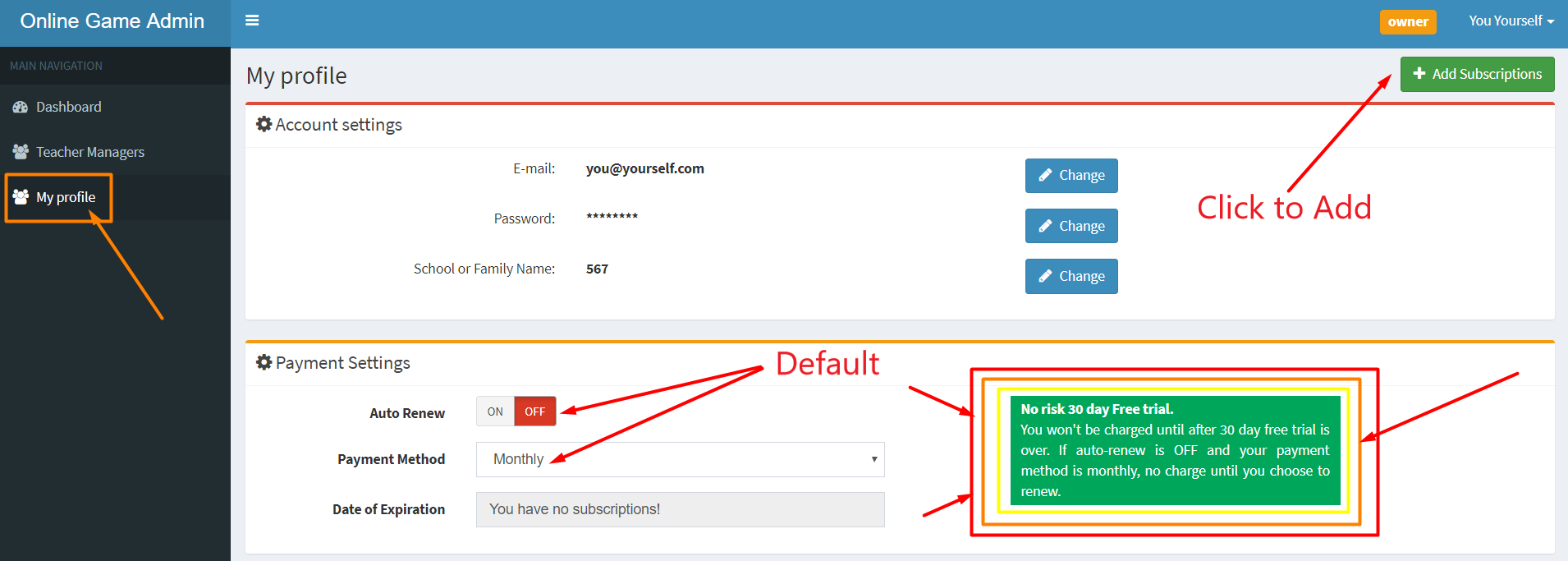
Go to the “My Profile” page to order subscriptions.  There you click on + Add Subscriptions on the “My Profile” page of your account.  It looks like this picture. 

No gotcha here–See how the auto-renew is turned off by default?  

After you click on + Add Subscriptions this dialog box will pop up.

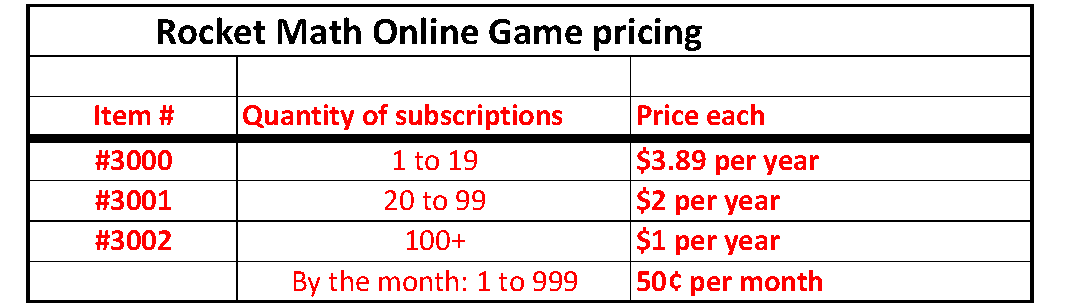
This person in this picture has payments set to yearly.  So the price for one subscription is $3.89 for the year.

If you leave it set to monthly, the price will be $.50 (50 cents/month).
To order more than one subscription hover in the box and you’ll see arrows to increase the number of subscriptions.  This box will automatically discount to $2 for quantities of 20 or more and down to $1 for quantities of 100 or more.
Hit the green payment data to pay with a credit card.  You’ll get this Stripe dialog box.  You fill out your credit card info and hit the pay button, but remember, you will not be charged a thing for 30 days.

Monthly, non auto-renewal expires if you don’t act.

Note: As long as you leave the renewal period set to monthly, and leave auto renew set to OFF in your profile, then your subscription will simply end after 30 days.  No matter how many subscriptions you order, your credit card won’t be charged until you login and renew.  So you can try the game for free to see if it’s worth paying for with no risk of being charged for it.  When you decide it is worthwhile, come back into “My Profile” switch the renewal period to yearly, and make sure you have as many subscriptions as you want, and then change to “Auto Renew.”   You can switch it back  to non renew after you renew, but there’s no other way to renew ahead of time with the credit card.  But if your subscription has expired, you will see a green “Renew Subscription” button in “My Profile” and you can click on that to renew.

Yearly renewal gives you lower prices (and still no charge for the first month).

If you are pretty certain, go ahead and set the renewal to yearly and then order your subscriptions.  You’ll get the best price and you’ll automatically get the discounts for quantity.  Your credit card will not be charged until the end of your 30 day trial, so if you cancel before then you do not pay a thing.


Get a free 30-day trial of our Online Game

Here’s information (that may not be apparent) about the next step–after registering for a free account for the Rocket Math Online Game.  The next step is to to try out the game with some students by signing up for our No risk 30 day trial. 

Your credit card will not be charged until the end of your 30 day trial, so if you cancel before then you do not pay a thingYou can order from the “My Profile” page of your account with a credit card to order subscriptions. It looks like this picture. 

No gotcha here–See how the auto-renew is turned off by default?  

Leave the renewal period set to monthly, and leave auto renew set to OFF in your profile.

Your subscription will simply end after 30 days.

No matter how many subscriptions you order, your credit card won’t be charged until you login and renew.  So you can try the game for free to see if it’s worth paying for with no risk of being charged for it.

Non-credit card options

If you wish to buy subscriptions by sending in a Purchase Order here’s a link to our order form. Or, if you wish to order online with either PayPal or a PO number click this link to get to that page

Either in PayPal or with a PO we will give you 13 months, and if you tell us you don’t want it during the first month, we’ll cancel your subscription and cancel the invoice. With PayPal we’ll give you a full refund if you don’t want to keep it.    

If you ask, I can also manually give you a 30 day free trial–without you having to enter a payment method.  Then we can send an invoice if you wish to continue.  Just contact don@rocketmath.com, with the number of subscriptions you would like to use during your free trial. 

What if teachers won’t do Rocket Math?

Don’t argue, just prove it works! 

Joyce asks: 

How can we encourage the teacher who refuses rocket math and administration does not reinforce (or enforce) the program’s use?

Dr. Don’s response:

  Joyce,

     This is a great question.  Frankly, one of the most annoying things I found during my time as a teacher were the constant “new” fads.  I got sick and tired of being told to do things I knew would not work.  I don’t blame people for being skeptical or an administration that won’t go to bat for a new curriculum.  I think it is the responsible thing to do. Which is why schools should test everything for themselves, which isn’t that hard to do.  Prove to yourself it works with your students in your school with your staff.  Then you know it is worth doing.  Only then do you have a responsibility to reinforce the program’s use, only after it is proven.
In one of the first schools to use Rocket Math we had a veteran teacher who said she did not think Rocket Math would be any better than the things she had been doing to help her students learn math facts for years.  The principal wisely allowed as how that might be possible, but asked if she would be willing to test her assertion.  Rocket Math has 2-minute timings of all the facts which the students take every couple of weeks.  The principal asked if she would give that test to her students at the beginning and the end of the year and compare her results with that of other classes.  She agreed.  At the end of year the Rocket Math students were far higher in their fluency than her students, even though at the beginning of the year her students had been more fluent than the other students.  At that point she said, “Well this proves it to me.  I’ll be using Rocket Math next year.”
   Just use those 2-minute timings as pre and post tests and see if there is anything that will beat Rocket Math.  Any teacher worth their salt should want to use a curriculum that is effective and helps students learn.
I have the following standing offer on my website.  If any school will conduct research comparing Rocket Math to some other method of practicing math facts and share your results–I will refund half of the purchase price of the curriculum.  If a school finds some other method is more effective, I will refund 100% of your purchase price.

Intervention Tip: Have students practice test

Sometimes students need to review test problems also.

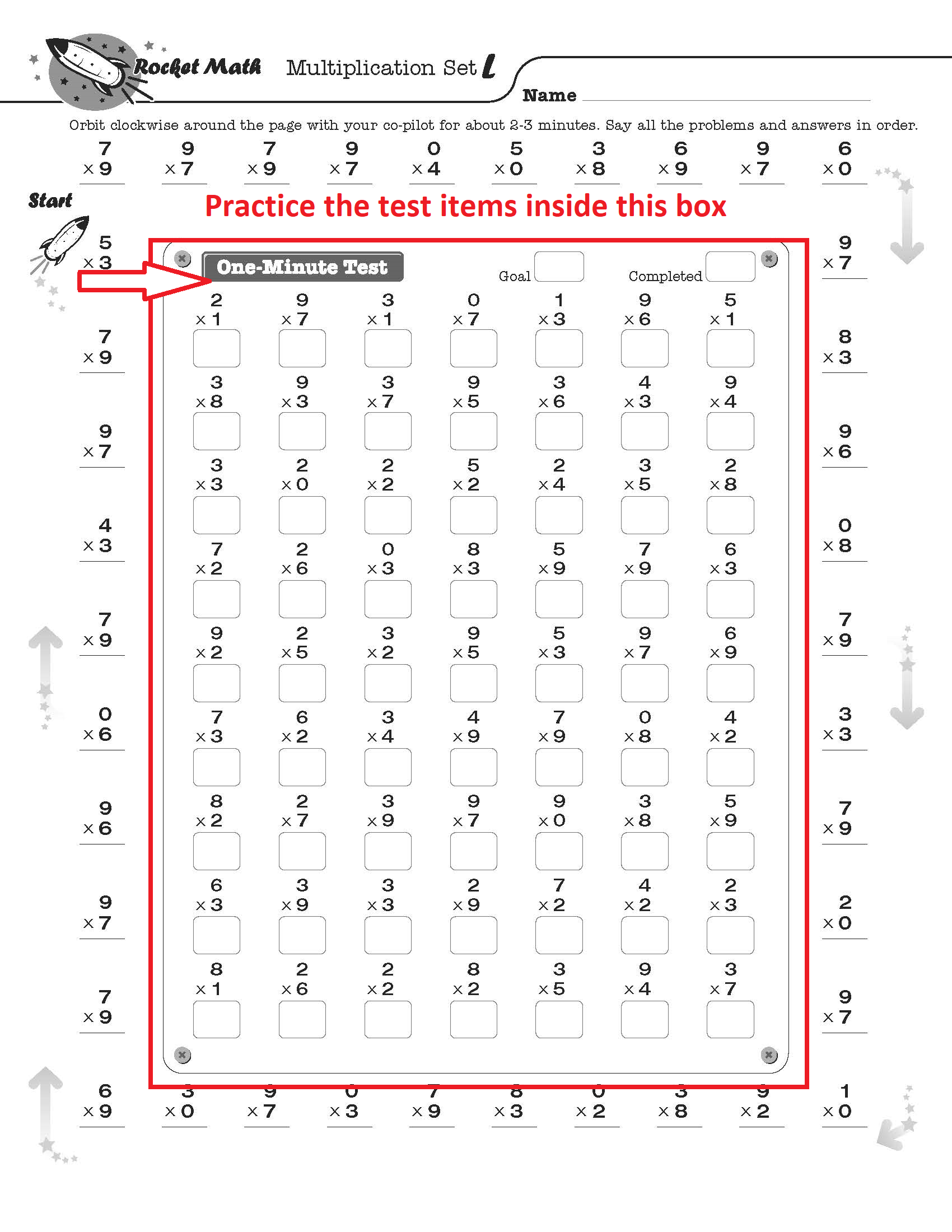
You know that there is a difference between the test problems and the practice problems, right?  The problems practiced around the outside are the recently introduced facts.  The problems inside the test box are an even mix of all the problems taught so far.  Sometimes students have forgotten some of the older facts.  For example, if there has been a break for a week or more, or if the student has been stuck for a couple of weeks, the student may have forgotten some of the facts from earlier and may need a review of the test problems.

How you could diagnose for this problem.  Have the student practice orally on the test problems inside the box with you.  If the student hesitates on several of the problems that aren’t on the outside practice, then the student needs to review the test items.

Solution. If you have this problem with quite a few students (for example after summer break or after Christmas break) then have the whole class do this solution.  For the next week, after practicing around the outside, instead of taking the 1 minute test in writing, have students practice the test problems orally with each other.  Use the same procedures as during the practice—two or three minutes with answer keys for the test, saying the problem and the answer aloud, correction procedures for hesitations, correct by saying the problem and answer three times, then going back—then switch roles.   Do this for a week and then give the one-minute test.   Just about everyone should pass at that point.

Solution.  If you have this problem with a handful of students, find a time during the day for them to practice the test problems orally in pairs.  If the practice occurs before doing Rocket Math so much the better, but it will work if done after as well.  They should keep doing this until they pass a couple of levels within six days.

If neither the first or the second solutions seem to work, write to me again and I’ll give you some more ideas.

Four star rating for Rocket Math Apps

Rocket Math App received 4 Stars!

App Names: Rocket Math Add at Home, Add at School, Multiply at Home, and Multiply at School

Developer’s name: Rocket Math, LLC

App Link :

https://itunes.apple.com/us/app/rocket-math-multiply-at-home/id1048024368?mt=8

Primary School Apps (5-7 Years)

Educational App Store Review

Rocket Math is an offshoot of an existing programme for schools designed to increase children’s speed and fluency in answering simple arithmetic. This app encourages frequent short sessions and is supported by plenty of information explaining its purpose and methods.

The purpose of Rocket Math is to build what its developer terms “automaticity” in arithmetic. A fluent reader does not need to decode simple and frequently encountered words letter by letter. The same can be true for frequently encountered arithmetic.

When automaticity is achieved in arithmetic the answers are available in an instant. The advantages of this, beyond speed, are that it leaves more of the person’s mental processes available for other aspects of the problem. If a person does not have to think about achieving simple arithmetic answers, he or she can concentrate on the more complex and lengthier aspects of a problem.

Rocket Math the app follows on from a well-established programme of the same name based on traditional written resources. Repeat practice and a steady increase in the breadth of the covered arithmetic are at the heart of its methods.

Children are taken through a series of stages in which they are faced with a rapid succession of arithmetic questions. Remember, the purpose of this app is to build fluency in frequently encountered arithmetic problems, not complex ones. As such, the questions will be simple ones and, at first, until the breadth expands, there will be little variation in them. Only three seconds is allowed per question so, for some children, developing enough fluency to progress will be difficult but others will thrive on the challenge.

Answers are given by typing them onto a built-in number pad. The app is simple to use and looks attractive. Its space-travel styling and theme add a game-like feel although it is not a game. Speech provides a response to incorrect answers and provides encouragement between levels. It all works very well and provides the exact type of practice that it promises.

An unusual but useful feature is that the app enforces its little-and-often recommendations by insisting on a thirty-minute break after 5 minutes of play. As multiple sessions are likely to yield better results than a single, marathon session, this is an excellent feature that will prevent children from relying on a last-minute catch-up rather than a steady engagement with the app. This, combined with a useful breakdown of each child’s performance in the student report screen, provides reassurance to adults that their children are making the best possible use of the app.

A family of apps is available and potential buyers should think about which they need. Two of the apps cover addition and subtraction and two cover multiplication and division. Your choice here is obviously dependent on what aspect you would like to cover.

The remaining choice is between a school and a home version. They are identical in functionality except that the home version is free to download with a lengthy trial period. The school version has a flat, one-off, fee. Prospective teachers would still be wise to download the home version first so that they can appraise the app’s suitability.

If they choose to utilise the app within their school then buying the school version will be a simpler process than the in-app purchase of the home version. It will also allow schools to utilise the volume purchasing programme whereby they can receive a discount for buying twenty or more of the same app.

Parents will be pleased to see that the app caters for up to three children. As each child engages with the app, parents can check to see how they are performing and offer help, encouragement or rewards as they see fit.   Some useful background information on the app’s purposes and usage are provided within the app itself and a more comprehensive overview of the Rocket Math ethos is available on the developer’s website.

All of the Rocket Math apps provide a learning opportunity that is tightly focused on realising their goal of improving children’s arithmetic fluency. As such, if this is a goal that you also share, you will find them good value and useful apps.

How fast should students be with math facts?

Students should be automatic with the facts.  How fast is fast enough to be automatic?

Editor’s Note: “Direct retrieval” is when you automatically remember something without having to stop and think about it.

Some educational researchers consider facts to be automatic when a response comes in two or three seconds (Isaacs & Carroll, 1999; Rightsel & Thorton, 1985; Thorton & Smith, 1988).  However, performance is not automatic, direct retrieval when it occurs at rates that purposely “allow enough time for students to use efficient strategies or rules for some facts (Isaacs & Carroll, 1999, p. 513).”

Most of the psychological studies have looked at automatic response time as measured in milliseconds and found that automatic (direct retrieval) response times are usually in the ranges of 400 to 900 milliseconds (less than one second) from presentation of a visual stimulus to a keyboard or oral response (Ashcraft, 1982; Ashcraft, Fierman & Bartolotta, 1984; Campbell, 1987a; Campbell, 1987b; Geary & Brown, 1991; Logan, 1988).  Similarly, Hasselbring and colleagues felt students had automatized math facts when response times were “down to around 1 second” from presentation of a stimulus until a response was made (Hasselbring et al. 1987).”   If however, students are shown the fact and asked to read it aloud then a second has already passed in which case no delay should be expected after reading the fact.  “We consider mastery of a basic fact as the ability of students to respond immediately to the fact question. (Stein et al., 1997, p. 87).”

In most school situations students are tested on one-minute timings.  Expectations of automaticity vary somewhat.  Translating a one-second-response time directly into writing answers for one minute would produce 60 answers per minute.  However, some children, especially in the primary grades, cannot write that quickly.   “In establishing mastery rate levels for individuals, it is important to consider the learner’s characteristics (e.g., age, academic skill, motor ability).  For most students a rate of 40 to 60 correct digits per minute [25 to 35 problems per minute] with two or few errors is appropriate (Mercer & Miller, 1992, p.23).”   This rate of 35 problems per minute seems to be the lowest noted in the literature.

Other authors noted research which indicated that “students who are able to compute basic math facts at a rate of 30 to 40 problems correct per minute (or about 70 to 80 digits correct per minute) continue to accelerate their rates as tasks in the math curriculum become more complex….[however]…students whose correct rates were lower than 30 per minute showed progressively decelerating trends when more complex skills were introduced.  The minimum correct rate for basic facts should be set at 30 to 40 problems per minute, since this rate has been shown to be an indicator of success with more complex tasks (Miller & Heward, 1992, p. 100).”   Rates of 40 problems per minute seem more likely to continue to accelerate than the lower end at 30.

Another recommendation was that “the criterion be set at a rate [in digits per minute] that is about 2/3 of the rate at which the student is able to write digits (Stein et al., 1997, p. 87).”  For example a student who could write 100 digits per minute would be expected to write 67 digits per minute, which translates to between 30 and 40 problems per minute.    Howell and Nolet (2000) recommend an expectation of 40 correct facts per minute, with a modification for students who write at less than 100 digits per minute.  The number of digits per minute is a percentage of 100 and that percentage is multiplied by 40 problems to give the expected number of problems per minute; for example, a child who can only write 75 digits per minute would have an expectation of 75% of 40 or 30 facts per minute.

If measured individually, a response delay of about 1 second would be automatic.  In writing 40 seems to be the minimum, up to about 60 per minute for students who can write that quickly.  Teachers themselves range from 40 to 80 problems per minute.  Sadly, many school districts have expectations as low as 50 problems in 3 minutes or 100 problems in five minutes.  These translate to rates of 16 to 20 problems per minute.  At this rate answers can be counted on fingers.   So this “passes” children who have only developed procedural knowledge of how to figure out the facts, rather than the direct recall of automaticity.

References

Ashcraft, M. H. (1982).  The development of mental arithmetic: A chronometric approach.  Developmental Review, 2, 213-236.

Ashcraft, M. H. & Christy, K. S. (1995).  The frequency of arithmetic facts in elementary texts:  Addition and multiplication in grades 1 – 6.  Journal for Research in Mathematics Education, 25(5), 396-421.

Ashcraft, M. H., Fierman, B. A., & Bartolotta, R. (1984). The production and verification tasks in mental addition: An empirical comparison.  Developmental Review, 4, 157-170.

Ashcraft, M. H. (1985).  Is it farfetched that some of us remember our arithmetic facts?  Journal for Research in Mathematics Education, 16 (2), 99-105.

Campbell, J. I. D.  (1987a).  Network interference and mental multiplication.  Journal of Experimental Psychology: Learning, Memory, and Cognition, 13 (1), 109-123.

Campbell, J. I. D.  (1987b).  The role of associative interference in learning and retrieving arithmetic facts.  In J. A. Sloboda & D. Rogers (Eds.) Cognitive process in mathematics: Keele cognition seminars, Vol. 1.  (pp. 107-122). New York: Clarendon Press/Oxford University Press.

Geary, D. C. & Brown, S. C. (1991).  Cognitive addition: Strategy choice and speed-of-processing differences in gifted, normal, and mathematically disabled children.  Developmental Psychology, 27(3), 398-406.

Hasselbring, T. S., Goin, L. T., & Bransford, J. D. (1987).  Effective Math Instruction: Developing Automaticity.  Teaching Exceptional Children, 19(3) 30-33.

Howell, K. W., & Nolet, V.  (2000).  Curriculum-based evaluation: Teaching and decision making.  (3rd Ed.)  Belmont, CA: Wadsworth/Thomson Learning.

Isaacs, A. C. & Carroll, W. M. (1999).  Strategies for basic-facts instruction. Teaching Children Mathematics, 5(9), 508-515.

Logan, G. D. (1988).  Toward an instance theory of automatization.  Psychological Review, 95(4), 492-527.

Mercer, C. D. & Miller, S. P. (1992).  Teaching students with learning problems in math to acquire, understand, and apply  basic math facts.  Remedial and Special Education, 13(3) 19-35.

Miller, A. D. & Heward, W. L. (1992).  Do your students really know their math facts?  Using time trials to build fluency.  Intervention in School and Clinic, 28(2) 98-104.

Rightsel, P. S. & Thorton, C. A. (1985).  72 addition facts can be mastered by mid-grade 1.  Arithmetic Teacher, 33(3), 8-10.

Stein, M., Silbert, J., & Carnine, D.  (1997)  Designing Effective Mathematics Instruction: a direct instruction approach (3rd Ed).  Upper Saddle River, NJ: Prentice-Hall, Inc.

Thorton, C. A. & Smith, P. J. (1988).  Action research: Strategies for learning subtraction facts.  Arithmetic Teacher, 35(8), 8-12.