Filling testing-created gaps in your schedule.

Many schools are starting spring testing soon, and it wreaks havoc with the daily schedule. People outside education don’t really understand how much school schedules are disrupted by attempting to test everyone in the school on the available computers. Not to mention catching all the students who are absent during their assigned time. Disrupted schedules create small gaps in the schedule, which are hard to fill, even more so when not every student is present. Let me present an option to fill those small gaps–do Rocket Math! Here’s five reasons why you should.

1) By this time of the year, students know the Rocket Math routine, so it should not take more than ten to fifteen minutes to run, start to finish. So Rocket Math can fill small gaps.

2) Even if Rocket Math has been done once during the day, a second or even third session during the day will NOT harm students, it will actually help them progress faster. (As long as you have at least a half hour between sessions).

3) It is beneficial for the students in the room even when some students are out doing make-up testing. It won’t require you to re-teach a lesson.

4) In contrast to free reading or make work activities, which only fill time, students doing Rocket Math will be learning critical skills that are necessary for future success.

5) In contrast to the stress of the accountability tests, Rocket Math is something students know well and have success at. They know what they are doing and they see their growth. They know they are learning. This is a powerful antidote to the not-so-straightforward tasks, questions and expectations of the accountability tests.

I highly recommend keeping Rocket Math folders handy for filling those small gaps in the daily schedule caused by testing.


What’s wrong with this picture?

If you are seeing this in your school, you need Rocket Math!

Recently I gave my pre-service student teachers at Portland State University an assignment to do screening tests of basic skills in their placements. I was shocked to see how few of the screening tests showed students who were fluent with basic, single-digit math facts, where they could answer math facts as quickly as they could write. When children cannot answer math facts quickly and easily they are placed at a unnecessary disadvantage when it comes to doing math.

It is true that learning math facts takes time. No one can learn all of them in a matter of a few days or a week. It takes most students daily practice for months to learn all the facts in an operation. But when you consider that we require students to attend school five hours a day for years and years, it is pretty shocking to realize how many children do not have fluent mastery of math facts when they get to middle school. When the job can be done in ten minutes a day, and every child could become fluent in all four operations of addition, subtraction, multiplication and division by the end of fourth grade, why isn’t it?

Sometimes, teachers have been taught in their schools of education that helping children memorize things is somehow harmful. With that belief, teachers won’t try to do something systematic like Rocket Math. But after a year or two teaching, especially upper elementary grades, and struggling to teach higher math concepts to children who are interrupted by finger counting in the middle of every single computation, teachers learn that belief is simply wrong. Children are helped immensely by memorizing basic math facts. It enables them to have “number sense,” to easily appreciate the relationships among numerals, and to easily do computation.

Probably the main reason more students are not taught math facts, to the level they need, is that teachers are not aware of a tool that can help them do that. They don’t know that students enjoy doing learning math facts when it is done right. They don’t know that it can be done as a simple routine that takes ten minutes a day. They don’t know how easily students can master all of the facts. In short, they don’t know that Rocket Math exists. Someday a friend of theirs will tell them, because that is how Rocket Math spreads–by word-of-mouth.

If you read this, and you have never seen Rocket Math in action, you may be skeptical. Tell you what, write to me and if you need to see it in action to believe me, and don’t have a friend using Rocket Math, I’ll send you a free subscription to try it out.

Don’t I need to teach doubles and other combinations first?

There is a lot of advice out there that teachers need to introduce different tricks to remembering math facts to help students learn the facts. Things like doubles, or doubles plus ones, or special combinations that add to ten are recommended to be taught to students. Teachers are exhorted to use many different kinds of exercises to teach these different ways of remembering facts. Is that necessary to do before memorizing facts as we do in Rocket Math? The simple answer is, “No, that’s not necessary.”
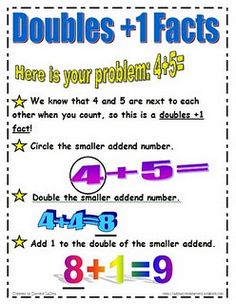
DoublesPlusOne
How do we know? What’s the evidence? There are two basic sources of evidence, one from experience and another from logic.
Let’s look at the logical reasons these are not necessary. The goal of Rocket Math, and any good math fact memorization program, is to develop automaticity in answering math facts. Automaticity means the student can instantly answer the fact, without any intervening thought process. So even if students first learn those memory tricks they have to be abandoned in favor of simply recalling the fact from memory.

An intervening thought process would go like this, “Four plus five is like four plus four but one more. Four plus four is eight , so one more is nine. So four plus five is nine.” But the goal of Rocket Math is to simply come to the point where the student reads, “Four plus five is,” and the answer, nine, pops into mind without another thought. Logic tells us that if the learner ultimately has to abandon the strategy, the only reason for learning the strategy is if it is needed as a transition. In other words, if students have to learn the facts to the point where they don’t use the strategy, then the only reason to learn the strategy is if they need it to get to the point of memorizing the facts.
This brings us to the second piece of evidence, experience. I know from experience tha students don’t need these strategies to learn the facts.  When I started using my original hand-written version of Rocket Math with my students with learning disabilities–it worked without them knowing other strategies!  In the past fifteen years thousands of children have learned math facts to automaticity using Rocket Math without learning those different tricks. If it were necessary, then they wouldn’t be able to do it. The reason it is not necessary is that students only have to memorize two facts at a time and that’s just not difficult to do. Give them plenty of practice with those two (enough so that they come to be able to answers as fast as they can write) and they will know the facts without some other (intervening) strategy.
So you don’t have to teach all those different tricks to students to remember facts. Just use Rocket Math, and make sure they are practicing the right way with corrective feedback from their partner. Their results will speak for themselves.