Are students really “friends?”

I hear teachers calling their students “friends” quite commonly these days.  While the use of the term “friends” is certainly harmless enough, it reminds me that there are extremely important distinctions between the way a person should treat friends and the way a teacher should treat students.  I don’t want to stop teachers from calling their students “friends” but I do think it is critical for teachers to know why and how they should not treat their students as friends.

The main reason that teachers should not treat students as friends concerns expectations.  With friends you’re nice to them and hope that makes them like you.  Then if they like you, they will be considerate of your feelings and treat you well.  Many beginning teachers expect that a classroom of students will be like a room full of friends.  If you are unfailingly nice to them, they will in turn be considerate of you and attempt to acquiesce to your wishes.  Unfortunately, this does not work.  Why?  Primarily because a teacher has to ask students to do things they’d rather not do and has to keep their attention on things to which they’d rather not pay attention.  In short, teachers are authority figures rather than friends.  Friends can get up and leave when they aren’t interested in what you’re doing, but students are required to stay.  Therefore teachers must treat students differently than they treat friends.

The first way that treating friends and students should be different concerns how a teacher reacts to student academic errors.  When a student answers a question incorrectly it shows they have a misunderstanding.  For example, a student says that the sun orbits around the earth.  That misunderstanding needs to be corrected to set the student “straight.”  A teacher who allows a student to continue with a misunderstanding is doing that student a disservice.  Errors should be corrected immediately, in a nice way, but as clearly as possible.  For example, the teacher says that although it appears as if the sun rotates around the earth, actually the earth orbits around the sun.  A good teacher may even take the opportunity to model how a spinning globe creates the illusion that the distant sun is going around us.  The student should be taught/told the correct understanding in as unequivocal a manner as possible and the teacher needs to check to be sure that the student learned the correct information both immediately after the correction and a few minutes later to see that the correct answer is retained.

When a friend makes a factual error, it is socially expected that you will not make a big deal of it.  It is socially inept to clearly and loudly correct errors of fact among friends.  At best one can simply not confirm an incorrect statement, but pointing it out as incorrect is just rude.  Teachers who treat their students as friends will make light of or gloss over errors, and they fail to teach students as a result.

Another way treating friends and students should be different concerns how a teacher reacts to student behavior.  Teachers need to learn to “catch ‘em being good.”  Teachers should look for students who are doing the right thing and should praise/recognize them by name, make eye contact and name the behavior they are doing that is exemplary.  “Alan has his desk clear, his textbook out and he’s ready to start learning.  He’s looking ready for college.”  Praising and recognizing appropriate behavior in the classroom helps prompt other students towards what they should be doing as well as reinforcing Alan.  It sends the signal of the behaviors the teacher values in the classroom and teaches students what’s expected.  At the same time the teacher should deliberately not give any attention to students who are not doing the right thing, who have not gotten ready to start.

With friends we are expected to give non-contingent attention.  We give them love and attention because of who they are, not based on how they behave.  One doesn’t turn away from a friend and deliberately pay attention and begin talking to someone across the room because you approve of their behavior more.  If you did that it would be too rude to your friend and it might hurt your friendship.  Instead, if your friend misbehaved at a party you would begin by attending to your friend, to see what’s wrong, or find out what you can do for them.  That attention reinforces your friendship and proves you’re a good friend.  In a classroom, teachers who respond to misbehavior as they would to a friend end up reinforcing the inappropriate behavior and they get a lot more misbehavior from all of their students.

There is a role for non-contingent reinforcement of students.  They need to know that the teacher cares about them as people.  The time for that is at neutral times when the student is not misbehaving, such as when entering the classroom, out on the school grounds not during class, or even when circulating the room.  Giving appropriate and friendly social attention to the student at times when they aren’t in crisis or off-task helps create good relationships within the classroom and is valuable.  In that circumstance “friends” is just what is wanted.

A third and final way that teachers should not treat students as friends is when students break the rules.  To establish order in a classroom there needs to be rules and consequences for rule-breaking.  Consequences need not be major or draconian, but they do need to be applied consistently.  If a teacher says, “Wait to be called on before you speak,” the teacher needs to not answer or engage with students who call out without raising their hand and waiting.  The teacher should ignore the student calling out and call on someone who raised their hand.  That needs to be consistently applied, no matter who the student is who calls out.  Students only learn to follow the rules when the consequences are consistent.

I wouldn’t recommend treating friends in this manner.  If friends blurt out and interrupt your turn speaking, we generally tolerate it.  When a friend breaks a rule, we don’t apply consequences.  We might complain to them.  We hope that our friendship will cause them to re-examine their behavior, but we’d rather “ask” them not to do it than apply swift consequences.  That is because we are ultimately not authority figures with our friends.  But teachers are authority figures and they therefore have to treat their students differently than they would treat their friends.  As long as teachers understand this, they can certainly call their students “friends.”

What best honors & motivates achievement?

Recognition for real, tangible accomplishments, that not everyone gets.

What makes for a great award, or great recognition that really motivates?  In the final analysis, recognition, like an olympic gold medal, is not about what you receive–it’s about how hard you worked to get it.  If students worked hard, and accomplished something real and tangible, then the recognition they are given, regardless of its form, will be valuable and meaningful.  A paper certificate given out by an adult that represents weeks or months of effort, an honest accomplishment, will be highly prized.  Those are the certificates that are posted prominently in the bedroom or on the refrigerator at home, because it was hard to get.

Remember that when you want to honor student achievement at the end of the year.  If you give awards to every student, then an award means little or nothing.  If on the other hand, students know they had to work and put forth effort to earn the reward, then it is a real honor.  Rocket Math has many built in landmarks of accomplishment that are great to recognize publicly.  Certainly completing an operation is one of the most commonly celebrated achievements.
Chase

This student’s teacher tweeted this picture of the student and his Rocket Chart, proving his accomplishment.  This is something to be really proud of, because it represents a real, tangible accomplishment.  Another accomplishment is when a student beats his or her individual best in two-minute timings.  Yet another tangible Rocket Math accomplishment is being able to pass two levels in one week or ten levels in a month!

What motivates students to try to achieve is knowing what has to be done and believing they can do it. This is another reason why recognizing real, tangible accomplishments works so well. If the other students can see what their recognized peer did and they understand what has to be done to get there, they are motivated to get some of that glory for themselves. Getting through Level Z of Rocket Math is something students know they can do, if they just keep working at it. It is hard to believe you will become Student of the Month, if you don’t know what the previous recipients did to achieve that honor. But if you know that working hard and practicing your math facts every day can get you there–then you can believe it is possible.

What’s wrong with this picture?

If you are seeing this in your school, you need Rocket Math!

Recently I gave my pre-service student teachers at Portland State University an assignment to do screening tests of basic skills in their placements. I was shocked to see how few of the screening tests showed students who were fluent with basic, single-digit math facts, where they could answer math facts as quickly as they could write. When children cannot answer math facts quickly and easily they are placed at a unnecessary disadvantage when it comes to doing math.

It is true that learning math facts takes time. No one can learn all of them in a matter of a few days or a week. It takes most students daily practice for months to learn all the facts in an operation. But when you consider that we require students to attend school five hours a day for years and years, it is pretty shocking to realize how many children do not have fluent mastery of math facts when they get to middle school. When the job can be done in ten minutes a day, and every child could become fluent in all four operations of addition, subtraction, multiplication and division by the end of fourth grade, why isn’t it?

Sometimes, teachers have been taught in their schools of education that helping children memorize things is somehow harmful. With that belief, teachers won’t try to do something systematic like Rocket Math. But after a year or two teaching, especially upper elementary grades, and struggling to teach higher math concepts to children who are interrupted by finger counting in the middle of every single computation, teachers learn that belief is simply wrong. Children are helped immensely by memorizing basic math facts. It enables them to have “number sense,” to easily appreciate the relationships among numerals, and to easily do computation.

Probably the main reason more students are not taught math facts, to the level they need, is that teachers are not aware of a tool that can help them do that. They don’t know that students enjoy doing learning math facts when it is done right. They don’t know that it can be done as a simple routine that takes ten minutes a day. They don’t know how easily students can master all of the facts. In short, they don’t know that Rocket Math exists. Someday a friend of theirs will tell them, because that is how Rocket Math spreads–by word-of-mouth.

If you read this, and you have never seen Rocket Math in action, you may be skeptical. Tell you what, write to me and if you need to see it in action to believe me, and don’t have a friend using Rocket Math, I’ll send you a free subscription to try it out.

Don’t I need to teach doubles and other combinations first?

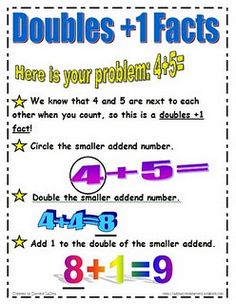
There is a lot of advice out there that teachers need to introduce different tricks to remembering math facts to help students learn the facts. Things like doubles, or doubles plus ones, or special combinations that add to ten are recommended to be taught to students. Teachers are exhorted to use many different kinds of exercises to teach these different ways of remembering facts. Is that necessary to do before memorizing facts as we do in Rocket Math? The simple answer is, “No, that’s not necessary.”
DoublesPlusOne
How do we know? What’s the evidence? There are two basic sources of evidence, one from experience and another from logic.
Let’s look at the logical reasons these are not necessary. The goal of Rocket Math, and any good math fact memorization program, is to develop automaticity in answering math facts. Automaticity means the student can instantly answer the fact, without any intervening thought process. So even if students first learn those memory tricks they have to be abandoned in favor of simply recalling the fact from memory.

An intervening thought process would go like this, “Four plus five is like four plus four but one more. Four plus four is eight , so one more is nine. So four plus five is nine.” But the goal of Rocket Math is to simply come to the point where the student reads, “Four plus five is,” and the answer, nine, pops into mind without another thought. Logic tells us that if the learner ultimately has to abandon the strategy, the only reason for learning the strategy is if it is needed as a transition. In other words, if students have to learn the facts to the point where they don’t use the strategy, then the only reason to learn the strategy is if they need it to get to the point of memorizing the facts.
This brings us to the second piece of evidence, experience. I know from experience tha students don’t need these strategies to learn the facts.  When I started using my original hand-written version of Rocket Math with my students with learning disabilities–it worked without them knowing other strategies!  In the past fifteen years thousands of children have learned math facts to automaticity using Rocket Math without learning those different tricks. If it were necessary, then they wouldn’t be able to do it. The reason it is not necessary is that students only have to memorize two facts at a time and that’s just not difficult to do. Give them plenty of practice with those two (enough so that they come to be able to answers as fast as they can write) and they will know the facts without some other (intervening) strategy.
So you don’t have to teach all those different tricks to students to remember facts. Just use Rocket Math, and make sure they are practicing the right way with corrective feedback from their partner. Their results will speak for themselves.