
Can you test Rocket Math orally?

Students with difficulty writing can take Rocket Math tests orally.

Rachel writes:
Hi Don,
My seven year old daughter has dyslexia and dysgraphia, and perhaps some ADD/ADHD. I’ve been wondering if I could test Rocket Addition or Subtraction with her orally while we are working on her writing speed? We homeschool, so I would be doing it with her one-on-one anyway. If doing it orally is possible, then how do I calculate the number she should be expected to answer correctly in a minute? Her Rapid Automatic Naming rate is quite slow. Would that factor in? Also, should I go back to addition, or start with subtraction since that is what we are working on now? I hadn’t planned to move past addition until she had all her facts memorized, but when we had her tested for learning disabilities, the consultant suggested to let her move forward with concepts while still working on facts. Thank you for your help.

P.S. I got a universal subscription to Rocket Math and started with Rocket Writing for Numerals since her writing rate was way too slow to continue with facts. I would like to continue with Rocket Writing for Numerals because I see the value in gaining automaticity in writing numerals.

Dr. Don answers:
Rachel,
Can you test Rocket Math orally? Yes, you can. When you give the one-minute test have your daughter simply tell you the answer to the items in the test. She does not have to read the problems, just say the answers to the problems in order. The expectation is 40 problems in a minute because handwriting is not an issue. Once she says the answer to 40 problems in a minute she has passed that level.

By the way, if you are practicing with her there might be a temptation to keep practicing for a long period of time. Please don’t. No more than about 3 minutes at a time is optimal. You can take a 15 minute break and then do another 3 minute session, but don’t ever go over 5 minutes at a time. It is very hard mental work and needs to be done in short segments or it will become very punishing AND her performance will begin to deteriorate.

I recommend mastering addition before beginning subtraction–because the two are so close. Doing both at the same time will cause proactive and retroactive inhibition (a special kind of confusion). See my blog on that. If you are in the middle of subtraction already, stay in that operation. If you haven’t started subtraction, don’t until addition is mastered (passing Level Z!). Yes, move on with concepts. Concepts would be other things like how to figure out subtraction problems with counters, or how to borrow. Memorizing subtraction facts is not a concept, it’s a skill, so you should wait on that!

Interesting that you bring up her Rapid Automatic Naming. It is my opinion that Rapid Automatic Naming is a trainable skill as well as handwriting speed. Much easier for some students–who need little training–than it is for others, but trainable nonetheless. She probably will take more practice to get to the level of automaticity that is more easily reached by others, but that doesn’t mean it is not achievable. What’s more, since automaticity with math facts is necessary to allow her to concentrate on higher order issues in math, she has to reach the same level of automaticity as others, so she can concentrate, even if it does take longer to get there.

This same principle applies in other tool skills such as decoding (or typing) as well. Just because it is more work for a child to come to automaticity in decoding does not change the fact that automaticity in decoding is a necessary prerequisite for full comprehension of what is being read. It took me many hours of extra practice after school to become as automatic at touch typing as the girls in my typing class-but I still had to reach the same milestones or I wouldn’t be able to touch type today.


Is 80 problems in 2 minutes appropriate for 2nd graders?

Our Writing Speed Test sets very realistic goals for students.

Principal Linda writes:
We are using Rocket Math in 2nd grade. I am in a high achieving school district. My second grade teachers feel that there is no way a second grader can complete 80 math problems in 2 minutes. We had our highest achieving student (doing 4th grade math) she could only answer 76 problems.
How was the 80 problems in 2 minutes derived? Is this appropriate for 2nd graders?
I am having a hard time convincing some teachers about even doing TIMED math facts tests. They feel it creates too much anxiety for kids. Thoughts??

Dr. Don answers:

Absolutely your teachers are right! Very rare to find a 2nd grader who could write the answers to 80 problems in two minutes–even after completing Rocket Math! The number of items on the page is NOT the expectation. The purpose of the two-minute timing is to monitor progress, to be graphed and and to see if over time–over weeks–the students are improving in the number of problems they can answer in 2 minutes. Only give that test once a week or once every two weeks while they are doing Rocket Math daily. If they are learning facts by practicing with each other on a daily basis, after a week or two most students should be able to answer one or two more facts during the 2 minute timing than they did the last time they were tested. That’s all we are looking for in progress monitoring–an upward trend on the individual student graph.

Please look carefully at my site for information about expectations which should always be based on how fast students can write rather than being the same for all second graders. Nowhere does it ever say 80 problems in two minutes as an expectation! In fact, we leave the vertical axis on the Individual Student graph open, so that the teacher sets the bottom number of the vertical axis just below what the student does on their first timing. We don’t specify what students should be able to do. All we are looking for is individual improvement. If most of the students are improving, and their graphs shown an upward trend, then the program is working!

On the daily One-Minute timing, there are only facts the student has mastered, and there, students are expected to answer as many facts in a minute as they can write, based on the Writing Speed Test. For most second graders that is something less than 40, but it varies by student. Hopefully your teachers are setting expectations based on the Writing Speed Test. Teachers who do not use the Writing Speed Test to establish individualized goals and instead demand the same thing of all students in the grade without regard for writing skill would be harming the children and violating the directions on how to use the program.

Some schools require benchmarks which I did post on the home page. “Click here to see my basic math fact recommended benchmarks to use with Rocket Math to implement the Common Core.” However, those should be lowered for students who cannot write that quickly according to their Writing Speed Test.

Please share my recent blog about the value of orally practicing in pairs vs taking timed tests. “Does research show student achievement increases from taking timed drills?” The short answer is no. It is the orally practicing in pairs that helps students learn. The timed tests are there only to confirm that they are learning. Some teachers even allow students to choose when they want to take the timed test, e.g., to wait until they have practiced enough days to feel that they have a shot at passing. That is a great way to give students control over their experience with Rocket Math. I hope this helps!

How can I get my 1st graders to practice in pairs effectively?

Picture from a great blog Fun in First on blogspot

Ann asks:

Hello, Don.
I’m trying to get first grade teams on board with Rocket Math and would appreciate some tips for that grade level. I am very experienced with Rocket Math, but not sure how successful partner tracking is at grade 1.
Any tips?
Thanks so much.

Dr. Don answers:
Did you watch my YouTubevideo on how to teach your students how to practice?

You will need to model by being the student, and have a student model how to track, and how to correct errors and hesitations. Continue doing this in front of the whole class until the student does it perfectly and then enthusiastically praise that student for know how to be a “good checker.”
You need to choose other students and do that same modeling and practicing procedure. You’ll have to show them how to sit, how to hold the papers etc. Do this until every student can be a “good checker” and then practice some more.

You can then bring up pairs of students and have them model for the class how to sit, hold the papers, and practice and how to be a “good checker.” Praise them for showing everyone “how to be a good checker.” Then when you turn your class loose to actually practice in pairs you must circulate, listen carefully, praise and recognize being a “good checker.”

First graders can do paired practice and do it well. They just need more teaching.  Check-out the Fun-in-First blog above for more ideas on how to have first graders work in pairs.

Ann answers:
That was very helpful. Thank you. It’s exactly what we do to train fluency partners.

How can you choose the best Ed Apps for your students?

An interview with Karen Mahon, Ed.D. CEO and founder of Balefire Labs, scientifically rigorous Ed app reviewers.

Dr. Don asks: What is the difference between the best and the average educational apps?

Karen Mahon: We see many apps that say that they are “educational” but it seems like they just have educational content without any deliberate instructional design in the apps. Just packing an app with a bunch of ABCs and 123s doesn’t make it a good app. The best apps use methods that have been proven effective by scientific research, including adapting levels of difficulty and a mastery-based approach. Another feature that separates the average apps from the best apps is that the best apps include performance reports that are sufficiently detailed such that teachers can tell what a student has or has not learned by using the app and can even determine which skills need additional intervention. We call these “actionable” data.

Dr. Don asks: Why do you think schools need help picking the best apps?

Karen Mahon: The biggest reason schools need help is time. There are tens of thousands of learning apps and games in the app stores. Not only do teachers not have time to comb through the available apps, but they often don’t have time to preview an individual app long enough to see the full range of what the app teaches and how its curriculum progresses. Saving money is a secondary consideration. Our teachers like to know that an app is worthwhile before spending money on it, but they tell us that their bigger issue is time. By us giving teachers and schools the “short list” of the best apps to use in the classroom, they can focus on what really requires their attention: integrating apps into their curriculum.

Dr. Don asks: How does Balefire Labs evaluate educational apps?

Karen Mahon: We have a rubric of 12 research-based criteria that describe the best practices of instructional design and usability design. These criteria delineate the features and functions that have been shown to make instruction effective and easy to use. Because we have an objective set of criteria, we can evaluate each and every app in the same way. This allows teachers and parents to compare apps with each other directly, selecting the strongest ones for their kids. Our teachers and parents find that our approach is more objective and transparent than other app review services on the market today.

Balfire_Labs_BestEdApp_Badge_2015blue
Dr. Don asks: What made you pick the Rocket Math apps for the Best of 2015?

Karen Mahon: Put simply, the two Rocket Math apps were among the 16 highest rated apps of the year, according to our rubric. We reviewed more than 1,200 learning games and apps in 2015. Oftentimes when awards are given it’s kind of a mystery how they were decided. In our case there’s no mystery. The 16 apps that received awards were the ones that met the most of our criteria and scored the highest ratings.

Does research show that student achievement increases from timed daily drill?

Students memorize math facts by practicing a limited set of problems with a partner who corrects all errors and hesitations.

A teacher writes:
Could you point me toward some research showing student achievement increases from timed daily drills. My superintendent is a hard sell and will ask me to prove the strategy works from independent research.

Dr. Don answers:
Your superintendent is right to be skeptical. Student achievement does NOT increase from timed daily “drills.” The typical “mad minutes” program is generally worthless in improving student knowledge of math facts.

Students memorize math facts by practicing a limited set of problems with a partner who corrects all errors and hesitations. In Rocket Math students practice with a partner and become fluent with only two facts and their reverses at a time. They take a one-minute test to see if they have learned those facts to the level of fluency. Only then, once they have learned those fluently, are two more facts added on the next sheet. [Here’s a 3-minute video that explains how practice works in more detail.]

Once students finish learning the facts in an operation you can measure that by giving them a test of all the facts in that operation and they will be able to answer far more facts in a timed test than students who have to figure out and count on their fingers to answer those facts.

General achievement in math is improved by ready knowledge of math facts to the extent that one measures students’ ability to do computation. Nonetheless the Common Core includes fact knowledge in these standards:

CCSS.Math.Content.2.OA.B.2 Fluently add and subtract within 20 using mental strategies. By end of Grade 2, know from memory all sums of two one-digit numbers.
CCSS.Math.Content.3.OA.C.7 Fluently multiply and divide within 100, using strategies such as the relationship between multiplication and division (e.g., knowing that 8 × 5 = 40, one knows 40 ÷ 5 = 8) or properties of operations. By the end of Grade 3, know from memory all products of two one-digit numbers.

I would recommend a test of Rocket Math within a few classrooms, compared to an equal number of classrooms that don’t use Rocket Math. Measure each class by means of the two-minute timings of all the facts in the operation and see if there is a large difference (over time) between the students who learn using Rocket Math and the students who continue to do whatever the district is doing now. Be sure that the same ten-minutes a day is used to study math facts in both groups.

Here is my offer from my “Studies and Results” page of my website:

NOTE TO TEACHERS, SCHOOLS, DISTRICTS: While I am waiting for others to conduct and publish research on Rocket Math, I make the following offer.

If you conduct research comparing Rocket Math to some other method of practicing math facts and share your results–I will refund half of the purchase price of the curriculum.
If you find some other method is more effective, I will refund 100% of your purchase price.

I am certain it is the best math facts practice curriculum available but I have to wait for more researchers independent of me to confirm that fact.

Struggling sixth graders–what to use?

Sara writes:
I have used Rocket Math with 4th graders for the entire school year with great success. Now I will be using it with struggling 6th graders. Where do you recommend I begin with them? Multiplication? I have only purchased the addition-division set, so do you also recommend I purchase the extended 11’s and 12’s for both multiplication and division? Thanks!

Dr. Don answers:

Sara,

    Thanks for asking!  Sixth graders who are struggling will need to start with Multiplication, however some might know some of the facts.  After you do the Writing Speed tests you can set goals for the daily One-Minute timing, but also for the 15-second probes.  Once you have those goals, you can use the “Placement Probe” for multiplication.  Read about these tests and how to use them in Rocket Math FAQs Pages L and M   You might even have some students who will pass all the levels of the placement probe, and you can do the same thing for Division with the placement probes.  Be aware that because the probes are only 15 seconds the expectations are pretty easy to meet if they can squeeze in a few extra seconds–so you have to be VERY vigilant during those probes.  I would do all four fairly quickly, so there’s no time to write down any extra numbers.
    Most sixth graders who are struggling with math don’t have basic facts to fluency, so they will probably only need the basic subscription.  However, if your class is mixed you may have some students who don’t need the basics (1s through 9s facts) and then they could review and move ahead by doing the 10s, 11s, and 12s in Multiplication. The cool thing about Rocket Math programs is that they can all run at the same time, so you can have a mix of students in a room who are not only in different levels of say Multiplication but some can be in Division and others in 10s, 11s, and 12s.  Everyone can follow the same ten minute routine.  I am happy about the Universal subscription because it allows you access to those upper programs if you need them without having to make a new purchase.
   Because you already have a lifetime license I can extend to you the discount for lifetime license holders so that a Universal Subscription is only $24.  I will send you a coupon code you can use.

Are marathon practice sessions a good idea?

Melinda writes:
Good afternoon,
First, I want to say that we use Rocket Math at our school and the kids absolutely LOVE it!! They are so motivated to do Rocket Math each and every day!
I am seeking help on how to address teachers not doing Rocket Math consistently each day, but then having a “marathon” and completing several levels, up to 5, at once. I personally do not see the benefit in doing so, as the facts are not learned to where the students can effectively or efficiently recall them to apply them. I just wanted your opinion(s) and some expert advice on addressing this situation.
I appreciate your time and look forward to your response,

Dr. Don answers:
Melinda,
That is a very tough problem to solve. You are right that it is much better to do daily sessions because of the way memories are consolidated overnight. We also know from decades of research on learning that spaced practice (across days) is far more powerful and effective than massed practice in terms of long term learning. In other words, the same amount of time devoted to Rocket Math practice spread out over the week would ensure much better learning of facts than doing five sessions all in one day. Even more detrimental is the lack of practice for several days, which allows a lot more forgetting, making it harder for students to succeed the next time they practice.  Not to mention the fact, that students get really tired practicing during a long session rather than a 2 to 3 minute sprint.

So getting in daily practice sessions is an important issue. I imagine that one quick discussion of this fact in a faculty meeting could ensure that everyone knows daily practice is better. I am also 100% certain that teachers are not doing these marathon sessions because they think they are better, but because they are trying to make up for not doing Rocket Math for the previous five days.

What I learned as an administrator is that exhorting teachers to do the right thing is ineffective, especially when you know they are doing it wrong because they can’t seem to do it the right way. You have to find out what are the impediments to doing daily Rocket Math practice. You could anonymously poll your staff to find out, but I’ll wager it’s one of two problems, or both of them.

First problem is not having an efficient routine for distributing folders, starting practice, switching roles, taking the timed test, and collecting folders. Instead of a ten minute routine, I have seen teachers take 25 to 45 minutes to do the Rocket Math sequence because things were so chaotic. If you have ten minutes allotted to do Rocket Math and it takes 25 minutes–then you make yourself late every time you do it.

Learning how to have more efficient routines could be a collaborative task among grade level meetings. Teachers need to discuss all of their steps in detail to find the efficient alternatives to what they are doing. Teachers at a given grade level can learn from each other if they take on–as a team–the goal of getting their Rocket Math routines to be more efficient. Routines like checking passed tests and filling folders after school (instead of having students line up to get their sheets), setting up partners ahead of time, allowing students to begin practicing as soon as they can get to their partner’s desk (so they benefit from hurrying), can make a huge difference. Routines mean that the teacher doesn’t have to be telling students what to do, she just watches to see they are doing it and praises them for doing so. See also under the Resources Tab on our website, the Rocket Math FAQs–Letter R: How do I establish the daily routine so it runs smoothly?

The second problem is not setting aside a good time to do Rocket Math. The end of the math lesson, or the end of any lesson, is particularly bad time because Rocket Math is skipped whenever the lesson goes long. Much better to set up to do Rocket Math first thing. Even better is first thing after recess or lunch or some other break–which allows the teacher (or a helper) to distribute the folders onto student desks. That way students come in and get started on Rocket Math immediately. Students like doing Rocket Math and so if you put it at the beginning of a block of time they will automatically do it every day.

If teachers teach efficient routines to their students, so that the students know exactly what to do without being told, and they establish a good time for Rocket Math to happen (at the start of a block of time), they will be able to do Rocket Math daily. And everyone will be happier and more successful!

Re-install the Rocket Math iPad App over the break

Kathie writes,

Good Morning Don,
We have a couple of classrooms in our elementary building (Aurora, IL) that are using Rocket Math via the app on iPads. If their iPads are wiped clean, will they lose their Rocket Math data or is that data stored within their account somewhere else?
Thanks! Kathie

Dr. Don answers,

Kathie,
Good question! Yes, the data is stored within the app on their iPads, so if you delete the current Rocket Math apps [Rocket Math Addition and Rocket Math Multiplication] you’ll delete the student information and they will have to start over at Set A.  Same thing if you have to uninstall and re-install them for some reason.

You can do this without upsetting the students if you warn them ahead of time. Especially good to do it over Christmas break so that students are aware they will have to start fresh in January. With the app students make pretty fast progress, so it would actually be beneficial for them to run through the sequence again and get all that extra practice.

We “break ground” this month on a web-based version of Rocket Math where we will keep the data in an account somewhere so this won’t happen. It will of course play through a browser and require an internet connection to do that, but we are working on it. When it is ready this spring we will announce it through Dr. Don’s Hints and Tips, so be sure to subscribe.


Why doesn’t Rocket Math go to 12×12=144?

Yes, Rocket Math now does “go to 144.”

Valerie wrote:
Hi there,
I was wondering if you’re going to have Rocket Math go through 144 ever. If not, I was wondering if you could give me the rationale as to why you don’t. Thank you and have a great day!

Dr. Don writes,

Hello Valerie,
That is a good question and thank you for asking. I am going to send you a free one year Universal subscription to Rocket Math, because I can guess that you don’t have one, and because I can tell you’re obviously a devoted Rocket Math user.

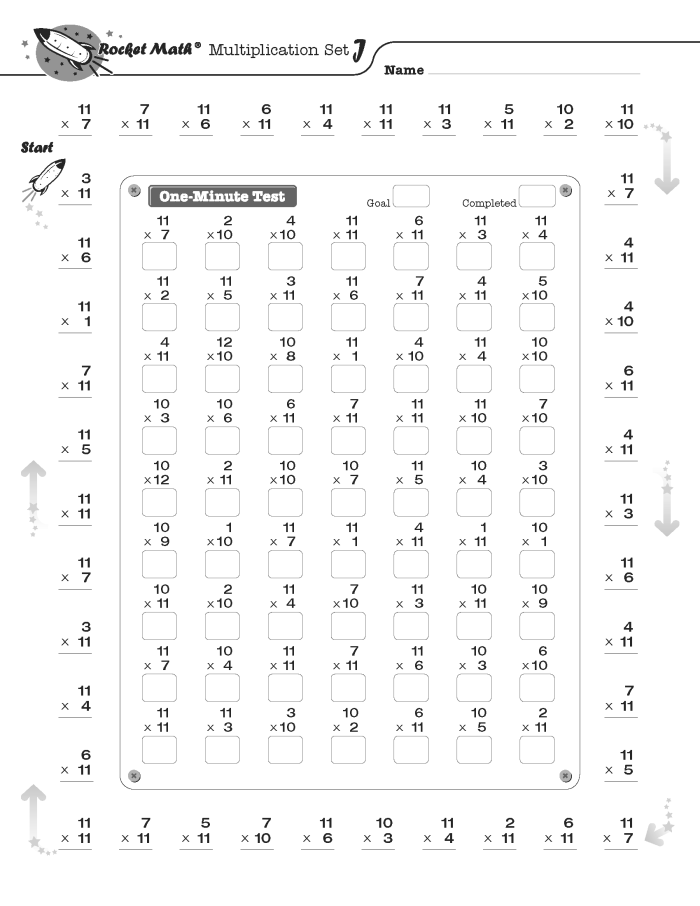
Rocket Math licenses (the way we used to do business) provided only 1s-9s in the four operations. Now we have subscriptions instead. While the basic subscription only provides access to the 1s-9s of the four operations, I have much more in the Universal subscription. The extra drawers that are part of the Universal subscription include Multiplication 10s, 11s, and 12s (including 12 x 12 = 144) and Division 10s, 11s, and 12s. These programs are meant to be done after the 1s-9s are learned, and include a hefty dose of review of the 1s-9s facts along with the new facts. You can see an example of Set J above.

But wait! There’s more! The Universal subscription drawers include Add to 20 (13+6, 4+11, 15+5), Factors, Integers, Rocket Writing for Numerals, and Skip Counting. I’m working on Subtract from 20 as well, which will be added to the Universal subscription as soon as it is done. One of the joys of the subscription is that I can add new programs and make them available immediately to my customers, that they can see whenever they go to their “Filing cabinet on the web.” That way I won’t ever have long time customers who don’t know what is available. You see, I made those 10s, 11s, and 12s a couple of years ago, but you never knew. Thanks for asking Valerie, and thanks for being a loyal Rocket Math user!

What happens if we don’t practice daily?

Hi Dr. Don,
I have another question. Why do you recommend practicing Rocket Math every day? Would doing it only a couple days a week be okay?
Thanks,
Julie

Hello Julie,
Thanks for asking. The importance of daily practice has to do with the nature of building memory. If you practice daily almost all students will make good progress, and pass a level every few sessions. A few minutes practice and then overnight time for the memories to sink in, and then all the students get to practice again before they forget. If you practice just a couple of times a week then only the most able students would be able to remember and benefit from the last practice session–the more time to forget the more students forget. Much better to activate those memories and build those neural connections every day. The success rate of your students will go WAY down if you do it only a couple of days a week. Many students would not be able to pass and would get frustrated. That’s why it is designed to be a fast activity–less than ten minutes a day once you build the routine. We find that the least able 10% of your students may need to practice orally twice a day to make good progress. That’s why getting parents involved is such a good idea.