How School Math Fluency Programs Work

Math Fluency Programs should be part of on-going elementary school routines

Most elementary teachers do some activities to promote math fluency.  Yet many elementary children are not fluent with math facts by the time they hit upper elementary or middle school.  A hit-or-miss approach allows too many students, especially the most vulnerable, to slip through the cracks.   Math fluency programs, like Rocket Math’s Worksheet Program, need to be part of your elementary school’s routine.  Effective math fluency programs should be properly structured and every math teacher should be on board, every year.

Math fact fluency enables students to develop number sense

Many teachers learn in their training programs about the importance of “number sense.”  Students who have “number sense” can easily and flexibly understand relations between numbers.  They can recombine numbers in various ways and see the components of numbers.  Students with number sense can intuit the fact that addition and subtraction are different ways of looking at the same relations.

What is not taught in most schools of education is that developing fluency with the basic math facts ENABLES the development of number sense much better than anything else.  Once students memorize facts, they are available for students to call upon to understand alternate configurations of numbers. Students find it much easier to see the various combinations when they when they can easily recall math facts.  Once students master the basic facts, math games that give flexibility to thinking about numbers become much easier.

It may be hard for new teachers, straight from indoctrination in the schools of education, to imagine this is true.  However, if they land in an elementary school with a strong math fact fluency program they will see the beneficial effect of memorization.
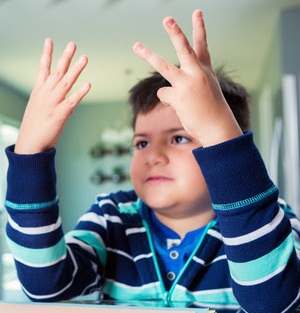
young boy wearing a blue striped shirt counting to seven on his fingersWhy is math fact fluency important

In the primary grades, students who have not developed fluency in math facts will have a harder time learning basic computation.

Students who are not fluent with math facts find the worksheets in the primary grades to be laborious work.  They finish fewer of them and may begin to dislike math for this reason.

By the time students reach upper elementary, if they have not memorized the math facts, they find it very difficult to complete math assignments at their grade level.  They find themselves unable to estimate or do mental math for problem-solving.  The need to figure out math facts will continue to distract non-fluent students while they are learning new math procedures like algorithms.

In the upper grades, their inability to figure out multiplication facts becomes a huge stumbling block.  Manipulations of fractions, decimals, and percentages will not make intuitive sense to students because they haven’t memorized those facts.  Without math fact fluency, students rarely succeed in pre-algebra and may be prevented from learning algebra and college-level math entirely.

Math fact fluency must be assured through regular monitoring
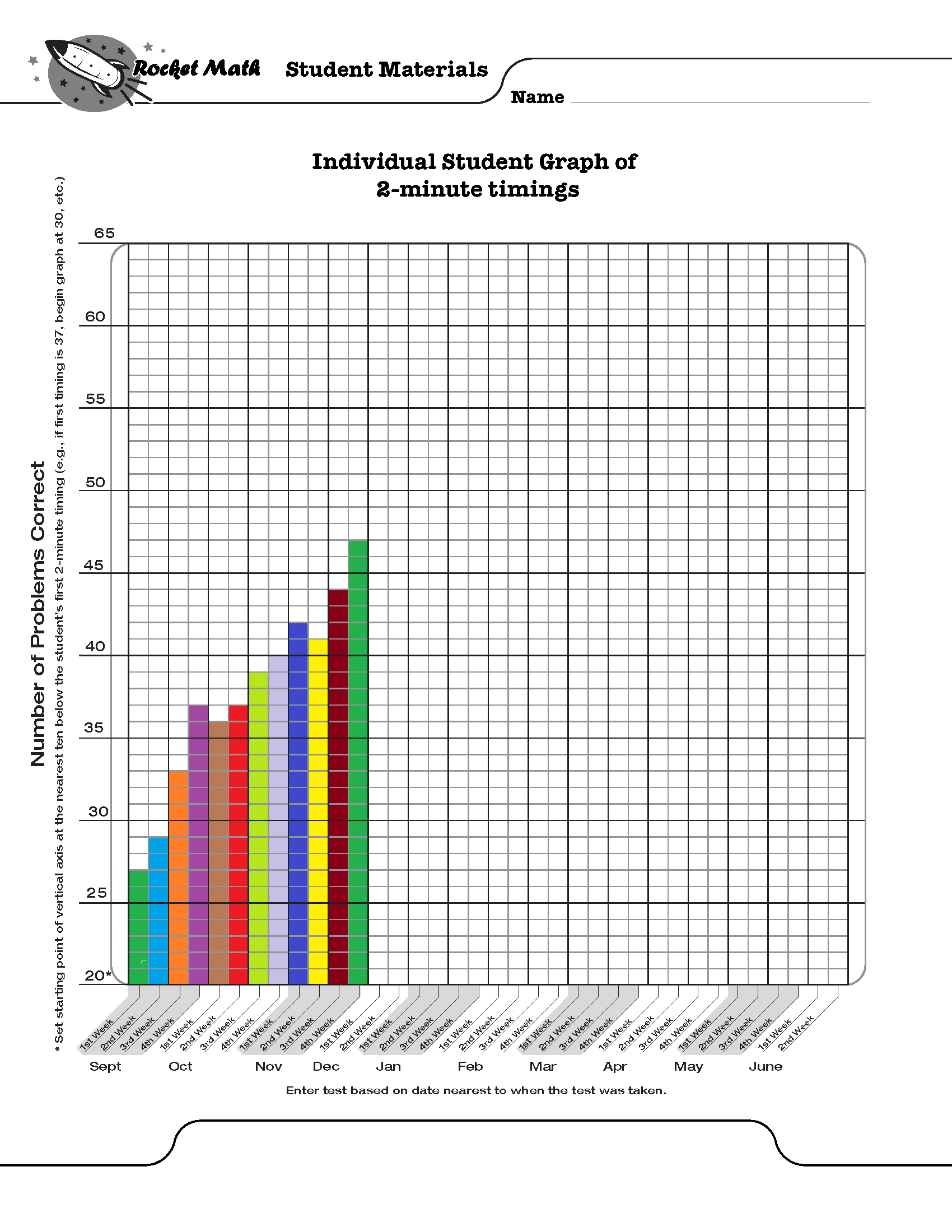
Some students will need up to ten times more practice to develop math fluency than other students.  Therefore, monitoring student success in memorizing the facts is critical. Teachers can assume that what is “enough practice” for some students is NOT going to be enough practice for all students.  Effective math fluency programs must have a progress monitoring component built in.  Progress monitoring gives comparable timed tests of all the facts at intervals during the year.  Teachers look at the results of these timed tests to check on two things:

1. Are students gradually improving their fluency with all the facts gradually over the year? 

In other words, are students able to answer more facts in the same amount of time?  If they aren’t improving, then the instructional procedures aren’t working and need to be modified or replaced.  Math fluency programs like Rocket Math’s Worksheet Program have two minute timings of all the facts in each operation that can be given and the results graphed to see if there is steady improvement.

2. Are all students reaching expected levels of performance at each grade level each year?

Proper math fluency programs identify students who are not meeting expectations and give them more intensive interventions.  Ultimately, by the end of fourth grade all students should be able to fluently answer basic 1s – 9s fact problems from memory in the four operations of add, subtract, multiply and divide. Fluent performance is generally assumed to be 40 problems per minute, unless students cannot write that quickly.

Expectations vary by grade level and the sequence with which schools teach facts can vary.  While it is great to achieve all that the Common Core suggests, it is critical only to assure that students master and gain fluency in 1s through 9s facts.  Some schools in some neighborhoods may find that waiting until second grade to begin math facts may not provide enough time for all students to achieve fluency.  When to begin fact fluency and how much to expect each year should be based on experience rather than some outside dictates.

Successful math fluency programs must have these 3 features


  1. Sequences of small sets

    No one can memorize ten similar things, like the 2s facts, all at once. Students easily master math facts when they can learn and memorize small amounts of facts at one time. Effective math fluency programs define math fact sequences, which students memorize at their pace before moving onto new math facts. Rocket Math’s fluency program uses only two facts and their reverses in each set from A through Z.

  2. Self-paced progress

    Even if you only introduce small sets of math facts, some students need more time to memorize than others.  If you introduce the facts too fast, students will begin to jumble them together and progress will be lost. The pace of introducing facts must be based on mastery—not some pre-defined pace.  This is why doing all the multiplication facts as a class in the first six weeks of third grade does not work.  It is just too fast for some students.  Once they fall behind it all becomes a blur.

  3.  Effective practice and corrections

    When students are practicing facts, they will come to ones they have forgotten or can’t recall immediately.  Those are the facts on which they need more practice.  Allowing students to stop and figure out the facts they don’t know while practicing, does not help the student commit them to memory.  Instead, students need to IMMEDIATELY receive the fact and the answer, repeat it and try to remember it.  Then they need to attempt that fact again in a few seconds, after doing another couple of problems.  If they have remembered the fact and can recall it, then they are on their way to fluency.  But students must practice the next day to cement in that learning.

Math fluency programs like Rocket Math’s Worksheet Program teach students math facts in small sets, allow students to progress at their own pace, and support effective practice and error correction. Each Rocket Math Worksheet program has 26 (A to Z) worksheets specially designed to help kids gradually (and successfully) master math skills. Gain access to all of them with a Universal Subscription or just the four basics (add, subtract, multiply, divide–1s to 9s) with a Basic Subscription.
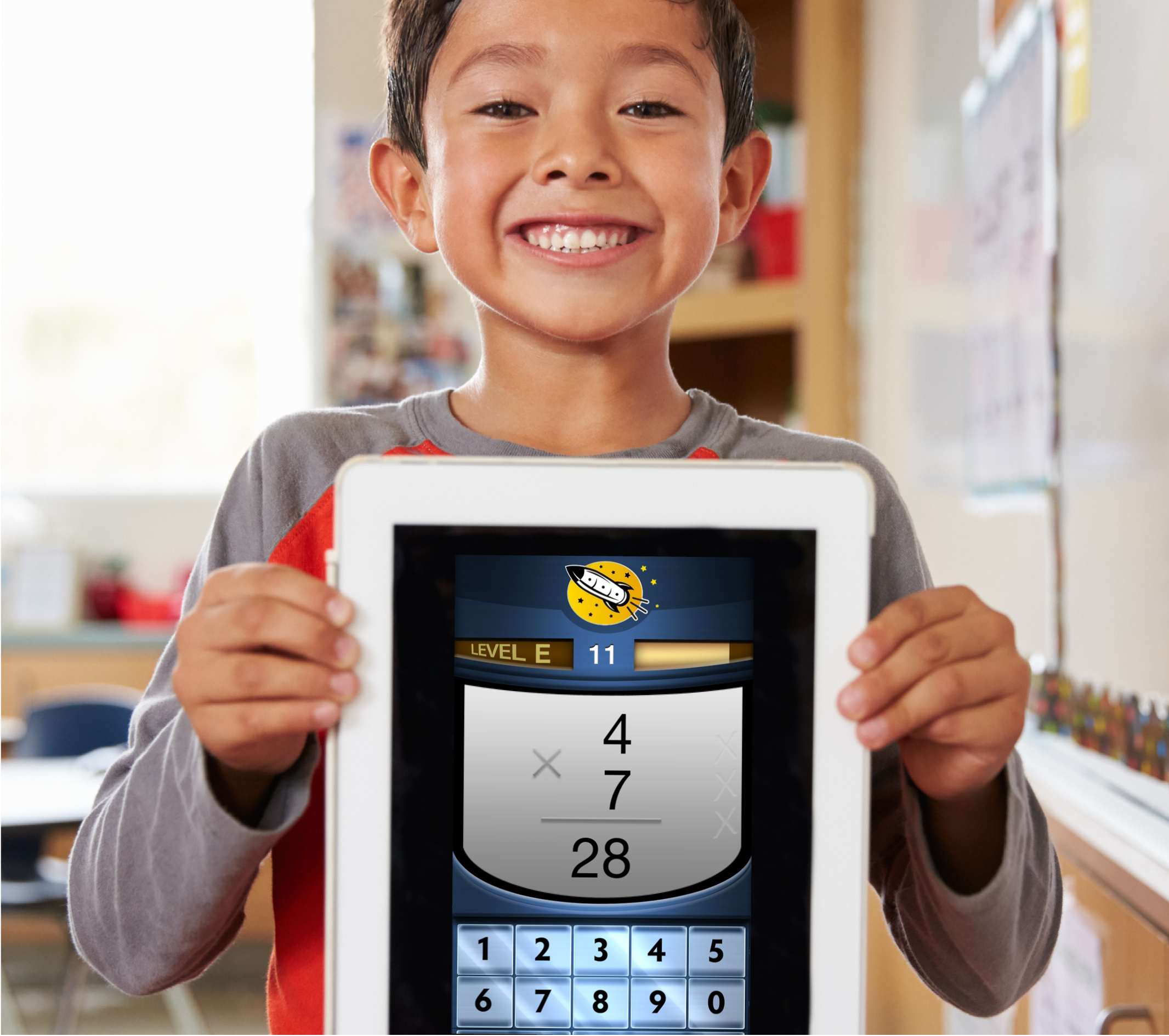


Does Your Kid’s App Teach Math Fact Fluency – Or Waste Time?

Just playing a math facts game won’t build math fact fluency

There are a lot of apps out there that look like they would help your child learn math fact fluency.  If they have to answer math facts, won’t that work?  Not really.  Just playing a game that asks you to answer facts won’t help you learn new facts.  In fact, most apps for practicing facts are discouraging to students who don’t know their facts well.  Why?  Because most of the people designing the app don’t have any experience teaching.  A teacher, like the creator of the Rocket Math App, is trained to effectively teach new math facts (or any facts) to a student and knows an effective math app from an ineffective one.

3 essential features of an effective math fact app

There are plenty of ineffective math apps.  Some apps don’t give the answers when a student doesn’t know them.  Some apps just fill in the answer for the student and then move on.  When the student doesn’t know the answer, the app has to teach it.  To teach math fact fluency, the app has to do these three things:

  1. The app has to tell the problem and the answer to the student.

  2. It has to ask the student to give the correct answer to the problem.

  3. It has to ask the problem again after a short delay to see if the student can remember the answer.

Without doing these three things there’s no way the app is going to be able to teach a new fact to the student.

An effective math app will only teach a few math facts at a time

Nobody can learn a bunch of new and similar things all at the same time.  A person can only learn two, three, or four facts at a time. You cannot expect to learn more.*  That’s enough for one session.  The student has to practice those facts a lot of times to commit them to memory.  Once or twice is not enough. It also won’t help to practice the same fact over and over.  Proper math fact fluency practice intermingles new math facts along with facts the learner has already memorized.  However, no more than two to four facts should be introduced at a time.  If a student has to answer a lot of random untaught math facts, you will have a very frustrated learner.

Practice must focus on building math fact fluency

Some students learn to solve addition problems by counting on their fingers.  That’s a good beginner strategy, but students need to get past that stage. They need to be able to simply and quickly recall the answers to math facts. An app is good for developing recall.  But the app has to ask students to answer the facts quickly, faster than they can count on their fingers.  The app has to distinguish when a student is recalling the fact (which is quick) from figuring out the fact (which is slow).  Second, the app must repeatedly ask the learned facts in a random order, so students are recalling.  But the app should not throw in new facts until all the facts are mastered and can be answered quickly.

Introduce new facts only when old facts are mastered

The trick to effectively teaching math facts is to introduce new math facts at an appropriate pace.  If you wait too long to introduce math facts, it gets boring and wastes time.  If you go too fast, students become confused.  Before introducing new facts, students need to master everything you’ve given them.  An effective app will test whether students have mastered the current batch of math facts before introducing more facts.  And it will also introduce math facts at a pace based on student mastery.  That’s the final piece of the puzzle to ensure students learn math facts from an app.

*Rocket Math App focuses on two facts and their reverses at a time, such as 3+4=7, 4+3=7, 3+5=8 and 5+3=8.

Why Multiplication Games Are Awful & What to Do About It

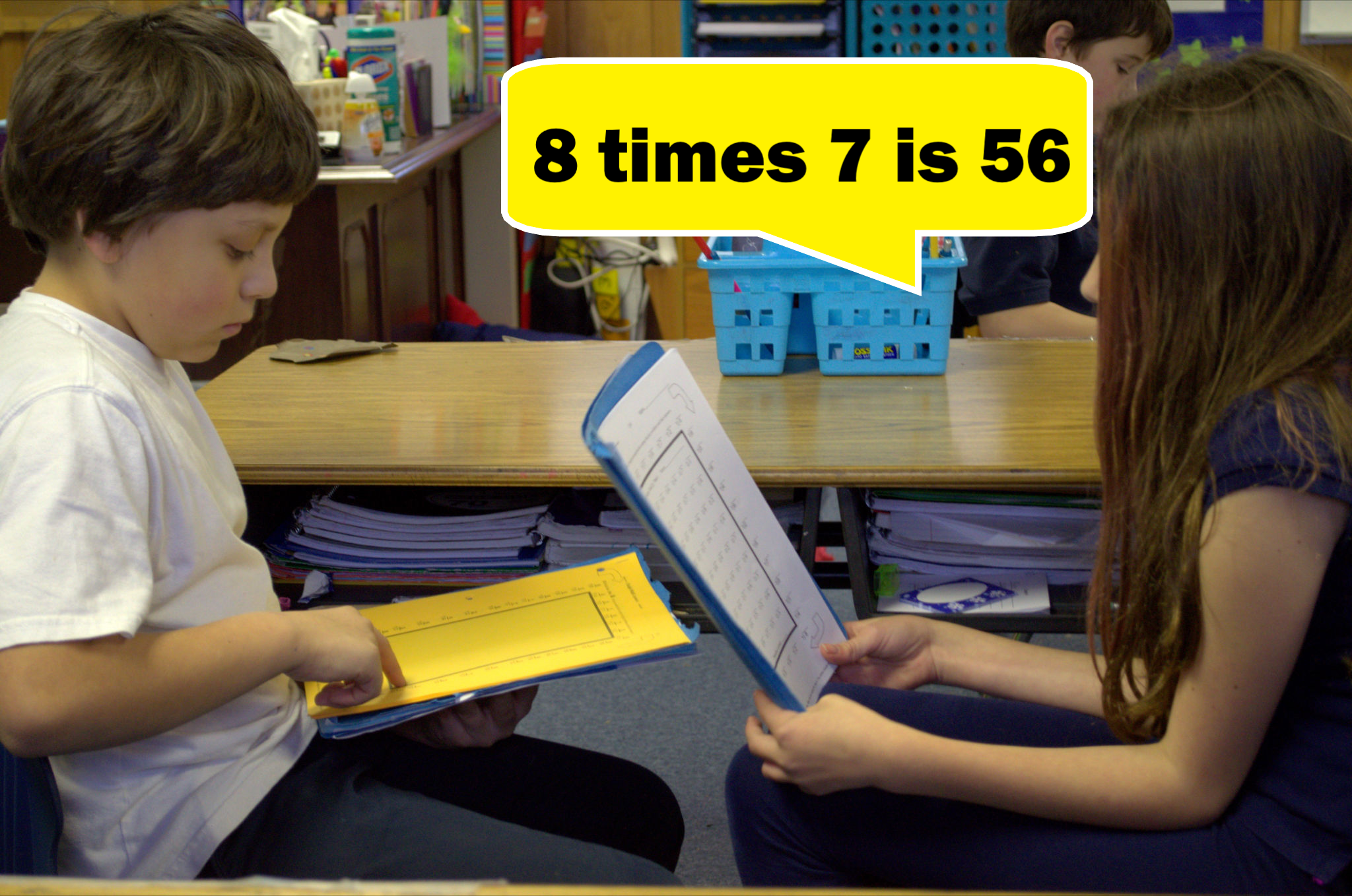
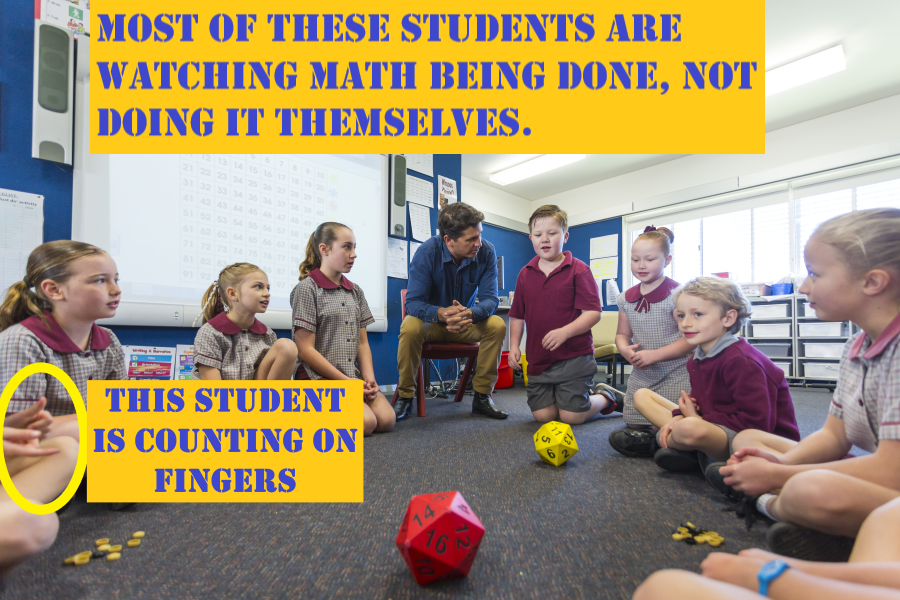
As a university supervisor of pre-service teachers, I’ve seen my share of bad lessons.  Among the most painful were when student teachers would try to liven up their lessons to impress me by having the students do a math game.  My student teachers wanted their students to learn math facts and to do so in a fun way.  The picture above is typical of what I would see.  Here are the reasons that most multiplication games that the student teachers implemented were awful.

(For multiplication games that work in and out of the classroom, check out Rocket Math’s Worksheet Program and Online Game.)

Waiting for your turn at a multiplication game is not learning!

As you can see in the picture above, all but one of the students are just waiting for their turn.  They aren’t doing math.  The students are just watching the student who is playing.  No one likes waiting, and your students are no exception.  Any game that has turn-taking among more than two students wastes time.

Make sure your multiplication games are structured so all or most students are engaged and playing all the time.  You want students to have as much engaging practice as possible while practicing math facts at speed.  If everyone can be doing that at the same time, that’s optimal.  No more than two students should be taking turns at a time.

A multiplication game that allows using a known strategy to figure out facts (like finger counting) is not learning!

Learning math facts involves memorizing these facts so that students know them by memory, by recall.  Committing facts to memory is why there is a need for lots of practice.  If the game allows time for students to count on their fingers or use some other strategy for figuring out the answer to facts, then there is no incentive for students to get better.

In the lower left corner of the picture you can see one student counting on their fingers—which is better than just watching—but is not learning the facts, it is just figuring them out.  The most able students in an elementary school are able to memorize facts on their own when they tire of figuring them out day in and day out.  But the rest of the students will just do their work patiently year after year without memorizing if you don’t create the conditions for them to memorize facts.

Make sure that your multiplication games reward remembering facts quickly rather than just figuring them out.  Speed should be the main factor after accuracy.  Fast-paced games are more fun and the point should be that the more facts you learn the better you’ll do.

Multiplication games that randomly present ALL the facts make learning impossible.

It is a basic fact of learning that no one can memorize a bunch of similar things all at once.  To memorize information, like math facts, the learner must work on a few, two to four facts, at a time.  With sufficient practice, every learner can memorize a small number of math facts. Once learners master a set of math facts, they can learn another batch.  But if a whole lot are presented all at once, it is impossible for the learner to memorize them.

Make sure your multiplication games are structured so that each student is presented with only facts they know.  A good game presents only a few facts at a time.  As students learn some of the math facts, more can be added, but at a pace that allows the learner to keep up.  The optimal learning conditions are for the learner to have a few things to learn in a sea of already mastered material.

Rocket Math Multiplication Games

We designed Rocket Math games to help kids gradually (and successfully) master math skills. Students use Rocket Math’s Worksheet Program to practice with partners, then take timings. Students can also individually develop math fact fluency—from any device, anywhere, any time of day—with Rocket Math’s Online Game.

How to Grade 1-Minute Math Fluency Practice Tests

Katy L from Wilson Elementary asks: How can I keep up with everyday Rocket Math grading? Do you teach students to grade their own 1-minute math fluency practice tests?

Dr. Don answers:

Only grade 1-minute math fluency practice tests if students pass

An integral part of the Rocket Math Worksheet Program is the 1-minute math fluency practice test. One-minute fluency practice tests are administered every day, to the whole class, and only after students practice in pairs for two to three minutes each. Check out the FAQs page to learn more about conducting 1-minute math fluency practice tests in class.

Teachers do NOT need to grade, score, or check daily Rocket Math 1-minute math fluency practice tests unless the student has met their goal. Students do NOT need to grade their own daily Rocket Math fact fluency tests either.

Why grading each math test is not important

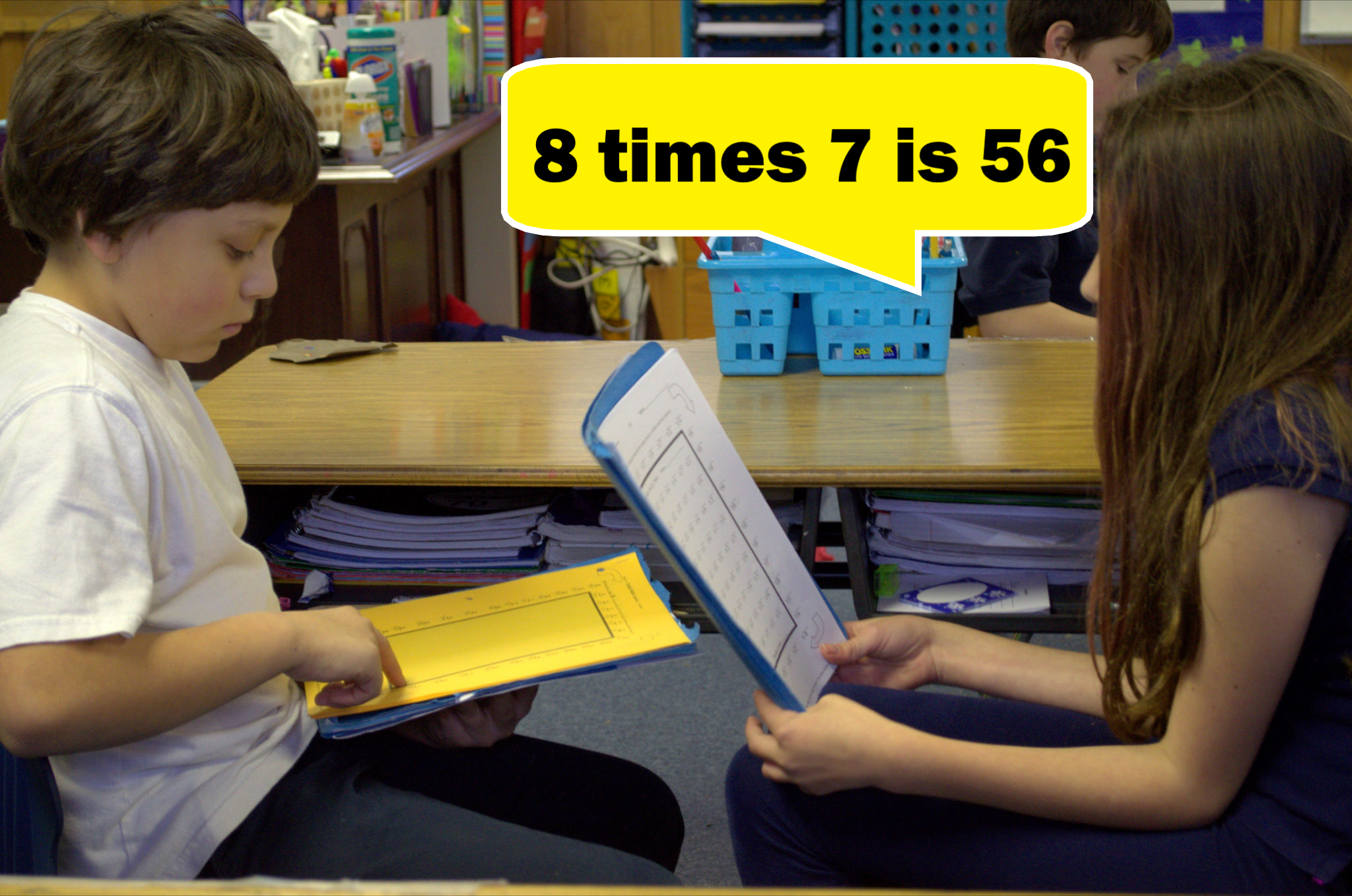
The important part of math fluency practice is the oral practice with the partner before the test–what’s going on in this picture. Because the students are orally practicing every day and getting corrections from their partners, there should be VERY FEW errors on the 1-minute math fluency written tests.  

Correcting written tests doesn’t help students learn anyway. Corrections are only helpful if they are immediate, the student has to acknowledge the correct answer, and remember it for a few seconds–all of which is part of the oral correction procedure. “Correcting” what’s on the paper takes a lot of time and does not help students learn more, so it shouldn’t be done. But you have to check them before declaring that the student has passed a level.

How do you know if a student passes?

Students should have a packet of 6 sheets math fact fluency sheets at their level. Each Rocket Math student has an individual goal. For example, if a student has a goal of 32 (based on their Writing Speed Test) and they only do 31, they know they did not pass. If the student does 32 or more, they pass!

What to do when a student beats their goal (passes)

If a student meets or beats their goal, then have them stand up, take a bow, and then turn their folder into a place where you check to see that all problems were answered correctly. When YOU check (after school?), make sure all of the completed problems were correct and the student met their goal. If so, then you put the unused sheets in that packet back into the filing crate and re-fill the student’s folder with a packet of 6 worksheets at the next level and hand the folder back the next day.

When students receive the new packet of worksheets, they know to color in another letter on the Rocket Chart (and maybe put a star on the Wall Chart).

What to do if a student doesn’t pass?

Students who don’t meet their goals, don’t pass. These students should put the non-passing sheet into their backpacks and take the sheet home for more practice.

The next day they will use the next sheet in their packet of 6. If you want to give them points, do that the next day after they bring back their worksheet where they did a session at home (signature of helper should be there) and all items on the test are completed. If that’s done, they get full points.

Sometimes you’ll catch errors on sheets that students turn in as “passes.” If you see an error, the student doesn’t pass. As a result, the student keeps the old packet and has to continue with that same level worksheet.

For more information about conducting 1-minute math fluency practice tests in class and how to implement the Rocket Math worksheet program, visit the FAQs page.

Are you ready for summer?

Preparing now can insure that students will maintain their Rocket Math learning over the summer.

(1) The simplest and most important thing you can do to get ready for summer is to save those Rocket Math folders at the end of the year. The folders can then be given to the next year’s teacher, so he or she knows where the student left off. Given special practice techniques at the start of fall (outlined below), students do NOT have to go back or start an operation all over again the next year. Some students take months to get where they are in an operation, and it is a terrible waste of their time to start them over. Especially if they have new faster writing speed goals, now they really have to work hard to master each set and it may take them quite a while.

(2) Make sure to take a few days to re-teach your students how to correct and when to correct (errors and hesitations).  Teach this by modeling errors and hesitations and have students be your checker and model how to correct for the other students to see.  Keep working with that student until you get perfect corrections even on hesitations.  Then “rinse and repeat” with another student.  Do this teaching and modeling for ten minutes each day for the first week or so.

Two students participating in one of Rocket Math's math fluency programs(3) Start students practicing on the last set completed (passed) the previous year but for the first five practice sessions, practice on that set in a special way. First practice in partners around the outside for two or three minutes. But then, instead of taking a written test, have students practice in pairs orally with the test (inside the box), for two minutes. Practice the same way as around the outside. Have the student read each problem aloud and answer it from memory. The checker will need to have the test answer key. Practice for two to three minutes and then switch roles. This practice will provide the necessary review of all the facts learned so far, and will bring them right back up to speed.

(4) After a week of oral practice sessions with the test, then allow students to take the written test. Evaluate students based on their writing speed goals from last year (don’t re-test and raise them). Arrange for extra oral practice on the test for anyone who doesn’t pass. In the extra practice, make sure they orally practice the test in the center as well. Keep up the extra practice, on that same set until they pass. They should get there in a few days. They already learned this, they are just bringing it back. They haven’t forgotten it, the connection just needs a little strengthening.

(5) If students finished an operation before leaving, you can start them on the next operation appropriate for their grade. Second graders who have finished addition, for example, would start with subtraction (1s – 9s), and then go on to Subtract from 20, then Skip Counting.  Third graders need to be taught the concept of multiplication first, but then should begin multiplication, regardless of what they completed earlier.  Multiplication is so critical for future success in math you cannot let any child in your room (if you are in 3rd grade or above) leave it without learning those multiplication facts.  Best thing you can do for their math careers.

Now that you know what to do–enjoy the summer!