
Author: Dr. Don
What about students who can’t pass in 6 tries?
A teacher writes:
Help! I’m feeling bogged down in Rocket Math. I have some students who have been working on the same sheet for over 10 times and are no closer to passing. What am I doing wrong?
Dr. Don answers:
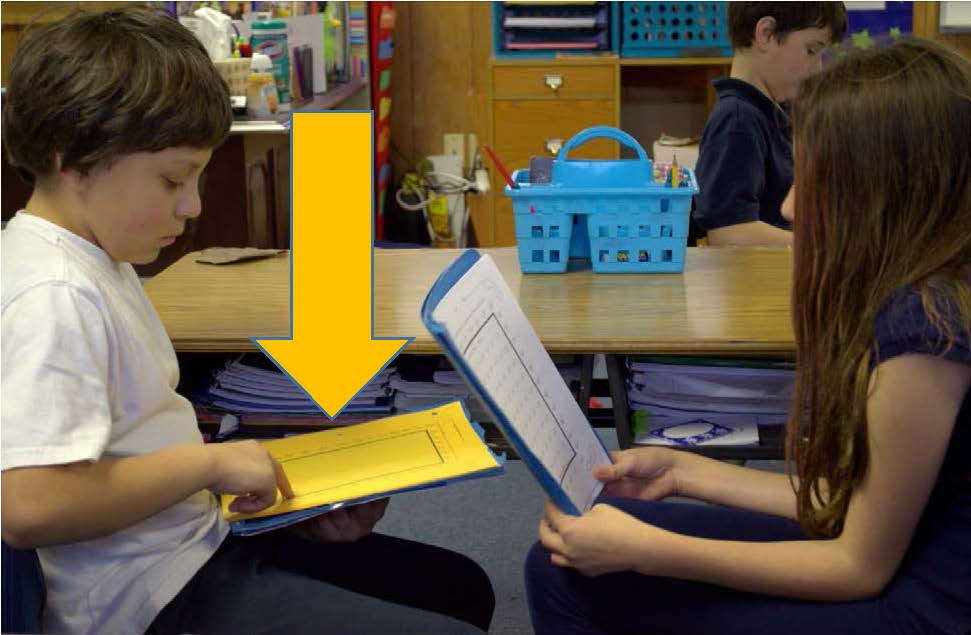
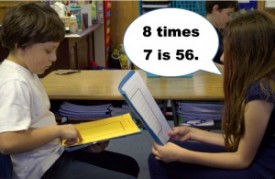
The problem could be one of several things. You have to diagnose what it could be. I am assuming you have students practicing orally in pairs, with answer keys, for at least two minutes per partner every day (as shown in the picture above). I am assuming you already have students, who do not pass, take home the sheet on which they didn’t pass and finish it as homework and practice with someone at home. The extra practice session at home each day can be a big help and the students should be motivated to do that. If this is the case and you still have a problem, below are two possible things that may be needed.
(#1) Need to improve practicing procedures. Pick one of the students who is stuck and be that student’s partner while they practice orally. Make sure they are saying the whole problem and the answer aloud so you can hear what they are saying. Correct even any hesitations, not just errors. Correct the student by saying the correct problem and answer, having them repeat the correct problem and the answer three times, then back up three problems and move forward again.
Diagnosis. If, after practicing with you, the student does much better on the one minute timing and passes or nearly passes (this is what I usually found) then you know the problem is poor practicing procedures. If your work with the student makes no difference (they don’t do better on the one-minute timing) and they seem equally slow on all the problems then it is not practicing procedures at fault. Try #2
Solution: Monitor your students closely during oral practice to see if they are all following the correct practice procedures. If you have quite a few students who aren’t practicing well you may need to re-teach your class how to practice. [Note: Even if they know how to do it but aren’t doing it right, treat it as if they just don’t know how to to do it correctly.] Stop them and re-do the modeling of how to practice and how to correct for several days before allowing them to practice again. If your students haven’t been practicing the right way, they won’t be passing frequently, and they will be unmotivated. You have to get them practicing the right way so they can be successful and so they can be motivated by their success.
Solution: If you have poor practicing with only a handful of students you might assign them to more responsible partners and explain to them that they need to practice correctly. During oral practice monitor them more carefully the next few days to be sure they are practicing better and passing more frequently.
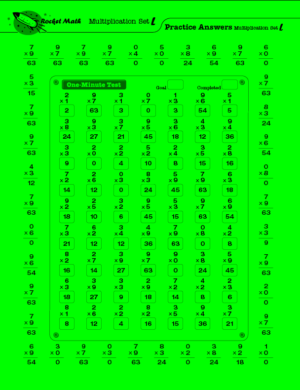
(#2) Need to review test problems also. The problems practiced around the outside are the recently introduced facts. The problems inside the test box are an even mix of all the problems taught so far. If there has been a break for a week or more, or if the student has been stuck for a couple of weeks, the student may have forgotten some of the facts from earlier and may need a review of the test problems.
Diagnosis. Have the student practice orally on the test problems inside the box with you. If the student hesitates on several of the problems that aren’t on the outside practice, then the student needs to review the test items.
Solution. If you have this problem with quite a few students (for example after Christmas break) then have the whole class do this solution. For the next three or four days, after practicing around the outside, instead of taking the 1 minute test in writing, have students practice the test problems orally with each other. Use the same procedures as during the practice—two minutes with answer keys for the test, saying the problem and the answer aloud, correction procedures for hesitations, correct by saying the problem and answer three times, then going back—then switch roles. Do this for three or four days and then give the one-minute test. Just about everyone should pass at that point.
Solution. If you have this problem with a handful of students, find a time during the day for them to practice the test problems orally in pairs. If the practice occurs before doing Rocket Math so much the better, but it will work if done after as well. They should keep doing this until they pass a couple of levels within six days.
If neither the first or the second solutions seem to work, write to me again and I’ll give you some more ideas.

Are students really “friends?”
I hear teachers calling their students “friends” quite commonly these days. While the use of the term “friends” is certainly harmless enough, it reminds me that there are extremely important distinctions between the way a person should treat friends and the way a teacher should treat students. I don’t want to stop teachers from calling their students “friends” but I do think it is critical for teachers to know why and how they should not treat their students as friends.
The main reason that teachers should not treat students as friends concerns expectations. With friends you’re nice to them and hope that makes them like you. Then if they like you, they will be considerate of your feelings and treat you well. Many beginning teachers expect that a classroom of students will be like a room full of friends. If you are unfailingly nice to them, they will in turn be considerate of you and attempt to acquiesce to your wishes. Unfortunately, this does not work. Why? Primarily because a teacher has to ask students to do things they’d rather not do and has to keep their attention on things to which they’d rather not pay attention. In short, teachers are authority figures rather than friends. Friends can get up and leave when they aren’t interested in what you’re doing, but students are required to stay. Therefore teachers must treat students differently than they treat friends.
The first way that treating friends and students should be different concerns how a teacher reacts to student academic errors. When a student answers a question incorrectly it shows they have a misunderstanding. For example, a student says that the sun orbits around the earth. That misunderstanding needs to be corrected to set the student “straight.” A teacher who allows a student to continue with a misunderstanding is doing that student a disservice. Errors should be corrected immediately, in a nice way, but as clearly as possible. For example, the teacher says that although it appears as if the sun rotates around the earth, actually the earth orbits around the sun. A good teacher may even take the opportunity to model how a spinning globe creates the illusion that the distant sun is going around us. The student should be taught/told the correct understanding in as unequivocal a manner as possible and the teacher needs to check to be sure that the student learned the correct information both immediately after the correction and a few minutes later to see that the correct answer is retained.
When a friend makes a factual error, it is socially expected that you will not make a big deal of it. It is socially inept to clearly and loudly correct errors of fact among friends. At best one can simply not confirm an incorrect statement, but pointing it out as incorrect is just rude. Teachers who treat their students as friends will make light of or gloss over errors, and they fail to teach students as a result.
Another way treating friends and students should be different concerns how a teacher reacts to student behavior. Teachers need to learn to “catch ‘em being good.” Teachers should look for students who are doing the right thing and should praise/recognize them by name, make eye contact and name the behavior they are doing that is exemplary. “Alan has his desk clear, his textbook out and he’s ready to start learning. He’s looking ready for college.” Praising and recognizing appropriate behavior in the classroom helps prompt other students towards what they should be doing as well as reinforcing Alan. It sends the signal of the behaviors the teacher values in the classroom and teaches students what’s expected. At the same time the teacher should deliberately not give any attention to students who are not doing the right thing, who have not gotten ready to start.
With friends we are expected to give non-contingent attention. We give them love and attention because of who they are, not based on how they behave. One doesn’t turn away from a friend and deliberately pay attention and begin talking to someone across the room because you approve of their behavior more. If you did that it would be too rude to your friend and it might hurt your friendship. Instead, if your friend misbehaved at a party you would begin by attending to your friend, to see what’s wrong, or find out what you can do for them. That attention reinforces your friendship and proves you’re a good friend. In a classroom, teachers who respond to misbehavior as they would to a friend end up reinforcing the inappropriate behavior and they get a lot more misbehavior from all of their students.
There is a role for non-contingent reinforcement of students. They need to know that the teacher cares about them as people. The time for that is at neutral times when the student is not misbehaving, such as when entering the classroom, out on the school grounds not during class, or even when circulating the room. Giving appropriate and friendly social attention to the student at times when they aren’t in crisis or off-task helps create good relationships within the classroom and is valuable. In that circumstance “friends” is just what is wanted.
A third and final way that teachers should not treat students as friends is when students break the rules. To establish order in a classroom there needs to be rules and consequences for rule-breaking. Consequences need not be major or draconian, but they do need to be applied consistently. If a teacher says, “Wait to be called on before you speak,” the teacher needs to not answer or engage with students who call out without raising their hand and waiting. The teacher should ignore the student calling out and call on someone who raised their hand. That needs to be consistently applied, no matter who the student is who calls out. Students only learn to follow the rules when the consequences are consistent.
I wouldn’t recommend treating friends in this manner. If friends blurt out and interrupt your turn speaking, we generally tolerate it. When a friend breaks a rule, we don’t apply consequences. We might complain to them. We hope that our friendship will cause them to re-examine their behavior, but we’d rather “ask” them not to do it than apply swift consequences. That is because we are ultimately not authority figures with our friends. But teachers are authority figures and they therefore have to treat their students differently than they would treat their friends. As long as teachers understand this, they can certainly call their students “friends.”
Rocket Math adds inexpensive three-month subscriptions
Rocket Math has added “trial size” three month subscriptions. Now you can try-out a 3-month Rocket Math basic subscription (item #1000) for only $10. This gives you access to over 400 pages of worksheets, forms, assessments, answer keys and instructions to the popular math facts practice program a fraction (1/3 to be specific) of the price of the annual subscription. Don’t renew and you won’t have to pay again–it won’t auto-renew. For only $15 you can try out the Universal subscription item #1001 for three months. The Universal Subscription includes nine other programs.
(click on each for more information):
- Rocket Writing for Numerals AND
- Add to 20 (e.g., 13 + 6, 4 + 11, 15 + 5)AND
- Subtract from 20 (18-15, 15-5, 19-8) AND
- 10s, 11s, 12s Multiplication AND
- 10s, 11s, 12s Division AND
- Factors (How to find all the factors) AND
- Skip Counting AND
- Integers (adding and subtracting positive and negative numbers) AND
- Equivalent Fractions.
As Dr. Don completes new practice programs he adds them to the Universal subscription. If you are unsure about whether you would use the Rocket Math subscription, here’s an inexpensive way to try it out. If you are not sure about what Rocket Math is try watching this three minute video introduction.

How fast should students be with math facts?
Students should be automatic with the facts. How fast is fast enough to be automatic?
Editor’s Note: “Direct retrieval” is when you automatically remember something without having to stop and think about it.
Some educational researchers consider facts to be automatic when a response comes in two or three seconds (Isaacs & Carroll, 1999; Rightsel & Thorton, 1985; Thorton & Smith, 1988). However, performance is not automatic, direct retrieval when it occurs at rates that purposely “allow enough time for students to use efficient strategies or rules for some facts (Isaacs & Carroll, 1999, p. 513).”
Most of the psychological studies have looked at automatic response time as measured in milliseconds and found that automatic (direct retrieval) response times are usually in the ranges of 400 to 900 milliseconds (less than one second) from presentation of a visual stimulus to a keyboard or oral response (Ashcraft, 1982; Ashcraft, Fierman & Bartolotta, 1984; Campbell, 1987a; Campbell, 1987b; Geary & Brown, 1991; Logan, 1988). Similarly, Hasselbring and colleagues felt students had automatized math facts when response times were “down to around 1 second” from presentation of a stimulus until a response was made (Hasselbring et al. 1987).” If however, students are shown the fact and asked to read it aloud then a second has already passed in which case no delay should be expected after reading the fact. “We consider mastery of a basic fact as the ability of students to respond immediately to the fact question. (Stein et al., 1997, p. 87).”
In most school situations students are tested on one-minute timings. Expectations of automaticity vary somewhat. Translating a one-second-response time directly into writing answers for one minute would produce 60 answers per minute. However, some children, especially in the primary grades, cannot write that quickly. “In establishing mastery rate levels for individuals, it is important to consider the learner’s characteristics (e.g., age, academic skill, motor ability). For most students a rate of 40 to 60 correct digits per minute [25 to 35 problems per minute] with two or few errors is appropriate (Mercer & Miller, 1992, p.23).” This rate of 35 problems per minute seems to be the lowest noted in the literature.
Other authors noted research which indicated that “students who are able to compute basic math facts at a rate of 30 to 40 problems correct per minute (or about 70 to 80 digits correct per minute) continue to accelerate their rates as tasks in the math curriculum become more complex….[however]…students whose correct rates were lower than 30 per minute showed progressively decelerating trends when more complex skills were introduced. The minimum correct rate for basic facts should be set at 30 to 40 problems per minute, since this rate has been shown to be an indicator of success with more complex tasks (Miller & Heward, 1992, p. 100).” Rates of 40 problems per minute seem more likely to continue to accelerate than the lower end at 30.
Another recommendation was that “the criterion be set at a rate [in digits per minute] that is about 2/3 of the rate at which the student is able to write digits (Stein et al., 1997, p. 87).” For example a student who could write 100 digits per minute would be expected to write 67 digits per minute, which translates to between 30 and 40 problems per minute. Howell and Nolet (2000) recommend an expectation of 40 correct facts per minute, with a modification for students who write at less than 100 digits per minute. The number of digits per minute is a percentage of 100 and that percentage is multiplied by 40 problems to give the expected number of problems per minute; for example, a child who can only write 75 digits per minute would have an expectation of 75% of 40 or 30 facts per minute.
If measured individually, a response delay of about 1 second would be automatic. In writing 40 seems to be the minimum, up to about 60 per minute for students who can write that quickly. Teachers themselves range from 40 to 80 problems per minute. Sadly, many school districts have expectations as low as 50 problems in 3 minutes or 100 problems in five minutes. These translate to rates of 16 to 20 problems per minute. At this rate answers can be counted on fingers. So this “passes” children who have only developed procedural knowledge of how to figure out the facts, rather than the direct recall of automaticity.
References
Ashcraft, M. H. (1982). The development of mental arithmetic: A chronometric approach. Developmental Review, 2, 213-236.
Ashcraft, M. H. & Christy, K. S. (1995). The frequency of arithmetic facts in elementary texts: Addition and multiplication in grades 1 – 6. Journal for Research in Mathematics Education, 25(5), 396-421.
Ashcraft, M. H., Fierman, B. A., & Bartolotta, R. (1984). The production and verification tasks in mental addition: An empirical comparison. Developmental Review, 4, 157-170.
Ashcraft, M. H. (1985). Is it farfetched that some of us remember our arithmetic facts? Journal for Research in Mathematics Education, 16 (2), 99-105.
Campbell, J. I. D. (1987a). Network interference and mental multiplication. Journal of Experimental Psychology: Learning, Memory, and Cognition, 13 (1), 109-123.
Campbell, J. I. D. (1987b). The role of associative interference in learning and retrieving arithmetic facts. In J. A. Sloboda & D. Rogers (Eds.) Cognitive process in mathematics: Keele cognition seminars, Vol. 1. (pp. 107-122). New York: Clarendon Press/Oxford University Press.
Geary, D. C. & Brown, S. C. (1991). Cognitive addition: Strategy choice and speed-of-processing differences in gifted, normal, and mathematically disabled children. Developmental Psychology, 27(3), 398-406.
Hasselbring, T. S., Goin, L. T., & Bransford, J. D. (1987). Effective Math Instruction: Developing Automaticity. Teaching Exceptional Children, 19(3) 30-33.
Howell, K. W., & Nolet, V. (2000). Curriculum-based evaluation: Teaching and decision making. (3rd Ed.) Belmont, CA: Wadsworth/Thomson Learning.
Isaacs, A. C. & Carroll, W. M. (1999). Strategies for basic-facts instruction. Teaching Children Mathematics, 5(9), 508-515.
Logan, G. D. (1988). Toward an instance theory of automatization. Psychological Review, 95(4), 492-527.
Mercer, C. D. & Miller, S. P. (1992). Teaching students with learning problems in math to acquire, understand, and apply basic math facts. Remedial and Special Education, 13(3) 19-35.
Miller, A. D. & Heward, W. L. (1992). Do your students really know their math facts? Using time trials to build fluency. Intervention in School and Clinic, 28(2) 98-104.
Rightsel, P. S. & Thorton, C. A. (1985). 72 addition facts can be mastered by mid-grade 1. Arithmetic Teacher, 33(3), 8-10.
Stein, M., Silbert, J., & Carnine, D. (1997) Designing Effective Mathematics Instruction: a direct instruction approach (3rd Ed). Upper Saddle River, NJ: Prentice-Hall, Inc.
Thorton, C. A. & Smith, P. J. (1988). Action research: Strategies for learning subtraction facts. Arithmetic Teacher, 35(8), 8-12.
How should students practice math facts?
Students should practice with a checker holding an answer key.
- One student has a copy of the PRACTICE answer key and functions as the checker while the practicing student has the problems without answers. The practicing student reads the problems aloud and says the answers aloud. It is critical for students to say the problems aloud before saying the answer so the whole thing, problem and answer, are memorized together. We want students to have said the whole problem and answer together so often that when they say the problem to themselves the answer pops into mind, unbidden. (Unbidden? Yes, unbidden. I just kinda like that word and since I am writing this, I get to use it.)
- A master PRACTICE answer key is provided—be sure to copy it on a distinctive color of paper (yellow in the picture) to assist in classroom monitoring. The distinctive color is important for teacher monitoring. If you are ready to begin testing and you see yellow paper on a desk, you know someone has answers in front of him/her. When you make these distinctively colored (there, I said it again) copies, be sure to copy all of the answer sheets needed for a given operation and staple them into a booklet format…one for each student who is working in that operation. For some reason (I actually know the reason) teachers always want to find a way to put the answer keys permanently into the students’ folders. DON’T. Students need to be able to hold these in their hot little hands, outside of their folders. Then answer keys will be the same regardless of the set of facts on which a student is working. So students working on multiplication will have the answers to ALL the practice sets for multiplication. This allows students from different levels to work together without having to hunt up different answer keys.
- The checker watches the PRACTICE answer key and listens for hesitations or mistakes. If the practicing student hesitates even slightly before saying the answer, the checker should immediately do the correction procedure, explained below. (Let’s stop here. This is critical. Critical, I tell ya. This correcting hesitations thing is sooooo important. I mean really important. You can probably guess why. We need students to be able to say the answer to these problems without missing a beat — not even half a beat. So students must be taught that there is no hesitation allowed. Really.) Of course, if the practicing student makes a mistake, the checker should also do the correction procedure.
- The correction procedure has three steps:
- The checker interrupts and immediately gives the correct answer.
- The checker asks the practicing student to repeat the fact and the correct answer at least once and maybe twice or three times. (I recommend three times in a row.)
- The checker has the practicing student backup three problems and begin again from there. If there is still any hesitation or an error, the correction procedure is repeated. Here are two scenarios:
Scenario One
Student A: “Five times four is eighteen.”
Checker: “Five time fours is twenty. You say it.”
Student A: “Five times four is twenty. Five times four is twenty. Five times four is twenty.”
Checker: “Yes! Back up three problems.”
Student A: (Goes back three problems and continues on their merry way.)Scenario Two
Student A: “Five times four is … uhh…twenty.”
Checker “Five times four is twenty. You say it.”
Student A: “Five times four is twenty. Five times four is twenty. Five times four is twenty.”
Checker: “Yes! Back up three problems.”
Student A: (Goes back three problems and continues on their merry [there is a lot of merriment
in this program] way.)
- This correction procedure is the key to two important aspects of practice. One, it ensures that students are reminded of the correct answers so they can retrieve them from memory rather than having to figure them out. (We know they can do that, but they will never develop fluency if they continue to have to “figure out” facts.) Two, this correction procedure focuses extra practice on any facts that are still weak.
- Please Note: If a hesitation or error is made on one of the first three problems on the sheet, the checker should still have the student back up three problems. This should not be a problem because the practice problems go in a never-ending circle around the outside of the sheet. Aha…the purpose for the circle reveals itself!
- Each student practices a minimum of two minutes. The teacher is timing this practice with a stopwatch…no, for real, time it! After a couple of weeks of good “on-task” behavior you can “reluctantly” allow more time, say two and a half minutes. Later, if students stay on task you can allow them up to about three minutes each. Make ‘em beg! If you play your cards right (be dramatic), you can get your students to beg you for more time to practice their math facts. I kid you not. I’ve seen it all over the country…really!
- After the first student practices, students switch roles and the second student practices for the same amount of time. It is more important to keep to a set amount of time than for students to all finish once around. It is not necessary for students to be on the same set or even on the same operation, as long as answer keys are provided for all checkers. If students have the answer packet that goes with the operation they are practicing and their partner is on a different operation, they simply hand their answer packet to their partner to use for checking. I know what you are thinking. Yes, I realize that “simply handing” something between students is often fraught with danger. I was a teacher too. All of the parts of the practice procedure will need to be practiced with close teacher monitoring several (hundreds of) times prior to beginning the program. Not really “hundreds,” but if you want this to go smoothly, as with anything in your classroom, you will need to TEACH and PRACTICE the procedural component of this program to near mastery. Keep reading. I will tell you HOW to do this practice. (This is VERY directive.)
- The practicing student should say both the problem and the answer every time. This is important because we all remember in verbal chains.
- Saying the facts in a consistent direction helps learn the reverses such as 3 + 6 = 9 and 6 + 3 = 9.
- To help kids with A.D.D. (and their friends) the teacher can make practice into a sprint-like task. “If you can finish once around the outside, start a new lap at the top and raise your fist in celebration!” Recognize these students as they start a second “lap” either with their name on the board or oral recognition — “Jeremy’s the first one to get to his second lap. Oh, look at that, Mary and Susie are both on their second laps. Stop everyone, time is up. Now switch roles and raise your hand when you and your partner are ready to begin practicing.”
Can’t I copy answer keys for half the students?
Shane asks: After the answer keys are copied onto colored paper, can’t I just make enough copies of answers for half the students? It seems that they will only be using the answer keys while working with a partner and therefore will only need 1 set of keys per pair.
Dr. Don answers: Lots of people think this, but here are four examples of issues that make it preferable for each student to have their own answer key, and yes, it should be on colored paper.
1) When students are absent you must pair two students but under the one-answer-key-per-pair both students could be “without” answer keys! In both cases, their partner has the answer key and that folder is in their desk.
2) When someone comes in to help or volunteer, you want Johnny to practice Rocket Math with that person–but Johnny doesn’t have an answer key–his partner does. So Johnny has to go searching for an answer key. If Johnny had his own answer key he could just get out his Rocket Math folder and go to work.
3) The Title 1 or Special Ed teacher or instructional assistant might offer to do extra practice with a student, the student takes his/her folder down to the a place to practice–but doesn’t have an answer key.
4) Alex moves up to division, but his partner doesn’t have an answer key to division–another example where Alex needs his own answer key.
Can a few minutes of fact practice each day be harmful?
Practice is not harmful as long as students are successful.
The best way to practice math facts is by saying them aloud to a person who can tell you if you’re wrong or hesitant in your responses. If you are wrong or hesitant, you should practice on that particular fact a bit more until you know it well. This is an effective way to learn anything, including math facts. It is especially valuable if students are given a limited set of facts to learn at each step so they develop and maintain mastery as they learn. If practice is set up carefully, and students get positive feedback showing they are learning and making progress, it is enjoyable and motivating for students. This is the essence of Rocket Math. How in the world could this be harmful? Only by doing it wrong, and doing it wrong specifically in a way that students are not successful.
If teachers skip the practice and learning part and just give the tests–that would be harmful. Students won’t get a chance to learn and will experience failure. The daily oral practice is the heart of Rocket Math–it can’t be skipped!
Daily tests in Rocket Math determine if a student has learned the set of facts he or she is working on, and learned them well enough to have a new set to be added to memory. If students are not proficient in the facts they are working on now (proficient means being able to say a fact and its answer without any hesitation) then they will become overwhelmed with the memorization and will not be successful. So it is critical that teachers are certain (based on the daily tests) that students can answer all the facts up to that point without hesitation. Otherwise they will not be successful and it won’t be enjoyable.
Goals for those daily tests must be based on how quickly students can write. Slow writers must have lower goals. Fast writers must have higher goals. Every student’s goal should be “as fast as her fingers can carry her” and no faster. Arbitrarily raising those goals (expecting faster performance than possible) or arbitrarily lowering those goals (moving students on to the next set before they have mastered the previous set) will cause students to be unsuccessful.
If the checker does not listen and correct errors or hesitations, a student can practice incorrectly and learn the wrong fact. They can also fail to get the tiny bit of extra practice they need on a fact that they can’t quickly remember yet. If practice does not proceed as it should, then students will not learn as they should. Lack of success will make facts practice onerous or counterproductive. The teacher has to monitor students practicing carefully to make sure they are doing it the right way to be successful.
Rocket Math has very explicit instructions here and answers to FAQs here. I have a 3 hour training DVD here. I am available at don@rocketmath.com to answer questions. Practicing math facts ten minutes a day is NOT harmful, if we do it in the way that students are successful.
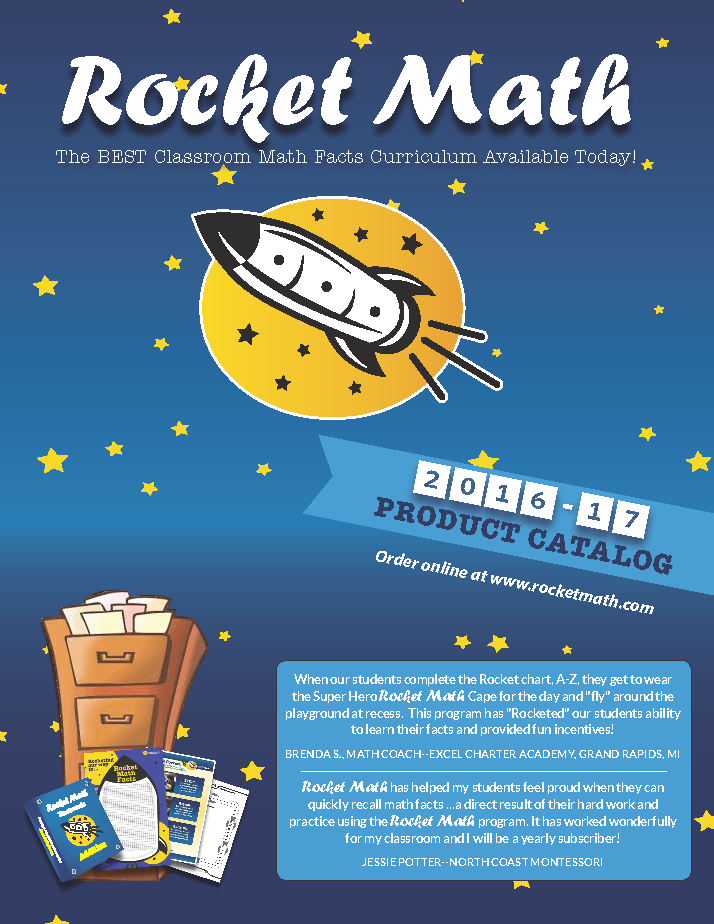
Catalog for Rocket Math 2016-17 now available
The 2016-17 Rocket Math catalog is now available. Request one be mailed to you free-of-charge at this link. We have simplified our subscription pricing, so that you can order on-line and get the bulk discount for any number of subscriptions. Any number over ten will get you the Basic Subscription for $10 instead of $29, and the Universal Subscription for $30 instead of $49. But the main reason to get the catalog is to see the cool supplemental stuff we have available from Rocket Math.
Race for the Stars games will liven up facts practice in your room. You can get these individually, you can get a Game Center to set up in your room, or you can get a Tournament crate that several classrooms can share. 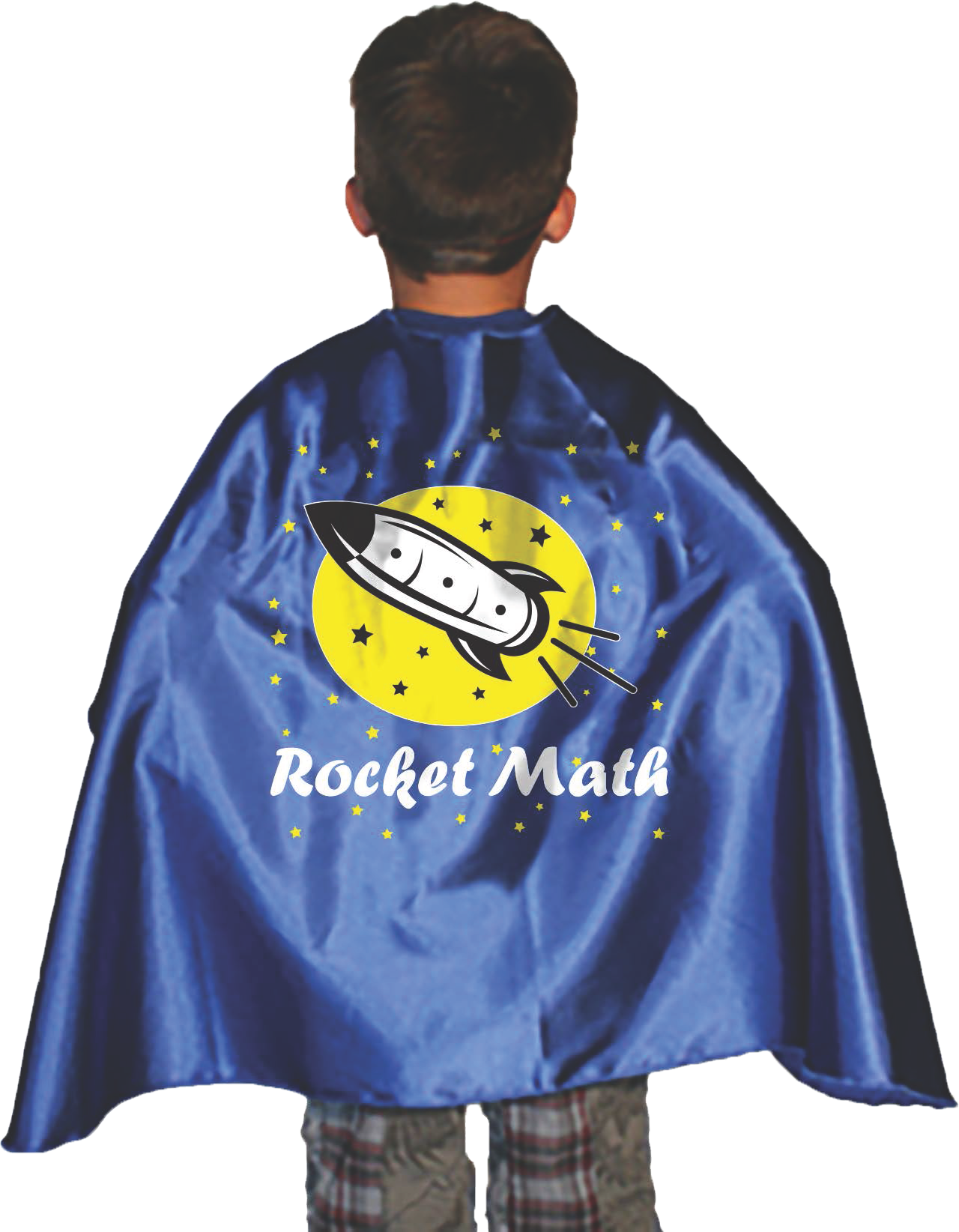
Supplements to aid with motivation are available with achievement awards, success stickers, reward pencils and even the shiny and alluring Super Hero Rocket Math cape (pictured here).
There are also a training DVD, as well as crates for organizing and charts for your walls. Get your free catalog today and start planning for your next gift-receiving holiday!
How to avoid unhealthy competition: Using the Wall Chart.
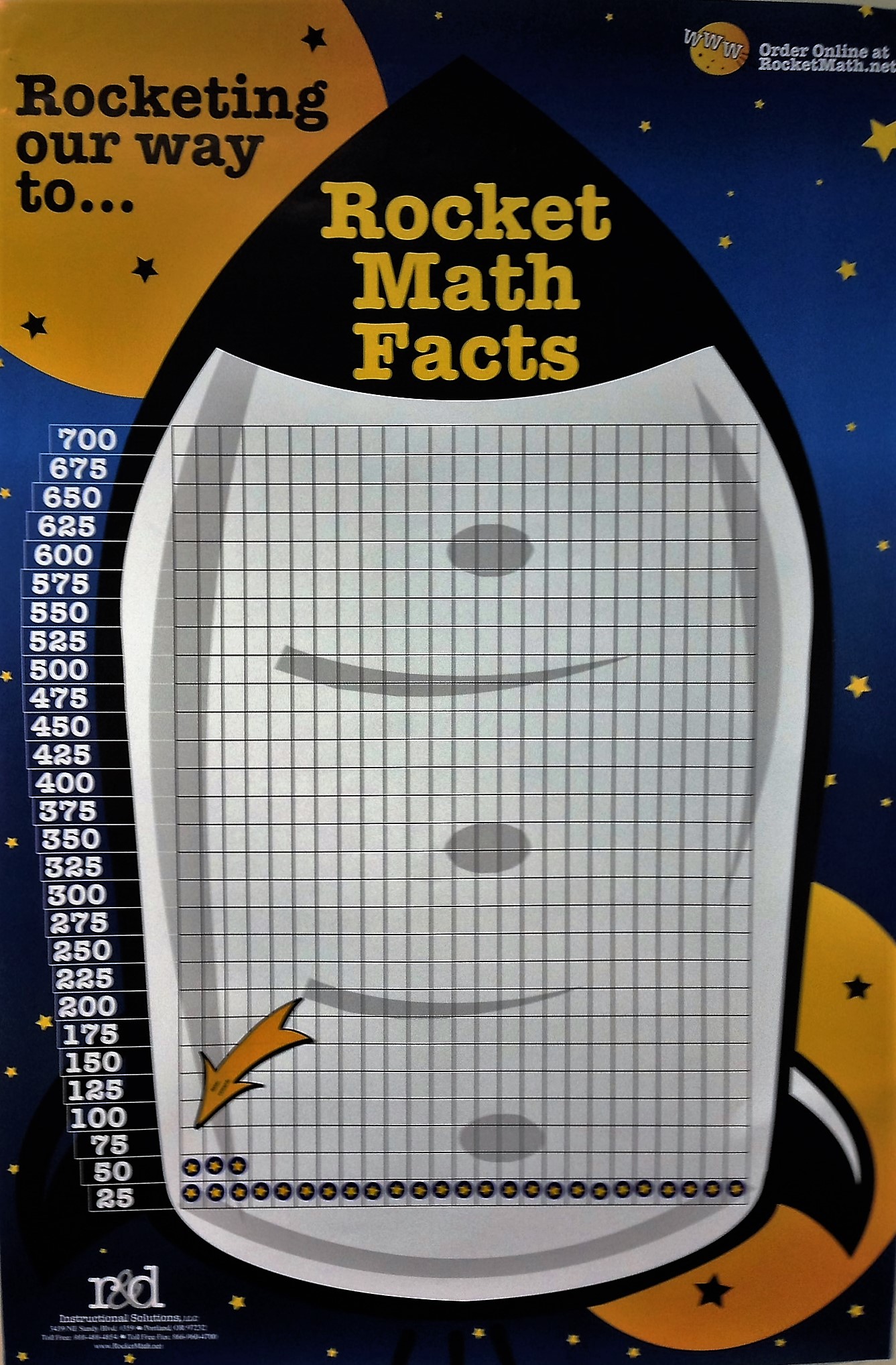
When students begin to pass levels in Rocket Math, and color in the Rocket Chart in their folders, they naturally are proud of their accomplishments. Invariably when I go into classrooms students want to tell me what level they are “on.” Left unchecked this can sometimes grow into unhealthy competition where some students begin to feel really bad about their slower progress, and students in the lead act arrogantly or disrespectfully. The Rocket Math Wall Chart is designed to curb that competition, by putting all the students on the same team.
 The Wall Chart comes with over 700 star stickers. Each time a student passes a level the teacher awards them with a star sticker, which they take up to the Wall Chart and put into one of the squares in the chart. Students fill the chart from the bottom up. The teacher sets a goal in a few weeks, which date is marked on the goal arrow, and the goal arrow is placed a couple of rows up from where the students are now. (You can just see that in the picture above.) If the students fill in the squares up to the arrow–before the date specified on the arrow–they earn a group reward such as extra recess time, or a popcorn party, etc.
 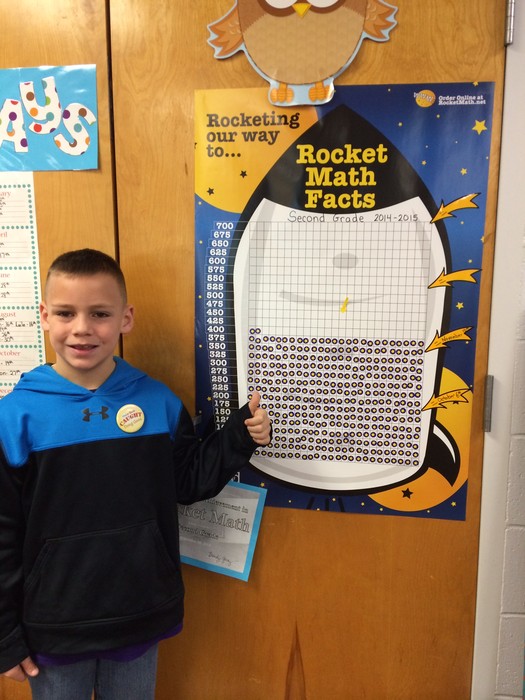 In this way, each time a student passes a level they are putting up a score for the whole team. It is good for everyone. The teacher is able to praise the class for their hard work and accomplishments, and the whole class is able to feel good about their collective effort.
Passers-by as well as interested administrators can praise the class as a whole for their successes with Rocket Math. The Rocket Math Wall Chart becomes a focus of pride and recognition for the whole class. The normal price for the Wall Char (#2005) of $18 includes directions, plenty of star stickers, four goal arrows, and the chart itself. They are cheaper by the dozen, $135 for all twelve.