
Facts practice: does it belong in middle school math?

It sure does, if you’re seeing this happen in your class!

Most middle school math teachers confide to me that their classrooms are negatively impacted by the number of students who stop to count out facts on their fingers.  Their issue was always what to do during facts practice with the other students who do know their facts.  It has taken a couple of years but I have put together a package of pre-algebra skills that are worth middle school students’ time practicing which are available in the Universal Subscription. Because the routine of Rocket Math is the same whether the students are practicing basic multiplication facts or learning equivalent fractions you’ll be able to manage all these different levels during the same ten-minute session.

Teachers know it is imperative that finger-counting middle schoolers get practice learning their facts.  Rocket Math is an excellent way to do that.  They will develop fluency and automaticity with the basic facts in an operation in a semester and from then on your lessons will be much easier.  Not only that, but a much higher proportion of the students will be finishing assignments.  There is a “Placement Probe” that can identify students who know their facts in about one minute. The students who know the basic facts of multiplication and division can be placed into the pre-algebra practice programs.
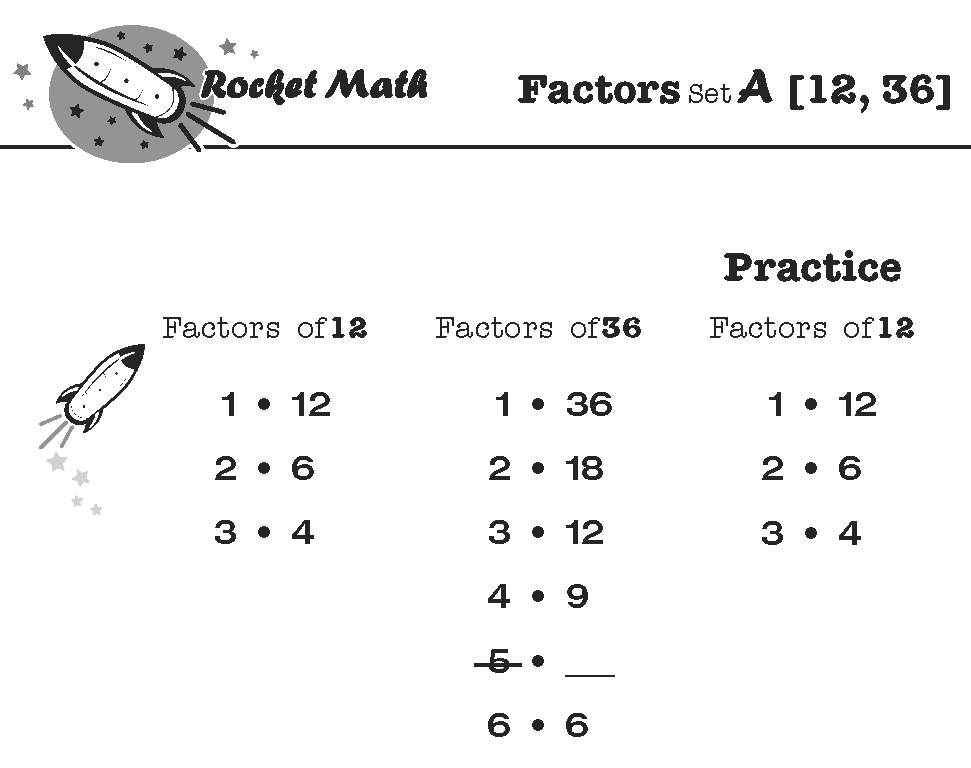
Factors Answers AFACTORS. Students probably ought to begin with the Factors program. What are the factors of 24? Answer: 1 and 24, 2 and 12, 3 and 8, 4 and 6. This is what students learn by memory from doing this program. Students practice with a partner, take a daily one minute timing, fill in a Rocket Chart, just like regular Rocket Math. Students learn all the factors for these numbers in this sequence: 12, 36, 24, 48, 18, 32, 16, 64, 10, 40, 20, 72, 8, 25, 50, 6, 21, 30, 60, 15, 45, and 100.
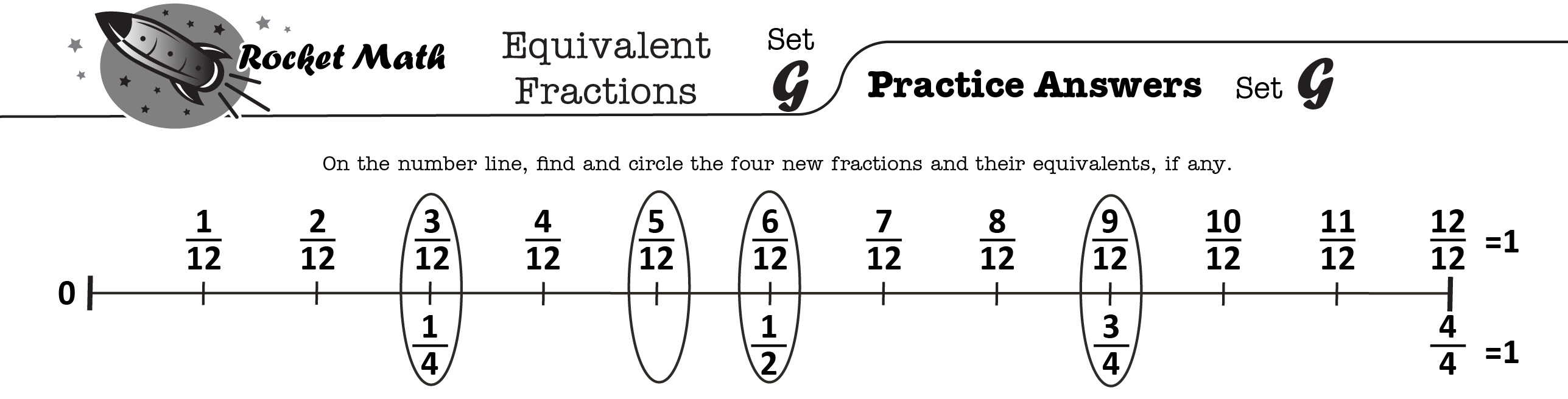


Fraction Number Line GEQUIVALENT FRACTIONS.  Students need to know that six-eighths is equivalent to three-fourths and that four-twelfths is equivalent to one-third.  While they can calculate these, it is very helpful to know the most common equivalent fractions by memory.  One of the most common problems students have in fractions is not “reducing their answers to simplest form.”  Equivalent fractions will help students commit 100 common equivalent fractions to memory.  Each set (A through Z) has four fractions which are displayed on a fraction number line.  Students frequently learn fractions equivalent to one,such as ten-tenths, as well as fractions that can’t be reduced, for example three-fourths is equivalent to three-fourths.  Using the fraction number line will help with student understanding of why those fractions are equivalent.

Integers ArrowsINTEGERS (Adding and subtracting positive and negative numbers).  Integers displays problems on a vertical number line and then teaches students two rules about how to solve problems that add or subtract positive and negative numbers.

Rule 1: Go up when you add a positive number OR subtract a negative number.
Rule 2: Go down when you subtract a positive number OR add a negative number.

Students gradually learn several variations of all four types of problems.  They practice with the number line on each page and then have a chance to build fluency on the top half of the page as they work with their partner.  You will probably not be surprised that there is a one-minute test on each set.  The goals are slightly different than before.  Students are to be 100% accurate and to complete at least 80% of their rate at answering simple addition and subtraction problems.

10s, 11s, 12s Multiplication and 10s, 11s, 12s Division facts are also available in the Universal Subscription.  If you have students who think they know the basic facts, but need review, putting them into either of these programs will review the 1s through 9s facts, teach them new ones and allow them to save face.

Among these five programs there are good things for ALL middle school math students to learn, even the more advanced students.  This will enable a math teacher to devote ten minutes a day to fact practice without holding anyone back.  Everyone will have something meaningful to practice during that time.  I think this could be a huge step forward for a lot of middle school MATH classrooms.

 

Will finger counting ever go away?

Some “experts” in education think that teaching and practicing rote information, like math facts, is unnecessary.  Just let students do math or do games and they will learn facts well enough to get by.  That is true for a few students, but many students continue to count on their fingers up into junior high and high school if we don’t help them commit these facts to memory!  So the short answer to the question of whether finger counting will ever go away, is “No!” unless we do something.

One of the things that is unique about Rocket Math is that students begin to learn facts well enough so they have instant recall.  By practicing orally with a peer, they are saying the facts and the answers aloud, and from memory, over and over again.  By doing that, students come to the point that, when they say that problem to themselves, the answer pops into their heads without effort, like the words to an advertising jingle.  When the answer occurs to them instantly, they realize they know the answer before they can count on their fingers, and they stop.  This is how finger counting goes away.  Students recall the answer before they have to start counting fingers.  The end of finger counting comes with the kind of daily oral practice that the procedures of Rocket Math provide.

Open letter to parents: Rocket Math HOME Apps

Dear Parents,

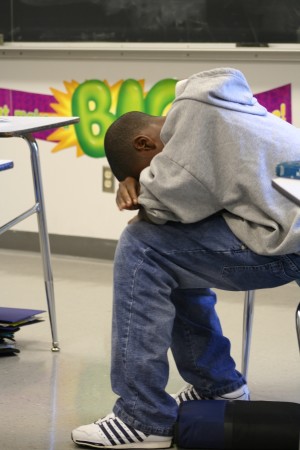
I designed the Rocket Math Apps to help children LEARN math facts such as 9 + 7 or 6 x 9.  Most apps have students randomly practice math facts, but aren’t much help in learning the facts in the first place!  The Rocket Math App is different because your child will be successful from the start and will gradually learn all the facts in each operation—without noticing!  They will play the app, but as they progress through the Levels A to Z they will LEARN all of the facts in sequence. Children will learn them well enough so that they don’t have to count on their fingers or stop to figure out the answer.  They will know the facts automatically so they can get on with the rest of learning math.  Take it from a long-time educator, they will begin to enjoy math once they stop struggling with figuring out facts, like this young man is doing.

HOME Versions Try it risk free! I don’t expect you to take my word for this.  If you download Rocket Math Addition HOME or Rocket Math Multiplication HOME you won’t have to pay up front.  Your child can try out the app and pass levels up through Level K for free.  At that point your child has already mastered at least 36 basic facts.  They are learning and probably enjoying it too!  Then if your child wants to continue playing Rocket Math, we ask that you purchase the app for $2.99 through an in-app purchase.  See the two icons to the left.  Please look for these free versions of the Rocket Math apps with the word HOME in their name and on their icon.


Why do we have two apps?
  I designed the Rocket Math Apps so that children couldn’t skip around and avoid the “hard” facts they need to learn.  The App follows the same careful sequence in the paper-and-pencil version that has worked in schools have for over 15 years.  Once a child starts on Addition, they have to follow the sequence through addition Level Z and into subtraction.  The app can keep track of up to three children as they work through the levels.  We have two apps because you may have another child who needs to work on Multiplication and Division.  Now you can download Rocket Math Multiplication HOME for that other child and your children can each proceed through their own sequence and take turns working on the same device.

Why do children have to take a 30-minute “battery recharge?”  So they continue to keep playing and learning the facts until they finish Level Z and know all the facts.  Through field testing of the Rocket Math Apps before publishing it, we found that children would keep playing for TOO LONG and wore themselves out.  (Learning is hard mental work!)  Children who played too long stopped playing the app and stopped learning!  Now that they can only play for five minutes at a time, they are happy to open the app after the break and do another five minutes of learning.   Take it from an education professor, learning that is spaced out like this, through short practice sessions over many days or weeks is THE BEST WAY TO LEARN.

Thanks!  And here’s to solving the problem of counting on your fingers to do math!

Sincerely, Dr. Don

PS.  Here’s a link to download a copy of this letter to share with parents.

Why do multiplication facts have priority after 3rd grade?

Because older students CANNOT succeed in math without multiplication facts.

Am I sure? Yes, I’m sure. “But,” you say, “my students are still counting addition and subtraction on their fingers.”

I know. And I am still sure—fourth grade and up—multiplication. Why? Once children are in fourth grade it is critical that teachers make sure they memorize multiplication facts—primarily because you can’t be sure of how much help they will get later to learn the math facts. Sadly, your students may only learn one operation to fluency. If so, multiplication facts have priority over addition and subtraction. Besides complex multiplication and division, the multiplication facts are needed for success in fractions and ratios. Students have to immediately see the relationships between numbers in order to understand topics like equivalent fractions, reducing fractions, combining unlike fractions, as well as ratios. Let’s be honest here…those are the things that state tests LOVE to ask about. Not to mention, these are the pre-algebra skills students need to be successful in algebra and the rest of math.

If you have the students for long enough (at least one year) you may find that they finish and have mastered both multiplication and division facts. Then you can go back and have them learn addition and subtraction facts as well.

Don’t get me wrong — I know that addition and subtraction facts are VERY IMPORTANT — it’s just that multiplication is MORE IMPORTANT.

Summer School? Use Rocket Math!

Hi Dr. Don,
We plan on using Rocket Math with our Summer School students in grades 3rd-8th. I know you recommend Multiplication for these students. We will only have these students for 12 days over the course of 3 weeks. Any thoughts on how you would implement it? Your opinion is greatly appreciated.
Yvonne K. Colland ELD – Instructional Technology Coach

Thank you, Yvonne,
Twelve days is VERY short, however students enjoy Rocket Math, if they don’t have to do it too long at one time. I would recommend three ten-minute sessions each day spread out as much as possible. So one at the start of the day, one in the middle and one just before going home. If there’s an hour or more between sessions students won’t mind. They can take it home and practice at home if they like.
The regular practice with a peer for 2-3 minutes, switch roles and take a test can be done in ten minutes.
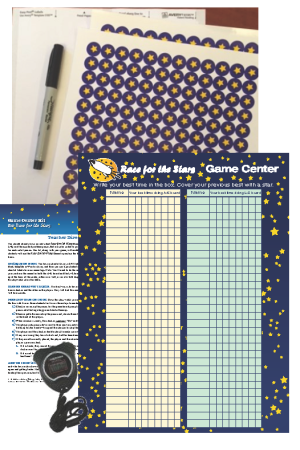
The next thing you could do is set up the Game Center with the Race for the Stars Multiplication game set out. The Game Center has a poster for students names and they get to post their best time on each board of Race for the Stars. Students can put the 24 problems cards on race-for-the-stars-product-imagery-multiplicationeach board down next to the answers as fast as they can with a partner timing them on the included (Silent!) stopwatch. When they beat their best time on the board they get to post the new time and put a star sticker over their previous time. That would stimulate a lot of practice. Right now we have a coupon code FreeGameWithCtr that gives you the Race for the Stars game free with the purchase of item #2112 Game Center with stopwatch ($49).

Finally, if your school has iPads, or if you can have students bring in iPads or iPhones, there is the Rocket Math Multiplication App that sells for $2.99 (half that if you purchase through the Apple Education VPP).  Students can practice on that app for five minutes at a time and each device cRocket Math iOS Multiplication App Top Rated by Balefirean support up to three students.  Students love to play that game and you can print out Rocket Charts for them to keep track of their progress.  If they can take it home they’ll be sure to practice more there.

I’m not certain you could get all the students through Level Z in the three weeks you have, but you could make a big dent in it.  Most importantly they would know as many facts as they could learn which would put them ahead in learning the rest.

Do students practice sums to 12 or 18?

Julie asks:
For addition and subtraction, do students practice with sums through 12’s or 18’s? For example, 12+ 6. Thanks.

Dr. Don answers:
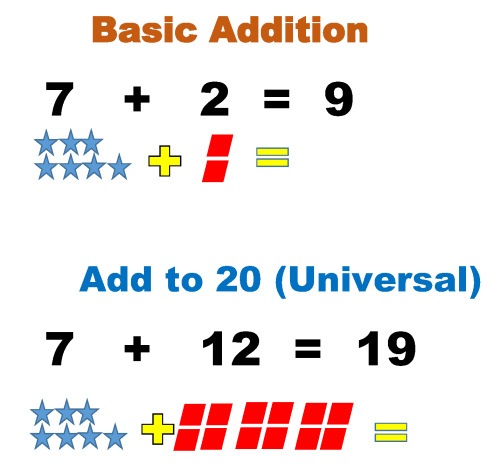
Hi Julie!  The Rocket Math basic program (and basic subscription) is 1s through 9s both for addition and subtraction–meaning students practice single digit sums up to 9+9 and subtracting single digit numbers up to 18-9. The Rocket Math Universal subscription provides access to the Add to 20 program which includes 7 + 12 and the Subtract from 20 program which includes 19-7. The Add to 20 and Subtract from 20 programs were added because the Common Core recommends students be fluent at adding and subtracting these numbers mentally without manipulatives.

As the picture above suggests if a student knows 7+2 is 9, it doesn’t take much to learn that 7+12 is 19. However, the Add to 20 program will give students practice with those facts. Especially for students who master the 1s through 9s facts quickly, these additional programs will cement in the basic facts learning by extending them to some teen number addends. Conversely, for students who struggle with learning the 1s though 9s facts, these extra facts should be considered optional or enrichment, in my opinion.

So I recommend first graders learn the 1s-9s addition first followed by the Add to 20. Then in second grade the 1s though 9s subtraction followed by Subtract from 20. Not everyone will get through both, but kids will see the connections doing the higher problems if they have completed 1s through 9s first. They won’t need to practice to Z before they see the patterns and can do the problems without much practice. I am happy to provide this extra option for those who can take advantage of it.

Are you ready for summer?

Preparing now can insure that students will maintain their Rocket Math learning over the summer.

(1) The simplest and most important thing you can do to get ready for summer is to save those Rocket Math folders at the end of the year. The folders can then be given to the next year’s teacher, so he or she knows where the student left off. Given special practice techniques at the start of fall (outlined below), students do NOT have to go back or start an operation all over again the next year. Some students take months to get where they are in an operation, and it is a terrible waste of their time to start them over. Especially if they have new faster writing speed goals, now they really have to work hard to master each set and it may take them quite a while.

(2) Make sure to take a few days to re-teach your students how to correct and when to correct (errors and hesitations).  Teach this by modeling errors and hesitations and have students be your checker and model how to correct for the other students to see.  Keep working with that student until you get perfect corrections even on hesitations.  Then “rinse and repeat” with another student.  Do this teaching and modeling for ten minutes each day for the first week or so.

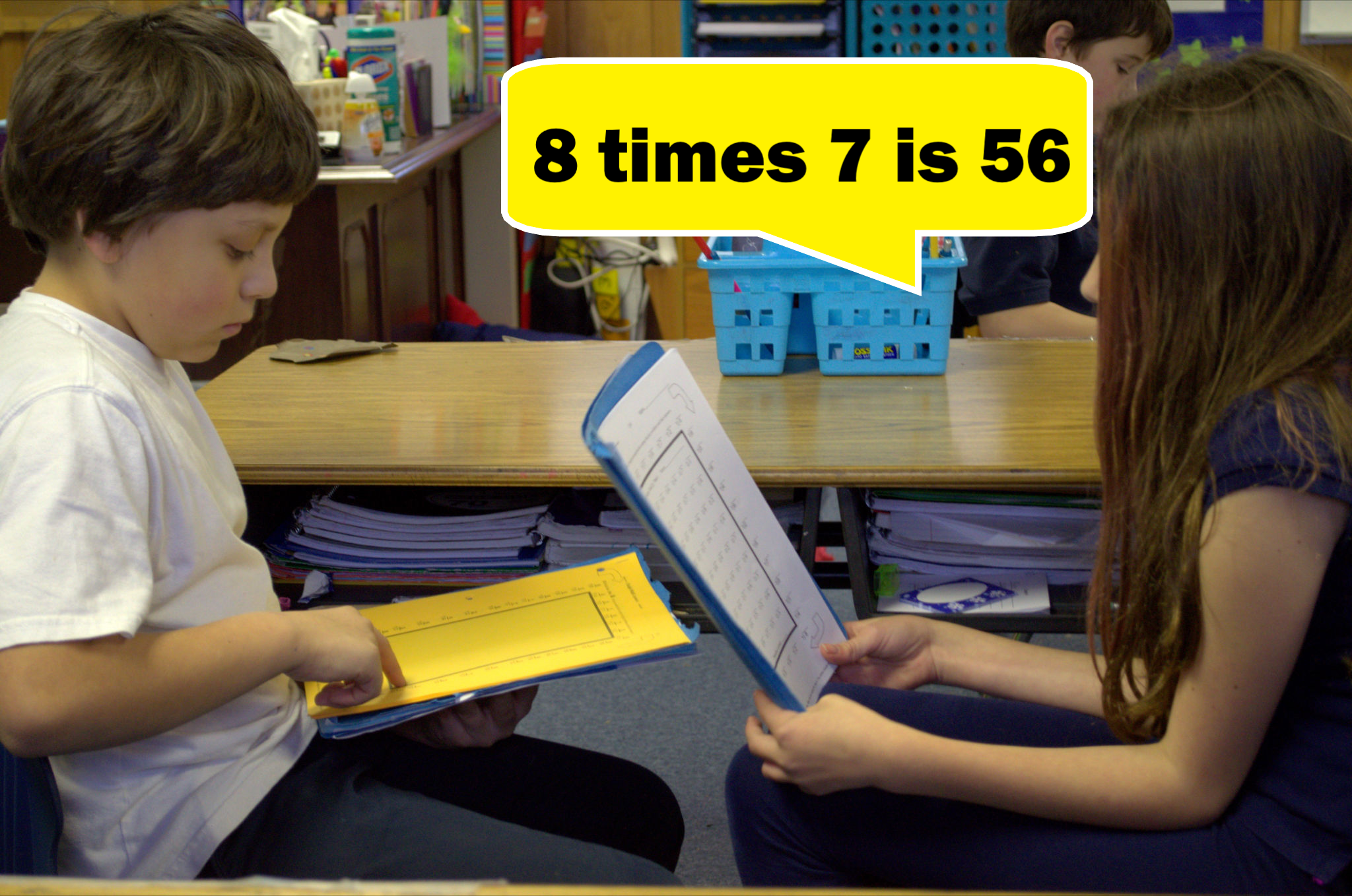
Two students participating in one of Rocket Math's math fluency programs(3) Start students practicing on the last set completed (passed) the previous year but for the first five practice sessions, practice on that set in a special way. First practice in partners around the outside for two or three minutes. But then, instead of taking a written test, have students practice in pairs orally with the test (inside the box), for two minutes. Practice the same way as around the outside. Have the student read each problem aloud and answer it from memory. The checker will need to have the test answer key. Practice for two to three minutes and then switch roles. This practice will provide the necessary review of all the facts learned so far, and will bring them right back up to speed.

(4) After a week of oral practice sessions with the test, then allow students to take the written test. Evaluate students based on their writing speed goals from last year (don’t re-test and raise them). Arrange for extra oral practice on the test for anyone who doesn’t pass. In the extra practice, make sure they orally practice the test in the center as well. Keep up the extra practice, on that same set until they pass. They should get there in a few days. They already learned this, they are just bringing it back. They haven’t forgotten it, the connection just needs a little strengthening.

(5) If students finished an operation before leaving, you can start them on the next operation appropriate for their grade. Second graders who have finished addition, for example, would start with subtraction (1s – 9s), and then go on to Subtract from 20, then Skip Counting.  Third graders need to be taught the concept of multiplication first, but then should begin multiplication, regardless of what they completed earlier.  Multiplication is so critical for future success in math you cannot let any child in your room (if you are in 3rd grade or above) leave it without learning those multiplication facts.  Best thing you can do for their math careers.

Now that you know what to do–enjoy the summer!

Challenge your students with the Race for the Stars Game Center!

race-for-the-stars-product-imagery-subtraction
How can you entice your students to play the Race for the Stars game in a center?

By letting them post their record/best time for completing the game boards. Race for the Stars is a great game for students to practice their math facts. The game provides 24 problems tiles students can race to put down next to the answers in the game board as fast as they can. There is now a Game Center Kit that give you everything you need to set up a center in your room that students will want to visit. The key is the poster with room for student labels with their names. Then next to their name is a place for them to write their best time at filling the game board. Well, actually their partner with the stop watch should probably write down their time. All the students in the class can rotate through the Game Center to record how fast they can fill either or both of the two game boards. One, for levels A-K are the first facts to be learned in Rocket Math. The second game board, L-Z are the facts learned in the last half of the Rocket Math levels.

But how can you motivate your students to play the game again and again to get the practice they need?

Here is the coolest part of the Race for the Stars Game Center. Students can go back and get someone to time them filling the Race for the Stars gameboard again. If the timer with the stopwatch sees that the student beat their previous best, they get to record the new record time, AND cover the old time up with a star sticker. Getting to put up a star sticker next to your name proves you were able to beat your own previous best–that is impressive! In fact, the savvy teacher will make a daily stop to see who in the class has been able to add a star sticker to the poster next to their name, showing that they beat their previous best time.

And that is how you motivate students to use the Race for the Stars Game Center (item #2112) to practice their math facts in their spare time!

Can you avoid summer losses with Rocket Math?

Take up where they left off before the summer!

Don’t think students have to start over in Rocket Math. They have learned the facts so well that with careful review they can take up where they left off!

There is a way to start off the year on the same set on which students left off at the end of last school year (providing you know where that was). You do need to do a slightly different procedure at the start of the year, however.

Notice on the Set L sheet above that only five of the facts on the One-Minute Test are new–the rest are review from the previous sets. That means that practice around the outside will help with the new facts, but won’t review those older facts from previous set. If you test the students on any set after the summer they might not pass because they need a little review of those older facts.

Here’s the way to beat the summer forgetting:
For the first week of school have the students add another practice session with the One-Minute Test each day. Give them the test answer keys, give them 2 to 3 minutes with their partner to orally practice the test problems with the same correction procedure as usual. Hint: have them take the sheets home and practice with a responsible sibling or a parent as well. A week to ten days of this extra review of the test problems and they will be successfully passing levels in Rocket Math–starting right from where they left off in June!

Five interventions for frustrated students

Erica writes:
My son currently is in second grade and uses Rocket Math in his school. He has been doing addition and is on Level “S”. Most of his class has moved onto subtraction and multiplication.
My concern with him is where does this leave him next year in 3rd grade?? Is he left behind? He knows the addition facts orally but fails to meet his goal on the 1minute drills due to his anxiety and frustration with being timed. He struggles to move forward even though he knows his addition facts!
With this scenario, how does Rocket Math help? How will he ever move on to learn subtraction and multiplication? He’s a smart kid but can’t seem to succeed with this method!
Please help me to see otherwise!

Dr. Don answers:
Erica, I can see why you are frustrated. Students should not take more than three to five days to pass a level in Rocket Math and no more than a year to pass an operation such as addition. The rule is: If you child is frustrated by Rocket Math–it isn’t being done right! The school should not be complacent and should not leave your son to fall way behind his classmates. If a student takes longer than six days to pass a level I recommend that the school or the teacher should intervene. Interventions should happen in a matter of days, rather than allowing students to stall for weeks or months. You are writing in response to my post, so you know you can read the directions, even get the program and work with your son at home to help him. What interventions should be tried with your son?

1. My first intervention would be to practice Level S test (inside the box) orally with your son in the evenings once or twice. If he has been on Level S for a long time, there are facts on the test that need review–through oral practice. Use the same correction procedure we recommend everywhere: if he makes any hesitation, give the correct problem and answer, have your son repeat it three times, then back up three problems and go again. A couple of days of that and he should pass handily at school.

2. If that didn’t help your son pass in two days, my second intervention would be to watch your son take a written test and see what is going on, see if there is evidence of frustration, or anxiety, or if there are behaviors during testing that are interfering with good test results. If you want to send me video of your son taking the test at home, I could probably tell what is the issue that is holding him back. There may be some test-taking behaviors he can learn, such as not stopping during the test, or not erasing sloppy answers, which would improve his test results.

3. The third intervention I would do is give the Level S test orally. There are a number of reasons a student might not be passing and I have blogged and have video clips on YouTube that address what to do with students who are “stuck.” You write that you know that he “knows his facts.” Probably because when you ask him a fact, he can answer it immediately, without having to stop and figure it out. If that is true he should be able to verbally tell you the answer (not read the problem, just say the answer) to 40 facts in a minute at Level S. You could test him at home to find out if he does know the facts at Level S. If he can orally answer 40 facts on the Level S test, he knows the facts well enough and should have passed. If he is not passing the written test even though he can verbally say the answer to 40 facts in a minute, then his writing goal is off for some reason. Another piece of data that would suggest his writing goal is off, is if he has been stalled at some rate of problems and hasn’t improved his rate for a week. That suggests that that number of facts (whatever it is) is all he can actually do, and his writing goals need to be revised down to the number he can write when taking a one-minute written test (assuming he is on a level on which he can verbally answer 40 problems in a minute). In a couple of places in the directions (FAQs), I explain that, so you can share with the teacher.

4. What if, as you suggest, he is freezing up during the written test due to “anxiety and frustration with being timed?” The best way to overcome anxiety is to keep doing the thing that makes you anxious, which is why most students stop being anxious about Rocket Math after a couple of weeks. A fourth intervention would be to practice taking the test in writing–but untimed. If he completed all the items on the test several times at home, untimed, he would stop being so anxious about doing it under timed conditions. Most students also understand why they are being timed (to see if they know the facts without hesitation). He will not get unduly frustrated if you explain to him this is just a race and if he doesn’t give up he will keep getting better until he wins. Of course, if his writing goal is too high and he can’t possibly meet the goal, he will become frustrated.

5. If your son cannot already orally say the answers to 40 problems on the Level S test in one minute, he needs some more practice. My fifth intervention would to practice with your son–be his partner. He may not have a conscientious partner at school and may not be getting the most out of his 2 minute practice time. I routinely find that when I practice with students (the right way with correcting hesitations as well as errors) even once, they suddenly pass or come very close. The quality of the practice is critical to learning to answer these facts without hesitation. If practice allows students to stop and figure out the fact every time they will take a very long time to get to knowing those facts instantly. If that is the case, if you practice orally with your son once or twice an evening at home, the right way, he will begin to pass every few days at school. He will finish addition this school year.

In third grade I recommend that all students start multiplication at the same time even if they have not “finished” subtraction. Multiplication facts are far more important, so subtraction facts can wait. If you closely follow your son’s progress in learning multiplication facts with Rocket Math, you can intervene in time to make sure he does not get frustrated or fall behind. It should take him three to five days to pass a level, but no longer than that. With some extra practice at home you can be sure he will be successful. Knowing basic facts instantly will be very important for him, so don’t give up!