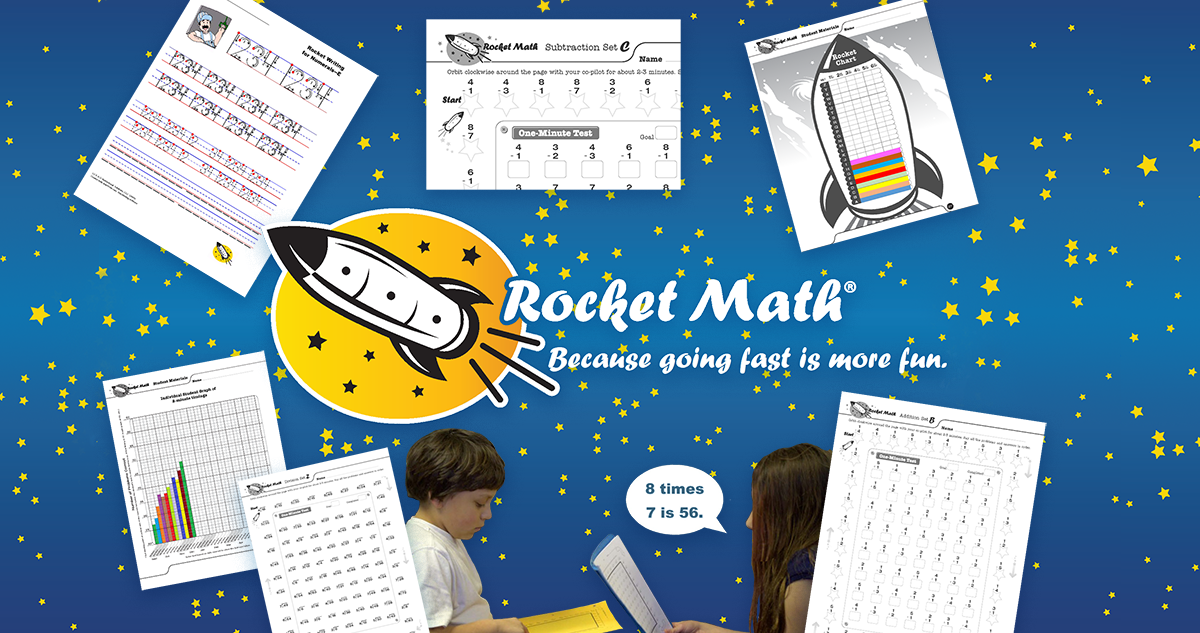

Are your students wary of working with integers?

Many students find integers confusing.  If you add a negative to a negative are you getting more or less??? Over the years different “rules” have been used to try to remember what should happen.  Rules such as “two negatives make a plus” or “opposite signs subtract.”  Whatever is used to try to remember, it interferes with a student’s ability to quickly and reliably get the answers without having to stop and puzzle it out.
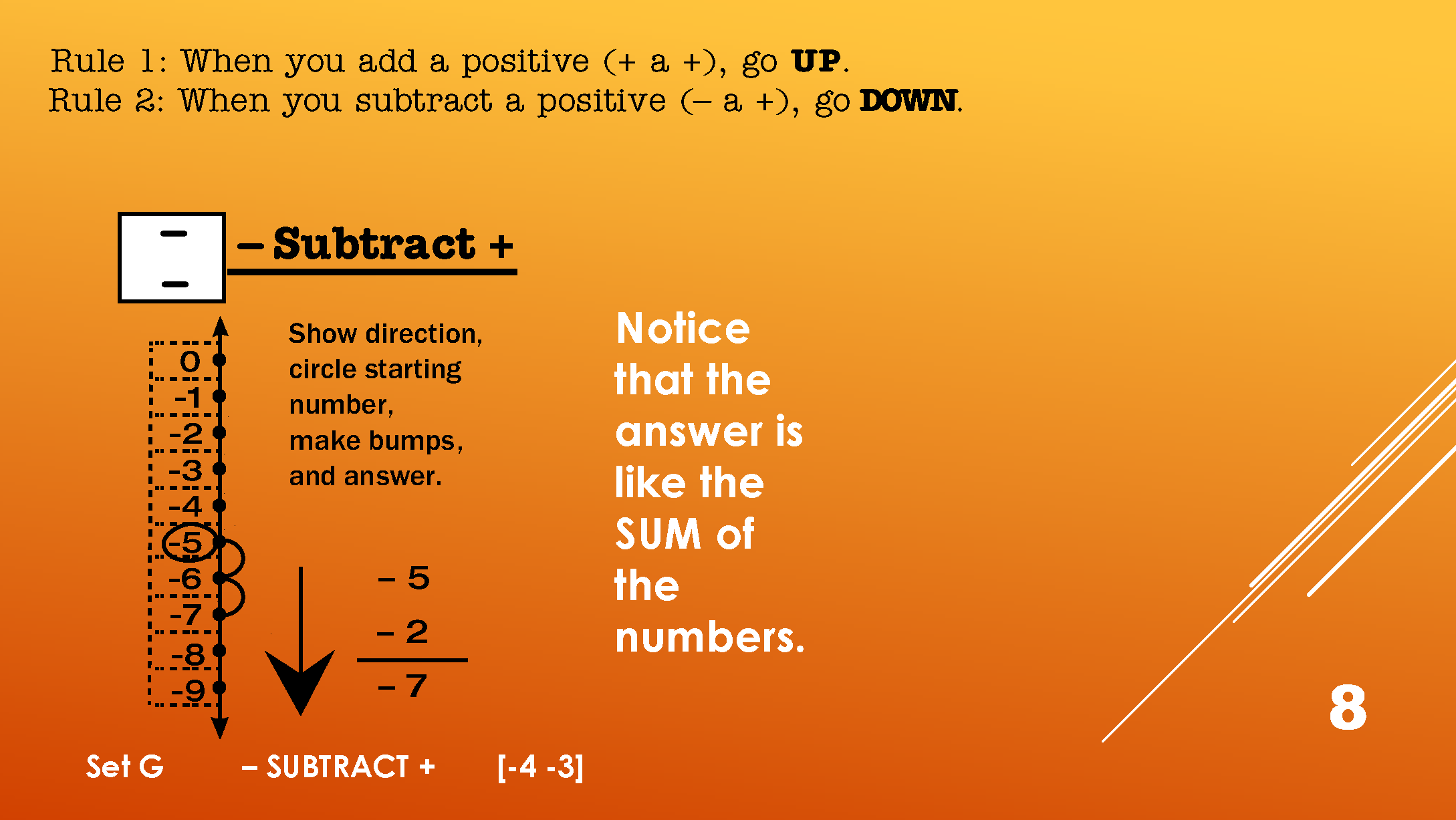
I have posted a series of free lessons online (links below) that use a vertical number line to take some of the confusion out of the process.  Turns out there are a total of eight types of problems but all of them can be solved with the same process on the vertical number line.  Intuitively on a vertical number line, up is more and down is less.

(1) Mixed Integers Set A1 Positive add a positive

(2) Mixed Integers Set A2 Positive subtract a positive

(3) Mixed Integers Set D Negative add a positive

(4) Mixed Integers Set G Negative subtract a positive

(5) Mixed Integers Set J Negative subtract a negative

(6) Mixed Integers Set M Positive subtract a negative

(7) Mixed Integers Set P Positive add a negative

(8) Mixed Integers Set S Negative add a negative

Using the vertical number line there are two rules to learn.  Rule 1: When you add a positive or subtract a negative you go up on the number line.  Rule 2: When you subtract a positive or add a negative you go down on the number line.

So first thing to figure out is whether you’re going up or down.  Once you do that you simply make “bumps” going either up or down from where you start.  That gives you the answer without any uncertainty.  These lessons are quick (about 2 minutes) and identify a pattern of whether the answer is like the sum or the difference between the numbers.  Once students can recognize the pattern they can begin to answer fluently and without a struggle.
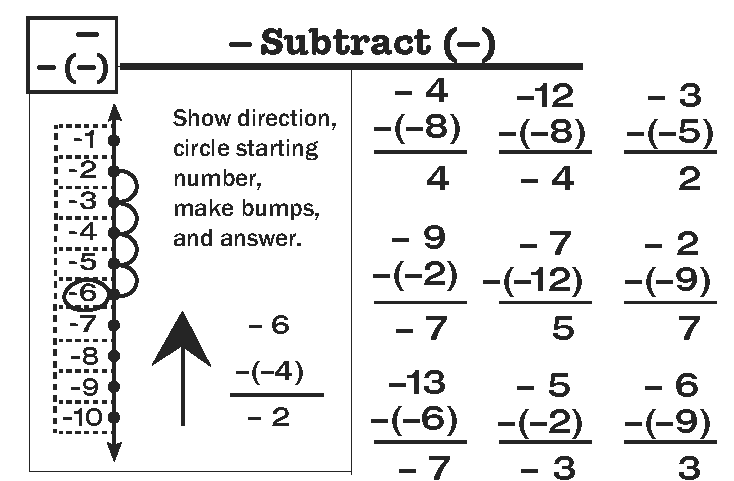
To help with the work of learning to quickly and easily recognize each pattern in Integers Rocket Math now includes a “Mixed Integers” program in our Universal Subscription.  (Click here to get a 60-day trial subscription for $13 –rather than the standard $49 a year.) Students use the vertical number line to work a problem. In this example: -6 minus (-4).  Then they have a set of problems with the same pattern they can orally answer without having to use the number line.

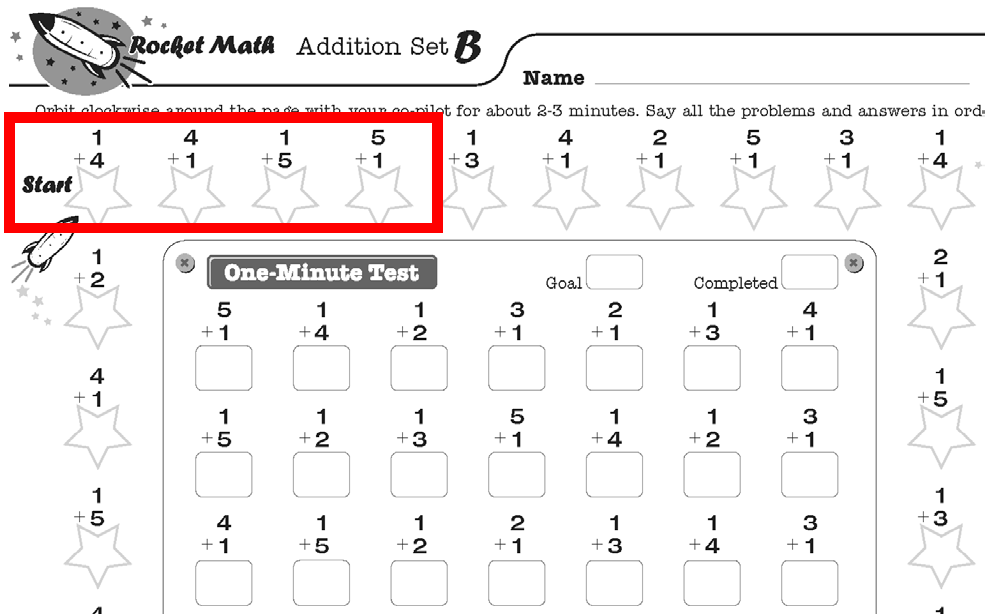
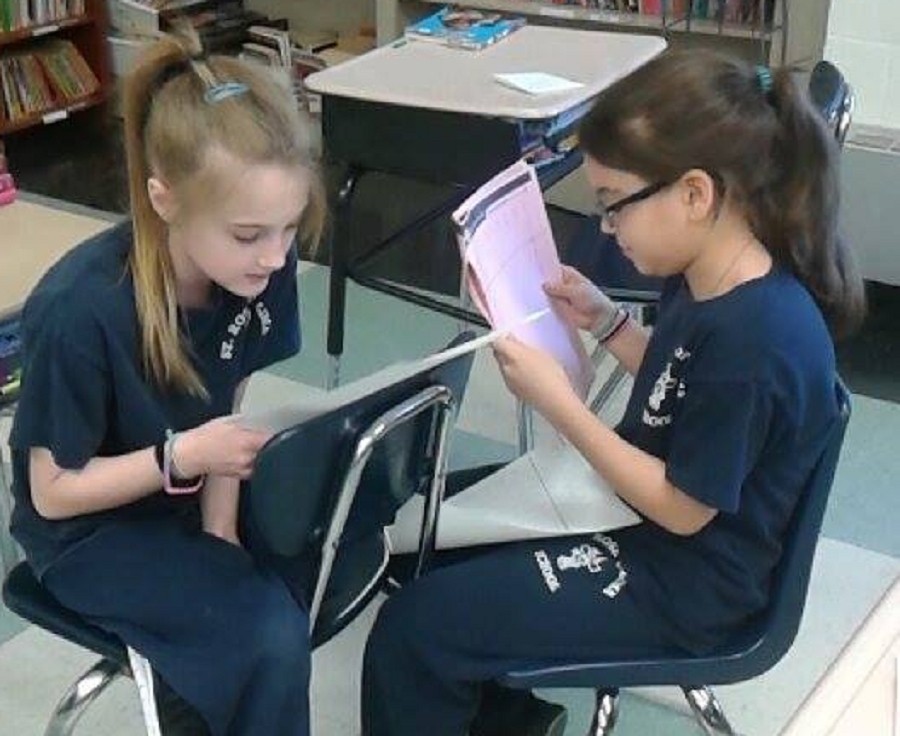
As with all Rocket Math programs there is a 3 minute practice session, with a partner.  Then the two switch roles.  Then the practice is followed by a one-minute test.  If the student can answer the problems without hesitations the level is passed.  If it is still difficult the student stays with that level a bit longer.  When a new pattern is introduced the tests will have a whole row of problems that are the same pattern. When that level is passed the next test will have two types of problems in each row.  The next level has 3 types, then 4 types in each row.  Then the problem types are mixed.  This way the student develops fluency in recognizing the type of problem and how to derive the answer quickly.

Rocket Math has a money-back satisfaction guarantee.  If you try this and find it isn’t everything you hoped, in terms of helping your students become fluent with integers, I’ll gladly refund your money.  I’m betting they’re going to love it.

 

Four star rating for Rocket Math Apps

Rocket Math App received 4 Stars!

App Names: Rocket Math Add at Home, Add at School, Multiply at Home, and Multiply at School

Developer’s name: Rocket Math, LLC

App Link :

https://itunes.apple.com/us/app/rocket-math-multiply-at-home/id1048024368?mt=8

Primary School Apps (5-7 Years)

Educational App Store Review

Rocket Math is an offshoot of an existing programme for schools designed to increase children’s speed and fluency in answering simple arithmetic. This app encourages frequent short sessions and is supported by plenty of information explaining its purpose and methods.

The purpose of Rocket Math is to build what its developer terms “automaticity” in arithmetic. A fluent reader does not need to decode simple and frequently encountered words letter by letter. The same can be true for frequently encountered arithmetic.

When automaticity is achieved in arithmetic the answers are available in an instant. The advantages of this, beyond speed, are that it leaves more of the person’s mental processes available for other aspects of the problem. If a person does not have to think about achieving simple arithmetic answers, he or she can concentrate on the more complex and lengthier aspects of a problem.

Rocket Math the app follows on from a well-established programme of the same name based on traditional written resources. Repeat practice and a steady increase in the breadth of the covered arithmetic are at the heart of its methods.

Children are taken through a series of stages in which they are faced with a rapid succession of arithmetic questions. Remember, the purpose of this app is to build fluency in frequently encountered arithmetic problems, not complex ones. As such, the questions will be simple ones and, at first, until the breadth expands, there will be little variation in them. Only three seconds is allowed per question so, for some children, developing enough fluency to progress will be difficult but others will thrive on the challenge.

Answers are given by typing them onto a built-in number pad. The app is simple to use and looks attractive. Its space-travel styling and theme add a game-like feel although it is not a game. Speech provides a response to incorrect answers and provides encouragement between levels. It all works very well and provides the exact type of practice that it promises.

An unusual but useful feature is that the app enforces its little-and-often recommendations by insisting on a thirty-minute break after 5 minutes of play. As multiple sessions are likely to yield better results than a single, marathon session, this is an excellent feature that will prevent children from relying on a last-minute catch-up rather than a steady engagement with the app. This, combined with a useful breakdown of each child’s performance in the student report screen, provides reassurance to adults that their children are making the best possible use of the app.

A family of apps is available and potential buyers should think about which they need. Two of the apps cover addition and subtraction and two cover multiplication and division. Your choice here is obviously dependent on what aspect you would like to cover.

The remaining choice is between a school and a home version. They are identical in functionality except that the home version is free to download with a lengthy trial period. The school version has a flat, one-off, fee. Prospective teachers would still be wise to download the home version first so that they can appraise the app’s suitability.

If they choose to utilise the app within their school then buying the school version will be a simpler process than the in-app purchase of the home version. It will also allow schools to utilise the volume purchasing programme whereby they can receive a discount for buying twenty or more of the same app.

Parents will be pleased to see that the app caters for up to three children. As each child engages with the app, parents can check to see how they are performing and offer help, encouragement or rewards as they see fit.   Some useful background information on the app’s purposes and usage are provided within the app itself and a more comprehensive overview of the Rocket Math ethos is available on the developer’s website.

All of the Rocket Math apps provide a learning opportunity that is tightly focused on realising their goal of improving children’s arithmetic fluency. As such, if this is a goal that you also share, you will find them good value and useful apps.

Why should you renew your Rocket Math subscription?

Reason #1 to renew.

So I can be here for you.  Your subscription enables me (Dr. Don) to be available to work full-time on Rocket Math.  I can be here to answer your questions, help you with your implementation, provide customer service and to continue to expand our offerings.  Every day I correspond with and often get to talk with customers who have questions and need help. In the past year, I’ve added programs such as Add to 20, Subtract from 20, Fact Families, Skip Counting and others to the Universal Subscription. (Check out the list on this link.) I am quite excited about the three new programs (Learning Addition ComputationLearning Subtraction Computation, and Learning Multiplication Computation) that I’ve recently added to the Universal subscription.  (Check ’em out using the links.) Additionally, I have added tools such as the classroom wide aimlines in Excel to keep track of the progress of your whole class.  Most exciting of all, I have a team developing a browser-based Rocket Math game that students will be able to use at home and at school with one log-in. Your subscriptions make all of that possible.  Thank you.

Reason #2 to renew. 

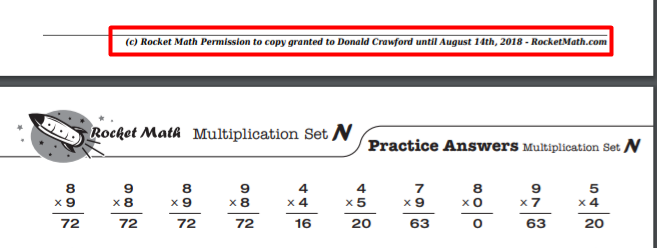
You get permission to copy.  The second reason to renew is that the subscription gives you “permission to copy” the materials for a limited time.  After the subscription expires, permission to copy the materials also expires (it is no longer granted).  As you can see, the footers on our materials now show your name and the expiration date.  In order to continue printing and copying the Rocket Math worksheets, I ask that you please renew your subscription.

Reason #3 to renew.

You can access our filing cabinet.  The third reason to renew is so that you continue to have access to the Rocket Math filing cabinet on the web.  New and updated materials are constantly being added to the filing cabinet. The materials now number in the thousands of pages!
 You can much more easily print from the website filing cabinet, than you can from a paper master copy.  You can print from home and even print from your phone.  When anyone finds an error in one of the thousands of worksheets, I can change it the same day in this virtual filing cabinet.  When anyone asks for a new form I can share it with everyone instantly.

“Knowing” means never having to figure it out

Most people, for example, know their name, by memory.

In a previous blog I discussed  What does CCSS mean by “know from memory?”    

A reader asked the following question:

This topic of “know from memory” is something I have been digging into as a special educator. I wonder what your thoughts are about whether certain accommodations from these “know from memory” standards would actually be modifying the curriculum?

For example, if we used “extra time to respond” and the student had to use their fingers or some other method to count, would they then not be doing the standard?

This relates to where I’m at in middle school math, but I think that it’s reflected in the continuum of the common core maths.

Thanks.

Dr. Don’s response: 

Actually, your example is very clear that it is not “knowing from memory.” You are describing “deriving from a strategy” or what I call, “figuring it out.” When you know it from memory, when you recall the answer, then you stop having to “figure it out.”

Knowing from memory and figuring something out are two very different things. I used to ask workshop participants to imagine sitting next to me in a bar and asking me for my name. What if, instead of saying, “Hi, my name is Don,” something different happened?  What if, like the man pictured above, I was puzzled and said, “Wait a second, I have it here on my driver’s license.” Most people would likely turn their attention elsewhere while wondering what kind of traumatic brain injury I had sustained! They would very likely say to themselves, “OMG, that man doesn’t know his own name.”

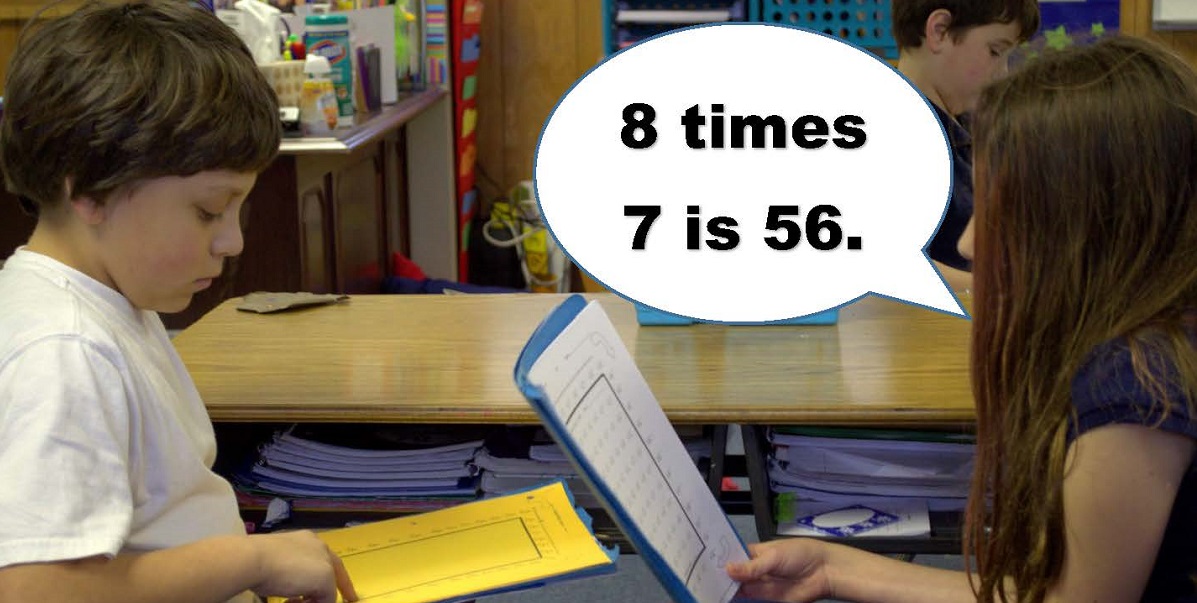
The purpose of the verbal rehearsal that is a daily part of Rocket Math is to cement these basic facts in memory. Then when a student says to themselves, “8 times 7 is,” the answer pops into their mind with no effort. It takes quite a bit of practice to achieve that. However, the ability to instantly recall the answers to basic math facts makes doing mathematical computation a relative breeze. It make seeing relationships among numbers very obvious. It makes reducing fractions and finding common denominators easy. That’s why the Common Core thinks “knowing from memory” is so worthwhile. It’s why I began promoting Rocket Math in the first place.

Do you know the active ingredient in Rocket Math?

Timed tests are not the important part of Rocket Math.

The “active ingredient” in the Rocket Math prescription, the thing that makes it work, is not timed tests.  Timed tests don’t actually teach and often don’t really help students develop fluency.  The usual timed tests of a random selection of all the facts can assess fluency in math–but they don’t work to develop it!

The “active ingredient,” the thing that makes Rocket Math effective, is verbal rehearsal.  When students practice with their partner the students read the facts and RECALL the answers from memory and say them aloud.  That verbal rehearsal is what cements them into memory.  Reading the fact and recalling the answer from memory strengthens the neural connection.

Why do we give the daily tests in Rocket Math?  Not to teach, but only to assess whether the facts introduced thus far have been learned well enough for the student to have new facts added to what they are learning.  Individual students learn at different rates.  Some students need only a couple of days of practice to memorize two new facts while others may need several days.  The purpose of the daily tests is just to see if the student needs more practice time, or is ready to “swallow” some more facts.

As I note in my basic training presentation, “It’s like feeding mush to a baby.  You have to make sure they have swallowed the last mouthful before you give them more.”   See an explanation in this You Tube video in our Rocket Math channel: https://youtu.be/J8cWSDG0Di8

Keeping track of progress in Rocket Math

Which students are progressing as fast as they should be in Rocket Math?

And how fast should they be progressing, anyway?

Over the years of helping teachers and schools implement Rocket Math I have learned that a complete laissez-faire attitude about student progress can mean that some students get stuck for weeks on the same sheet.  Needless to say, students who get stuck, come to hate Rocket Math.  When this happens, those students don’t get through all the operations they should learn.  So we need to intervene, and give them more help.  It turns out that some students need more practice, sometimes two or three times more practice, to learn the facts than their peers.  To get such students through one operation a year means they have to have extra practice sessions scheduled in each day.  Here’s a link to a blog about how to provide extra help.

But which students need extra practice sessions?   Under Resources/Educator Resources I’ve created two versions of a tool that can help.

Whole Class Excel Rocket Math (2 operations in a year) Aimline.  This is pictured to the right.  It is needed for 2nd grade and 4th grade and up when students need to finish one operation and do a second one in a year.  The expectations needed to pass two operations in one year are basically that students should pass two sets each week.  If they have studied some the year before, they will be able to pass sets in the first operation at a quick pace.  For example if they have done much of Rocket Math Addition in first grade, in second grade they should be able to pass those addition sets again in a day or two.  That will put them ahead of the expectations and they should have a plus by their name most of the year.  Conversely, if they are not able to pass sets quickly, (see the students highlighted in yellow) they will get a minus by their name and should start getting extra sessions scheduled daily.

How does the Excel Aimline work?

Please note: The pictured EXAMPLE Rocket Math Excel Aimline is available from the link or in the Resources/Educator Resources page for you to download. 

Take the blank template and save it for next year.  Then fill out one for this year.  Look at a calendar and on row 4 enter the month and on row 5 enter the starting day of each week in the school year.  so each column numbered 1 through 36 will correspond to a week in your school year.  In row 7 you see the green expected set to be passed by the end of that week.  At the end of week 1 we expect that students will have at least passed Set A.   By the end of week 2 they should have passed Set C to be on pace to finish two operations in a year.

Entering student names.  Starting in row 10 you enter the student names in column B.  This class only has ten students, but I’m guessing yours probably has more!   Cool thing about excel is you only have to enter those names once.  And if you’re really good you can freeze that column so you can easily see it later in the year.

Entering weekly information.  Each week grab all the student folders and for each student enter the highest set they have passed.  You can see that from the Rocket Chart on the outside of the folder, so you don’t even have to open the folders.  If the letter they have passed is equal or higher than the green set expected at the top of the column for that week, then put a plus by the letter they have passed.

Look at Alvin Ailey at the top of my class list.  Week 1 he had passed both Set A and B, so I wrote “B” in his square.  I put a plus because it is exceeds the expected level for the first week.  By the second week he had also passed Sets C and D.  Only up to “C” is expected,  so I wrote “D” and also gave him a plus.  Alvin is rocking it!

Look at Cindy Crawford a little further down the class list.  Week 1 she had passed Set A, so I wrote an “A” in her she got a plus because she met the expectation.  But by week 2 she had only passed Set B, when C is expected to be passed, so I wrote “B” in her square, with a minus indicating she is below expectation.  Now I highlighted her square yellow, but that’s kind of advanced so you don’t really have to do that.  Only Excel experts can do that, although it really makes it easy to pick out who needs help.  We can see that Cindy continues to make slow progress and continues to get minuses.  She needs to have extra practice sessions scheduled to finish two operations this year.  That pace is fine for one operation per year, but not two.

Look down at Gary Grummond.  He didn’t pass even Set A by the end of the first week so I wrote “np” in the first square.  He continues to make progress the next few weeks, but not fast enough to complete two operations in a year.

Row 8 Fraction of students meeting expectation.    After entering all the students for the week you can see how you are doing overall in your class.  Make a fraction with the numerator being the number of students who are meeting the expectation over the denominator of the number of students in the class.  You want a high fraction nearer to 1.

If that fraction falls below 70%, meaning more than 30% of your class is not on track, then you should institute a class-wide intervention.  Either add an extra practice session each day, or see if there is room to improve the quality of practice.  See these blogs and posts about how to monitor for the quality of practice.

Whole Class Excel Rocket Math (1 operatipon per year) Aimline.   In grades 1 and 3 where students are expected only to complete one operation in a year, you can use this Excel Aimline.  The expectations needed to pass one operations in a year are basically that students should pass one set each week.   Everything else about how you use the excel form is the same.  Note that if you want students to do two operations in the year (for example both subtraction and multiplication in 3rd grade) then you would use the two operation aimline.


Looking for free math worksheets?

Do you want your students to learn OR are you just keeping them busy?

It’s OK if you need busywork.  

It’s critical to keep some of your students occupied in order for you to have the peace and quiet you need to teach other students.  Those free math worksheets of random facts are fine for busywork, provided students already know the facts.

Get a 60 day trial for only $13

Sign Up Now!

BUT

(and this is a big but) if you want students to actually learn facts, you need math worksheets that are more systematic than the usual fact practice worksheets.  A random mix of problems (on those free math worksheets) is fine for practicing what you already know, but it is USELESS for learning new facts.

Students who don’t know their facts are left painfully counting on their fingers to do their “work.” This just wastes their time and makes them come to HATE math.

I know, because I made my students do it for years. 🙁

 I discovered that with systematic practice students can actually learn math facts!

In order to learn new facts students must concentrate on a few they don’t know and practice those particular facts until they know them “by memory” without having to figure them out.  After students have learned those they can then tackle a few more.  That’s the only way to learn a bunch of facts.  That’s what Rocket Math does. Watch this video to see it in action.

 Rocket Math worksheets are not free, but they will actually teach. rocket math worksheets

Each sheet (A-Z) adds two new facts and their reverses, making the process of learning them painless.  By the time students have worked their way through the A-Z worksheets of an operation they know the facts “by heart” or as the Common Core calls it “by memory.”

If LEARNING is your goal, you’ll need something more effective than the free math worksheets.


Rocket Math has a MONEY-BACK guarantee.

If you spend the $13 to get a trial subscription and you decide Rocket Math doesn’t work or you don’t want to use the program, we’ll gladly refund your money.


Plus

Students have more fun and learn better when they are practicing orally, with a partner so they can get corrections and extra teaching on any facts they don’t know well.  That is part of how Rocket Math works.  So it won’t just be busywork.  Your students will actually learn the facts and be proud of it.


5 easy ways to get help running Rocket Math.

Here are 5 ways to get help with the procedures for successful Rocket Math implementation.

1.) Use the ***NEW*** search function.  At the upper left of the blue navigation bar is an icon of a magnifying glass.  Click on that and a search bar opens in the middle of the page.  Click within the search bar and you can type in whatever you are looking for.  It will bring up blogs, parts of the directions, basically anything I’ve written on the subject–which is a lot.  You can get pretty specific very fast, so try this first.  I’m very excited to have added this feature this week, which is why it is top of my list!

2)  FAQs.  Look at the Rocket Math FAQs page.  Click on the linked words to the left, or navigate to it.  The FAQs page is the third Rocket Math Filing cabinet on the webitem under ABOUT in navigation.  The FAQs page displays all of the questions from the teacher directions, and my answers, so you can scroll down to the topic you need quickly.   However, all the FAQs will show up in the search function as well.

2.5) The FAQs are also available in the Rocket Math filing cabinet.  They are in the top drawer, the “Forms and Information” drawer of the filing cabinet.  There are titles of the FAQs so you can open and print any one you wish.  Good for sharing with other staff.

3) Rocket Math YouTube channel. You can go to the Rocket Math YouTube channel.  Click on the linked words to the left, or search for Rocket Math in You Tube.  If you scroll down the page you can click on “View Full Playlist” and then you’ll be able to see all the topics that are available.  Right now there are 37 videos, but that could change if we add some more.

4) DVD training.  Order the Workshop Training DVD (#2004) for $29  This is the whole training from Dr. Don filmed and broken into chapters.  It is over 3 hours and gives a lot of rationale for the procedures we recommend.  Very helpful if Rocket Math is new for your staff.  Really important to do things as recommended.  Having coached this in many schools for many years, I can promise you it will go better if you follow the directions!

5) Contact Dr. Don.  Really.  You can call me (800) 488-4854 during west coast school hours and I’ll probably be able to answer the phone directly.  It’s a joy for me to talk about implementing Rocket Math with teachers, so don’t be shy.  But if you don’t reach me, please send an email to don@rocketmath.com rather than leave your phone number because during the school day teachers are very hard to reach.  I’d rather just write an answer in an email so we don’t miss each other.  And if it is a new question I’ll probably turn my answer into a blog that can be found through the search function.

How long should I allocate for Rocket Math daily?

Jessica asks:

As I am planning my daily schedule I am looking for how long I should set aside for Rocket Math each day.  What do you suggest?

Dr. Don answers: 

If you allocate 15 minutes a day for Rocket Math that will be enough.  You might have trouble meeting finishing that quickly in the beginning before the routine is established.  But once the routine is set there is no need to take more time than that–each partner of the pair is practicing for 2 to 3 minutes and the test takes only one minute.  Don’t try to have everyone correct their partners papers as that will take too long.  Making sure that students practice every day with their partner is critical to success, so anything that makes you feel “we don’t have time for Rocket Math today” is harmful to student learning.

The other key is to be sure to teach students how to practice with each other.  If you can train your students to correct hesitations you will accomplish a lot with your Rocket Math practicing time.  Please take a look at my video on “How to teach students how to practice.”   Take the time allocated to Rocket Math for the first several days of school and follow this teaching procedure.  It will pay off for you all year long in improved learning during Rocket Math time.

Learning Addition Computation quickly and easily

Rocket Math adds something new: Addition—Learning Computation

After becoming fluent with addition facts the best way for students to retain the knowledge of those facts is by doing addition computation. Rocket Math has added a new program to the Universal Subscription that teaches addition computation.  If students have not been taught addition computation, this program breaks it down into small, easy-to-learn steps that are numbered in a teaching sequence that leaves nothing to chance.  There is an placement assessment that can be given to figure out where the student should begin in the sequence.

Note that the number for each skill gives the grade level as well as indicating the teaching sequence.  Skill 2a is a 2nd grade skill and after skill 2f is learned the next in the sequence is skill 3a.  The sequence of skills is drawn from M. Stein, D. Kinder, J. Silbert, and D. W. Carnine, (2006) Designing Effective Mathematics Instruction: A Direct Instruction Approach (4th Edition) Pearson Education: Columbus, OH.

(1b) Adding 1-, or 2-digit numbers; no renaming

(2a) Adding three single-digit numbers

(2b-c) Adding 3-digit numbers; no renaming

(2c) Adding 3-digits to 1 or more digits; no renaming

(2d) Adding three 1- or 2-digit numbers; no renaming

(2e) Adding two 2-digit numbers, renaming 1s to 10s

(2f) Adding 3-digit numbers, renaming 1s to 10s

(3a) Adding a 1-digit number to a teen number, under 20

(3b) Adding two 2- or 3-digit numbers; renaming 10s to 100s

(3c) Adding 3-digit numbers; renaming twice

(3d) Adding three 2-digit numbers; renaming sums under 20

(3e) Adding four multi-digit numbers; renaming, sums under 20

(4a) Adding a 1-digit number to a teen number, over 20

(4b) Adding three 2-digit numbers, sums over 20

(4c) Adding four or five multi-digit numbers, sums over 20

For each skill there is a suggested Teaching Script giving the teacher/tutor/parent consistent (across all the skills we use the same explanation) language of instruction on how to do the skill.  The script helps walk the student through the computation process.  For the teacher, in addition to the script, there are answer keys for the five worksheets provided for each skill.

Each worksheet is composed of two parts.  The top has examples of the skill being learned that can be worked by following the script.  After working through those examples with the teacher the student is then asked to work some review problems of addition problems that are already known.  The student is asked to do as many as possible in 3 minutes—a kind of sprint.  If all is well the student should be able to do all the problems or nearly all of them, but finishing is not required.  Three minutes of review is sufficient for one day.

There are five worksheets for each skill.  Gradually as the student learns the skill the teacher/tutor/parent can provide progressively less help and the student should be able to do the problems without any guidance by the end of the five worksheets.  There are suggestions for how to give less help in the teaching scripts.  Thumbnail previews can be found here.