
Should second graders begin multiplication facts?

Jen writes:
Hi Don,
I am a 2nd grader teacher and LOVE the Rocket Math program. Currently my students are on the addition and subtractions tests. I have had a handful of students pass addition and subtraction, but instead of moving them on to multiplication, I started them on an addition challenge (much higher goals). Not sure if that was a good idea, I just didn’t feel they were ready for multiplication. Do you suggest that 2nd graders do Rocket Math multiplication? Thank you for any help!

Dr. Don answers:
Hi Jennifer,

We have a couple of new options. You can use the Add to 20 program for your second graders who have passed all the subtraction worksheets. That will reinforce the single digit facts but also extend to the Common Core expectations that students would be fluent with combinations like 11+7 and 13+4. The worksheets of the Add to 20 program are part of the Universal subscription. I plan to get Subtract from 20 done soon, and I will also add that to the Universal subscription. So if you want to address those Common Core objectives, those two programs are things you can assign to 2nd graders who finish basic 1s-9s subtraction.

We also have another program, Skip Counting, that is part of the Universal subscription. That teaches students the count-by series, such as counting by 4s (4, 8, 12, 16, 20, 24, etc) to 40, and 9s to 90. The skill of skip counting is a great transition to multiplication because students are essentially learning successive addition when they are skip counting. So Skip Counting would be a great program for second graders after subtraction, especially good for helping them get ready for multiplication.

As far as when to start multiplication, it depends on your students’ concept development. Before beginning to memorize multiplication it is important that students understand the process of multiplication and what it means. If they have done skip counting, successive addition and/or drawn arrays then they probably understand multiplication. Ultimately the best test is whether, given unlimited time, but no help, those students can figure out any single digit multiplication fact, such as 7 x 9. [Don’t ask an easy one like 3 x 4, as they might have learned that by heart already.] If they can figure out any multiplication fact successfully, then they understand the concept. If they cannot figure it out, then they need more conceptual work before starting to memorize multiplication. So the answer about whether second graders are ready for multiplication facts is not necessarily the same for all students.

Why not start with subtraction in 3rd grade?

Julie asks:

Hi Don, My staff has a question about which operation to start with. In our district, we have data that shows students are struggling with subtraction. We really want to put emphasis on getting the subtraction facts memorized. What are your thoughts about 3rd grade starting with subtraction in the beginning of the year and switching to multiplication the second half of the year regardless of having completed Z in subtraction? Thanks!

Dr. Don answers:

Dear Julie,
Your teachers are right that a lot of students may not be fluent with subtraction facts. There are several reasons for that. And yes, it would be possible to start with subtraction in 3rd grade and then switch to multiplication as students finish, or by mid-year at the latest. But I would not recommend it because you will then have a problem with not every child getting through multiplication in 3rd grade, which results in a similar problem in fourth grade. What would be better would be to get every second grader fluent in subtraction facts before 3rd grade.

Why? It is important to understand the problem before specifying the solution. Students have trouble learning subtraction facts primarily because they have not achieved automaticity in addition facts first. And why aren’t they automatic in addition facts? Usually because they didn’t start early enough and work on addition facts long enough in first grade to get to automaticity with addition facts.

A second reason students don’t master subtraction during grade 2, happens when the school doesn’t keep track of folders from first grade. If students have to start completely over with addition in second grade, they don’t have enough time (if they are a child who needs a bunch more time to learn facts) to get through both addition and subtraction. They go slowly through addition again, and don’t get into subtraction until well after the middle of the second grade. So the first push is to try to get everyone passing subtraction in 2nd grade.

What you don’t want to do is start over again in subtraction in third grade and struggle through that all year and then not have enough time to master multiplication in third grade. Because multiplication facts are so important, it would be better to do the reverse. Start with multiplication in third grade–because it has priority–and then for those who finish multiplication allow them to “go on” to subtraction. It is much better to start fourth grade strong in multiplication facts (even if you still count on your fingers for subtraction) than to be a fourth grader who is strong in subtraction, but unable to answer multiplication facts!

How do students correct in Skip Counting?

Principal Luebke writes:
Dr. Don,
We have some fast Rocket Math students at our school. We want them to keep working and improving all the time. I want some students to start the skip counting function. What is the correction procedure while practicing? Do the checkers say the next number is ___, start over? Thank you,

Dr. Don answers:

Great question! There should have been some special directions in the Skip Counting Drawer for teachers. I fixed that this morning. Here’s what I posted there.

How Students Should Practice SKIP COUNTING

Students should practice by saying the skip counting series in order from memory. They learn the harder series in parts, so they only have to say the part they are learning at that point. For example, in Set G students are to learn the first four numbers of the count by 9s which are 9, 18, 27, 36. When practicing in Set G, the checker says: “Count by 9s to 36.” [That’s exactly what it says on the little cloud at the base of the rocket, making it easy for the checker!] The student then says, “Nine, eighteen, twenty-seven, thirty-six.” Of course, in Set H the student says the 9s to 63, and then in Set I all the way to 81.
Saying series in the same order every time is very important as it creates the verbal chain. Eventually, after many repetitions, an amazing thing happens. Whenever the student starts to say the first part of the skip counting series the rest of the series will pop into mind unbidden. (I try to use the word “unbidden” at least once in everything I write – just because I can.) This automatic coming-to-mind is called “automaticity” and is the goal of practice.

The student should say the series in order without any hesitation. I really mean NO hesitation! Now I will say that a few different ways to prove that I am really serious. I want students to practice these series until they are as automatic as saying their name. If even a slight pause is needed to think of the answer, I want them to practice until it comes to mind without any effort at all. This will enable them (after these series are learned) to easily learn multiplication facts and go on to concentrate on the higher functions of math.

CORRECTION: Each time an error or hesitation is made, the helper/checker should follow the following correction procedure. It is really important to do this correction procedure. The correction procedure is part of that “secret important stuff” that makes Rocket Math work.
1. Helper states the whole series up to that number, for example: “Nine, eighteen, twenty-seven, thirty six.” (If the student has said the right answer but hesitated somewhere in the middle, the helper can confirm it by saying, “Yes, that was right, but you hesitated, so let’s practice that some more. Nine, eighteen, twenty-seven, thirty-six.”
2. After the helper says the series once, the helper and the student should say the series together twice. “Say it with me: Nine, eighteen, twenty-seven, thirty-six. And again, nine, eighteen, twenty-seven, thirty-six.” Then have the student repeat the skip counting series three times.
3. Go back and do the previous series [just one, not three!], which is enough so this series comes up again before the student forgets it. (Rinse and repeat as necessary.)

Note that this same correction procedure is to be used each time there is an error or hesitation. If the student hesitates again after they went back one series and started again, just repeat the correction procedure. Say it together twice, then three times without help, go back one series and start again. Repeat this practice until there is no hesitation. Extra practice on a series, to lock it into memory, is important work and should not be considered a bad sign. THAT is what we are doing here—LEARNING!!

How do you complete the Individual Student graph?

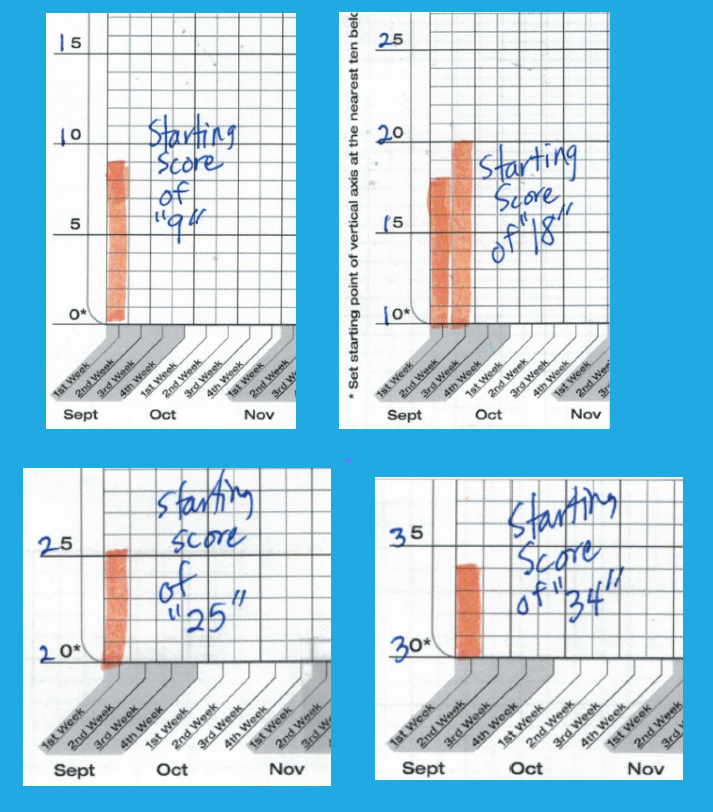
Here are four examples of how to complete the vertical axis on the Individual Student Graph.

Amy writes:
I have a question about the Individual Student graph form. Can you send me example of a completed graph? I understand marking 10 points lower but the 0…5…..0…5….0…5 axis confused me.

Dr. Don answers:

Amy,
Here are some examples of how you would fill out the vertical axis of the Individual Student Graph depending on what the student’s starting score was on the Two-Minute Timings. The form says, “Set starting point of vertical axis at the nearest ten below the student’s first 2-minute timing (e.g., if first timing is 37, begin graph at 30, etc.).”

If a picture is worth a thousand words, then these four examples should make the procedure clearer. Thanks for asking for examples–which is often the best way to explain/teach something!

If the starting score was 9, you would set the starting point of the vertical axis at zero.

If the starting score of the two-minute timing was 18, you would set the starting point of the vertical axis at ten.

If the starting score of the two-minute timing was 25 you would set the starting point of the vertical axis at twenty.

If the starting score of the two-minute timing was 34 you would set the starting point of the vertical axis at thirty.

How can I get my 1st graders to practice in pairs effectively?

Picture from a great blog Fun in First on blogspot

Ann asks:

Hello, Don.
I’m trying to get first grade teams on board with Rocket Math and would appreciate some tips for that grade level. I am very experienced with Rocket Math, but not sure how successful partner tracking is at grade 1.
Any tips?
Thanks so much.

Dr. Don answers:
Did you watch my YouTubevideo on how to teach your students how to practice?

You will need to model by being the student, and have a student model how to track, and how to correct errors and hesitations. Continue doing this in front of the whole class until the student does it perfectly and then enthusiastically praise that student for know how to be a “good checker.”
You need to choose other students and do that same modeling and practicing procedure. You’ll have to show them how to sit, how to hold the papers etc. Do this until every student can be a “good checker” and then practice some more.

You can then bring up pairs of students and have them model for the class how to sit, hold the papers, and practice and how to be a “good checker.” Praise them for showing everyone “how to be a good checker.” Then when you turn your class loose to actually practice in pairs you must circulate, listen carefully, praise and recognize being a “good checker.”

First graders can do paired practice and do it well. They just need more teaching.  Check-out the Fun-in-First blog above for more ideas on how to have first graders work in pairs.

Ann answers:
That was very helpful. Thank you. It’s exactly what we do to train fluency partners.

Don’t cause confusion: teach only one operation at a time.

Don’t switch back and forth between two Learning Tracks

Teachers often ask me if they can start Rocket Math and do both addition and subtraction at the same time–to help their students catch up quicker. Or they ask, can we do multiplication and division at the same time.  No, don’t do it! It will cause special kinds of confusion (called proactive and retroactive inhibition) as students try to memorize the relationships among the numbers.

Students learning only addition for example, are learning one number family 5*3=8 and 3*5=8. So 5 and 3, no matter which order you put them, they go with 8. That’s pretty easy, no way to get confused. But if students are learning subtraction facts at the same time they have a lot more to remember. On top of learning which numbers go together students have to learn which operation is going on. They also have to remember that 5*3 is sometimes 8, and sometimes 5*3 is 2. And 8*3 is sometimes 11 and sometimes 5 depending on which operation is going on. Switching back and forth from addition to subtraction adds a layer of confusion. It does not make it impossible, it just makes it harder because it is a little more confusing. If you teach only one operation at a time students will find it much easier and they will learn faster and be more successful. That is what we want after all, right?

Can you teach through Fact Families?

Yes, you can. If students learn facts in families (3+2=5, 2+3=5, 5-2=3, 5-3=2) they learn the three numbers as a family.  They know if they know any two of the numbers of that family, then they can recall the third number.  This is a good way to learn facts.  Many teachers prefer it, so we offer it as an option in Rocket Math.  The only research I have seen on this showed that learning operations separately, first all addition, then all subtraction, was a bit more efficient than learning through fact families.  But there may be a benefit from learning in fact families that makes the fact that it is slower worthwhile.  That’s an open question.  Would make a great master’s study–especially since Rocket Math has both fact families and single operations available.  We have it in the Worksheet Program and the Online Game, so it would be easy to compare and students could be randomly assigned to the condition.

How to get parents to help you

Dear-ParentsOne-Page

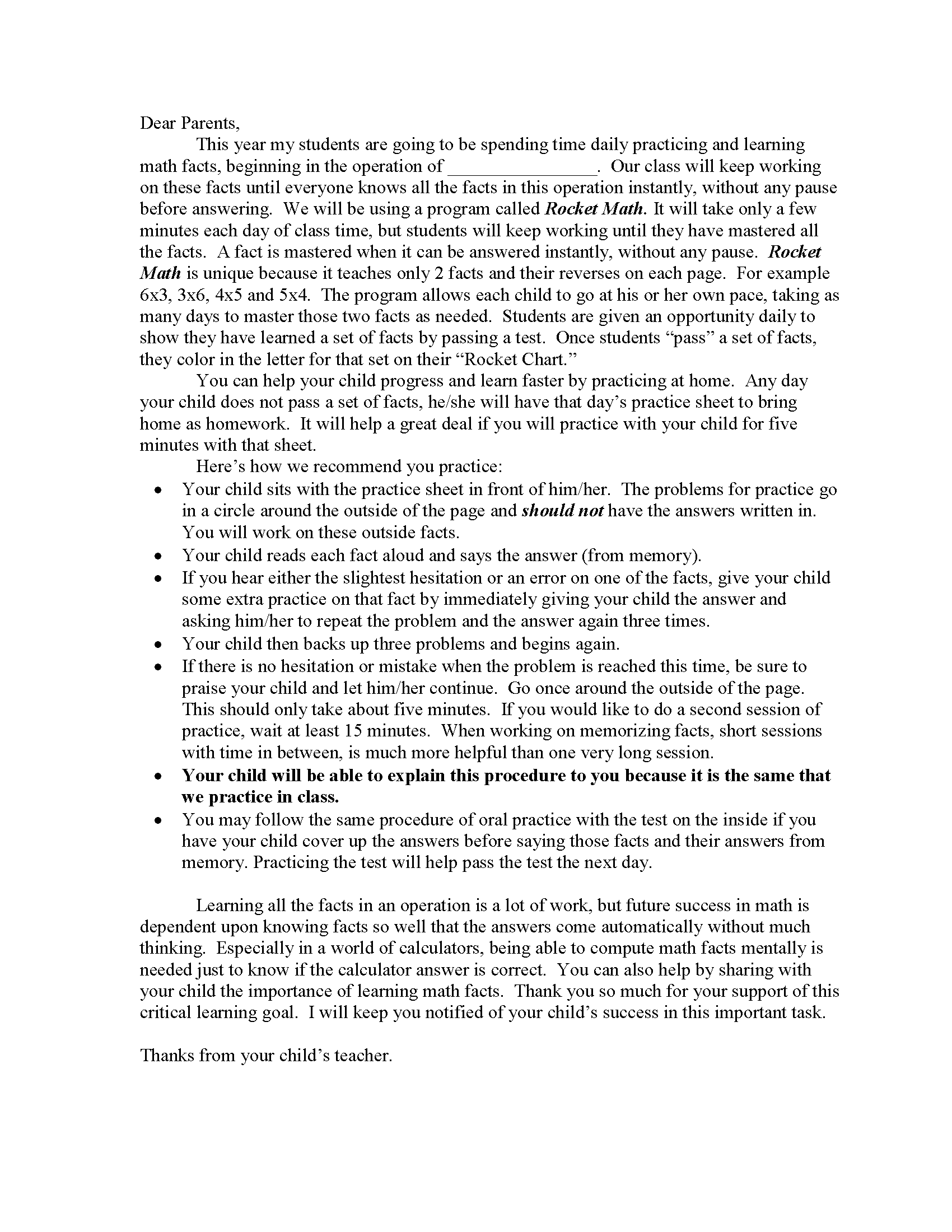
If students practice math facts a couple of times a day throughout the year, they will never forget them! Parents will help you if you give them the tools, which you can easily do with Rocket Math. Start with a letter to parents telling them what you are doing.  The letter is a good start for parents to know how to practice.  We have included a two page parent letter from Dr. Don in the virtual filing cabinet in our subscription website.

If you would like to personalize a letter we also have a one-page letter in Word that you can edit and make your own here.  We also have one in Spanish here.

Back-to-school night is the best time to teach parents how to practice Rocket Math.

If you’re really smart you can also use back-to-school night to show parents how to do practice at home.  A good way to do this is to have a couple of students demonstrate how to practice, and do the correction procedure, so parents see what to do.

Now that parents know what to do, be sure that all your students are taking home their used practice and test page from Rocket Math each day. Students should complete the test and then get a parent or someone else in their family to help them practice around the outside. Then they could also practice the test, as long as they aren’t looking at the answers.

This extra practice session at night will make a big difference in how fast students pass a level. You might even let the students in on the secret. (One teacher I know announced publicly to the class that they weren’t supposed to practice at night because it would give them an unfair advantage, but then individually told each student she’d make an exception, in their case. Soon the whole class was practicing each night diligently!)

Use the “Thank You to my Helper” achievement awards so that students can take them home and thank their helper when they pass a level. Ask students who is practicing at home, and then you could call home to thank those parents for their help. You will be amazed how these things will increase the amount of help you get from home and thereby improve the success of Rocket Math in your classroom.