What’s so special about Rocket Math Flashcards?

Question: Okay, I have a question about the Rocket Math flashcards. I’m a retired teacher, doing some tutoring on the side now. I have TouchMath flashcards and Really Good Stuff flashcards. What is the difference from Rocket Math flashcards, other than your directions for use? Can the cards I have be used? I read somewhere on here that your goal is to help teachers and kids, not to just make money! LOL. Thanks!
Nancy

Answer: Good question. What’s So Special About Rocket Math Flashcards?

Remember: The best condition for learning is having a few things to learn in a sea of mastered material!

  • Rocket Math flashcards are coded in sequence so that it is easy to have only 12 cards in the “working deck” at a time, and the right 12 cards at all times.
  • Only 3 of the “working deck” are new or “hard.”
  • When beginning addition and subtraction Rocket Math flashcards provide nine “name the numeral” cards so that students still have only three new facts to learn out of the first 12 cards in the working deck.
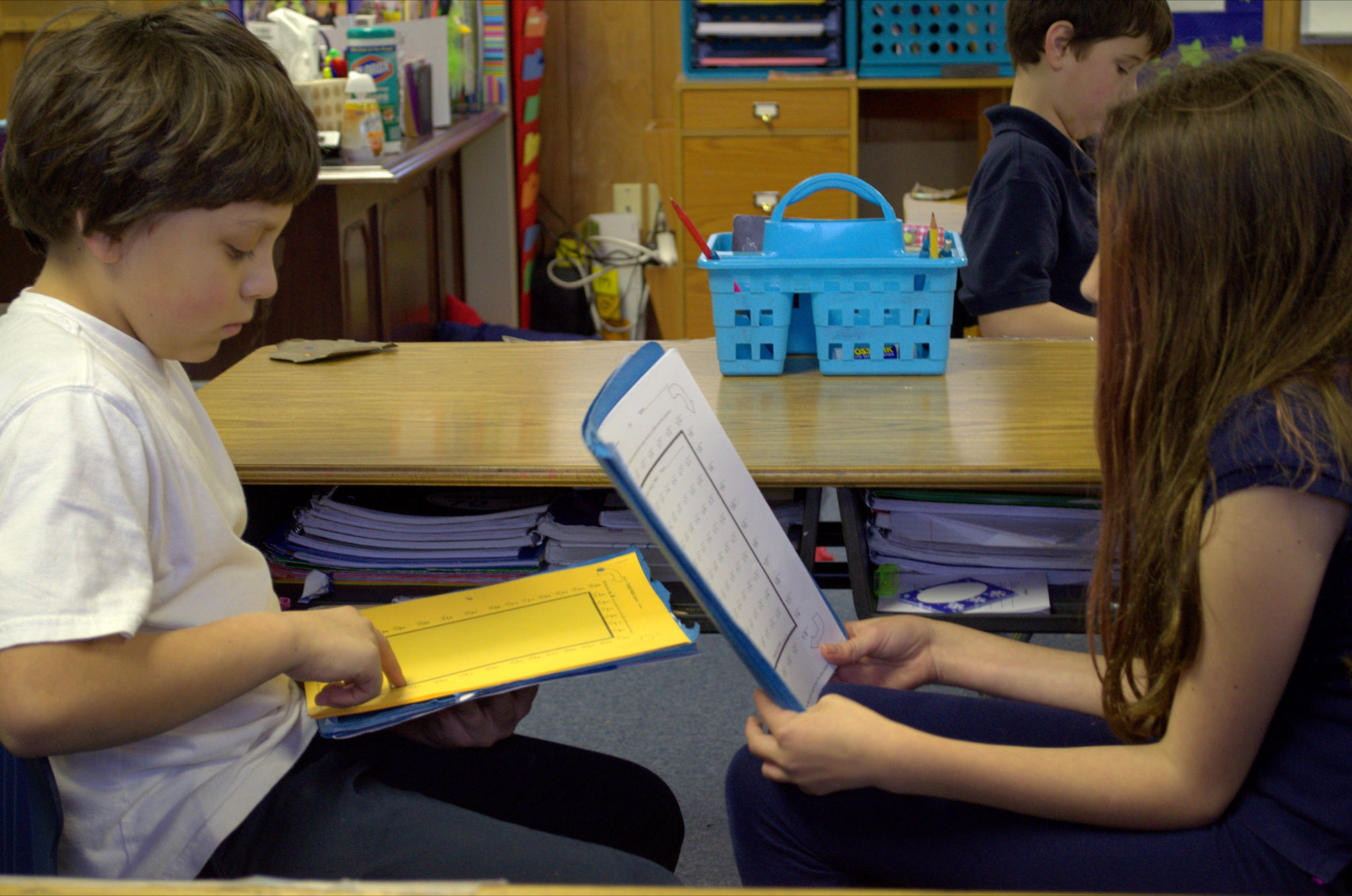
  • Students are taught to practice by saying the problem and the correct answer without any hesitation.
  • A “practice partner” follows a specified correction procedure any time there is an error or hesitation.
  • Rocket Math flashcards allow for a few short practice sessions (3-4 minutes) each day.
  • New cards are added to the “working deck” only after a “cold” run-through is 100% correct.
  • The “coded” cards indicate which cards are to be removed to make room for the new cards.
  • Mastered (removed) cards become the “review deck.”
  • “Coding” allows users to follow the Rocket Math sequence–which is very smart and helps students learn the facts more easily.

Some of these points are, in fact part of the directions and could be used with other flashcards sets. However, to do this with other flashcard sets would require one to add some known facts to the set for starting out, and for one to number the cards in the right sequence. Thanks for asking!


When to begin Rocket Math?

Question: I am the K-1 instructional coach for our district and I am looking for the contact information for a 1st grade teacher who has done Rocket Math in first grade. We have a building who will be piloting the program in first grade and would like some advice on what time of year is best to begin the program!

Answer: We don’t keep customer contact information to give out–our privacy policy does not allow that. [However, we are about to create a Rocket Math Ambassadors web page for teachers who volunteer to be available to take questions from other teachers about Rocket Math. We’ll announce it in Dr. Don’s Hints and Tips.]

Answer to your second question: You want to know when in first grade to begin the program. The answer to your question is that students can begin math facts in First grade as soon as they understand the concept of addition. This is the kind of information discussed in our Teacher Directions and in our Rocket Math FAQs here in letter “E.”

When are students ready to begin fact memorization in an operation?

When they “understand the concept” of the operation. “And how does one know that?” you might be asking. Well, we’re going to tell you. Drumroll, please. Children “understand” an operation when they are able to compute or figure out any fact in the operation. They can use their fingers to figure out the addition and subtraction facts. Or they can use successive addition to figure out the multiplication facts. Or they can use manipulatives and get the right answer. Or they can draw lines, or horses, or dots, or cookies  (We’ve seen it all.) and get the answer. Somehow, some way, given any fact in the operation, and unlimited time, the child can figure out the answer. Then the child is ready to begin memorizing.

This might be at the start of the school year, or might not be true until November–depending on your district’s scope and sequence. Hope this answers your question.

Monitor, monitor, monitor

As Dr. Anita Archer says, aside from teaching, the most important thing a teacher does is monitor students as they are working. This is doubly true during Rocket Math. Far from being a time to sit down while the students are happily engaged in “doing Rocket Math,” this is a time when it is imperative that the teacher must be up moving around and listening to the quality of the practice. Walking around the room to see that everyone appears to be on task is the minimum, but really stopping to listen to the students is the gold standard in monitoring. (Me, I have to squat down or bend over to be able to hear clearly.)

During Rocket Math the teacher should be tuning in and listening to pairs of students as they practice to be sure of several things. (1) Is the student saying the entire problem and the answer each time? (2) Is the student audible to the checker? (3) Is the checker tracking with his/her finger so you can tell if they are following along? (4) Is the checker correcting hesitations, as well as errors? [Give public praise, perhaps after the practice session to every checker you heard correct a hesitation–that’s a really big deal!] (5) Does the checker follow the three step correction?

The teacher cannot know whether or not practice is being done correctly without careful monitoring and listening to the pair of students as they practice. Praise the pair if they are doing it right. Then move on to another pair and monitor them. Keep moving to as many pairs of students as you can during the two to three minutes of oral practice.

By the way, look out for students who go once around and stop! This is supposed to be an endless task. That is why the problems now go in a circle around the outside so the students know to go on to a second lap if they can. The best teachers institute a signal (fist in the air for example) that shows which students have made it to the second lap during the practice time. That should be a badge of honor. It often means that the student has no hesitations on any of the newer facts and will be likely to pass that day. But hard work and diligent working–enough to get to a second lap should be rewarded in any case.

If the teacher finds that students are NOT practicing and correcting as they should it is time to go back to the beginning and model for students how they should practice and correct. More on that in another blog. For now, just be sure to monitor, monitor, monitor during Rocket Math.

Trying to teach reading by the light of a shared candle

How can a teacher run a math fact fluency program with access to only a couple of computers?

Asa asks:
Don, My school doesn’t currently have a fluency program in place and I’d really like to implement one as I think it’s a real need for my kids. I have 65 5th grade students. I don’t have access to technology on a 1 to 1 basis in my classroom. I have a couple of computers and a few ipads. Where would be good place for me to start?

Dr. Don answers:
Hi Asa,  What you describe is like trying to teach reading by the light of a shared candle! Until you have computers (or iPads) for everyone, using computer based programs to provide facts practice won’t work! A paper-and-pencil program is really much more realistic.
The paper-and-pencil version of Rocket Math works really well. Because students work with each other in partner practice they enjoy it. The daily one-minute timings are a good challenge, and the fact that they only have to learn two facts on each set means within a few days they can pass a set. Filling in the Rocket Chart from the bottom up gives them a sense of accomplishment and they learn an important life lesson–that studying and practicing can help you learn!
For one teacher the cost of a Basic annual subscription is $29, so it’s not too expensive to start.

Listen to the Rocket Math in a Nutshell presentation on our home page www.rocketmath.com for a good quick idea of how this runs. Next print out and read the Teacher Directions from our Free Resources page here. Then when you have a clear idea what you’ve got to do, go ahead and get the Basic Subscription. You’ll be glad you did.

Oh, in case you don’t see this word of advice, with fifth graders start everyone on multiplication (even if they are counting on their fingers.) Fifth graders who aren’t fluent with the basic facts are a case for triage!!  If they never memorize another operation other than multiplication they might be able to make it through fractions and other pre-algebra topics if they know multiplication facts–so that is the place to start.

How to get parents to help you

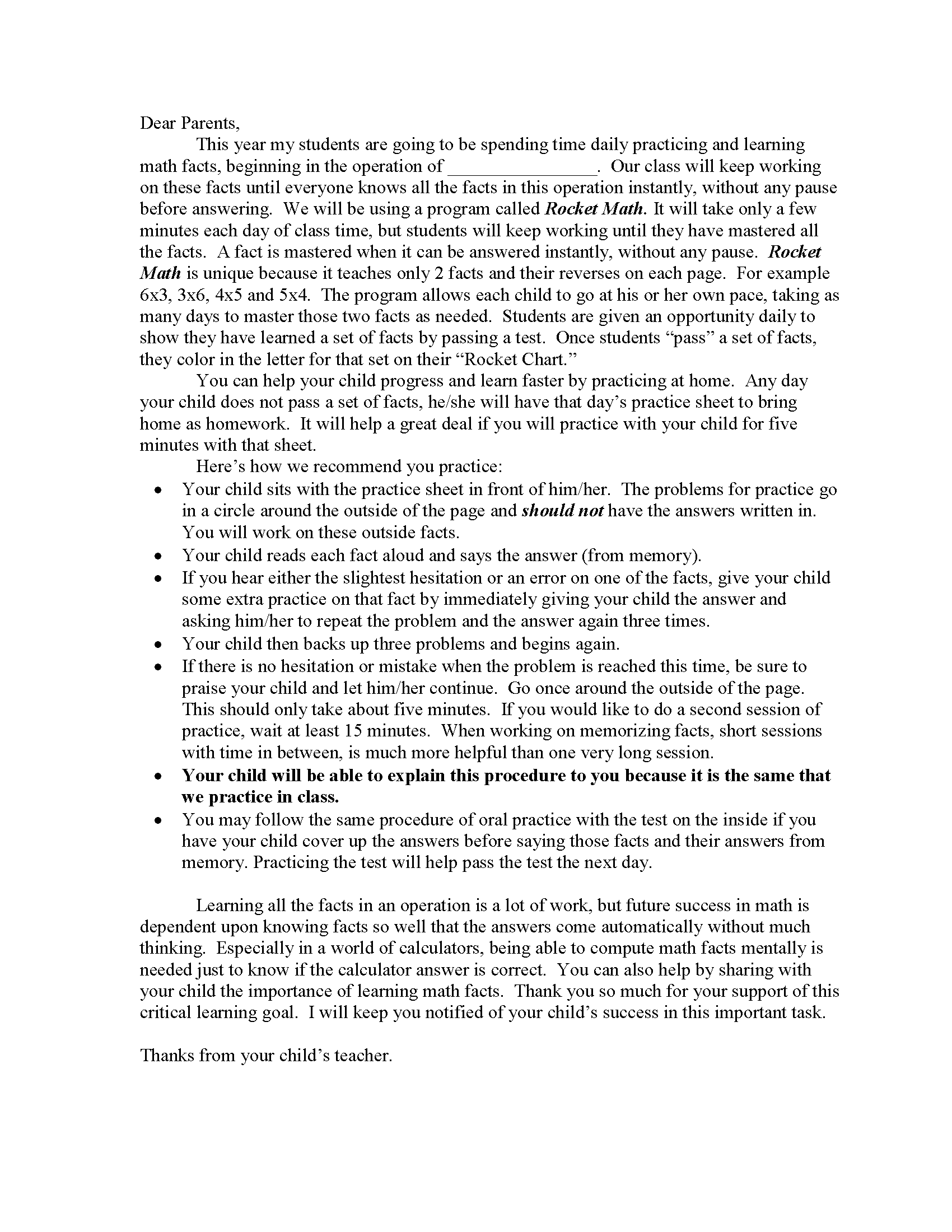
Dear-ParentsOne-Page

If students practice math facts a couple of times a day throughout the year, they will never forget them! Parents will help you if you give them the tools, which you can easily do with Rocket Math. Start with a letter to parents telling them what you are doing.  The letter is a good start for parents to know how to practice.  We have included a two page parent letter from Dr. Don in the virtual filing cabinet in our subscription website.

If you would like to personalize a letter we also have a one-page letter in Word that you can edit and make your own here.  We also have one in Spanish here.

Back-to-school night is the best time to teach parents how to practice Rocket Math.

If you’re really smart you can also use back-to-school night to show parents how to do practice at home.  A good way to do this is to have a couple of students demonstrate how to practice, and do the correction procedure, so parents see what to do.

Now that parents know what to do, be sure that all your students are taking home their used practice and test page from Rocket Math each day. Students should complete the test and then get a parent or someone else in their family to help them practice around the outside. Then they could also practice the test, as long as they aren’t looking at the answers.

This extra practice session at night will make a big difference in how fast students pass a level. You might even let the students in on the secret. (One teacher I know announced publicly to the class that they weren’t supposed to practice at night because it would give them an unfair advantage, but then individually told each student she’d make an exception, in their case. Soon the whole class was practicing each night diligently!)

Use the “Thank You to my Helper” achievement awards so that students can take them home and thank their helper when they pass a level. Ask students who is practicing at home, and then you could call home to thank those parents for their help. You will be amazed how these things will increase the amount of help you get from home and thereby improve the success of Rocket Math in your classroom.

Trying to use the app to support the paper-and-pencil Rocket Math

Customers would like to be able to use the app to help their child pass a certain level in the Rocket Math paper-and-pencil program at school. They are thinking that if their child is on Set L in the paper-and-pencil version at school, they should be able to set up their child to practice Set L in the app, which will help them pass the same level at school.

Actually the program does not work that way. Instead the Rocket Math app has everyone progress through the levels in order, starting at A and only gradually working their way up to Level L. Why isn’t it possible to just focus on Set L in the app? We could have set the app up that way. Why didn’t we? Answer: Because it wouldn’t help!

The test in the paper-and-pencil version of Set L is MOSTLY about problems from sets A through K. The test on Set L is a random mixture of all the problems learned in sets A through K. See the picture? The new facts in Set L (7×9 and 9×7) only appear five times in the test of 56 facts. But, those facts do show up 16 times in the practice on Set L (around the outside). That practice is how the new facts are learned.

Students can bring home the worksheet from Set L. Each day they don’t pass they should bring the used worksheet home for homework. They should practice with the most recently introduced facts around the outside of the test. They can even practice reading and answering all the facts on the test if they like. Orally practicing the facts in the test on Set L is probably the best way to focus practice for passing the paper-and-pencil test.

The Rocket Math app randomly selects problems from the set of facts that should be known because they have already been learned. Practice within the app will never be the same two times in a row, but it will be sampling of the right problems. Practicing on the app teaching the facts and adds to student’s knowledge. It is good for them, but it can’t guarantee they will pass the paper-and-pencil test the next day.

Students should NOT be expected to “pass” a set of facts in the paper-and-pencil Rocket Math the first day or two of practice. It is better if they don’t. They should spend three or four days practicing before they get fast enough to pass. Spending time practicing is the best way to cement in their learning. The goal is that students can remember those facts for life. If they practice on the app and practice at school, the end result will be that they know the facts better for the rest of their lives. The more time students spend practicing math facts, the better off they will be. That is FAR more important than getting through Rocket Math quickly.

That being said, after going once through the levels A through Z of the Rocket Math app (or the paper-and-pencil version), there is nothing wrong with going through it again if they have the time and the willingness.

Add a bonus session for students who don’t pass quickly

In most schools there are a few children who are not making good progress with Rocket Math. They don’t pass as quickly at each level. Assuming that students are practicing the way they should with a partner (teachers should monitor this closely), and their writing goals are reasonable (sometimes they become unsustainable), you may be looking at students who need more than the usual amount of practice. Some students do need two or three times more practice than their peers. Sadly, these are often the students who do not practice at home either. So the question is how to get them the extra practice they need to keep up with the class. Luckily, Rocket Math lends itself to arranging extra practice.

A school’s first option should be a cross-graded Rocket Math “Bonus” session some time during the school day. Students can work at all grade levels and in all operations in this group. Students should all come with their folder containing all they need. Students should be assigned to the Rocket Math “Bonus” session after not passing a level within four or five practice days.

A teaching assistant or para-professional might be able to run this session, depending on their classroom management skills. It would be better to have the Title I or Special Education teacher run these sessions. This kind of remedial work will really help students.

Students would bring their Rocket Math folders from class to the “bonus” session—because their folder should include their answer key and everything they need to practice. Students do not need to be in the same grade or on the same operation to be partners because the answer keys needed are right there in the folder.

In the bonus session, students would practice with a partner for two or three minutes the same way they do in class. Then the two would switch roles. But then, instead of taking a written test, they could practice again orally but this time on the TEST for one minute and then switch roles. That way no paper is used up and no paperwork is required of the person running this session with students from several classes. The students should be done in less than 15 minutes. This extra practice if done properly and every day should help students to pass within a very few days.

Of course, students with IEPs in math should get a bonus session during the time they are with the special education teacher. And Title I students should get a bonus session with the Title I teacher. But the bonus session should be available based on need rather than labels or categories.

Don’t I need to teach doubles and other combinations first?

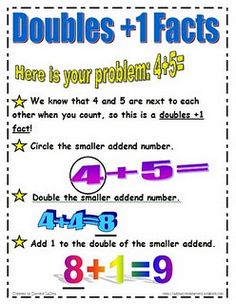
There is a lot of advice out there that teachers need to introduce different tricks to remembering math facts to help students learn the facts. Things like doubles, or doubles plus ones, or special combinations that add to ten are recommended to be taught to students. Teachers are exhorted to use many different kinds of exercises to teach these different ways of remembering facts. Is that necessary to do before memorizing facts as we do in Rocket Math? The simple answer is, “No, that’s not necessary.”
DoublesPlusOne
How do we know? What’s the evidence? There are two basic sources of evidence, one from experience and another from logic.
Let’s look at the logical reasons these are not necessary. The goal of Rocket Math, and any good math fact memorization program, is to develop automaticity in answering math facts. Automaticity means the student can instantly answer the fact, without any intervening thought process. So even if students first learn those memory tricks they have to be abandoned in favor of simply recalling the fact from memory.

An intervening thought process would go like this, “Four plus five is like four plus four but one more. Four plus four is eight , so one more is nine. So four plus five is nine.” But the goal of Rocket Math is to simply come to the point where the student reads, “Four plus five is,” and the answer, nine, pops into mind without another thought. Logic tells us that if the learner ultimately has to abandon the strategy, the only reason for learning the strategy is if it is needed as a transition. In other words, if students have to learn the facts to the point where they don’t use the strategy, then the only reason to learn the strategy is if they need it to get to the point of memorizing the facts.
This brings us to the second piece of evidence, experience. I know from experience tha students don’t need these strategies to learn the facts.  When I started using my original hand-written version of Rocket Math with my students with learning disabilities–it worked without them knowing other strategies!  In the past fifteen years thousands of children have learned math facts to automaticity using Rocket Math without learning those different tricks. If it were necessary, then they wouldn’t be able to do it. The reason it is not necessary is that students only have to memorize two facts at a time and that’s just not difficult to do. Give them plenty of practice with those two (enough so that they come to be able to answers as fast as they can write) and they will know the facts without some other (intervening) strategy.
So you don’t have to teach all those different tricks to students to remember facts. Just use Rocket Math, and make sure they are practicing the right way with corrective feedback from their partner. Their results will speak for themselves.

Counting on fingers–how do you stop it?

counting_on_fingers_to_do_math
Here’s a set of very smart questions from a customer, followed by my answer:
“I really like your practice procedure, but I’m wondering how you recommend ensuring that students aren’t counting on their fingers or trying to figure out problems during testing. I’ve been doing general timed tests with my class, and I tell students to skip problems they can’t quickly answer rather than try to figure them out. Still, there are always those students who don’t listen, and I see them skip counting on their fingers. How do you handle this issue during your testing? Are students allowed to skip around during a timed test?”

These are exactly the right questions. Rocket Math is designed specifically to prevent these problems.

  • First of all, Rocket Math Daily One-Minute timings are composed entirely of problems the students do know, so they don’t need to “skip problems you don’t know.” In fact, in the daily one-minute tests if students skip any problems they are counted as wrong, because it is evidence that they don’t know it. You can see the sequence in which multiplication facts are learned here. Set A in Multiplication, for example, it is composed entirely of 1 x numbers in which the answer is the number. There’s no need to finger count. There’s no need to skip around. Each set then only adds two facts and their reverses at most. Set B in Multiplication only adds 2×2, 2×3, and 3×2 to those ones facts. So by the time the student finishes practicing, even the first day, he/she should be able to answer all the facts on that day’s One Minute Timing without having to skip count on his/her fingers.
  • The other part of the equation in Rocket Math is that we set the goal individually for each student based on the Writing Speed Test. We set their goal as fast as their little fingers can carry them! There is no time to stop and count on fingers or stop writing answers to look for problems they like better. So students will NOT pass if they are doing any of those things. Of course, it’s up to you as the teacher to warn students ahead of time, “There is not enough time to take breaks, erase answers, or count on your fingers. If you do those things you won’t pass!”  And of course, students are very motivated to pass levels and move up the Rocket Chart.
  • Probably most importantly is making sure that when students practice with each other they follow the correction procedure for all hesitations. That way students learn they can (and must) answer the facts instantly when they know them. For the proper correction procedure See Letter O in our FAQs page.  Then read Letter P in our FAQs page “How do get my students to practice the right way?”

Why a test of writing speed?

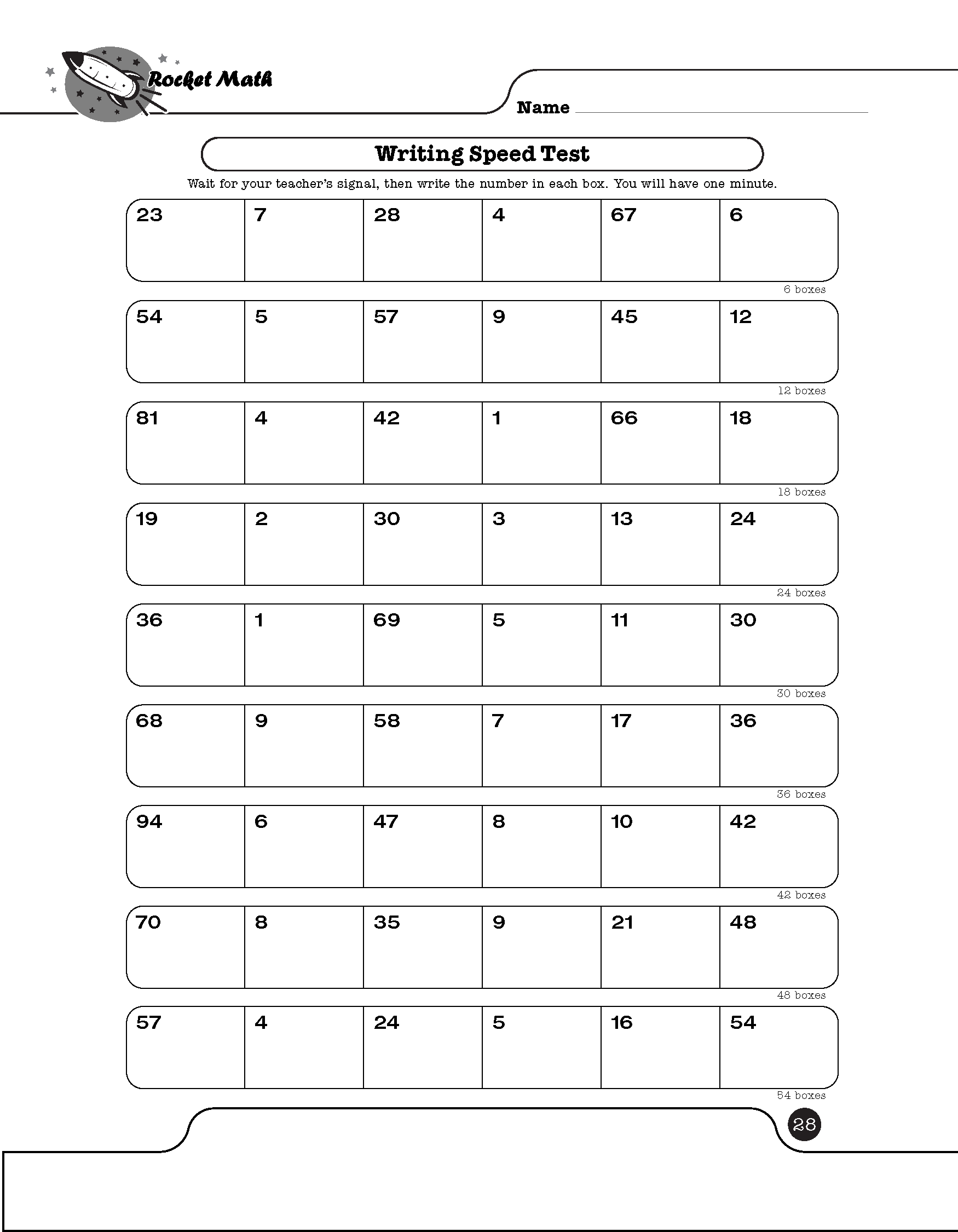
WritingSpeedTest

Question: What is the purpose of this writing speed test exactly? Should a child be held back from progressing through the levels simply because they have not passed the writing speed test, especially when they already know their math facts? Can you please clarify?

Answer: The purpose of the writing speed test is to make sure that students are not asked to write answers to math facts at a rate faster than they are able to write. The purpose is not to hold children back who know the facts—exactly the opposite. The test is to make sure their goals are appropriate and that they are not held back by their writing speed.

There is also an explanation under Letter “i” in our FAQs. It is also covered in the complete Teachers Directions–free to download.  Not all teachers have these directions—so feel free to share them.

What about students who can’t write the answers to 40 problems per minute? (This is a great question. We are very very impressed and glad you asked!)

For less than fluent writers their goal is to write as many answers as they can write in one minute. See the information about the Writing Speed Test for details of how their goal would be adjusted down from 40 problems per minute. Their goal will be to answer as fast as their little fingers can write! We do not want children to be hesitant, or have to stop to figure out math facts. We want them automatic, with as little thought required as possible. We definitely do not want them counting on their fingers. Allow us to repeat ourselves here… NO FINGER COUNTING!

Why do I have to give a writing speed test?

We have found that many children are not able to write the answers to 40 problems in one minute. They can orally say the answers to that many problems, but they can’t write that fast. In grades one and two it may be nothing more than an “inexperienced little hands” problem. In other grades handwriting speed is dependent on other variables.

When they learn their facts, but cannot pass a test, due to slow writing, we see much weeping, gnashing of teeth and pulling of hair. (And that’s just the teacher.) Suffice it to say, it’s not a pretty sight. So we want to establish goals for all students that are no faster than they can write. To do that we have to find out how fast they can write. That’s why we have to give the Writing Speed Test.

How do I give the Writing Speed Test?

The Writing Speed Test is pictured above.  The children are going to write in each box the number they see up in the corner of the box. They look at the number and write it. That’s just how fast they should be with the math facts—just look at the fact and write the answer without hesitation. However many boxes they can write the numbers for in one minute, determines the number of problems they can be expected to write the answers for in one minute. This sets their goal.

When you give the test, make sure all students are situated with their papers out, names on them and their pencil at the ready. Tell students to hold their pencil up (yes, in the air!) when they are ready. [This is a really cool technique to use for all timings. If students are holding their pencils at the ready and in the air, nobody can be cheating by starting early. Also, in this way you can look out over the masses and easily tell when everyone is set and ready to go.] The directions for the Writing Speed Test are on the test sheet. Read these aloud. Do not allow any students to start ahead of time as this will invalidate their score. Have the students write in the boxes as fast as they can for one minute. Then they can put the tests back into their folders, and turn in their folders. You will be taking the information from the test and putting it onto the goal sheet.