How should students practice math facts?

Students should practice with a checker holding an answer key. 

  • One student has a copy of the PRACTICE answer key and functions as the checker while the practicing student has the problems without answers. The practicing student reads the problems aloud and says the answers aloud. It is critical for students to say the problems aloud before saying the answer so the whole thing, problem and answer, are memorized together. We want students to have said the whole problem and answer together so often that when they say the problem to themselves the answer pops into mind, unbidden. (Unbidden? Yes, unbidden. I just kinda like that word and since I am writing this, I get to use it.)
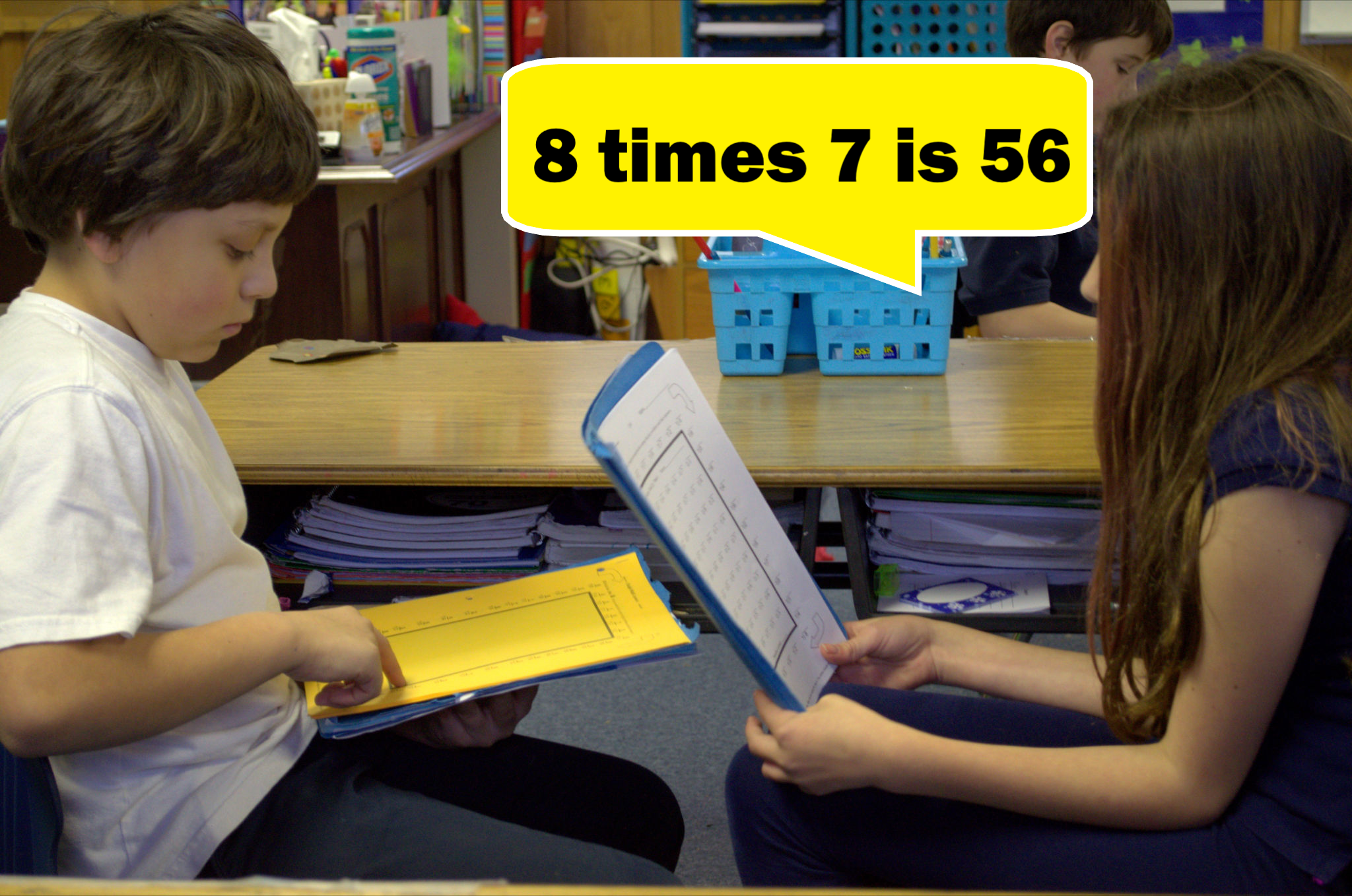
  • A master PRACTICE answer key is provided—be sure to copy it on a distinctive color of paper (yellow in the picture) to assist in classroom monitoring. The distinctive color is important for teacher monitoring. If you are ready to begin testing and you see yellow paper on a desk, you know someone has answers in front of him/her. When you make these distinctively colored (there, I said it again) copies, be sure to copy all of the answer sheets needed for a given operation and staple them into a booklet format…one for each student who is working in that operation. For some reason (I actually know the reason) teachers always want to find a way to put the answer keys permanently into the students’ folders. DON’T. Students need to be able to hold these in their hot little hands, outside of their folders. Then answer keys will be the same regardless of the set of facts on which a student is working. So students working on multiplication will have the answers to ALL the practice sets for multiplication. This allows students from different levels to work together without having to hunt up different answer keys.
  • The checker watches the PRACTICE answer key and listens for hesitations or mistakes. If the practicing student hesitates even slightly before saying the answer, the checker should immediately do the correction procedure, explained below. (Let’s stop here. This is critical. Critical, I tell ya. This correcting hesitations thing is sooooo important. I mean really important. You can probably guess why. We need students to be able to say the answer to these problems without missing a beat — not even half a beat. So students must be taught that there is no hesitation allowed. Really.) Of course, if the practicing student makes a mistake, the checker should also do the correction procedure.
  • The correction procedure has three steps:
    1. The checker interrupts and immediately gives the correct answer.
    2. The checker asks the practicing student to repeat the fact and the correct answer at least once and maybe twice or three times. (I recommend three times in a row.)
    3. The checker has the practicing student backup three problems and begin again from there. If there is still any hesitation or an error, the correction procedure is repeated. Here are two scenarios:

Scenario One
Student A: “Five times four is eighteen.”
Checker: “Five time fours is twenty. You say it.”
Student A: “Five times four is twenty. Five times four is twenty. Five times four is twenty.”
Checker: “Yes! Back up three problems.”
Student A: (Goes back three problems and continues on their merry way.)

Scenario Two
Student A: “Five times four is … uhh…twenty.”
Checker “Five times four is twenty. You say it.”
Student A: “Five times four is twenty. Five times four is twenty. Five times four is twenty.”
Checker: “Yes! Back up three problems.”
Student A: (Goes back three problems and continues on their merry [there is a lot of merriment
in this program] way.)


  • This correction procedure is the key to two important aspects of practice. One, it ensures that students are reminded of the correct answers so they can retrieve them from memory rather than having to figure them out. (We know they can do that, but they will never develop fluency if they continue to have to “figure out” facts.) Two, this correction procedure focuses extra practice on any facts that are still weak.
  • Please Note: If a hesitation or error is made on one of the first three problems on the sheet, the checker should still have the student back up three problems. This should not be a problem because the practice problems go in a never-ending circle around the outside of the sheet. Aha…the purpose for the circle reveals itself!
  • Each student practices a minimum of two minutes. The teacher is timing this practice with a stopwatch…no, for real, time it! After a couple of weeks of good “on-task” behavior you can “reluctantly” allow more time, say two and a half minutes. Later, if students stay on task you can allow them up to about three minutes each. Make ‘em beg! If you play your cards right (be dramatic), you can get your students to beg you for more time to practice their math facts. I kid you not. I’ve seen it all over the country…really!
  • After the first student practices, students switch roles and the second student practices for the same amount of time. It is more important to keep to a set amount of time than for students to all finish once around. It is not necessary for students to be on the same set or even on the same operation, as long as answer keys are provided for all checkers. If students have the answer packet that goes with the operation they are practicing and their partner is on a different operation, they simply hand their answer packet to their partner to use for checking. I know what you are thinking. Yes, I realize that “simply handing” something between students is often fraught with danger. I was a teacher too. All of the parts of the practice procedure will need to be practiced with close teacher monitoring several (hundreds of) times prior to beginning the program. Not really “hundreds,” but if you want this to go smoothly, as with anything in your classroom, you will need to TEACH and PRACTICE the procedural component of this program to near mastery. Keep reading. I will tell you HOW to do this practice. (This is VERY directive.)
  • The practicing student should say both the problem and the answer every time. This is important because we all remember in verbal chains.
  • Saying the facts in a consistent direction helps learn the reverses such as 3 + 6 = 9 and 6 + 3 = 9.
  • To help kids with A.D.D. (and their friends) the teacher can make practice into a sprint-like task. “If you can finish once around the outside, start a new lap at the top and raise your fist in celebration!” Recognize these students as they start a second “lap” either with their name on the board or oral recognition — “Jeremy’s the first one to get to his second lap. Oh, look at that, Mary and Susie are both on their second laps. Stop everyone, time is up. Now switch roles and raise your hand when you and your partner are ready to begin practicing.”

Can a few minutes of fact practice each day be harmful?

Practice is not harmful as long as students are successful.

The best way to practice math facts is by saying them aloud to a person who can tell you if you’re wrong or hesitant in your responses.  If you are wrong or hesitant, you should practice on that particular fact a bit more until you know it well. This is an effective way to learn anything, including math facts.  It is especially valuable if students are given a limited set of facts to learn at each step so they develop and maintain mastery as they learn.  If practice is set up carefully, and students get positive feedback showing they are learning and making progress, it is enjoyable and motivating for students.  This is the essence of Rocket Math.  How in the world could this be harmful?    Only by doing it wrong, and doing it wrong specifically in a way that students are not successful.

If teachers skip the practice and learning part and just give the tests–that would be harmful.  Students won’t get a chance to learn and will experience failure.  The daily oral practice is the heart of Rocket Math–it can’t be skipped!

Daily tests in Rocket Math determine if a student has learned the set of facts he or she is working on, and learned them well enough to have a new set to be added to memory.  If students are not proficient in the facts they are working on now (proficient means being able to say a fact and its answer without any hesitation) then they will become overwhelmed with the memorization and will not be successful.  So it is critical that teachers are certain (based on the daily tests) that students can answer all the facts up to that point without hesitation.  Otherwise they will not be successful and it won’t be enjoyable.

Goals for those daily tests must be based on how quickly students can write.  Slow writers must have lower goals. Fast writers must have higher goals.  Every student’s goal should be “as fast as her fingers can carry her” and no faster.  Arbitrarily raising those goals (expecting faster performance than possible) or arbitrarily lowering those goals (moving students on to the next set before they have mastered the previous set) will cause students to be unsuccessful.

If the checker does not listen and correct errors or hesitations, a student can practice incorrectly and learn the wrong fact.  They can also fail to get the tiny bit of extra practice they need on a fact that they can’t quickly remember yet.  If practice does not proceed as it should, then students will not learn as they should.  Lack of success will make facts practice onerous or counterproductive.  The teacher has to monitor students practicing carefully to make sure they are doing it the right way to be successful.

Rocket Math has very explicit instructions here and answers to FAQs here.  I have a 3 hour training DVD here.  I am available at don@rocketmath.com  to answer questions.  Practicing math facts ten minutes a day is NOT harmful, if we do it in the way that students are successful.

Will finger counting ever go away?

Some “experts” in education think that teaching and practicing rote information, like math facts, is unnecessary.  Just let students do math or do games and they will learn facts well enough to get by.  That is true for a few students, but many students continue to count on their fingers up into junior high and high school if we don’t help them commit these facts to memory!  So the short answer to the question of whether finger counting will ever go away, is “No!” unless we do something.

One of the things that is unique about Rocket Math is that students begin to learn facts well enough so they have instant recall.  By practicing orally with a peer, they are saying the facts and the answers aloud, and from memory, over and over again.  By doing that, students come to the point that, when they say that problem to themselves, the answer pops into their heads without effort, like the words to an advertising jingle.  When the answer occurs to them instantly, they realize they know the answer before they can count on their fingers, and they stop.  This is how finger counting goes away.  Students recall the answer before they have to start counting fingers.  The end of finger counting comes with the kind of daily oral practice that the procedures of Rocket Math provide.

Are you ready for summer?

Preparing now can insure that students will maintain their Rocket Math learning over the summer.

(1) The simplest and most important thing you can do to get ready for summer is to save those Rocket Math folders at the end of the year. The folders can then be given to the next year’s teacher, so he or she knows where the student left off. Given special practice techniques at the start of fall (outlined below), students do NOT have to go back or start an operation all over again the next year. Some students take months to get where they are in an operation, and it is a terrible waste of their time to start them over. Especially if they have new faster writing speed goals, now they really have to work hard to master each set and it may take them quite a while.

(2) Make sure to take a few days to re-teach your students how to correct and when to correct (errors and hesitations).  Teach this by modeling errors and hesitations and have students be your checker and model how to correct for the other students to see.  Keep working with that student until you get perfect corrections even on hesitations.  Then “rinse and repeat” with another student.  Do this teaching and modeling for ten minutes each day for the first week or so.

Two students participating in one of Rocket Math's math fluency programs(3) Start students practicing on the last set completed (passed) the previous year but for the first five practice sessions, practice on that set in a special way. First practice in partners around the outside for two or three minutes. But then, instead of taking a written test, have students practice in pairs orally with the test (inside the box), for two minutes. Practice the same way as around the outside. Have the student read each problem aloud and answer it from memory. The checker will need to have the test answer key. Practice for two to three minutes and then switch roles. This practice will provide the necessary review of all the facts learned so far, and will bring them right back up to speed.

(4) After a week of oral practice sessions with the test, then allow students to take the written test. Evaluate students based on their writing speed goals from last year (don’t re-test and raise them). Arrange for extra oral practice on the test for anyone who doesn’t pass. In the extra practice, make sure they orally practice the test in the center as well. Keep up the extra practice, on that same set until they pass. They should get there in a few days. They already learned this, they are just bringing it back. They haven’t forgotten it, the connection just needs a little strengthening.

(5) If students finished an operation before leaving, you can start them on the next operation appropriate for their grade. Second graders who have finished addition, for example, would start with subtraction (1s – 9s), and then go on to Subtract from 20, then Skip Counting.  Third graders need to be taught the concept of multiplication first, but then should begin multiplication, regardless of what they completed earlier.  Multiplication is so critical for future success in math you cannot let any child in your room (if you are in 3rd grade or above) leave it without learning those multiplication facts.  Best thing you can do for their math careers.

Now that you know what to do–enjoy the summer!

Filling testing-created gaps in your schedule.

Many schools are starting spring testing soon, and it wreaks havoc with the daily schedule. People outside education don’t really understand how much school schedules are disrupted by attempting to test everyone in the school on the available computers. Not to mention catching all the students who are absent during their assigned time. Disrupted schedules create small gaps in the schedule, which are hard to fill, even more so when not every student is present. Let me present an option to fill those small gaps–do Rocket Math! Here’s five reasons why you should.

1) By this time of the year, students know the Rocket Math routine, so it should not take more than ten to fifteen minutes to run, start to finish. So Rocket Math can fill small gaps.

2) Even if Rocket Math has been done once during the day, a second or even third session during the day will NOT harm students, it will actually help them progress faster. (As long as you have at least a half hour between sessions).

3) It is beneficial for the students in the room even when some students are out doing make-up testing. It won’t require you to re-teach a lesson.

4) In contrast to free reading or make work activities, which only fill time, students doing Rocket Math will be learning critical skills that are necessary for future success.

5) In contrast to the stress of the accountability tests, Rocket Math is something students know well and have success at. They know what they are doing and they see their growth. They know they are learning. This is a powerful antidote to the not-so-straightforward tasks, questions and expectations of the accountability tests.

I highly recommend keeping Rocket Math folders handy for filling those small gaps in the daily schedule caused by testing.

What’s wrong with this picture?

If you are seeing this in your school, you need Rocket Math!

Recently I gave my pre-service student teachers at Portland State University an assignment to do screening tests of basic skills in their placements. I was shocked to see how few of the screening tests showed students who were fluent with basic, single-digit math facts, where they could answer math facts as quickly as they could write. When children cannot answer math facts quickly and easily they are placed at a unnecessary disadvantage when it comes to doing math.

It is true that learning math facts takes time. No one can learn all of them in a matter of a few days or a week. It takes most students daily practice for months to learn all the facts in an operation. But when you consider that we require students to attend school five hours a day for years and years, it is pretty shocking to realize how many children do not have fluent mastery of math facts when they get to middle school. When the job can be done in ten minutes a day, and every child could become fluent in all four operations of addition, subtraction, multiplication and division by the end of fourth grade, why isn’t it?

Sometimes, teachers have been taught in their schools of education that helping children memorize things is somehow harmful. With that belief, teachers won’t try to do something systematic like Rocket Math. But after a year or two teaching, especially upper elementary grades, and struggling to teach higher math concepts to children who are interrupted by finger counting in the middle of every single computation, teachers learn that belief is simply wrong. Children are helped immensely by memorizing basic math facts. It enables them to have “number sense,” to easily appreciate the relationships among numerals, and to easily do computation.

Probably the main reason more students are not taught math facts, to the level they need, is that teachers are not aware of a tool that can help them do that. They don’t know that students enjoy doing learning math facts when it is done right. They don’t know that it can be done as a simple routine that takes ten minutes a day. They don’t know how easily students can master all of the facts. In short, they don’t know that Rocket Math exists. Someday a friend of theirs will tell them, because that is how Rocket Math spreads–by word-of-mouth.

If you read this, and you have never seen Rocket Math in action, you may be skeptical. Tell you what, write to me and if you need to see it in action to believe me, and don’t have a friend using Rocket Math, I’ll send you a free subscription to try it out.

Don’t I need to teach doubles and other combinations first?

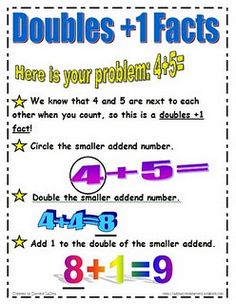
There is a lot of advice out there that teachers need to introduce different tricks to remembering math facts to help students learn the facts. Things like doubles, or doubles plus ones, or special combinations that add to ten are recommended to be taught to students. Teachers are exhorted to use many different kinds of exercises to teach these different ways of remembering facts. Is that necessary to do before memorizing facts as we do in Rocket Math? The simple answer is, “No, that’s not necessary.”
DoublesPlusOne
How do we know? What’s the evidence? There are two basic sources of evidence, one from experience and another from logic.
Let’s look at the logical reasons these are not necessary. The goal of Rocket Math, and any good math fact memorization program, is to develop automaticity in answering math facts. Automaticity means the student can instantly answer the fact, without any intervening thought process. So even if students first learn those memory tricks they have to be abandoned in favor of simply recalling the fact from memory.

An intervening thought process would go like this, “Four plus five is like four plus four but one more. Four plus four is eight , so one more is nine. So four plus five is nine.” But the goal of Rocket Math is to simply come to the point where the student reads, “Four plus five is,” and the answer, nine, pops into mind without another thought. Logic tells us that if the learner ultimately has to abandon the strategy, the only reason for learning the strategy is if it is needed as a transition. In other words, if students have to learn the facts to the point where they don’t use the strategy, then the only reason to learn the strategy is if they need it to get to the point of memorizing the facts.
This brings us to the second piece of evidence, experience. I know from experience tha students don’t need these strategies to learn the facts.  When I started using my original hand-written version of Rocket Math with my students with learning disabilities–it worked without them knowing other strategies!  In the past fifteen years thousands of children have learned math facts to automaticity using Rocket Math without learning those different tricks. If it were necessary, then they wouldn’t be able to do it. The reason it is not necessary is that students only have to memorize two facts at a time and that’s just not difficult to do. Give them plenty of practice with those two (enough so that they come to be able to answers as fast as they can write) and they will know the facts without some other (intervening) strategy.
So you don’t have to teach all those different tricks to students to remember facts. Just use Rocket Math, and make sure they are practicing the right way with corrective feedback from their partner. Their results will speak for themselves.