Looking for free math worksheets?

Do you want your students to learn OR are you just keeping them busy?

It’s OK if you need busywork.  
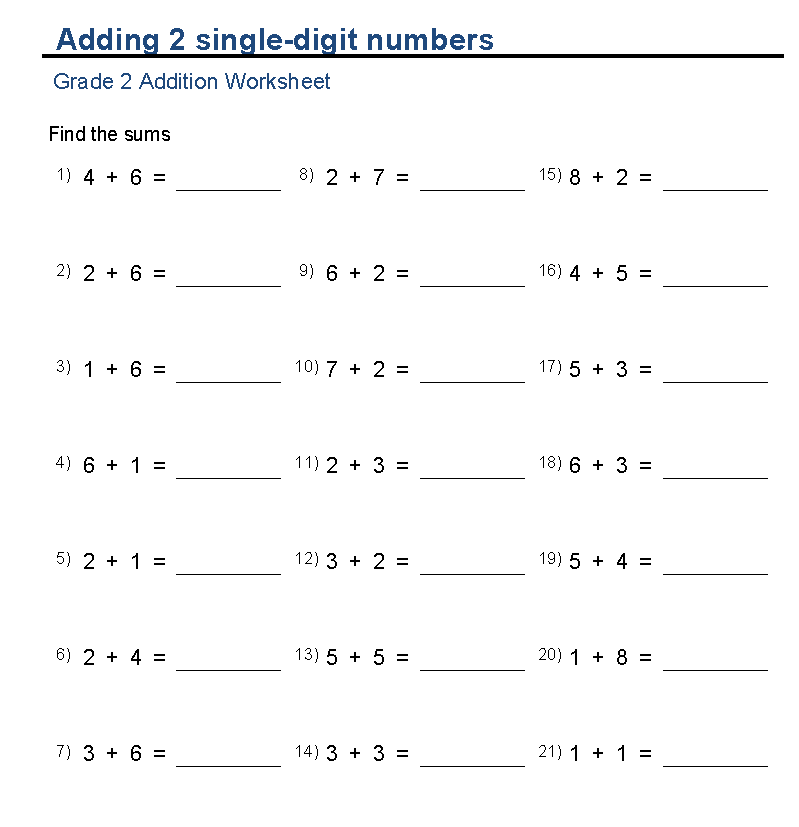
It’s critical to keep some of your students occupied in order for you to have the peace and quiet you need to teach other students.  Those free math worksheets of random facts are fine for busywork, provided students already know the facts.

Get a 60 day trial for only $13

Sign Up Now!

BUT

(and this is a big but) if you want students to actually learn facts, you need math worksheets that are more systematic than the usual fact practice worksheets.  A random mix of problems (on those free math worksheets) is fine for practicing what you already know, but it is USELESS for learning new facts.

Students who don’t know their facts are left painfully counting on their fingers to do their “work.” This just wastes their time and makes them come to HATE math.

I know, because I made my students do it for years. 🙁

 I discovered that with systematic practice students can actually learn math facts!

In order to learn new facts students must concentrate on a few they don’t know and practice those particular facts until they know them “by memory” without having to figure them out.  After students have learned those they can then tackle a few more.  That’s the only way to learn a bunch of facts.  That’s what Rocket Math does. Watch this video to see it in action.

 Rocket Math worksheets are not free, but they will actually teach. rocket math worksheets
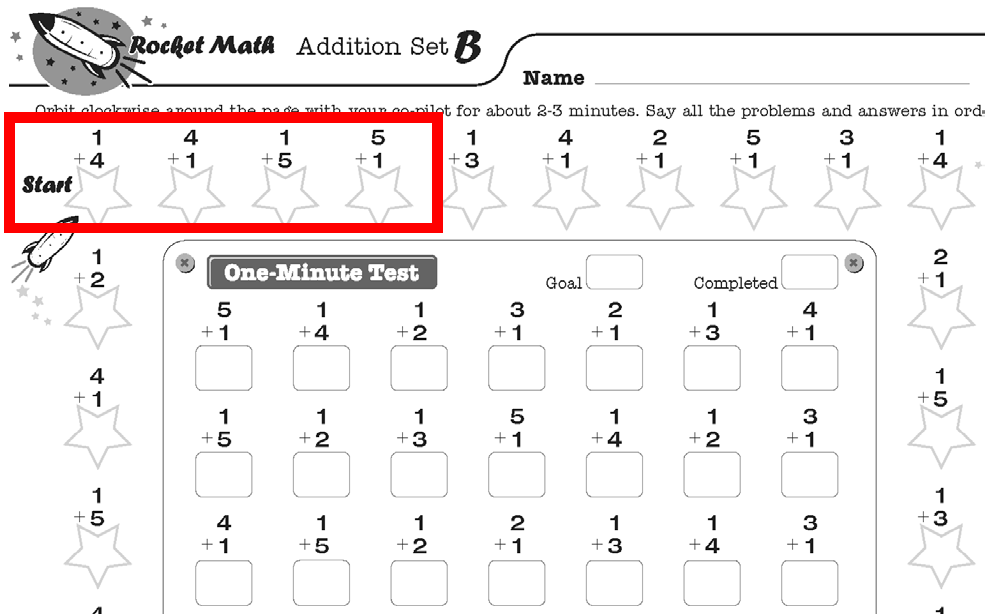
Each sheet (A-Z) adds two new facts and their reverses, making the process of learning them painless.  By the time students have worked their way through the A-Z worksheets of an operation they know the facts “by heart” or as the Common Core calls it “by memory.”

If LEARNING is your goal, you’ll need something more effective than the free math worksheets.


Rocket Math has a MONEY-BACK guarantee.

If you spend the $13 to get a trial subscription and you decide Rocket Math doesn’t work or you don’t want to use the program, we’ll gladly refund your money.


Plus

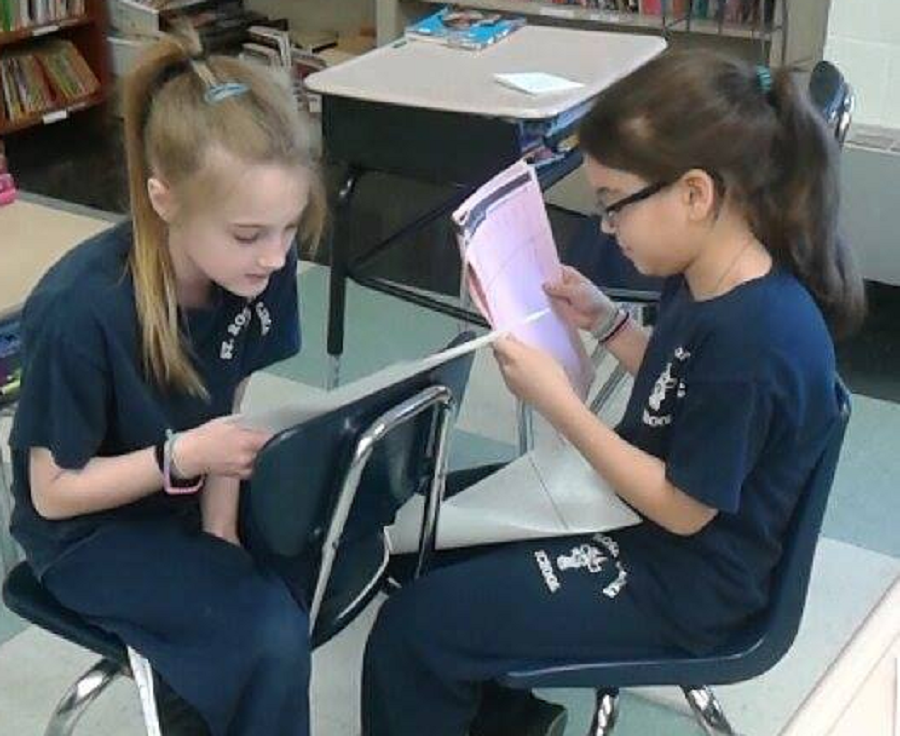
Students have more fun and learn better when they are practicing orally, with a partner so they can get corrections and extra teaching on any facts they don’t know well.  That is part of how Rocket Math works.  So it won’t just be busywork.  Your students will actually learn the facts and be proud of it.


Are you off to a good start with Rocket Math?

By now you’ve got Rocket Math up and running in your class.  If you’re hard-working, dedicated and smart you have read the instructions thoroughly.  If you need motivation to do so (I know it’s a lot to read through), check out this blog: Without the directions you may get lost!   So that’s the first thing to know.

If you want to quiz yourself (or your staff) Dr. Don has created a 20 question quiz you can take.  Where, how, and why you might want to do so, is explained in this blog that asks, “Do you know how to make Rocket Math enjoyable?”

Most importantly, you should be walking around during Rocket Math practice listening to your students to be sure they are correcting errors and hesitations the way they should–like every single time!  How important it is for you to be carefully monitoring practice cannot be stressed enough.   It’s not life or death, but it is learning or pretending, so you have to be certain that practice is going as it should.    If you need convincing please read this blog:  Monitor, monitor, monitor!

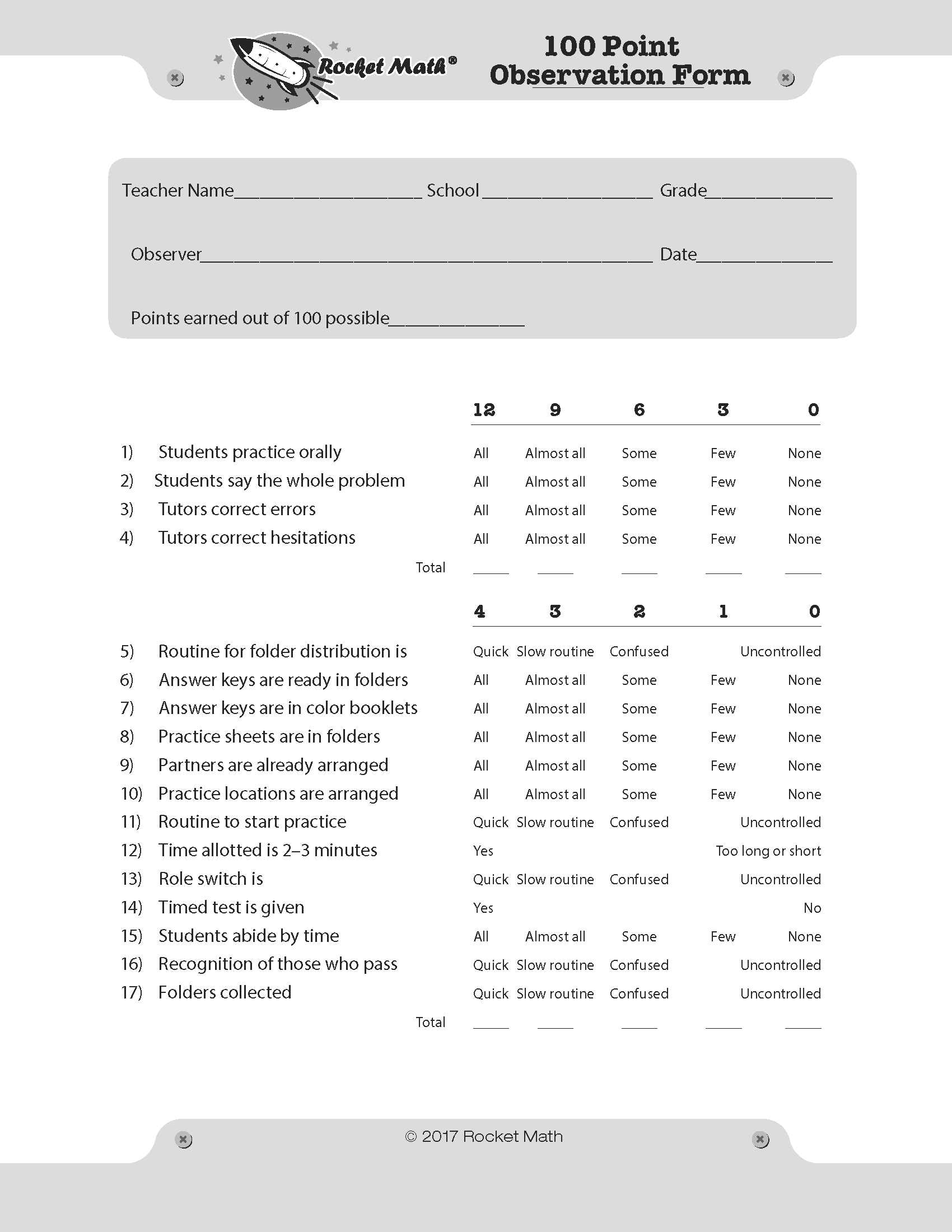
You can structure your self-evaluation, or get someone else to observe and help you evaluate yourself with the 100 point Observation form.  If you want to know, “How well do I implement Rocket Math?” this is the tool for you.  Click on the link here to get to the blog that will explain it as well as links to the form itself.

Finally, if monitoring or observations reveal that your students are NOT practicing as they should, what should you do about it.  Here is an FAQ on the topic, “How do I get my students to practice math facts the right way?”   And below is a video where Dr. Don shows what you must do to each students how to practice the right way.  Sorry, there’s no exciting gun play or car chases, but this is important to see.  If your students are not correcting the right way, this is what you have to do, so it’s valuable.


The 100-point observation form: How well do you implement Rocket Math?

Use the 100-point observation form to evaluate your implementation.

Use the 100-point Rocket Math Observation form to self-evaluate, or have someone observe your class doing Rocket Math and use the form to evaluate you.  The form observes and evaluates seventeen different indicators of the quality of your Rocket Math implementation.

You or your observer begin by looking at four important indicators of the quality of student practice.  The quality of the paired practice of your students provides most of the value of Rocket Math.  Accordingly, these four indicators provide nearly half of the 100 points.  If one or two of these things are not in place (tutors aren’t listening carefully and correcting errors AND hesitations, for example) the implementation will not earn high marks, because students won’t be learning nearly as well as they should or could.

The other thirteen indicators are mostly about the efficiency with which Rocket Math runs.  If it takes more than 15 minutes a day to complete Rocket Math, it won’t happen every day.  If Rocket Math doesn’t happen every day, students do not learn nearly as well as they should or could.

Where can you find the 100-point Observation form?

There are three places you can find this handy form.  (1) It is included in hard copy form in the Administrator and Coach Handbook which we sell and ship to you.

(2) The 100-point Observation form is also available for free on the Resources/Educator’s Resource page on our website where you can find this link to its pdf.

(3) And finally in the Rocket Math subscription filing cabinet, in the Forms and Information drawer, there is a section (pictured on the left) that is devoted to all the information in the Administrator and Coach Handbook and near the bottom you’ll see the 100-point Observation form for you to print out.

5 easy ways to get help running Rocket Math.

Here are 5 ways to get help with the procedures for successful Rocket Math implementation.

1.) Use the ***NEW*** search function.  At the upper left of the blue navigation bar is an icon of a magnifying glass.  Click on that and a search bar opens in the middle of the page.  Click within the search bar and you can type in whatever you are looking for.  It will bring up blogs, parts of the directions, basically anything I’ve written on the subject–which is a lot.  You can get pretty specific very fast, so try this first.  I’m very excited to have added this feature this week, which is why it is top of my list!

2)  FAQs.  Look at the Rocket Math FAQs page.  Click on the linked words to the left, or navigate to it.  The FAQs page is the third Rocket Math Filing cabinet on the webitem under ABOUT in navigation.  The FAQs page displays all of the questions from the teacher directions, and my answers, so you can scroll down to the topic you need quickly.   However, all the FAQs will show up in the search function as well.

2.5) The FAQs are also available in the Rocket Math filing cabinet.  They are in the top drawer, the “Forms and Information” drawer of the filing cabinet.  There are titles of the FAQs so you can open and print any one you wish.  Good for sharing with other staff.

3) Rocket Math YouTube channel. You can go to the Rocket Math YouTube channel.  Click on the linked words to the left, or search for Rocket Math in You Tube.  If you scroll down the page you can click on “View Full Playlist” and then you’ll be able to see all the topics that are available.  Right now there are 37 videos, but that could change if we add some more.

4) DVD training.  Order the Workshop Training DVD (#2004) for $29  This is the whole training from Dr. Don filmed and broken into chapters.  It is over 3 hours and gives a lot of rationale for the procedures we recommend.  Very helpful if Rocket Math is new for your staff.  Really important to do things as recommended.  Having coached this in many schools for many years, I can promise you it will go better if you follow the directions!

5) Contact Dr. Don.  Really.  You can call me (800) 488-4854 during west coast school hours and I’ll probably be able to answer the phone directly.  It’s a joy for me to talk about implementing Rocket Math with teachers, so don’t be shy.  But if you don’t reach me, please send an email to don@rocketmath.com rather than leave your phone number because during the school day teachers are very hard to reach.  I’d rather just write an answer in an email so we don’t miss each other.  And if it is a new question I’ll probably turn my answer into a blog that can be found through the search function.

How long should I allocate for Rocket Math daily?

Jessica asks:

As I am planning my daily schedule I am looking for how long I should set aside for Rocket Math each day.  What do you suggest?

Dr. Don answers: 

If you allocate 15 minutes a day for Rocket Math that will be enough.  You might have trouble meeting finishing that quickly in the beginning before the routine is established.  But once the routine is set there is no need to take more time than that–each partner of the pair is practicing for 2 to 3 minutes and the test takes only one minute.  Don’t try to have everyone correct their partners papers as that will take too long.  Making sure that students practice every day with their partner is critical to success, so anything that makes you feel “we don’t have time for Rocket Math today” is harmful to student learning.

The other key is to be sure to teach students how to practice with each other.  If you can train your students to correct hesitations you will accomplish a lot with your Rocket Math practicing time.  Please take a look at my video on “How to teach students how to practice.”   Take the time allocated to Rocket Math for the first several days of school and follow this teaching procedure.  It will pay off for you all year long in improved learning during Rocket Math time.

Take the Rocket Math Worksheet Program quiz

If you’re doing it right, Rocket Math should be a highlight of the day.

Doing Rocket Math ought to be one of the highlights of the school day.  If done correctly students should really enjoy daily practice, getting better, learning to go fast on facts.

Find out if you (or your staff) know just how to do Rocket Math right by taking the 20-question Quiz that Dr. Don has posted onto the website with the answer key.  You can find it on the website under Resources/Educator Resources as well as on the link in the previous sentence.

New information!  There are some questions in the quiz that are not even answered in the directions!  For example:

13. Any day there are an odd number of students in the class the teacher should**
____(a) ask students who have no partner to quietly sit through practice time.
____(b) be the partner of the student who doesn’t have a partner.
____(c) have a top student designated who practices alone.
____(d) have a group of three students who practice together.

There are tricks of the trade–ideas that have been put into blogs, which are part of the 20 item quiz.  Some of these tricks were not known at the time of  the original  Teacher Directions, which are still a good source of info about how to do Rocket Math.

An excellent in-service activity for experienced staff.

Dr. Don recommends that you print out the quiz and give it out to the teachers in a staff meeting.  Be sure to print out a copy of the answer key here.  Then after you give the quiz to the staff, you can discuss the correct answers using the answer key.  This is a great activity to engage all your staff, new and old, in a discussion of how to implement Rocket Math.  Care in the implementation makes a lot of difference in how much students enjoy the experience and how successfully they learn.  Remember, that the best motivator is success, so enabling success for all students is the key!

As always, if you have a question feel free to call Dr. Don at 888-488-4854.  His favorite thing to discuss is implementation of Rocket Math.

**  13. (c) have a top student designated who practices alone. Not explicitly stated anywhere in our directions but monitoring is critical, so the teacher cannot be anyone’s partner or else there will often be no monitoring of whether students are practicing the right way. A group of three is asking for fun and games so don’t do that. Your top student probably knows how to study best of all, so that’s who goes without a partner when that’s needed. Don’t have a student sit quietly and waste this time.

Do too many of your students hate math?

We want your students to have fun during math.

At Rocket Math we believe that students should enjoy math.  And we know that what students enjoy is going fast!  They enjoy being able to slam through a page of math facts or even a page of computation quickly and easily.  We know that students are motivated by a sense of accomplishment and a sense of competence.  They love getting “good” at math.

Practicing math facts until they are fully memorized is NOT a quick fix.  It takes time and dedication on the part of the teacher and the student.  But done right, within a matter of weeks both parties begin to see a difference.  Students say things like, “I can do this!”  or “I’m good at math!” when they see themselves succeeding and working through the multi-month process of learning all the facts in an operation.

As one of our teacher friends said, “I always start my math class with facts practice now, because it gives my students a sense of accomplishment, of success right off the bat.”  Let’s face it, practicing math facts, even with a partner, is not intrinsically interesting. It is true, that if it is not done right, students will not make progress.  But if it is done the right way, students learn, get good, pass small milestones and can begin to see progress.  Seeing progress gives students a sense of accomplishment and they love it.

Too many educators suggest that the way to get students to enjoy math is to avoid dull topics like math facts or computation.  Instead they want to immediately dive into complex, real-world, authentic, head-scratching-type problems that take even a committee hours to figure out. For most students that is not enjoyable.  It is painful.  And those students tend to avoid math or say they aren’t any good at it.

Done the right way, students can learn and become proficient with math facts and computation.   I know it seems counter-intuitive that developing skill and fluency with basic math facts and computation would help students come to enjoy math more.  But maybe you ought to consider it, because for decades we’ve been doing the opposite.  The results show that very few American-educated students major in math in college.  Maybe if we helped them feel like they were “good” at the beginning levels of math they might stick with it.  Just sayin’

Why is a gifted student having trouble with Rocket Math?

Question: Hi, Dr. Don! Just had a question recently from a parent of a gifted child whose son is having a lot of difficulty doing Rocket Math! He understands almost everything conceptually in math (in the 99% on national testing) but he is not being successful working with a partner on his math facts. Have you had this problem in other places? I’m not sure if the problem is he really can’t focus on the facts, he’s stubborn and doesn’t like details (big picture thinker), etc. He’s a very social kid so the partnering doesn’t seem to be the problem. I would greatly appreciate any suggestions you might have that I could give this mother. She says that he is fine at home doing his facts with her without a timer. But I don’t like the idea of excusing any student from doing this valuable practice. Thanks for your thoughts. Linda

Answer: I’ve blogged a bit on some of these issues elsewhere on the Rocket Math website, but let me try to be more specific here. First, gifted kids are stunned to find out that they have to work hard to memorize math facts. They probably need three or four days of practice—which to them seems like failure.  They are like an athletic kid who excels easily at every sport but finds he needs to work out with weights as much as a klutz to get to be able to lift heavy weights—his natural talent doesn’t help in this instance. So kids who’ve never had to work to learn things before, really are annoyed by having to practice several days in a row.  But it is really good for them!

How is mom practicing with him at home? Can she video him doing the test “untimed?”  If the child is “writing facts” and “without a timer” then he may be figuring out facts over and over—but is not getting to instant recall. That’s why the oral peer practice is so critical—if there is even a slight hesitation the child is to repeat the fact three times, back up three problems and come at it again—until the answer comes with no hesitation. There is a fundamental difference between instant recall of facts from memory and strategies to come to the answer by thinking it through. My parent letter addresses how to practice.  On the other hand, if the student is able to write the answers to math facts at a fast enough rate to complete 40 problems in a minute, but only when he thinks he is not being “timed” then he needs to learn how to do the same thing when he is being timed.

If he is not learning with the daily practice, we have to ask, “Why not?”  Social kids sometimes socialize instead of practicing. Social kids also can convince their partner not to do the correction procedure. Or they just say the answers instead of the whole problem and the answer. Any of those things would result in not successfully learning the facts. The teacher would need to monitor the quality of the practice. My experience has been that when students are “stuck” or “having difficulty” even just one session of practice done the right way rigorously (with me) and they suddenly improve enough to pass or to recognize they can pass the next day with another session of rigorous practice.

Last of all, sometimes the writing goals are off because of some glitch in how you gave the writing speed test.  So the student might know the facts well enough but not be able to write them fast enough to pass the tests.  If the student can answer 40 facts in a minute in the current set (just saying the answers without having to say the problems) then the facts are learned to automaticity—and the goal in writing should be lowered to whatever the student has done to this point.

Hope this helps. You are right not to excuse this student from learning math facts to automaticity. He might be a stellar mathematician someday if he learns his facts well enough that math computation is always easy for him. If math computation remains slow or laborious he won’t like it enough to pursue it as a career.

Without the directions you may get lost!

What happens when teachers don’t have a copy of the Rocket Math Teacher Directions?  Bad things!  

When teachers don’t have the written directions to Rocket Math, the essence of the program usually gets lost.  Procedures get modified and modified over the years until they are not even close to what should be occurring. Sometimes we have found schools that are not even providing daily oral practice.  Other schools don’t give the answer keys to the peer tutors.  Other schools don’t give the writing speed test and make up impossible-to-reach goals for students.  We often see teachers implementing the “Rocket Math” program incorrectly and wondering why it doesn’t work.  We ask them if they have read the teacher directions, and they say they didn’t know there were any.  When teachers have never seen the directions, is it any wonder they don’t know what they are supposed to be doing?  Hear-say directions handed down over the years from one teacher to another just don’t convey all the important details.  Teachers need the directions!

This is why I’d like you to have my complete directions for free. Even if you purchased Rocket Math ten years ago and haven’t gotten the updated versions since then, you can have these directions for free.  I have them in three places.  I have the directions broken out into FAQs on their own web page here.  That’s easy for quick reference.

The second place I have the Teacher Directions is as a downloadable booklet you can print out and distribute.  The Rocket Math Teacher Directions for the worksheet program booklet is here.   Please print this out and give to your teachers, especially in schools that began implementing several years back.  Read them and have a discussion at a professional development time.  You will be astounded at how much your implementation differs.

The third place I have the Teacher Directions is in the “filing cabinet on the web” for those of you who have the subscription. In the “Forms and Information” drawer we have the booklet and the FAQs which can be opened and printed out.

In school-wide implementations of Rocket Math, principals or math coaches need to take a leadership role.  The Administrator and Coach Handbook gives you forms with what to “look-for” in a Rocket Math implementation.  If you use that to observe Rocket Math in your classrooms you’ll quickly see whether or not things are going the way they should.   If you have a subscription to Rocket Math you’ll find all of the chapters of the Administrator and Coach Handbook in the “Forms and Information” drawer of our filing cabinet on the web.

Please take the time to see that you or your teachers are implementing Rocket Math according to the directions.  Trust me, it works SO MUCH BETTER if you do.  I wouldn’t steer you wrong!


Rush help to those who need it with an aimline

The sooner you provide extra help, the easier it will be to catch them up.  

How can you know when students need help to meet expectations?  Use the graph above, which is available from the Educator’s Resources page or here: One Semester Aimline.  It is also available in the basic subscription site, Forms and Information Drawer as an optional form. It is an “aimline” for finishing an operation (Sets A-Z) in one semester.  Schools that don’t start Rocket Math in first grade need students to finish addition in the first semester of 2nd grade and subtraction in the second semester.  This means that students who get stuck on a level for even a week need to be helped.

How an aimline works

If you indicate on this graph the week in which the student finishes each set in Rocket Math you can tell if the student is making enough progress, or if he/she needs to be getting extra practice sessions each day. If the student is working on a set above the line of gray boxes or on the line then progress is adequate–they are on track to finish the operation by the end of 18 weeks of the semester.  But if the student is working on a set that is below the line that means he/she needs intervention.

In the example above the student whose progress is shown in red is above the aimline.  That student has been passing at a rate that means he or she will finish the operation by completing Level Z by the end of the semester.  That student does not need any extra intervention.  In the example above the student in blue is falling behind.  By the fourth week that student has only passed Level C and so he needs to have extra help.

Intervene with better practice or with more practice

The first step would be to ensure this student has a good partner and is practicing the right way.  Sometimes students don’t stay on task or do not listen and correct their partner.  If the checker allows hesitations (while the student figures out the answer) and does not correct them immediately, the student will not improve.  The quality of practice is essential.  Fix the practice in class first and see if the rate of passing improves and the student starts to get up to the aimline.

The second step is to include this student in a group of students who get a second practice session each day.  They would work in pairs and do another Rocket Math session each day.  Whether or not they take tests is unimportant.  What is important is that they do the oral practice with a partner who corrects their hesitations as well as their errors.  This could be done by a Title One teacher or assistant or a special education teacher or assistant.  It should only take ten minutes.

Assigning a Practice session as homework can make the difference

Another step is to involve parents if that’s possible.  Another practice session (or two) at home each evening would make a big difference.  Parents will need to know how to correct hesitations, but there’s a parent letter in the Forms and Information drawer for that.  Also note that siblings can do this practice as well, as long as they have an answer key.

You will be pleasantly surprised at how an extra few minutes a day of good quality practice can help students progress much faster at Rocket Math.  The sooner you intervene, the easier it will be for the student to catch up.

NOTE: There is an aimline for finishing one operation in a year.  It is also in the Forms and Information drawer and on the Educator’s Resources page of our website.  If you follow recommendations and do addition in first grade, subtraction in second, and multiplication in third you can use that aimline.  It won’t require intervening on so many students.