How long should I allocate for Rocket Math daily?

Jessica asks:

As I am planning my daily schedule I am looking for how long I should set aside for Rocket Math each day.  What do you suggest?

Dr. Don answers: 

If you allocate 15 minutes a day for Rocket Math that will be enough.  You might have trouble meeting finishing that quickly in the beginning before the routine is established.  But once the routine is set there is no need to take more time than that–each partner of the pair is practicing for 2 to 3 minutes and the test takes only one minute.  Don’t try to have everyone correct their partners papers as that will take too long.  Making sure that students practice every day with their partner is critical to success, so anything that makes you feel “we don’t have time for Rocket Math today” is harmful to student learning.

The other key is to be sure to teach students how to practice with each other.  If you can train your students to correct hesitations you will accomplish a lot with your Rocket Math practicing time.  Please take a look at my video on “How to teach students how to practice.”   Take the time allocated to Rocket Math for the first several days of school and follow this teaching procedure.  It will pay off for you all year long in improved learning during Rocket Math time.

Without the directions you may get lost!

What happens when teachers don’t have a copy of the Rocket Math Teacher Directions?  Bad things!  

When teachers don’t have the written directions to Rocket Math, the essence of the program usually gets lost.  Procedures get modified and modified over the years until they are not even close to what should be occurring. Sometimes we have found schools that are not even providing daily oral practice.  Other schools don’t give the answer keys to the peer tutors.  Other schools don’t give the writing speed test and make up impossible-to-reach goals for students.  We often see teachers implementing the “Rocket Math” program incorrectly and wondering why it doesn’t work.  We ask them if they have read the teacher directions, and they say they didn’t know there were any.  When teachers have never seen the directions, is it any wonder they don’t know what they are supposed to be doing?  Hear-say directions handed down over the years from one teacher to another just don’t convey all the important details.  Teachers need the directions!

This is why I’d like you to have my complete directions for free. Even if you purchased Rocket Math ten years ago and haven’t gotten the updated versions since then, you can have these directions for free.  I have them in three places.  I have the directions broken out into FAQs on their own web page here.  That’s easy for quick reference.

The second place I have the Teacher Directions is as a downloadable booklet you can print out and distribute.  The Rocket Math Teacher Directions for the worksheet program booklet is here.   Please print this out and give to your teachers, especially in schools that began implementing several years back.  Read them and have a discussion at a professional development time.  You will be astounded at how much your implementation differs.

The third place I have the Teacher Directions is in the “filing cabinet on the web” for those of you who have the subscription. In the “Forms and Information” drawer we have the booklet and the FAQs which can be opened and printed out.

In school-wide implementations of Rocket Math, principals or math coaches need to take a leadership role.  The Administrator and Coach Handbook gives you forms with what to “look-for” in a Rocket Math implementation.  If you use that to observe Rocket Math in your classrooms you’ll quickly see whether or not things are going the way they should.   If you have a subscription to Rocket Math you’ll find all of the chapters of the Administrator and Coach Handbook in the “Forms and Information” drawer of our filing cabinet on the web.

Please take the time to see that you or your teachers are implementing Rocket Math according to the directions.  Trust me, it works SO MUCH BETTER if you do.  I wouldn’t steer you wrong!


Can’t I copy answer keys for half the students?

Shane asks: After the answer keys are copied onto colored paper, can’t I just make enough copies of answers for half the students? It seems that they will only be using the answer keys while working with a partner and therefore will only need 1 set of keys per pair.


Dr. Don answers: Lots of people think this, but here are four examples of issues that make it preferable for each student to have their own answer key, and yes, it should be on colored paper.

1) When students are absent you must pair two students but under the one-answer-key-per-pair both students could be “without” answer keys!  In both cases, their partner has the answer key and that folder is in their desk.

2) When someone comes in to help or volunteer, you want Johnny to practice Rocket Math with that person–but Johnny doesn’t have an answer key–his partner does. So Johnny has to go searching for an answer key.  If Johnny had his own answer key he could just get out his Rocket Math folder and go to work.

3)  The Title 1 or Special Ed teacher or instructional assistant might offer to do extra practice with a student, the student takes his/her folder down to the a place to practice–but doesn’t have an answer key.

4) Alex moves up to division, but his partner doesn’t have an answer key to division–another example where Alex needs his own answer key.

Are you ready for summer?

Preparing now can insure that students will maintain their Rocket Math learning over the summer.

(1) The simplest and most important thing you can do to get ready for summer is to save those Rocket Math folders at the end of the year. The folders can then be given to the next year’s teacher, so he or she knows where the student left off. Given special practice techniques at the start of fall (outlined below), students do NOT have to go back or start an operation all over again the next year. Some students take months to get where they are in an operation, and it is a terrible waste of their time to start them over. Especially if they have new faster writing speed goals, now they really have to work hard to master each set and it may take them quite a while.

(2) Make sure to take a few days to re-teach your students how to correct and when to correct (errors and hesitations).  Teach this by modeling errors and hesitations and have students be your checker and model how to correct for the other students to see.  Keep working with that student until you get perfect corrections even on hesitations.  Then “rinse and repeat” with another student.  Do this teaching and modeling for ten minutes each day for the first week or so.

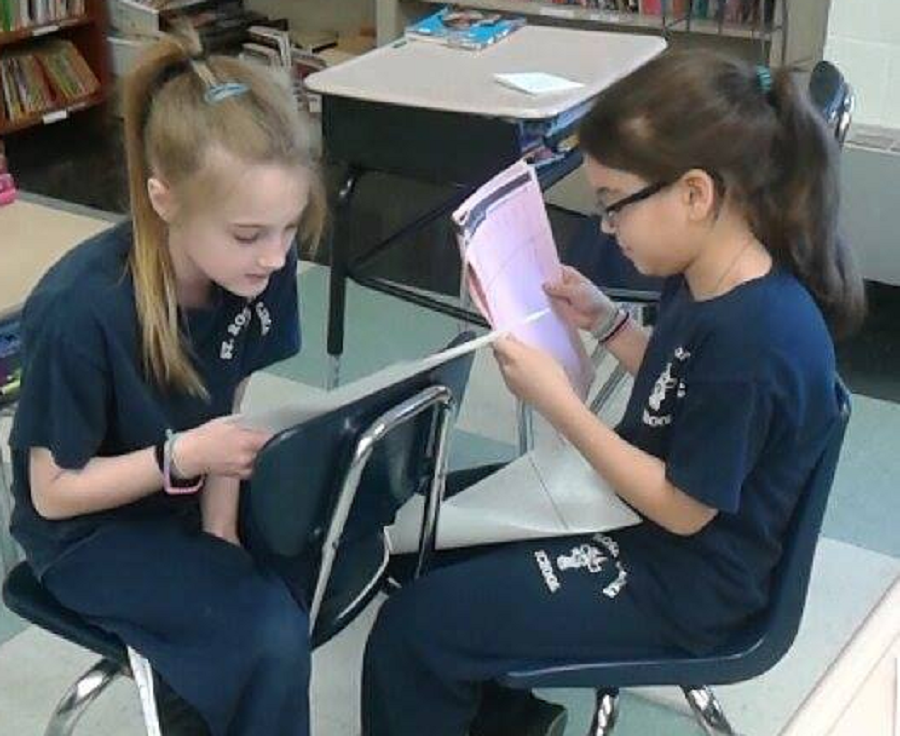
Two students participating in one of Rocket Math's math fluency programs(3) Start students practicing on the last set completed (passed) the previous year but for the first five practice sessions, practice on that set in a special way. First practice in partners around the outside for two or three minutes. But then, instead of taking a written test, have students practice in pairs orally with the test (inside the box), for two minutes. Practice the same way as around the outside. Have the student read each problem aloud and answer it from memory. The checker will need to have the test answer key. Practice for two to three minutes and then switch roles. This practice will provide the necessary review of all the facts learned so far, and will bring them right back up to speed.

(4) After a week of oral practice sessions with the test, then allow students to take the written test. Evaluate students based on their writing speed goals from last year (don’t re-test and raise them). Arrange for extra oral practice on the test for anyone who doesn’t pass. In the extra practice, make sure they orally practice the test in the center as well. Keep up the extra practice, on that same set until they pass. They should get there in a few days. They already learned this, they are just bringing it back. They haven’t forgotten it, the connection just needs a little strengthening.

(5) If students finished an operation before leaving, you can start them on the next operation appropriate for their grade. Second graders who have finished addition, for example, would start with subtraction (1s – 9s), and then go on to Subtract from 20, then Skip Counting.  Third graders need to be taught the concept of multiplication first, but then should begin multiplication, regardless of what they completed earlier.  Multiplication is so critical for future success in math you cannot let any child in your room (if you are in 3rd grade or above) leave it without learning those multiplication facts.  Best thing you can do for their math careers.

Now that you know what to do–enjoy the summer!

Can you avoid summer losses with Rocket Math?

Take up where they left off before the summer!

Don’t think students have to start over in Rocket Math. They have learned the facts so well that with careful review they can take up where they left off!

There is a way to start off the year on the same set on which students left off at the end of last school year (providing you know where that was). You do need to do a slightly different procedure at the start of the year, however.

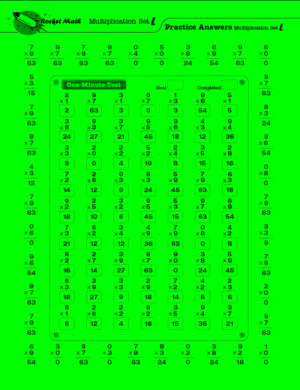
Notice on the Set L sheet above that only five of the facts on the One-Minute Test are new–the rest are review from the previous sets. That means that practice around the outside will help with the new facts, but won’t review those older facts from previous set. If you test the students on any set after the summer they might not pass because they need a little review of those older facts.

Here’s the way to beat the summer forgetting:
For the first week of school have the students add another practice session with the One-Minute Test each day. Give them the test answer keys, give them 2 to 3 minutes with their partner to orally practice the test problems with the same correction procedure as usual. Hint: have them take the sheets home and practice with a responsible sibling or a parent as well. A week to ten days of this extra review of the test problems and they will be successfully passing levels in Rocket Math–starting right from where they left off in June!

Can all 2nd graders finish subtraction?

Julie writes,

In our district, we have data that shows students are struggling with subtraction. We really want to put emphasis on getting the subtraction facts memorized. What are your thoughts about 3rd grade starting with subtraction in the beginning of the year and switching to multiplication the second half of the year regardless of having completed Z in subtraction?

Thanks, Julie

Dear Julie,

Multiplication facts are VERY important and you want to be sure that all third graders have enough time to master them. The best solution would be to get all your second graders through subtraction during the second grade year. Here are some suggestions to get better results–where more students develop automaticity in subtraction facts in second grade.

1) Start Rocket Writing for Numerals in the second half of Kindergarten, so that students leave K able to write numerals quickly.

2) Start Rocket Math Addition in the first month of first grade (because most all students) are able to write numerals fast enough. If you have a few who are below 18 boxes in a minute–give them extra work on Rocket Writing for Numerals to get them up to speed and into Rocket Math Addition before the end of October.

3) Monitor closely students who don’t pass an operation in six days and make sure they are getting a bonus practice session each day at school or encourage their parents to practice with them at home. Some few students will need extra help to practice twice or three times a day to make progress as fast as others.

4) Save folders from grade to grade (over the summer) so that students don’t have to start an operation over from the beginning (just continue on from where they left off) and so can finish an operation in a timely manner.

5) If students get stuck for more than a week, and definitely when they come back from the summer in the middle of an operation, have them practice the test problems orally as well as the outside problems. If they are only practicing the outside, and they are slow or have forgotten some of the cumulative review problems in the test, they need to practice the test problems (as well as the newer problems on the outside) to bring them up to speed.

I think that continuing a student in subtraction at the beginning of 3rd grade from where they left off in 2nd grade is an OK policy, but it is far better to have as a clear goal to get students through subtraction during 2nd grade. Hope this helps. -Don

Filling testing-created gaps in your schedule.

Many schools are starting spring testing soon, and it wreaks havoc with the daily schedule. People outside education don’t really understand how much school schedules are disrupted by attempting to test everyone in the school on the available computers. Not to mention catching all the students who are absent during their assigned time. Disrupted schedules create small gaps in the schedule, which are hard to fill, even more so when not every student is present. Let me present an option to fill those small gaps–do Rocket Math! Here’s five reasons why you should.

1) By this time of the year, students know the Rocket Math routine, so it should not take more than ten to fifteen minutes to run, start to finish. So Rocket Math can fill small gaps.

2) Even if Rocket Math has been done once during the day, a second or even third session during the day will NOT harm students, it will actually help them progress faster. (As long as you have at least a half hour between sessions).

3) It is beneficial for the students in the room even when some students are out doing make-up testing. It won’t require you to re-teach a lesson.

4) In contrast to free reading or make work activities, which only fill time, students doing Rocket Math will be learning critical skills that are necessary for future success.

5) In contrast to the stress of the accountability tests, Rocket Math is something students know well and have success at. They know what they are doing and they see their growth. They know they are learning. This is a powerful antidote to the not-so-straightforward tasks, questions and expectations of the accountability tests.

I highly recommend keeping Rocket Math folders handy for filling those small gaps in the daily schedule caused by testing.

How to tutor with Rocket Math

You can see this explained in our YouTube video here.

The first step in setting up a Rocket Math tutoring program is to make a folder for your student. Your Rocket Math subscription gives you access to our filing cabinet on the web. Open the Forms and Information drawer, look under Forms for Every Student and you’ll see the three forms you need. Print out the Rocket Chart and staple it on the front of a manila folder. Print out the Goal Sheet and staple it inside of the folder on the left. Print out the Individual Student Graph and staple it inside the folder on the right. Voila! You now have a student folder!

Next you must decide what operation you intend to teach to your student. Generally, begin with addition in first and second grade, and subtraction after addition is mastered. Starting in third grade multiplication has priority even if addition and subtraction are not mastered. Division comes after multiplication has been mastered.

Depending upon how well you know your math facts, it might be a good idea to make an answer key booklet. If you have two children working with each other, it is essential! You find a Practice Answers A-Z booklet under Answer Keys within each operation. Make the answer keys by printing out the PRACTICE ANSWERS A-Z booklet on a distinctive color of paper and stapling it into a packet.
Next, print out the writing speed test (found in the Forms and Information drawer under “Forms for Every student.”) Then on the first day, give this one-minute writing speed test. You are going to take the information of how many boxes completed from the writing speed test and transfer it to the goal sheet. On the goal sheet highlight the row with the student’s writing speed test results. That row gives you your student’s individualized goals for the 1-minute daily test.

Each day follow the same routine. Set up practice by getting out the student folder, which should have the right practice sheet for the day. Next, congratulate your student if they passed their previous set and let them color in the Rocket Chart for the level they passed. Now, you are ready to begin practicing. Have the student practice with you for two or three minutes followed by taking the one-minute timing. After the test, have the student fill in the date of this try on their Rocket Chart. Then evaluate to see if the student passed. If they had no errors and they met their individualized goal for the 1-minute timing (from the goal sheet) they passed. Then print the next lettered set from the website. If they didn’t pass, print the same sheet to practice again tomorrow.

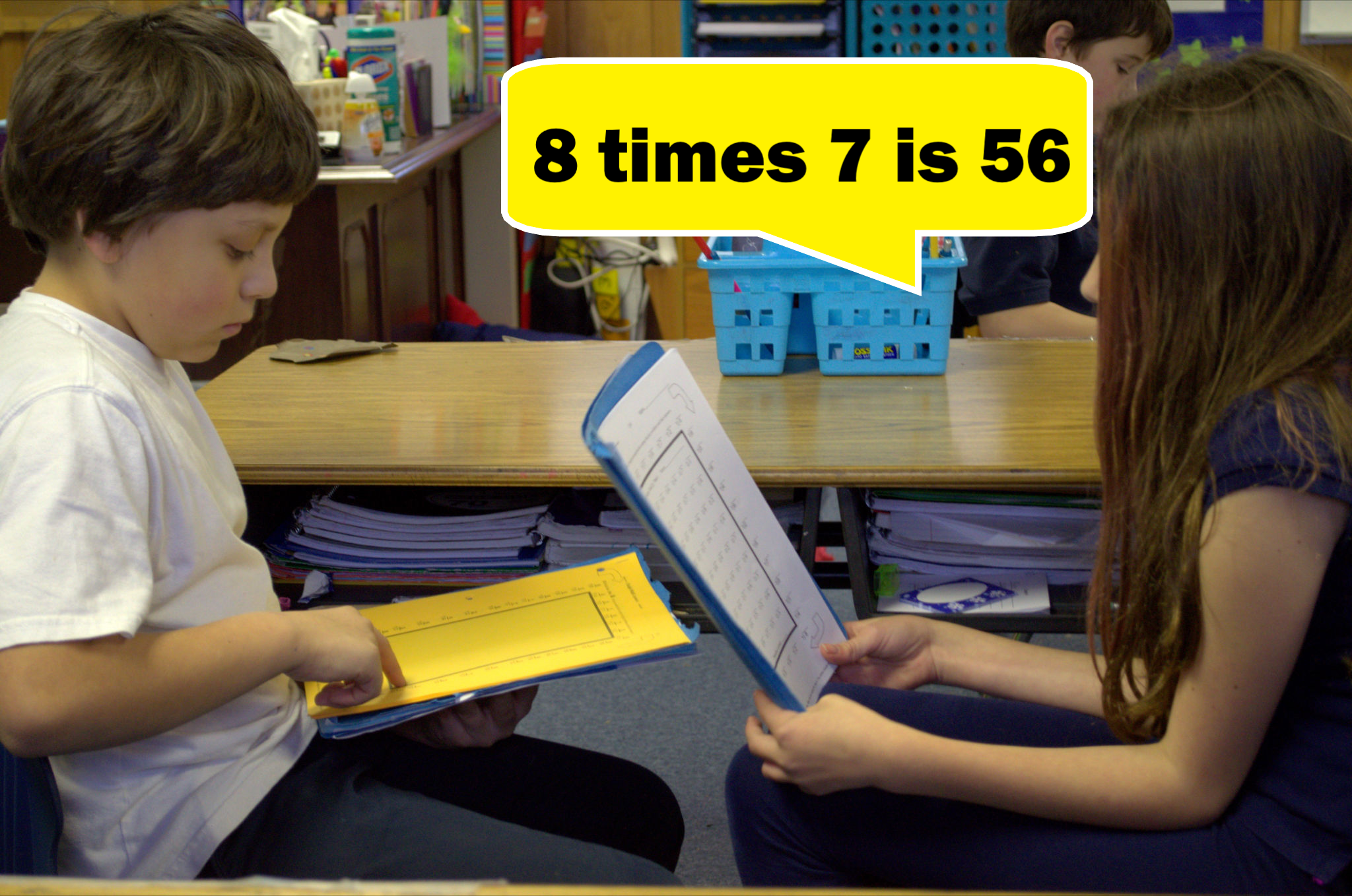
Daily practice is what makes Rocket Math work. The daily practice is verbal practice, with the student reading the problems around the outside of the Rocket Math worksheet and then saying answers aloud from memory as they go for two to three minutes. By saying the whole fact and the answer aloud each time, the student strengthens their memory of the whole verbal chain. Eventually, they can’t help but remember it—just like a popular advertising slogan. The daily oral practice is what makes Rocket Math work, not the tests! The daily practice is corrected practice, and it is essential that the tutor either knows the answers or has the answer key packet on colored paper, and the packet is turned to the matching page. While the student is practicing, all hesitations or errors are immediately corrected by the tutor. Once a student has read the problem aloud they should have already thought of the answer, so no hesitation is allowed.

If the student hesitates or makes an error, the tutor follows a specific three-step correction or teaching procedure. (1) The tutor interrupts to state the problem and the correct answer, (2) the tutor has the student repeat the problem and the correct answer three times, (3) then the student backs up three problems on the worksheet to give it another try.

Four days a week the student and tutor follow the daily practice routine and do the daily one minute timing. Once a week the student should do the 2-minute timing. This monitors progress and the student should graph their weekly results on the individual student graph inside their folder. If this is trending upward it is proof that the student is learning.

Here are some interventions, for students who are stuck. Remember: these students don’t need anything different, they just need more practice! (1) Make sure the student is not stopping during the test to erase, or look at the clock, or count on fingers, etc. (2) Do another 2-3 minute practice session daily (or two!). This will help kids get “over the hump” if they are stuck! (3) Just make sure to have at least a 30-minute break between practice sessions. (4) Try having students orally practice the tests also! (Because the test facts are different than the practice facts.)

You can expect students to be able to pass each set within 2 to 5 days—if you’re doing everything right. It’s important that students start at the beginning of an operation and are practicing correctly by saying the whole problem and the answer every time. Tutors must be correcting hesitations as well as errors and individualized goals must be based on the Writing Speed Test. If students are taking longer than two to five days, make sure they get extra practice sessions daily. For more suggestions see our website.

Should second graders begin multiplication facts?

Jen writes:
Hi Don,
I am a 2nd grader teacher and LOVE the Rocket Math program. Currently my students are on the addition and subtractions tests. I have had a handful of students pass addition and subtraction, but instead of moving them on to multiplication, I started them on an addition challenge (much higher goals). Not sure if that was a good idea, I just didn’t feel they were ready for multiplication. Do you suggest that 2nd graders do Rocket Math multiplication? Thank you for any help!

Dr. Don answers:
Hi Jennifer,

We have a couple of new options. You can use the Add to 20 program for your second graders who have passed all the subtraction worksheets. That will reinforce the single digit facts but also extend to the Common Core expectations that students would be fluent with combinations like 11+7 and 13+4. The worksheets of the Add to 20 program are part of the Universal subscription. I plan to get Subtract from 20 done soon, and I will also add that to the Universal subscription. So if you want to address those Common Core objectives, those two programs are things you can assign to 2nd graders who finish basic 1s-9s subtraction.

We also have another program, Skip Counting, that is part of the Universal subscription. That teaches students the count-by series, such as counting by 4s (4, 8, 12, 16, 20, 24, etc) to 40, and 9s to 90. The skill of skip counting is a great transition to multiplication because students are essentially learning successive addition when they are skip counting. So Skip Counting would be a great program for second graders after subtraction, especially good for helping them get ready for multiplication.

As far as when to start multiplication, it depends on your students’ concept development. Before beginning to memorize multiplication it is important that students understand the process of multiplication and what it means. If they have done skip counting, successive addition and/or drawn arrays then they probably understand multiplication. Ultimately the best test is whether, given unlimited time, but no help, those students can figure out any single digit multiplication fact, such as 7 x 9. [Don’t ask an easy one like 3 x 4, as they might have learned that by heart already.] If they can figure out any multiplication fact successfully, then they understand the concept. If they cannot figure it out, then they need more conceptual work before starting to memorize multiplication. So the answer about whether second graders are ready for multiplication facts is not necessarily the same for all students.

Why not start with subtraction in 3rd grade?

Julie asks:

Hi Don, My staff has a question about which operation to start with. In our district, we have data that shows students are struggling with subtraction. We really want to put emphasis on getting the subtraction facts memorized. What are your thoughts about 3rd grade starting with subtraction in the beginning of the year and switching to multiplication the second half of the year regardless of having completed Z in subtraction? Thanks!

Dr. Don answers:

Dear Julie,
Your teachers are right that a lot of students may not be fluent with subtraction facts. There are several reasons for that. And yes, it would be possible to start with subtraction in 3rd grade and then switch to multiplication as students finish, or by mid-year at the latest. But I would not recommend it because you will then have a problem with not every child getting through multiplication in 3rd grade, which results in a similar problem in fourth grade. What would be better would be to get every second grader fluent in subtraction facts before 3rd grade.

Why? It is important to understand the problem before specifying the solution. Students have trouble learning subtraction facts primarily because they have not achieved automaticity in addition facts first. And why aren’t they automatic in addition facts? Usually because they didn’t start early enough and work on addition facts long enough in first grade to get to automaticity with addition facts.

A second reason students don’t master subtraction during grade 2, happens when the school doesn’t keep track of folders from first grade. If students have to start completely over with addition in second grade, they don’t have enough time (if they are a child who needs a bunch more time to learn facts) to get through both addition and subtraction. They go slowly through addition again, and don’t get into subtraction until well after the middle of the second grade. So the first push is to try to get everyone passing subtraction in 2nd grade.

What you don’t want to do is start over again in subtraction in third grade and struggle through that all year and then not have enough time to master multiplication in third grade. Because multiplication facts are so important, it would be better to do the reverse. Start with multiplication in third grade–because it has priority–and then for those who finish multiplication allow them to “go on” to subtraction. It is much better to start fourth grade strong in multiplication facts (even if you still count on your fingers for subtraction) than to be a fourth grader who is strong in subtraction, but unable to answer multiplication facts!