
Facts practice: does it belong in middle school math?

It sure does, if you’re seeing this happen in your class!

Most middle school math teachers confide to me that their classrooms are negatively impacted by the number of students who stop to count out facts on their fingers.  Their issue was always what to do during facts practice with the other students who do know their facts.  It has taken a couple of years but I have put together a package of pre-algebra skills that are worth middle school students’ time practicing which are available in the Universal Subscription. Because the routine of Rocket Math is the same whether the students are practicing basic multiplication facts or learning equivalent fractions you’ll be able to manage all these different levels during the same ten-minute session.

Teachers know it is imperative that finger-counting middle schoolers get practice learning their facts.  Rocket Math is an excellent way to do that.  They will develop fluency and automaticity with the basic facts in an operation in a semester and from then on your lessons will be much easier.  Not only that, but a much higher proportion of the students will be finishing assignments.  There is a “Placement Probe” that can identify students who know their facts in about one minute. The students who know the basic facts of multiplication and division can be placed into the pre-algebra practice programs.
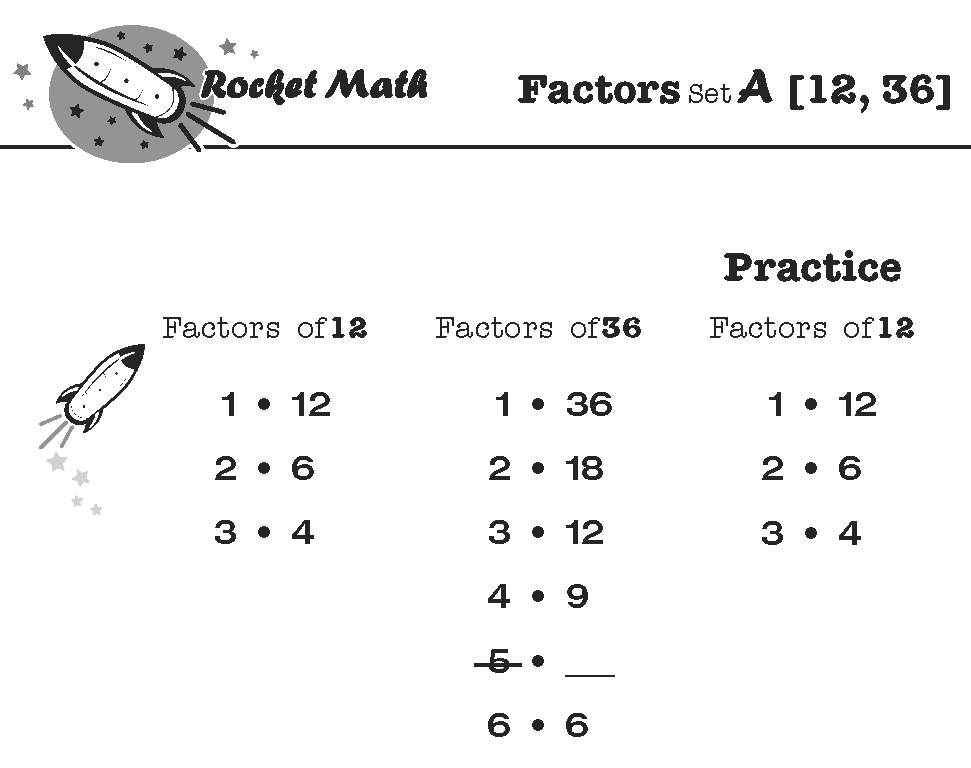
Factors Answers AFACTORS. Students probably ought to begin with the Factors program. What are the factors of 24? Answer: 1 and 24, 2 and 12, 3 and 8, 4 and 6. This is what students learn by memory from doing this program. Students practice with a partner, take a daily one minute timing, fill in a Rocket Chart, just like regular Rocket Math. Students learn all the factors for these numbers in this sequence: 12, 36, 24, 48, 18, 32, 16, 64, 10, 40, 20, 72, 8, 25, 50, 6, 21, 30, 60, 15, 45, and 100.
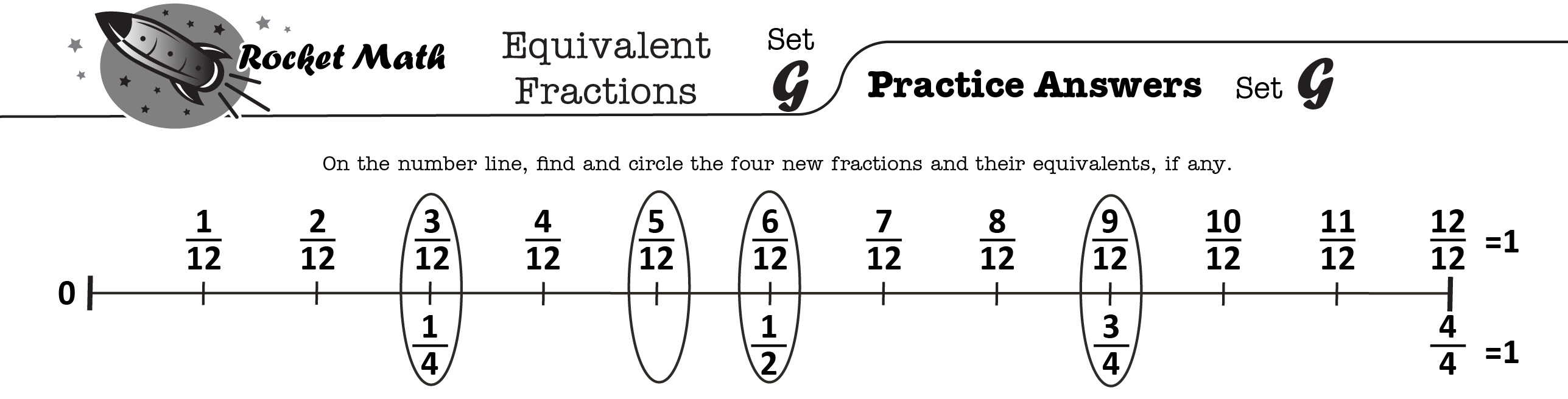


Fraction Number Line GEQUIVALENT FRACTIONS.  Students need to know that six-eighths is equivalent to three-fourths and that four-twelfths is equivalent to one-third.  While they can calculate these, it is very helpful to know the most common equivalent fractions by memory.  One of the most common problems students have in fractions is not “reducing their answers to simplest form.”  Equivalent fractions will help students commit 100 common equivalent fractions to memory.  Each set (A through Z) has four fractions which are displayed on a fraction number line.  Students frequently learn fractions equivalent to one,such as ten-tenths, as well as fractions that can’t be reduced, for example three-fourths is equivalent to three-fourths.  Using the fraction number line will help with student understanding of why those fractions are equivalent.

Integers ArrowsINTEGERS (Adding and subtracting positive and negative numbers).  Integers displays problems on a vertical number line and then teaches students two rules about how to solve problems that add or subtract positive and negative numbers.

Rule 1: Go up when you add a positive number OR subtract a negative number.
Rule 2: Go down when you subtract a positive number OR add a negative number.

Students gradually learn several variations of all four types of problems.  They practice with the number line on each page and then have a chance to build fluency on the top half of the page as they work with their partner.  You will probably not be surprised that there is a one-minute test on each set.  The goals are slightly different than before.  Students are to be 100% accurate and to complete at least 80% of their rate at answering simple addition and subtraction problems.

10s, 11s, 12s Multiplication and 10s, 11s, 12s Division facts are also available in the Universal Subscription.  If you have students who think they know the basic facts, but need review, putting them into either of these programs will review the 1s through 9s facts, teach them new ones and allow them to save face.

Among these five programs there are good things for ALL middle school math students to learn, even the more advanced students.  This will enable a math teacher to devote ten minutes a day to fact practice without holding anyone back.  Everyone will have something meaningful to practice during that time.  I think this could be a huge step forward for a lot of middle school MATH classrooms.


Will finger counting ever go away?

Some “experts” in education think that teaching and practicing rote information, like math facts, is unnecessary.  Just let students do math or do games and they will learn facts well enough to get by.  That is true for a few students, but many students continue to count on their fingers up into junior high and high school if we don’t help them commit these facts to memory!  So the short answer to the question of whether finger counting will ever go away, is “No!” unless we do something.

One of the things that is unique about Rocket Math is that students begin to learn facts well enough so they have instant recall.  By practicing orally with a peer, they are saying the facts and the answers aloud, and from memory, over and over again.  By doing that, students come to the point that, when they say that problem to themselves, the answer pops into their heads without effort, like the words to an advertising jingle.  When the answer occurs to them instantly, they realize they know the answer before they can count on their fingers, and they stop.  This is how finger counting goes away.  Students recall the answer before they have to start counting fingers.  The end of finger counting comes with the kind of daily oral practice that the procedures of Rocket Math provide.

Why do multiplication facts have priority after 3rd grade?

Because older students CANNOT succeed in math without multiplication facts.

Am I sure? Yes, I’m sure. “But,” you say, “my students are still counting addition and subtraction on their fingers.”

I know. And I am still sure—fourth grade and up—multiplication. Why? Once children are in fourth grade it is critical that teachers make sure they memorize multiplication facts—primarily because you can’t be sure of how much help they will get later to learn the math facts. Sadly, your students may only learn one operation to fluency. If so, multiplication facts have priority over addition and subtraction. Besides complex multiplication and division, the multiplication facts are needed for success in fractions and ratios. Students have to immediately see the relationships between numbers in order to understand topics like equivalent fractions, reducing fractions, combining unlike fractions, as well as ratios. Let’s be honest here…those are the things that state tests LOVE to ask about. Not to mention, these are the pre-algebra skills students need to be successful in algebra and the rest of math.

If you have the students for long enough (at least one year) you may find that they finish and have mastered both multiplication and division facts. Then you can go back and have them learn addition and subtraction facts as well.

Don’t get me wrong — I know that addition and subtraction facts are VERY IMPORTANT — it’s just that multiplication is MORE IMPORTANT.

Are you ready for summer?

Preparing now can insure that students will maintain their Rocket Math learning over the summer.

(1) The simplest and most important thing you can do to get ready for summer is to save those Rocket Math folders at the end of the year. The folders can then be given to the next year’s teacher, so he or she knows where the student left off. Given special practice techniques at the start of fall (outlined below), students do NOT have to go back or start an operation all over again the next year. Some students take months to get where they are in an operation, and it is a terrible waste of their time to start them over. Especially if they have new faster writing speed goals, now they really have to work hard to master each set and it may take them quite a while.

(2) Make sure to take a few days to re-teach your students how to correct and when to correct (errors and hesitations).  Teach this by modeling errors and hesitations and have students be your checker and model how to correct for the other students to see.  Keep working with that student until you get perfect corrections even on hesitations.  Then “rinse and repeat” with another student.  Do this teaching and modeling for ten minutes each day for the first week or so.

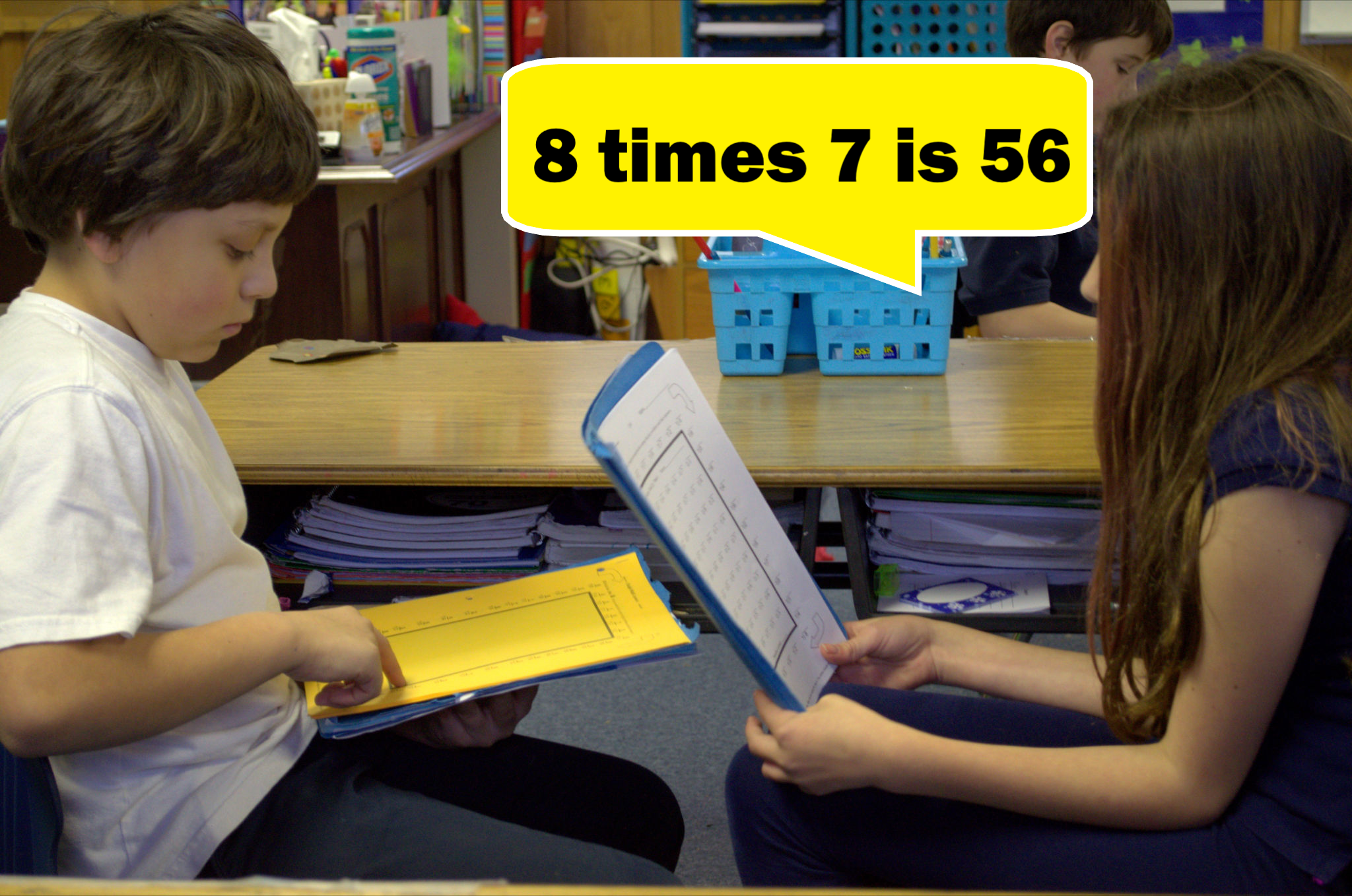
Two students participating in one of Rocket Math's math fluency programs(3) Start students practicing on the last set completed (passed) the previous year but for the first five practice sessions, practice on that set in a special way. First practice in partners around the outside for two or three minutes. But then, instead of taking a written test, have students practice in pairs orally with the test (inside the box), for two minutes. Practice the same way as around the outside. Have the student read each problem aloud and answer it from memory. The checker will need to have the test answer key. Practice for two to three minutes and then switch roles. This practice will provide the necessary review of all the facts learned so far, and will bring them right back up to speed.

(4) After a week of oral practice sessions with the test, then allow students to take the written test. Evaluate students based on their writing speed goals from last year (don’t re-test and raise them). Arrange for extra oral practice on the test for anyone who doesn’t pass. In the extra practice, make sure they orally practice the test in the center as well. Keep up the extra practice, on that same set until they pass. They should get there in a few days. They already learned this, they are just bringing it back. They haven’t forgotten it, the connection just needs a little strengthening.

(5) If students finished an operation before leaving, you can start them on the next operation appropriate for their grade. Second graders who have finished addition, for example, would start with subtraction (1s – 9s), and then go on to Subtract from 20, then Skip Counting.  Third graders need to be taught the concept of multiplication first, but then should begin multiplication, regardless of what they completed earlier.  Multiplication is so critical for future success in math you cannot let any child in your room (if you are in 3rd grade or above) leave it without learning those multiplication facts.  Best thing you can do for their math careers.

Now that you know what to do–enjoy the summer!

What best honors & motivates achievement?

Recognition only after real, actual accomplishments.

What makes for a great award, or great recognition that really motivates?  In the final analysis, recognition, like an Olympic gold medal, is not about what you receive–it’s about how hard you worked to get it.  If students worked hard, and accomplished something real and tangible, then the recognition they are given, regardless of its form, will be valuable and meaningful.  A paper certificate given out by an adult that represents weeks or months of effort, an honest accomplishment, will be highly prized. Those are the certificates that are posted prominently in the bedroom or on the refrigerator at home, because it was hard to get.

Recognition that is not given to everyone.

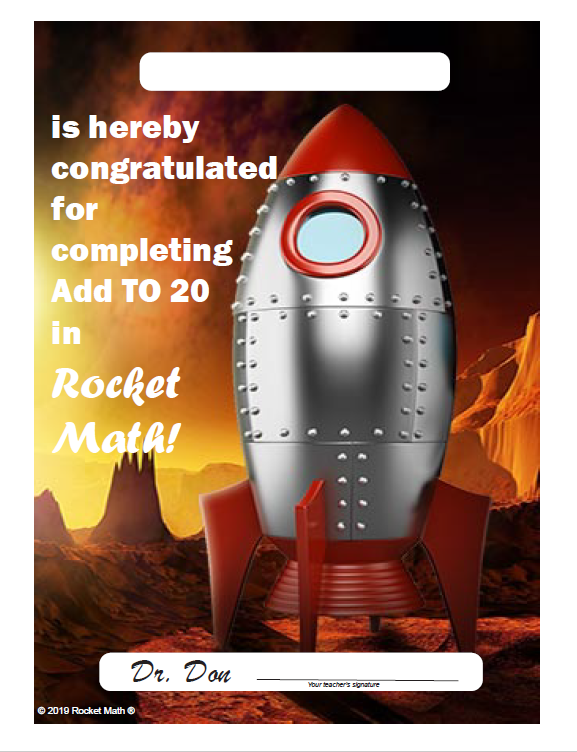
Remember this fact, when you want to honor student achievement at the end of the year.  If you give awards to every student, then an award means little or nothing.  If on the other hand, students know they had to work and put forth effort to earn the reward, then it is a real honor.  Rocket Math has many built in milestones of accomplishment that are great to recognize publicly.  Certainly completing an operation and getting a Learning Track Certificate, like the one to the left, is one of the most commonly celebrated achievements.

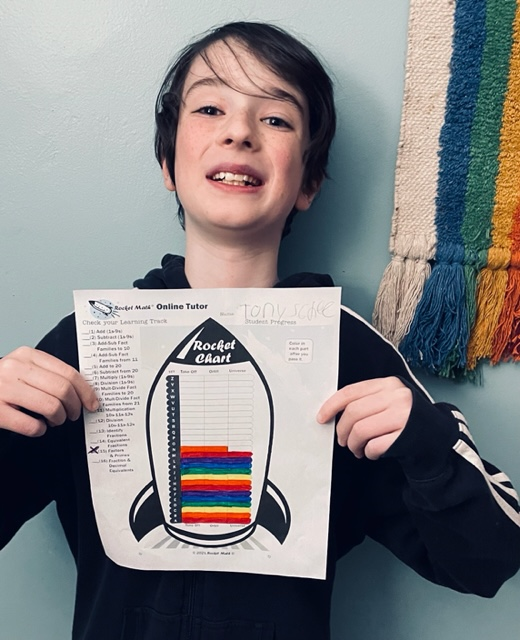
This student’s teacher shared this picture of the student and his Rocket Chart, proving his accomplishment as he moved up through the levels.  This is something to be really proud of, because it represents a real, tangible accomplishment.  Another accomplishment is when a student beats his or her individual best in two-minute timings.  Yet another tangible Rocket Math accomplishment is being able to pass two levels in one week or ten levels in a month!

Recognition for things the students know they can do.

What motivates students to try to achieve is (1) knowing what has to be done and (2) believing they can do it. This is another reason why recognizing real, tangible accomplishments works so well. If the other students can see what their recognized peer did and they understand what has to be done to get there, they are motivated to get some of that glory for themselves. Getting through Level Z of Rocket Math is something students know they can do, if they just keep working at it. It is hard to believe you will become Student of the Month, if you don’t know what the previous recipients did to achieve that honor. But if you know that working hard and practicing your math facts every day can get you there–then you can believe it is possible.

This is why Rocket Math motivates students.

Rocket Math was created to teach math facts to students.  They need this fundamental skill.  So that’s why it was created.  However, because Rocket Math has real, doable milestones that take work to achieve but that students can do, students are highly motivated by their accomplishments in Rocket Math.  They love it because they recognize their achievement.  If the teacher pays attention and also recognizes student effort and achievement, the students will be motivated to learn math facts.  Then math becomes a subject of pride and confidence, which is priceless.