Don’t argue, just prove it works!
Joyce asks:
How can we encourage the teacher who refuses rocket math and administration does not reinforce (or enforce) the program’s use?
Joyce,
Joyce asks:
How can we encourage the teacher who refuses rocket math and administration does not reinforce (or enforce) the program’s use?
Joyce,
On Thursday May 3rd, the Educational App Store is hosting a seminar with Dr. Don, “How to prepare students for math success.” Pacific time will be 8:30 AM, Eastern time 12:30 PM and London time will be 4:30 PM .
This 30-minute webinar focuses on the importance for future math success of developing fluency and automaticity with math facts and how to help students achieve it.
Dr. Don Crawford, the author of Rocket Math and Justin Smith, CEO of the Educational App Store will discuss
Here is the link to register for the webinar. https://www.educationalappstore.com/webinar/how-to-prepare-students-for-math-success
Sometimes students need to review test problems also.
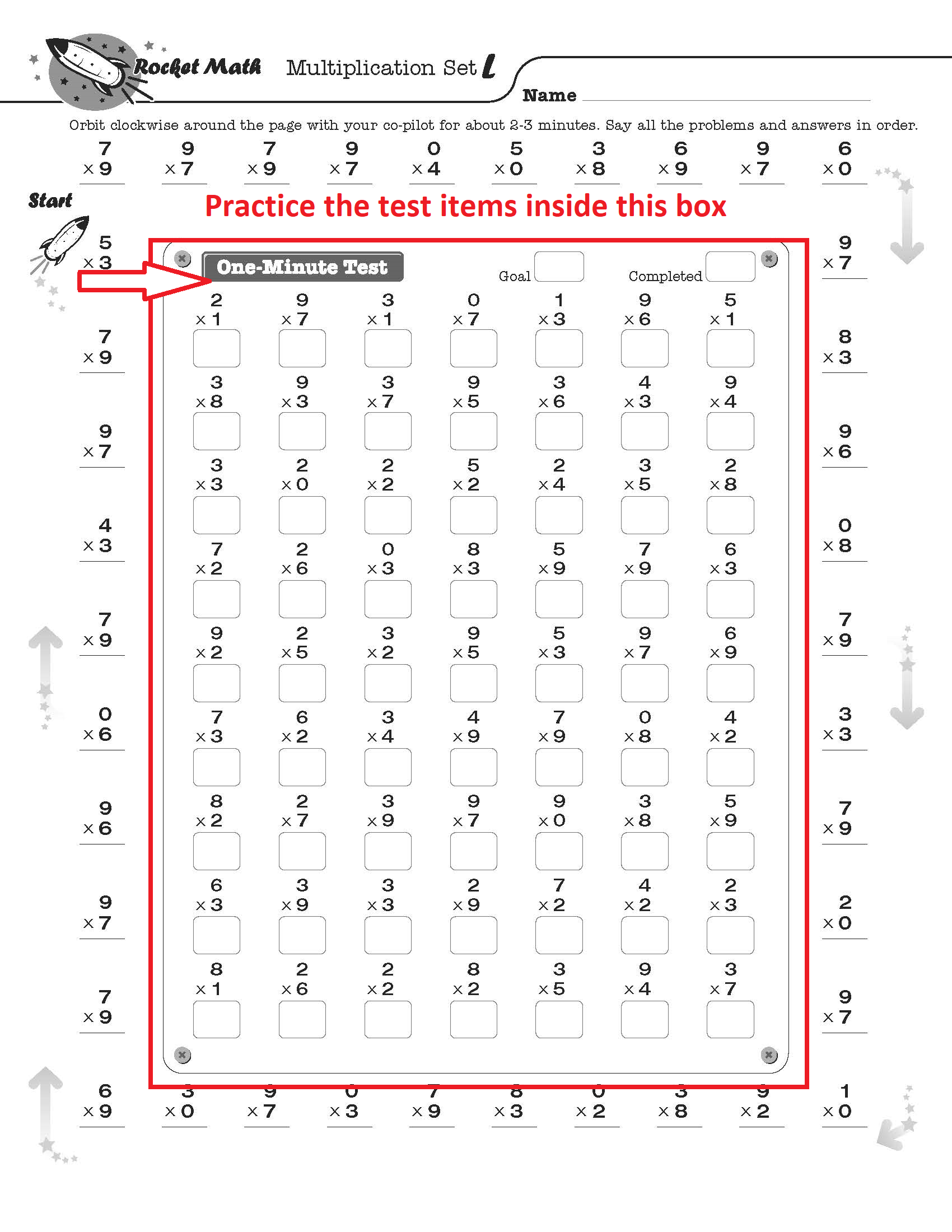
You know that there is a difference between the test problems and the practice problems, right? The problems practiced around the outside are the recently introduced facts. The problems inside the test box are an even mix of all the problems taught so far. Sometimes students have forgotten some of the older facts. For example, if there has been a break for a week or more, or if the student has been stuck for a couple of weeks, the student may have forgotten some of the facts from earlier and may need a review of the test problems.
How you could diagnose for this problem. Have the student practice orally on the test problems inside the box with you. If the student hesitates on several of the problems that aren’t on the outside practice, then the student needs to review the test items.
Solution. If you have this problem with quite a few students (for example after summer break or after Christmas break) then have the whole class do this solution. For the next week, after practicing around the outside, instead of taking the 1 minute test in writing, have students practice the test problems orally with each other. Use the same procedures as during the practice—two or three minutes with answer keys for the test, saying the problem and the answer aloud, correction procedures for hesitations, correct by saying the problem and answer three times, then going back—then switch roles. Do this for a week and then give the one-minute test. Just about everyone should pass at that point.
Solution. If you have this problem with a handful of students, find a time during the day for them to practice the test problems orally in pairs. If the practice occurs before doing Rocket Math so much the better, but it will work if done after as well. They should keep doing this until they pass a couple of levels within six days.
If neither the first or the second solutions seem to work, write to me again and I’ll give you some more ideas.
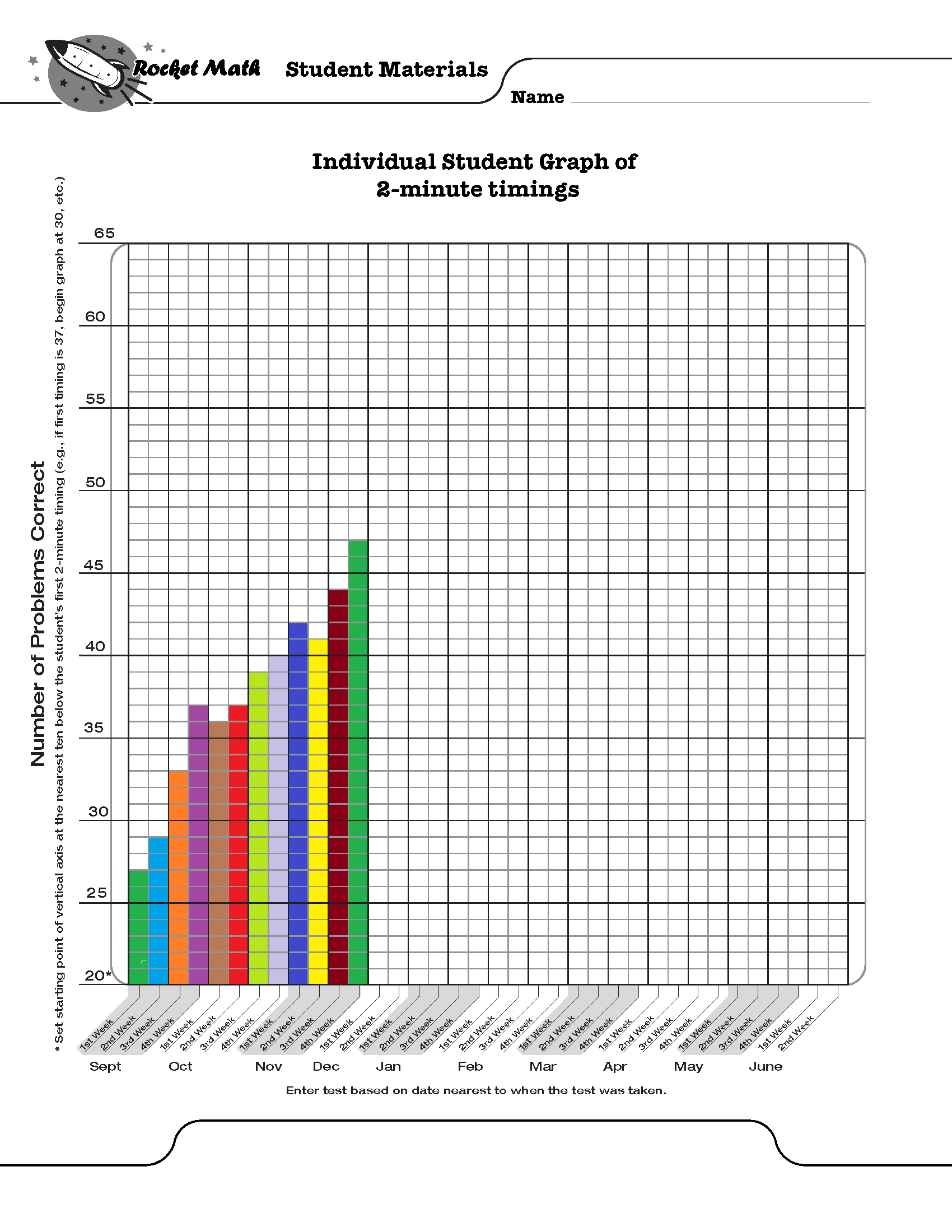
First of all, understand that the two-minute timings are NOT a teaching tool. They are an assessment tool only. Giving a two-minute timing of all the facts in an operation every week or two allows you to graph student performance. You graph student performance to see if it is improving. If the graph is going up, as in the picture above, then the student is learning. If the graph is flat, then the student is not really learning.
The individual graphs should be colored in by students allowing them to savor the evidence of their learning. The graphs should be shared with parents at conference time to prove that students are learning. 
Progress monitoring with two-minute tests are a curriculum-free method of evaluating a curriculum. If you use the same tests you can compare two methods of learning facts to see which one causes faster growth. This makes for a valid research study.
This kind of progress monitoring over time is also used in IEPs. You can draw an aimline from the starting performance on the two-minute timing to the level you expect the student to achieve by the end of the year. (Note the writing speed test gave you goals for the two-minute timing which you could use for your end-of-year goal.) The aimline on the graph, when it crosses the ending date of each quarter, will provide quarterly objectives that will enable quarterly evaluation of progress–required for an IEP.
These two minute timings are a scientifically valid method of proving whether students are learning math facts, in the same way that tests of oral reading fluency prove whether students are learning to read. They can be used to prove to a principal or a curriculum director, for example, that Rocket Math is working and is worth the time, paper and money it requires.
Adding and subtracting positive and negative numbers can be confusing for students. You can either start with a positive or a negative number and combine it with a positive or a negative number. That makes for four types or patterns of problems. Then when you consider addition and subtraction, the total is 8 problem types. Rocket Math Worksheet Program has three learning tracks to help students learn how to deal with integers. Mixed Integers include all eight types, whereas Learning to Add Integers and Learning to Subtract Integers each just deal with four types. [Mixed Integers may be too hard for some or all of your students–meaning they can’t pass levels in 6 tries. In that case, put them through the Learning to Add Integers and Learning to Subtract Integers first.]
The first issue for students is just to be certain of the answer. A vertical number line, where “up” is more and “down” is less helps provide certainty.
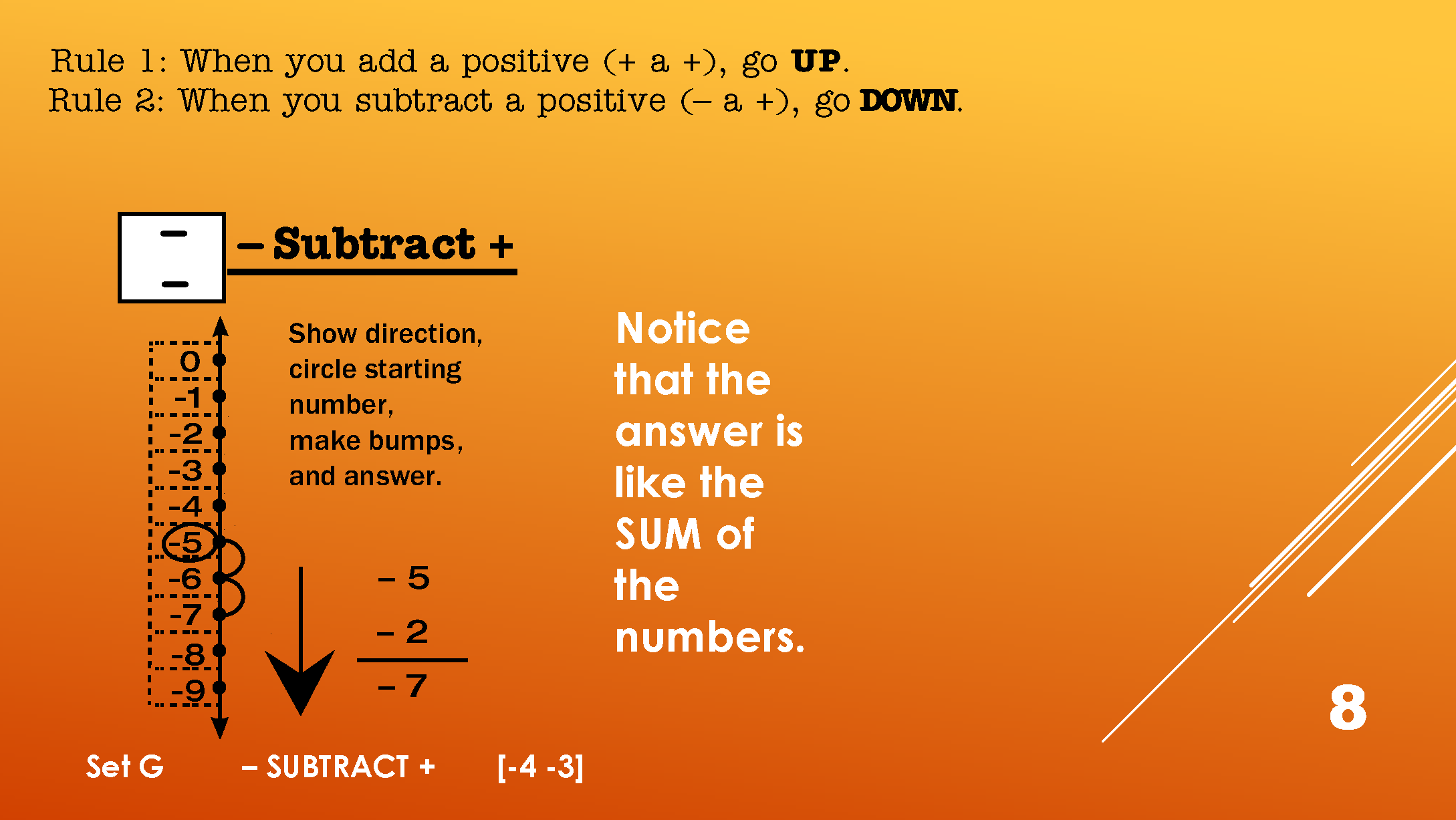
I have posted a series of free lessons online (links below) that use a vertical number line and a consistent procedure to take the confusion out of the process. Students can solve all eight types of problems with the same process on the vertical number line. Using the vertical number line there are two rules to learn. Rule 1: When you add a positive or subtract a negative, you go up on the number line. Rule 2: When you subtract a positive or add a negative, you go down on the number line.
So the first thing to figure out is what you are being asked to do (add or subtract a positive or a negative), and then use the rule to tell you whether you’re going up or down. Next step in the procedure is to circle the starting point on the number line. Once you circle the starting point, you show how far you’re being asked to go. You simply make the right number of “bumps” going either up or down from where you start. That gives you the answer without any uncertainty. These online lessons are quick (about 2 minutes) and identify a pattern of whether the answer is like the sum or the difference between the numbers. Once students can recognize the pattern they can begin to answer fluently and without a struggle
(1) Mixed Integers Set A1 Positive add a positive
(2) Mixed Integers Set A2 Positive subtract a positive
(3) Mixed Integers Set D Negative add a positive
(4) Mixed Integers Set G Negative subtract a positive
(5) Mixed Integers Set J Negative subtract a negative
(6) Mixed Integers Set M Positive subtract a negative
(7) Mixed Integers Set P Positive add a negative
(8) Mixed Integers Set S Negative add a negative
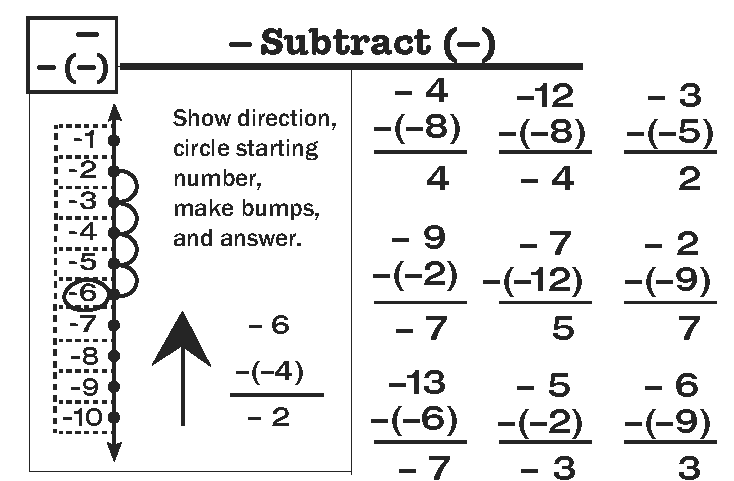
Here is a part of a page from the Mixed Integers learning track. The paired practice part of the program helps students learn to quickly and easily recognize each pattern. First, students use the vertical number line to work on a problem. In this example: -6 minus (-4). Then they have a set of problems with the same pattern (a negative subtracting a negative), which they should be able to answer orally without using the number line. Each worksheet includes all the types learned so far in the learning track.
As with all Rocket Math programs, there is a 2 to 3-minute practice session (at this level, I’d recommend 3 minutes), with a partner. Then the two switch roles. The practice is followed by a one-minute test. If the student can answer the problems in the test fluently (essentially without hesitations), the level is passed. As always, the student’s goals are individually determined by a Writing Speed Test. If a given level is still difficult, the student stays with that level a bit longer.
When a new pattern or type of problem is first introduced the one-minute tests will have a whole row of problems that are the same pattern. When the student passes the level, the next test will have two types of problems in each row. The next level has 3 types in a row, culminating in the fifth level, where the problem types are mixed. This way, the student develops fluency in recognizing the type of problem and how to derive the answer quickly. The Learning to Add Integers and Learning to Subtract Integers learning tracks take more time to learn the patterns, while Mixed Integers move more quickly.
Here’s a link to sign up for a Worksheet Subscription.
Here is a link to a quick, one-minute explanation of the paper-and-pencil version of Rocket Math.
Here’s where you can get started
using Rocket Math with a
(normally $49 a year).
Many students find integers confusing. If you add a negative to a negative are you getting more or less??? Over the years different “rules” have been used to try to remember what should happen. Rules such as “two negatives make a plus” or “opposite signs subtract.” Whatever is used to try to remember, it interferes with a student’s ability to quickly and reliably get the answers without having to stop and puzzle it out.
A Vertical Number line is more intuitively obvious for learning integers.I have posted a series of free lessons online (links below) that use a vertical number line to take some of the confusion out of the process. Turns out there are a total of eight types of problems but all of them can be solved with the same process on the vertical number line. Intuitively on a vertical number line, up is more and down is less.
(1) Mixed Integers Set A1 Positive add a positive
(2) Mixed Integers Set A2 Positive subtract a positive
(3) Mixed Integers Set D Negative add a positive
(4) Mixed Integers Set G Negative subtract a positive
(5) Mixed Integers Set J Negative subtract a negative
(6) Mixed Integers Set M Positive subtract a negative
(7) Mixed Integers Set P Positive add a negative
(8) Mixed Integers Set S Negative add a negative
Using the vertical number line there are two rules to learn. Rule 1: When you add a positive or subtract a negative you go up on the number line. Rule 2: When you subtract a positive or add a negative you go down on the number line.
So the first thing to figure out is whether you’re going up or down. Once you do that you simply make “bumps” going either up or down from where you start. That gives you the answer without any uncertainty. These lessons are quick (about 2 minutes) and identify a pattern of whether the answer is like the sum or the difference between the numbers. Once students can recognize the pattern they can begin to answer fluently and without a struggle.
To help with the work of learning to quickly and easily recognize each pattern in Integers Rocket Math now includes three “Integers” Learning Tracks in our Worksheet Program Universal Level Subscription. (Click here to get a 60-day initial trial subscription for less than the standard full-year subscription.)

The first integers learning track, Learning to Add Integers, is limited to adding integers. In the above list of lessons, the adding lessons are numbers 1, 3, 7, and 8. The second integers learning track, Learning to Subtract Integers, is limited to subtracting integers and teaches the processes shown in lessons 2, 4, 5, and 6. The third learning track, Mixed Integers Drawer combines all 8 processes into one learning track. If students are likely to have issues or begin to find the Mixed Integers lessons difficult, have them do the separate operation first.
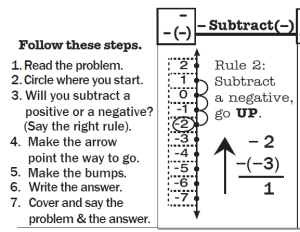
In the Rocket Math Integers lessons, students use the vertical number line to work a problem.
In this example: -2 minus (-3). They use a rule and then apply it to the number line to find the answer. Then they have a set of problems with the same pattern they can orally answer without having to use the number line.

As with all Rocket Math programs, there is a 3-minute practice session, with a partner. The partner who is checking has the answer key and corrects all errors immediately. Then the two switch roles. Then the practice is followed by a one-minute test. If the student can answer the problems without hesitation the level is passed. If it is still difficult the student stays at that level a bit longer. When a new pattern is introduced the tests will have a whole row of problems that are the same pattern. When that level is passed the next test will have two types of problems in each row. The next level has 3 types, then 4 types in each row. Then the problem types are mixed. This way the student develops fluency in recognizing the type of problem and how to derive the answer quickly.
Rocket Math has a money-back satisfaction guarantee. If you try this and find it isn’t everything you hoped, for in terms of helping your students become fluent with integers, I’ll gladly refund your money. I’m betting they’re going to love it.
Students need to practice daily to develop math fact fluency. When students are seeing regular success in Rocket Math, they are motivated and want to do Rocket Math every day (if not more.) This is how it should be. Students love Rocket Math when the implementation is being done well enough so they are passing every few days. If they start to complain about doing Rocket Math, then something is amiss–because they aren’t making enough progress to be motivated. You need to correct your implementation BEFORE that happens.
Students should pass a level in no more than 6 days. That’s the reason there is room for only six “tries” on the Rocket Chart. If any of your students are going beyond six “tries” without passing, there needs to be an intervention.
When students don’t pass regularly, they get discouraged. Teachers need to intervene to help students make regular progress. They don’t need to find a different way to practice like flashcards or something else. They just need more practice or better quality practice. For any student who is not passing in six days, the teacher or parent needs to either improve the quality of their practice or the amount of their practice–or possibly both.
You can check on the quality by observing each student as he or she practices with the partner. Monitoring carefully during practice is the key! 
Some students need two practice sessions each day, what football teams call “2-a-days!”
App Names: Rocket Math Add at Home, Add at School, Multiply at Home, and Multiply at School
Developer’s name: Rocket Math, LLC
App Link :
https://itunes.apple.com/us/app/rocket-math-multiply-at-home/id1048024368?mt=8
Primary School Apps (5-7 Years)
Rocket Math is an offshoot of an existing programme for schools designed to increase children’s speed and fluency in answering simple arithmetic. This app encourages frequent short sessions and is supported by plenty of information explaining its purpose and methods.
The purpose of Rocket Math is to build what its developer terms “automaticity” in arithmetic. A fluent reader does not need to decode simple and frequently encountered words letter by letter. The same can be true for frequently encountered arithmetic.
When automaticity is achieved in arithmetic the answers are available in an instant. The advantages of this, beyond speed, are that it leaves more of the person’s mental processes available for other aspects of the problem. If a person does not have to think about achieving simple arithmetic answers, he or she can concentrate on the more complex and lengthier aspects of a problem.
Rocket Math the app follows on from a well-established programme of the same name based on traditional written resources. Repeat practice and a steady increase in the breadth of the covered arithmetic are at the heart of its methods.
Children are taken through a series of stages in which they are faced with a rapid succession of arithmetic questions. Remember, the purpose of this app is to build fluency in frequently encountered arithmetic problems, not complex ones. As such, the questions will be simple ones and, at first, until the breadth expands, there will be little variation in them. Only three seconds is allowed per question so, for some children, developing enough fluency to progress will be difficult but others will thrive on the challenge.
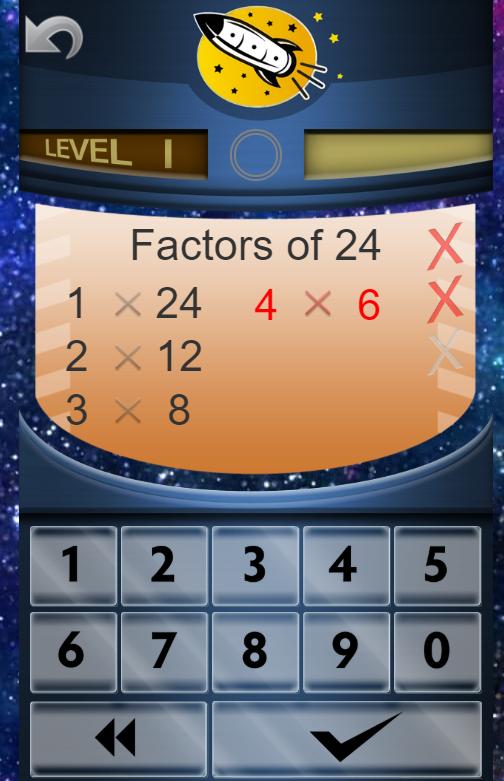
Answers are given by typing them onto a built-in number pad. The app is simple to use and looks attractive. Its space-travel styling and theme add a game-like feel although it is not a game. Speech provides a response to incorrect answers and provides encouragement between levels. It all works very well and provides the exact type of practice that it promises.
An unusual but useful feature is that the app enforces its little-and-often recommendations by insisting on a thirty-minute break after 5 minutes of play. As multiple sessions are likely to yield better results than a single, marathon session, this is an excellent feature that will prevent children from relying on a last-minute catch-up rather than a steady engagement with the app. This, combined with a useful breakdown of each child’s performance in the student report screen, provides reassurance to adults that their children are making the best possible use of the app.
A family of apps is available and potential buyers should think about which they need. Two of the apps cover addition and subtraction and two cover multiplication and division. Your choice here is obviously dependent on what aspect you would like to cover.
The remaining choice is between a school and a home version. They are identical in functionality except that the home version is free to download with a lengthy trial period. The school version has a flat, one-off, fee. Prospective teachers would still be wise to download the home version first so that they can appraise the app’s suitability.
If they choose to utilise the app within their school then buying the school version will be a simpler process than the in-app purchase of the home version. It will also allow schools to utilise the volume purchasing programme whereby they can receive a discount for buying twenty or more of the same app.
Parents will be pleased to see that the app caters for up to three children. As each child engages with the app, parents can check to see how they are performing and offer help, encouragement or rewards as they see fit. Some useful background information on the app’s purposes and usage are provided within the app itself and a more comprehensive overview of the Rocket Math ethos is available on the developer’s website.
All of the Rocket Math apps provide a learning opportunity that is tightly focused on realising their goal of improving children’s arithmetic fluency. As such, if this is a goal that you also share, you will find them good value and useful apps.
Knowing when you’ve found ALL the factors is the hard part.
Students have to learn how to find the factors of a number because several tasks in working with fractions require students to find the factors of numbers. Thinking of some of the factors of a number is not hard. What is hard is knowing when you have thought of ALL the factors. Here is a foolproof, systematic method I recommend: starting from 1 and working your way up the numbers. This is what student practice in the Worksheet Program Factors Learning Track. Students also learn the pairs of factors in this sequence in the Online Game.
Dr Don has a white board type video lesson that explains this in 6 minutes.
https://www.educreations.com/lesson/view/how-to-find-all-the-factors-of-a-number/46790401/
Bookmark this link so you can show it to your students.
How to find all the factors of numbers
Always begin with 1 and the number itself-those are the first two factors. You write 1 x the number. Then go on to 2. Write that under the 1. If the number you are finding factors for is an even number then 2 will be a factor. Think to yourself “2 times what equals the number we are factoring?” The answer will be the other factor.
However, if the number you are finding factors for is an odd number, then 2 will not be a factor and so you cross it out and go on to 3. Think to yourself “3 times what equals the number we are factoring?” There’s no easy rule for 3s like there is for 2s. But if you know the multiplication facts you will know if there is something. Then you go on to four—and so on.
The numbers on the left start at 1 and go up in value. The numbers on the right go down in value. You know you are done when you come to a number on the left that you already have on the right. Let’s try an example.
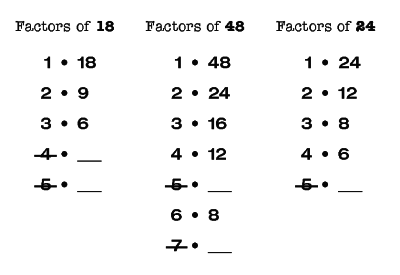
Let’s find the factors of 18. (To the left you see a part of a page from the Rocket Math factoring program.)
We start with the first two factors, 1 and 18. We know that one times any number equals itself. We write those down.
Next we go to 2. 18 is an even number, so we know that 2 is a factor. We say to ourselves, “2 times what number equals 18?” The answer is 9. Two times 9 is 18, so 2 and 9 are factors of 18.
Next we go to 3. We say to ourselves, “3 times what number equals 18?” The answer is 6. Three times 6 is 18, so 3 and 6 are factors of 18.
Next we go to 4. We say to ourselves, “4 times what number equals 18?” There isn’t a number. We know that 4 times 4 is 16 and 4 times 5 is 20, so we have skipped over 18. We cross out the 4 because it is not a factor of 18.
Next we go to 5. We might say to ourselves, “5 times what number equals 18?” But we know that 5 is not a factor of 18 because 18 does not end in 5 or 0 and only numbers that end in 5 and 0 have 5 as a factor. So we cross out the five.
We would next go to 6, but we don’t have to. If we look up here on the right side we see that 6 is already identified as a factor. So we have identified all the factors there are for 18. Any more factors that are higher we have already found. So we are done.
Now let’s do another number. Let’s find the factors of 48.
We start with the first two factors, 1 and 48. We know that one times any number equals itself.
Next we go to 2. 48 is an even number, so we know that 2 is a factor. We say to ourselves, “2 times what number equals 48?” We might have to divide 2 into 48 to find the answer is 24. But yes 2 and 24 are factors of 48.
Next we go to 3. We say to ourselves, “3 times what number equals 48?” The answer is 16. We might have to divide 3 into 48 to find the answer is 16. But yes 3 and 16 are factors of 48.
Next we go to 4. We say to ourselves, “4 times what number equals 48?” If we know our 12s facts we know that 4 times 12 is 48. So 4 and 12 are factors of 48.
Next we go to 5. We might say to ourselves, “5 times what number equals 48?” But we know that 5 is not a factor of 48 because 48 does not end in 5 or 0 and only numbers that end in 5 and 0 have 5 as a factor. So we cross out the five.
Next we go to 6. We say to ourselves, “6 times what number equals 48?” If we know our multiplication facts we know that 6 times 8 is 48. So 6 and 8 are factors of 48.
Next we go to 7. We say to ourselves, “7 times what number equals 48?” There isn’t a number. We know that 7 times 6 is 42 and 7 times 7 is 49, so we have skipped over 48. We cross out the 7 because it is not a factor of 48.
We would next go to 8, but we don’t have to. If we look up here on the right side we see that 8 is already identified as a factor. So we have identified all the factors there are for 48. Any more factors that are higher we have already found. So we are done.