5 easy ways to get help running Rocket Math.

Here are 5 ways to get help with the procedures for successful Rocket Math implementation.

1.) Use the ***NEW*** search function.  At the upper left of the blue navigation bar is an icon of a magnifying glass.  Click on that and a search bar opens in the middle of the page.  Click within the search bar and you can type in whatever you are looking for.  It will bring up blogs, parts of the directions, basically anything I’ve written on the subject–which is a lot.  You can get pretty specific very fast, so try this first.  I’m very excited to have added this feature this week, which is why it is top of my list!

2)  FAQs.  Look at the Rocket Math FAQs page.  Click on the linked words to the left, or navigate to it.  The FAQs page is the third Rocket Math Filing cabinet on the webitem under ABOUT in navigation.  The FAQs page displays all of the questions from the teacher directions, and my answers, so you can scroll down to the topic you need quickly.   However, all the FAQs will show up in the search function as well.

2.5) The FAQs are also available in the Rocket Math filing cabinet.  They are in the top drawer, the “Forms and Information” drawer of the filing cabinet.  There are titles of the FAQs so you can open and print any one you wish.  Good for sharing with other staff.

3) Rocket Math YouTube channel. You can go to the Rocket Math YouTube channel.  Click on the linked words to the left, or search for Rocket Math in You Tube.  If you scroll down the page you can click on “View Full Playlist” and then you’ll be able to see all the topics that are available.  Right now there are 37 videos, but that could change if we add some more.

4) DVD training.  Order the Workshop Training DVD (#2004) for $29  This is the whole training from Dr. Don filmed and broken into chapters.  It is over 3 hours and gives a lot of rationale for the procedures we recommend.  Very helpful if Rocket Math is new for your staff.  Really important to do things as recommended.  Having coached this in many schools for many years, I can promise you it will go better if you follow the directions!

5) Contact Dr. Don.  Really.  You can call me (800) 488-4854 during west coast school hours and I’ll probably be able to answer the phone directly.  It’s a joy for me to talk about implementing Rocket Math with teachers, so don’t be shy.  But if you don’t reach me, please send an email to don@rocketmath.com rather than leave your phone number because during the school day teachers are very hard to reach.  I’d rather just write an answer in an email so we don’t miss each other.  And if it is a new question I’ll probably turn my answer into a blog that can be found through the search function.


Take the Rocket Math Worksheet Program quiz

If you’re doing it right, Rocket Math should be a highlight of the day.

Doing Rocket Math ought to be one of the highlights of the school day.  If done correctly students should really enjoy daily practice, getting better, learning to go fast on facts.

Find out if you (or your staff) know just how to do Rocket Math right by taking the 20-question Quiz that Dr. Don has posted onto the website with the answer key.  You can find it on the website under Resources/Educator Resources as well as on the link in the previous sentence.

New information!  There are some questions in the quiz that are not even answered in the directions!  For example:

13. Any day there are an odd number of students in the class the teacher should**
____(a) ask students who have no partner to quietly sit through practice time.
____(b) be the partner of the student who doesn’t have a partner.
____(c) have a top student designated who practices alone.
____(d) have a group of three students who practice together.

There are tricks of the trade–ideas that have been put into blogs, which are part of the 20 item quiz.  Some of these tricks were not known at the time of  the original  Teacher Directions, which are still a good source of info about how to do Rocket Math.

An excellent in-service activity for experienced staff.

Dr. Don recommends that you print out the quiz and give it out to the teachers in a staff meeting.  Be sure to print out a copy of the answer key here.  Then after you give the quiz to the staff, you can discuss the correct answers using the answer key.  This is a great activity to engage all your staff, new and old, in a discussion of how to implement Rocket Math.  Care in the implementation makes a lot of difference in how much students enjoy the experience and how successfully they learn.  Remember, that the best motivator is success, so enabling success for all students is the key!

As always, if you have a question feel free to call Dr. Don at 888-488-4854.  His favorite thing to discuss is implementation of Rocket Math.

**  13. (c) have a top student designated who practices alone. Not explicitly stated anywhere in our directions but monitoring is critical, so the teacher cannot be anyone’s partner or else there will often be no monitoring of whether students are practicing the right way. A group of three is asking for fun and games so don’t do that. Your top student probably knows how to study best of all, so that’s who goes without a partner when that’s needed. Don’t have a student sit quietly and waste this time.

Making Math a Blast

shutterstock_257826658

RocketMath has changed the way students learn math and in the amount of time they learn it. This worksheet-based curriculum brings learning back to paper and pencil. Teaching students two facts and their reverses on each worksheet allows kids to learn at their own pace without the pressure of time.
Only ten minutes a day are required for this curriculum and students practice with partners’ so they are not alone in their math journey. Once a student feels comfortable with their lesson they participate in a one minute assessment to see if they are ready to move on.
Whether studying on their own or with a tutor, RocketMath makes math simple. To subscribe find the right plan that fits for you.

Struggling sixth graders–what to use?

Sara writes:
I have used Rocket Math with 4th graders for the entire school year with great success. Now I will be using it with struggling 6th graders. Where do you recommend I begin with them? Multiplication? I have only purchased the addition-division set, so do you also recommend I purchase the extended 11’s and 12’s for both multiplication and division? Thanks!

Dr. Don answers:

Sara,

    Thanks for asking!  Sixth graders who are struggling will need to start with Multiplication, however some might know some of the facts.  After you do the Writing Speed tests you can set goals for the daily One-Minute timing, but also for the 15-second probes.  Once you have those goals, you can use the “Placement Probe” for multiplication.  Read about these tests and how to use them in Rocket Math FAQs Pages L and M   You might even have some students who will pass all the levels of the placement probe, and you can do the same thing for Division with the placement probes.  Be aware that because the probes are only 15 seconds the expectations are pretty easy to meet if they can squeeze in a few extra seconds–so you have to be VERY vigilant during those probes.  I would do all four fairly quickly, so there’s no time to write down any extra numbers.
    Most sixth graders who are struggling with math don’t have basic facts to fluency, so they will probably only need the basic subscription.  However, if your class is mixed you may have some students who don’t need the basics (1s through 9s facts) and then they could review and move ahead by doing the 10s, 11s, and 12s in Multiplication. The cool thing about Rocket Math programs is that they can all run at the same time, so you can have a mix of students in a room who are not only in different levels of say Multiplication but some can be in Division and others in 10s, 11s, and 12s.  Everyone can follow the same ten minute routine.  I am happy about the Universal subscription because it allows you access to those upper programs if you need them without having to make a new purchase.
   Because you already have a lifetime license I can extend to you the discount for lifetime license holders so that a Universal Subscription is only $24.  I will send you a coupon code you can use.

Are marathon practice sessions a good idea?

Melinda writes:
Good afternoon,
First, I want to say that we use Rocket Math at our school and the kids absolutely LOVE it!! They are so motivated to do Rocket Math each and every day!
I am seeking help on how to address teachers not doing Rocket Math consistently each day, but then having a “marathon” and completing several levels, up to 5, at once. I personally do not see the benefit in doing so, as the facts are not learned to where the students can effectively or efficiently recall them to apply them. I just wanted your opinion(s) and some expert advice on addressing this situation.
I appreciate your time and look forward to your response,

Dr. Don answers:
Melinda,
That is a very tough problem to solve. You are right that it is much better to do daily sessions because of the way memories are consolidated overnight. We also know from decades of research on learning that spaced practice (across days) is far more powerful and effective than massed practice in terms of long term learning. In other words, the same amount of time devoted to Rocket Math practice spread out over the week would ensure much better learning of facts than doing five sessions all in one day. Even more detrimental is the lack of practice for several days, which allows a lot more forgetting, making it harder for students to succeed the next time they practice.  Not to mention the fact, that students get really tired practicing during a long session rather than a 2 to 3 minute sprint.

So getting in daily practice sessions is an important issue. I imagine that one quick discussion of this fact in a faculty meeting could ensure that everyone knows daily practice is better. I am also 100% certain that teachers are not doing these marathon sessions because they think they are better, but because they are trying to make up for not doing Rocket Math for the previous five days.

What I learned as an administrator is that exhorting teachers to do the right thing is ineffective, especially when you know they are doing it wrong because they can’t seem to do it the right way. You have to find out what are the impediments to doing daily Rocket Math practice. You could anonymously poll your staff to find out, but I’ll wager it’s one of two problems, or both of them.

First problem is not having an efficient routine for distributing folders, starting practice, switching roles, taking the timed test, and collecting folders. Instead of a ten minute routine, I have seen teachers take 25 to 45 minutes to do the Rocket Math sequence because things were so chaotic. If you have ten minutes allotted to do Rocket Math and it takes 25 minutes–then you make yourself late every time you do it.

Learning how to have more efficient routines could be a collaborative task among grade level meetings. Teachers need to discuss all of their steps in detail to find the efficient alternatives to what they are doing. Teachers at a given grade level can learn from each other if they take on–as a team–the goal of getting their Rocket Math routines to be more efficient. Routines like checking passed tests and filling folders after school (instead of having students line up to get their sheets), setting up partners ahead of time, allowing students to begin practicing as soon as they can get to their partner’s desk (so they benefit from hurrying), can make a huge difference. Routines mean that the teacher doesn’t have to be telling students what to do, she just watches to see they are doing it and praises them for doing so. See also under the Resources Tab on our website, the Rocket Math FAQs–Letter R: How do I establish the daily routine so it runs smoothly?

The second problem is not setting aside a good time to do Rocket Math. The end of the math lesson, or the end of any lesson, is particularly bad time because Rocket Math is skipped whenever the lesson goes long. Much better to set up to do Rocket Math first thing. Even better is first thing after recess or lunch or some other break–which allows the teacher (or a helper) to distribute the folders onto student desks. That way students come in and get started on Rocket Math immediately. Students like doing Rocket Math and so if you put it at the beginning of a block of time they will automatically do it every day.

If teachers teach efficient routines to their students, so that the students know exactly what to do without being told, and they establish a good time for Rocket Math to happen (at the start of a block of time), they will be able to do Rocket Math daily. And everyone will be happier and more successful!

Re-install the Rocket Math iPad App over the break

Kathie writes,

Good Morning Don,
We have a couple of classrooms in our elementary building (Aurora, IL) that are using Rocket Math via the app on iPads. If their iPads are wiped clean, will they lose their Rocket Math data or is that data stored within their account somewhere else?
Thanks! Kathie

Dr. Don answers,

Kathie,
Good question! Yes, the data is stored within the app on their iPads, so if you delete the current Rocket Math apps [Rocket Math Addition and Rocket Math Multiplication] you’ll delete the student information and they will have to start over at Set A.  Same thing if you have to uninstall and re-install them for some reason.

You can do this without upsetting the students if you warn them ahead of time. Especially good to do it over Christmas break so that students are aware they will have to start fresh in January. With the app students make pretty fast progress, so it would actually be beneficial for them to run through the sequence again and get all that extra practice.

We “break ground” this month on a web-based version of Rocket Math where we will keep the data in an account somewhere so this won’t happen. It will of course play through a browser and require an internet connection to do that, but we are working on it. When it is ready this spring we will announce it through Dr. Don’s Hints and Tips, so be sure to subscribe.


Why doesn’t Rocket Math go to 12×12=144?

Yes, Rocket Math now does “go to 144.”

Valerie wrote:
Hi there,
I was wondering if you’re going to have Rocket Math go through 144 ever. If not, I was wondering if you could give me the rationale as to why you don’t. Thank you and have a great day!

Dr. Don writes,

Hello Valerie,
That is a good question and thank you for asking. I am going to send you a free one year Universal subscription to Rocket Math, because I can guess that you don’t have one, and because I can tell you’re obviously a devoted Rocket Math user.

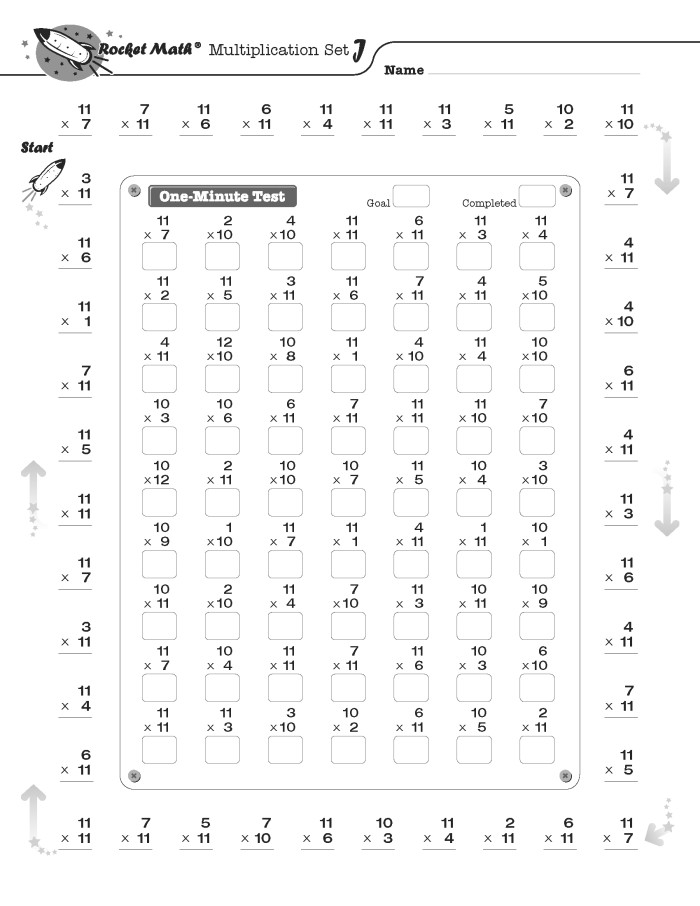
Rocket Math licenses (the way we used to do business) provided only 1s-9s in the four operations. Now we have subscriptions instead. While the basic subscription only provides access to the 1s-9s of the four operations, I have much more in the Universal subscription. The extra drawers that are part of the Universal subscription include Multiplication 10s, 11s, and 12s (including 12 x 12 = 144) and Division 10s, 11s, and 12s. These programs are meant to be done after the 1s-9s are learned, and include a hefty dose of review of the 1s-9s facts along with the new facts. You can see an example of Set J above.

But wait! There’s more! The Universal subscription drawers include Add to 20 (13+6, 4+11, 15+5), Factors, Integers, Rocket Writing for Numerals, and Skip Counting. I’m working on Subtract from 20 as well, which will be added to the Universal subscription as soon as it is done. One of the joys of the subscription is that I can add new programs and make them available immediately to my customers, that they can see whenever they go to their “Filing cabinet on the web.” That way I won’t ever have long time customers who don’t know what is available. You see, I made those 10s, 11s, and 12s a couple of years ago, but you never knew. Thanks for asking Valerie, and thanks for being a loyal Rocket Math user!

What happens if we don’t practice daily?

Hi Dr. Don,
I have another question. Why do you recommend practicing Rocket Math every day? Would doing it only a couple days a week be okay?
Thanks,
Julie

Hello Julie,
Thanks for asking. The importance of daily practice has to do with the nature of building memory. If you practice daily almost all students will make good progress, and pass a level every few sessions. A few minutes practice and then overnight time for the memories to sink in, and then all the students get to practice again before they forget. If you practice just a couple of times a week then only the most able students would be able to remember and benefit from the last practice session–the more time to forget the more students forget. Much better to activate those memories and build those neural connections every day. The success rate of your students will go WAY down if you do it only a couple of days a week. Many students would not be able to pass and would get frustrated. That’s why it is designed to be a fast activity–less than ten minutes a day once you build the routine. We find that the least able 10% of your students may need to practice orally twice a day to make good progress. That’s why getting parents involved is such a good idea.

Skipping, when is it OK?

We are not talking about this kind of skipping, but she is cute!

A customer asks:

One more question, if I may . . . (I did not see this answer in the manual or I was reading so fast I missed it!)

When doing the 1 minute or 2 minute tests, do the students have to do the problems in order? We have differing opinions on this, too! Some of us tell the students if they are stuck on one, don’t spend too much time and go on to the next. Others require that they do each problem in order as written. We are just trying to be consistent throughout all grade levels 1-4. Thanks so much for your thoughts and rationale.

Dr. Don’s answer:

A very good question. The answers are in the manual but it is sometimes hard to remember the information until you understand the rationale. So of course I am going to give it to you! The 1 minute daily test and the 2 minute timing are very different kinds of tests and so the rules are different.

The 1 minute daily test is a test of mastery–to see if the students have completely mastered all the facts up through that Set. So there should be no errors and nothing skipped. Some schools insist on left to right answering so that it is clear there was no skipping. If a student even wants to skip an item on the daily test–then clearly the student does NOT know all the facts to the level and should not pass. Hopefully clear.

On the other hand, the 2 minute timing, done once every week or two, is a progress measure (can you tell I’ve taught assessment classes?) to see if growth is occurring. So the test presents ALL the problems in the operation and asks whether the student can answer more of them in 2 minutes than he/she answered last week or the week before. We know there are items on the 2 minute timing that students don’t know to mastery. To answer the most possible in 2 minutes they should skip the ones they cannot remember and answer all the ones they know instantly. So it is not only OK to skip on the 2 minute timing, it’s a good idea.  As they make progress they will find more and more items they can answer instantly and so the number answered in 2 minutes will go up. The graph will show that progress–which is the outcome we want to see.
In short, no errors and no skipping on the daily one minute test. The 2 minute test we just count how many are correctly answered on the page and hope it goes up–and skipping is fine.

Without any errors–Really?

Cathy L. of Carterville, IL asks:

On page 17 of the manual it states that a student passes a set of facts by meeting or passing his personal goal without errors. In our school, 3rd grade, a student’s goal was 45 multiplication facts. The student got 54 problems but missed one — 1×2. He got that same problem correct several other times on the paper but missed one and the teacher said he had to try again. What are your thoughts on this? Thanks! We love rocket math!

Cathy, thanks for asking! And a big thank you for reading the manual!!!
Yes, we do say no errors. But, it is clear that the student knows the fact because he answered it correctly. The error is a “rate induced error” meaning he made it simply because he was going so fast. Research shows that students who “know” something can still make up to 5% rate induced errors. So there are certainly reasons to allow the student some leeway.
I’d lean toward leeway, but it might cause a problem because you are being inconsistent. [Many is the time my students made me regret a momentary lapse in consistency!] What about the next time he makes an error, or his next door peer? Students want to test the limits and so will force you to be consistent.
The good news is that there is very little chance of that happening again tomorrow, if you have the student do that set again tomorrow. In other words, he’ll get one more day of practice on that set of facts, which is certainly beneficial, and he’ll move on the next day. So all things considered, I’d ask him to try again tomorrow and see if he can’t meet his goal without any errors. It is better to 100% accurate even if that means you are a little slower. Hopefully you can see there is room for your own judgment, but there are consequences from being more lenient.