Do CCSS expect math facts memorizing?

Yes!  Without question, CCSS expects students to know math facts “from memory.”  Students should not be counting on their fingers nor having to stop and think about basic math facts.

CCSS.Math.Content.2.OA.B.2 Fluently add and subtract within 20 using mental strategies. By end of Grade 2, know from memory all sums of two one-digit numbers.
CCSS.Math.Content.3.OA.C.7 Fluently multiply and divide within 100, using strategies such as the relationship between multiplication and division (e.g., knowing that 8 × 5 = 40, one knows 40 ÷ 5 = 8) or properties of operations. By the end of Grade 3, know from memory all products of two one-digit numbers.

Worksheets alone will not get students to that place–it requires oral rehearsal of math facts until there are no hesitations.  That happens best with the kind of peer practice that Rocket Math is designed to provide.
Click here to see my basic math fact recommended benchmarks to use with Rocket Math to implement the Common Core.

What’s wrong with this picture?

If you are seeing this in your school, you need Rocket Math!

Recently I gave my pre-service student teachers at Portland State University an assignment to do screening tests of basic skills in their placements. I was shocked to see how few of the screening tests showed students who were fluent with basic, single-digit math facts, where they could answer math facts as quickly as they could write. When children cannot answer math facts quickly and easily they are placed at a unnecessary disadvantage when it comes to doing math.

It is true that learning math facts takes time. No one can learn all of them in a matter of a few days or a week. It takes most students daily practice for months to learn all the facts in an operation. But when you consider that we require students to attend school five hours a day for years and years, it is pretty shocking to realize how many children do not have fluent mastery of math facts when they get to middle school. When the job can be done in ten minutes a day, and every child could become fluent in all four operations of addition, subtraction, multiplication and division by the end of fourth grade, why isn’t it?

Sometimes, teachers have been taught in their schools of education that helping children memorize things is somehow harmful. With that belief, teachers won’t try to do something systematic like Rocket Math. But after a year or two teaching, especially upper elementary grades, and struggling to teach higher math concepts to children who are interrupted by finger counting in the middle of every single computation, teachers learn that belief is simply wrong. Children are helped immensely by memorizing basic math facts. It enables them to have “number sense,” to easily appreciate the relationships among numerals, and to easily do computation.

Probably the main reason more students are not taught math facts, to the level they need, is that teachers are not aware of a tool that can help them do that. They don’t know that students enjoy doing learning math facts when it is done right. They don’t know that it can be done as a simple routine that takes ten minutes a day. They don’t know how easily students can master all of the facts. In short, they don’t know that Rocket Math exists. Someday a friend of theirs will tell them, because that is how Rocket Math spreads–by word-of-mouth.

If you read this, and you have never seen Rocket Math in action, you may be skeptical. Tell you what, write to me and if you need to see it in action to believe me, and don’t have a friend using Rocket Math, I’ll send you a free subscription to try it out.

What does CCSS mean by “know from memory?”

Knowing from memory means not having to think about it.

Two of the best standards from the Common Core State Standards are on our home page:

By end of Grade 2, know from memory all sums of two one-digit numbers and

By the end of Grade 3, know from memory all products of two one-digit numbers.

These standards name the most important elementary math skills of all, because they are the foundation of all further work in mathematics.  But what does it mean to say students know math facts “from memory?”  It means that students don’t have to stop to figure it out.  Say for example a student is adding nine plus seven. A student can figure that out by thinking that because 9 is one more than 8 and 7 is one less than 8, the answer to 9+7 would be the same as 8+8, which is 16.  This is a smart strategy for figuring out the answer, but knowing it from memory means the student simply remembers the answer is 16.

So if second grade students know from memory the sums of all single digit numbers, they can answer any of those problems without hesitation, without having to stop and think about them.  That takes practice, to build up the neural connections, so that students remember the answers instantly without some intervening thought process.  That’s what Rocket Math is specifically designed to do.  Practicing figuring out the answer to facts is NOT the same thing as recalling them from memory.  So any practice procedure that allows students a long time to answer facts, allows hesitations, will not be very helpful in achieving that status of “knowing from memory.”

The peer practice procedures in Rocket Math require the “checker” to follow a “correction procedure” whenever there is a hesitation.  If the student has to stop even for a second to “think about it” they need more practice on that fact to commit it fully to memory.  The “correction procedure” provides that extra needed practice.  Having students complete worksheets on their own will NEVER eliminate that “stopping to figure it out.”  That is why the oral peer practice in Rocket Math is essential.  And that is why Rocket Math really will help students come to “know from memory” all sums of two one-digit numbers.

Teaching the value of hard work

A teacher asks:     

Our teachers just had parent/teacher conferences and had a few parents concerned about their student “not passing” levels in Rocket Math. The students AND parents of these students are having a hard time with their child struggling on Rocket Math when it is apparent that they “know” their facts. Their parents don’t know why they should have to have the speed when they clearly know their facts and these students are truly some of the top students (95th%ile on state standards). Although it has given those students some perspective on what it feels like and how you handle not accomplishing something with ease.  If they score 60 or above on their two minute timings consistently, should they be required to pass all levels?  What would be your recommendation to do with these students or tell their parents?

Dr. Don answers:

One of the most important benefits of Rocket Math is that it teaches students the value of hard work.  By practicing orally with their partner each day, and doing the correction procedure properly, students find they can learn math facts to the level of automaticity–to where they can answer them instantly without thinking and without hesitation.  That takes some practice and work, even for gifted students.  But everyone can do it with enough practice.  Although it is only ten minutes a day, the work of Rocket Math is very important in teaching students the value of their own efforts.  Students learn that even if they can’t pass initially, if they practice every day (and maybe some more at home with a parent or sibling), they get to the point that they can answer those problems as fast as they can write.  When they achieve this they are justly proud of themselves, because they know they earned the achievement through their own efforts.  Learning this lesson is quite possibly even more important than the math facts themselves.  This is an important lesson for life–that you benefit from working hard at something even if it doesn’t come easily.

The only way you could take that away from those students is by rewarding some of your brightest students with the same accomplishment without having to work through the levels.  You can use the placement probes to determine if students even need an operation–they can “test-out” of the operation in the beginning of the year.  But once you have determined that students need to work through the operation, the worst thing you could do to the class would be to suddenly announce that some students have “passed” without doing the work.  That would make everyone else feel like a dummy for having to work at it.

I will write a separate post on the things you can do for students who get stuck and can’t pass in six tries.  However, I want to stress that a key outcome of Rocket Math is learning the value of hard work in school.  Don’t do anything to undermine that.

How can you improve writing speed?

Tina asks:
Hello Don,
Do you have any recommendations for improving writing speed? My son’s school does not use Rocket Math, but we use it at home. He knows his addition facts rather quickly orally but is stuck at a much lower level at school because he cannot write them fast enough.
Thanks, Tina

Dr. Don answers:
Tina,
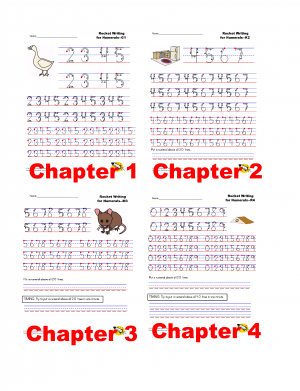
That is a very good question. Yes, you can improve writing speed. Increasing writing speed will come with practice, but a special kind of practice. The biggest problem slow writers have is that they “draw” the numerals. That is to say, they decide how to make the numerals look like they should and then draw them, rather than having a set way of doing the numbers. Step 1 is for them to learn how to most efficiently write the numerals using strokes that consistently go down and from left to write. Students need to learn the right way to form the numerals and then practice it exactly the same way over and over until it becomes habit. In Step 2 the students need to practice writing the numerals small enough to fit on the line, while still forming them the right way. In Step 3 and 4 students need to practice writing the numerals until they are fluent (speedy and still form them correctly and legibly).

A student can practice each page of Rocket Writing several times. How many times you ask? See my blog on the topic of How much practice is enough in Rocket Writing, because it is interesting to see that you can arrange it so that you trust your son to know how much practice he needs.

Rocket Writing for Numerals is part of the Universal Level of the Worksheet Program. If you only have a basic level subscription, you can upgrade to that.

Does research show that student achievement increases from timed daily drill?

Students memorize math facts by practicing a limited set of problems with a partner who corrects all errors and hesitations.

A teacher writes:
Could you point me toward some research showing student achievement increases from timed daily drills. My superintendent is a hard sell and will ask me to prove the strategy works from independent research.

Dr. Don answers:
Your superintendent is right to be skeptical. Student achievement does NOT increase from timed daily “drills.” The typical “mad minutes” program is generally worthless in improving student knowledge of math facts.

Students memorize math facts by practicing a limited set of problems with a partner who corrects all errors and hesitations. In Rocket Math students practice with a partner and become fluent with only two facts and their reverses at a time. They take a one-minute test to see if they have learned those facts to the level of fluency. Only then, once they have learned those fluently, are two more facts added on the next sheet. [Here’s a 3-minute video that explains how practice works in more detail.]

Once students finish learning the facts in an operation you can measure that by giving them a test of all the facts in that operation and they will be able to answer far more facts in a timed test than students who have to figure out and count on their fingers to answer those facts.

General achievement in math is improved by ready knowledge of math facts to the extent that one measures students’ ability to do computation. Nonetheless the Common Core includes fact knowledge in these standards:

CCSS.Math.Content.2.OA.B.2 Fluently add and subtract within 20 using mental strategies. By end of Grade 2, know from memory all sums of two one-digit numbers.
CCSS.Math.Content.3.OA.C.7 Fluently multiply and divide within 100, using strategies such as the relationship between multiplication and division (e.g., knowing that 8 × 5 = 40, one knows 40 ÷ 5 = 8) or properties of operations. By the end of Grade 3, know from memory all products of two one-digit numbers.

I would recommend a test of Rocket Math within a few classrooms, compared to an equal number of classrooms that don’t use Rocket Math. Measure each class by means of the two-minute timings of all the facts in the operation and see if there is a large difference (over time) between the students who learn using Rocket Math and the students who continue to do whatever the district is doing now. Be sure that the same ten-minutes a day is used to study math facts in both groups.

Here is my offer from my “Studies and Results” page of my website:

NOTE TO TEACHERS, SCHOOLS, DISTRICTS: While I am waiting for others to conduct and publish research on Rocket Math, I make the following offer.

If you conduct research comparing Rocket Math to some other method of practicing math facts and share your results–I will refund half of the purchase price of the curriculum.
If you find some other method is more effective, I will refund 100% of your purchase price.

I am certain it is the best math facts practice curriculum available but I have to wait for more researchers independent of me to confirm that fact.