U—How do I conduct the One-Minute Daily Test?

How do I conduct the One-Minute Daily Test?

After the practice time, the One-Minute Daily Test should be conducted, either immediately or after a delay. If there is a delay it will be harder for students to pass, but they will know their facts better when they do pass. It is also possible to do two practice sessions at different times during the day, but still do only one test per day. Each student should enter their goal at the bottom of their practice sheet before beginning the timing.

Have students hold their pencils up in the air when they are ready to start. Wait until all the pencils are in the air before you say to begin. If your clock has a second hand visible to all the children, you can tell them they may begin when the second hand reaches the 12—that way all eyes are on the clock rather than on their paper. You time while students write. At the end, collect the folders (along with the test papers) of only those children who claimed to have passed. You will have to check the tests for accuracy—but only the papers of the students who claim to have passed. If they know they did not pass (because they didn’t complete enough problems to have passed…after all, they know their goal) then you don’t have to check their paper until they do. (Yipppeee!!!)

Typically teachers hand back the folders the next day with the next set of pages to practice on, unless the student did not actually pass.

All students will need a new practice sheet for the following day. Students who passed their timings get the next set of facts in alphabetic sequence and students who did not pass get a clean copy of the same letter as before.

There are various ways to handle the distribution of sheets. At a minimum, you will need to create a set of lettered file folders so that the appropriate sheets can be organized and accessed. Remember the crate? Children can learn to get the next sheet on their own some time during the day. Often we see teachers have kids get the appropriate sheet on their way into the room in the morning. This becomes part of the morning routine. For students in Middle or High School, students can retrieve the appropriate sheet on their way into math class. Cooperative groups could send a representative up to collect sheets for the group. If you have some adult help, that person could put the appropriate sheets in each child’s folder. You might also have a student monitor do that.

Because most students will take a few tries before completing sheets you might reduce the traffic going to the files by having students collect 4, 5 or 6 copies of the page the first time. You could have 4-6 copies of the same set stapled together. Then if a student does not pass the one-minute timing they would not have to go to the crate to get a sheet. They would just turn to the next, clean copy. If students don’t use all of them, the clean sheets are still usable by another student. Remove the staple and recycle! You can do the same thing if you must fill the folders.

V—How do I keep track of which set each student should be practicing?

How do I keep track of which set each student should be practicing?

That’s where the Rocket Chart comes in! I bet you thought we had forgotten about the Rocket Chart you stapled on the front of each student’s folder. We didn’t. We have this down to a science. Every part is needed and there is no fluff! We are essentially “anti-fluff.” OK. We came clean on that one. Now the world knows!

The Rocket Chart for recording progress is included at the end of these directions. Either before or after each timing, when the student “tries” to pass the timing, he or she should enter the date of that try on the Rocket Chart for the set they are working on. This chart should have been stapled on the front side of their Rocket Math® folder. (Ha! You thought we were done nagging you about the folders? You were wrong…Sorry.) Please be aware that no one should go past six “tries” without intervention from you. See the section on “What do I do about students who are stuck?”

Whenever any student passes their One-Minute Daily Test they will color in the appropriate row on the Rocket Chart.

When a student has passed, the next day the student will begin practice on the next practice sheet. To help increase motivation, be sure to enthusiastically give some special recognition to students who pass their One-Minute Daily Test. Check out the certificates at the end of these directions. We made ‘em ourselves and if we thought that you ignored them, we would be so bummed. Find some way to give extra recognition for students’ hard work. Having a school administrator come in to distribute these certificates to elementary students is a good idea. Kids love that. This recognition is often more important to the children in the upper elementary grades where they have already struggled for some time. They need a little extra motivation.

W—What do I do about students who don’t pass?

Something is wrong if students don’t pass in six tries.  A student is stuck if they don’t pass a level within the six tries shown on the Rocket Chart. Do not allow being stuck to persist. Intervene with one of the ideas below for any students who don’t pass in six tries.

They don’t pass because the writing goal is too high.

Hopefully, you used the writing speed test to set individualized goals for your students.  If you didn’t please do that now and set their goals based on their actual writing speed.  Students cannot answer faster than they write!

Here’s a check to see if the goal is right.  If the student has never passed a timing, perhaps the child can’t really write that fast. Try testing the student orally (on the set they are stuck on) with the student orally telling you the answers. In oral testing the student says only the answers—not the whole problem. If the student can orally answer at least 40 facts in one minute, then the student is satisfactorily fluent with those facts. Therefore the handwriting goals must be too high. Reset his/her goals at the previous best that student has done at that level and let the student move on to the next set.

They don’t pass because they are not practicing the right way.

The most frequent reason students don’t pass is because the student’s partner does not insist the they practice the right way.

Bad practice practices are common.  For example, the student avoids saying the problems out loud and just says the answers.  The partner skips the correction procedure when the student hesitates. The partner allows the student to simply go on after a hesitation or error rather than going back three problems and trying again to see if they are faster now.

They don’t pass because they don’t know the proper correction procedure.

Practice with the class, making your students model the correction procedure.  The remedy for bad practice practices is for the teacher to practice with these students as recommended and see if that makes a difference. It often does. Let us tell you: This is typically the “magic bullet.” It is fascinating really. Carrying out the practice procedure as we have written it is VERY powerful. We wouldn’t lie to you. Consider practicing with the student yourself. Dr. Don often finds that when he does that, the student passes immediately.

They don’t pass because they don’t follow the practice procedures. 

Monitor, monitor, monitor. Monitor them very closely as students practice.  If the teacher practicing with these students does help, arrange to see that they practice the right way consistently during peer practice. You may have to change partners or watch over them daily until they start practicing the right way. Consider increasing motivation through more rewards and recognition to keep students practicing the right way.

Watch to see that the student is “on-task” throughout the timing. Some students fail to realize that looking up around the room during a timing will slow them down so much they won’t pass. (Really, we kid you not. We’ve seen kids–who stopped to check the clock several times during a one minute timing–be surprised that they didn’t pass!) If a student really cannot stay on task for 60 seconds, you might try cutting the goal and the time in half—give a 30-second timing with a goal cut in half as well. That may do the trick. It is often necessary to point out to younger students that erasing takes too long. Have you ever watched a second grader erase something? One could grow old waiting. Point out to students that perhaps putting a line through a mistake and writing the correct answer would save time.

They don’t pass because they aren’t trying to pass anymore.

To increase motivation, increase success.  The student may not be trying because he/she is unmotivated. Watch to see if the student is doing practice correctly or giving the test their best effort. Most often this is a result of failing to succeed rather than a cause. (That’s really a very important understanding for you to have, so we’re going to say it again!) Lack of student motivation is most often a result of failing to progress rather than a cause.  

If students are succeeding then consider adding reinforcement.  Make sure they have time to color in their Rocket Chart.  Have them stand up and take a bow when they pass.  Consider using the Wall Chart.  Think about ways to increase student motivation, including use of student achievement awards and social recognition for success.

They don’t pass because they are “in over their head.”

You can tell a student is in over their head just by watching over their shoulder as they complete a timing.  The student will hesitate on many of the facts.  Another way to tell, is if practicing with a student the right way doesn’t make a big difference, then the student may be stuck because he/she is “in over his/her head.” The student has officially passed several sets without completely mastering them. This should not happen if students always have to meet or beat their previous best—but sometimes it happens anyway. A sign that this has happened is that they have several facts in the set with which they are hesitant.

Back the student up a level or levels

The basic remedy for kids who are “in over their head” is to back up in the alphabet until you find a letter they can pass. You can either test back all at once or have the student move back one letter a day until they do pass after one day’s practice. Get them a new Rocket Chart to start over. Once you find out where the student is successful, make sure their goals are as fast as they can write—that you’re not letting them pass even though they are hesitant on some facts. If you announce a policy of “six tries and then you have to move back” and you announce this policy ahead of time, fewer students will get to six tries without passing! Being proactive is the key here. It is important to cover all of your bases prior to bad things happening. It is much better to pre-correct for something than to have to go back and re-teach a procedure or try to introduce one when a student is upset and losing motivation.

WARNING! Reducing the criterion for passing does not help.

(Yep, another warning. I am being proactive too!) Do not reduce the criterion to pass each sheet, as that will make it increasingly difficult for the students! They will not be learning each small set as well as they need to and you’ll be adding more facts faster than they can handle. The cumulative task will get more and more difficult. Only reduce the criterion if the student simply cannot write that fast—otherwise, they can learn all the facts to the same speed as they learned the first set.

X—How do I monitor students’ progress?

How do I monitor students’ progress?

You monitor progress by the two-minute timings. You can find the two-minute timings clearly labeled in the drawer of the “filing cabinet on the web.” Once a week or once every two weeks (I, of course, suggest every week.) have your students do a two-minute timing of all the facts. (I made the tests so that a good many of the entire world of facts for the given operation are represented. You do not have to figure this out. I wouldn’t wish that on you. It was a lot of work to get it just right.) The purpose of these two-minute timings is to see if students are improving in their knowledge of the facts. (These timings don’t really teach; they just help you monitor progress.) On days when you do a two-minute timing, do NOT do the regular practice sheets. (Even I, Dr. Overdo wouldn’t do that.)

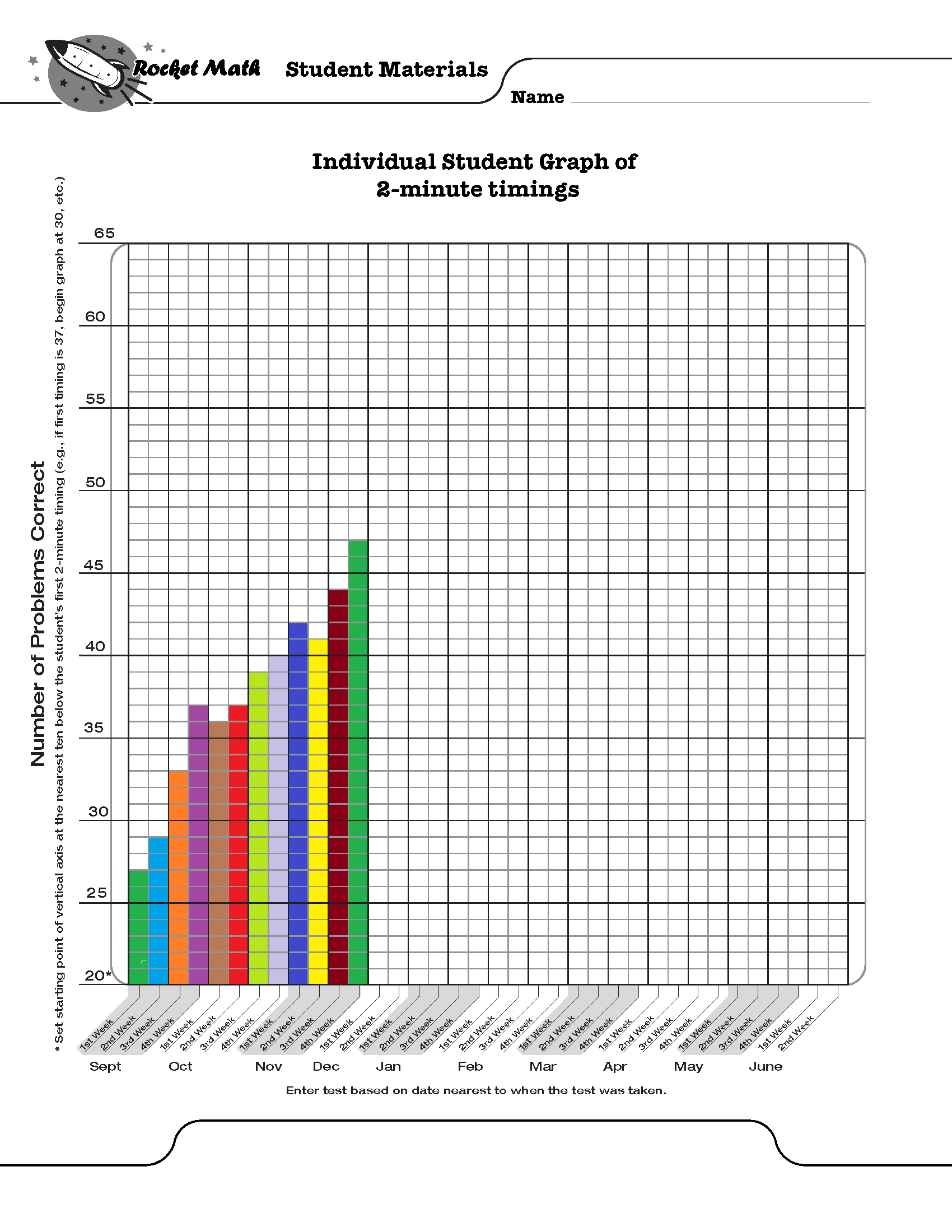
Each time the students complete a two-minute timing, they will graph their results on their Individual Student Graph in their student folder.  They graph the number of problems they answered correctly in two minutes.

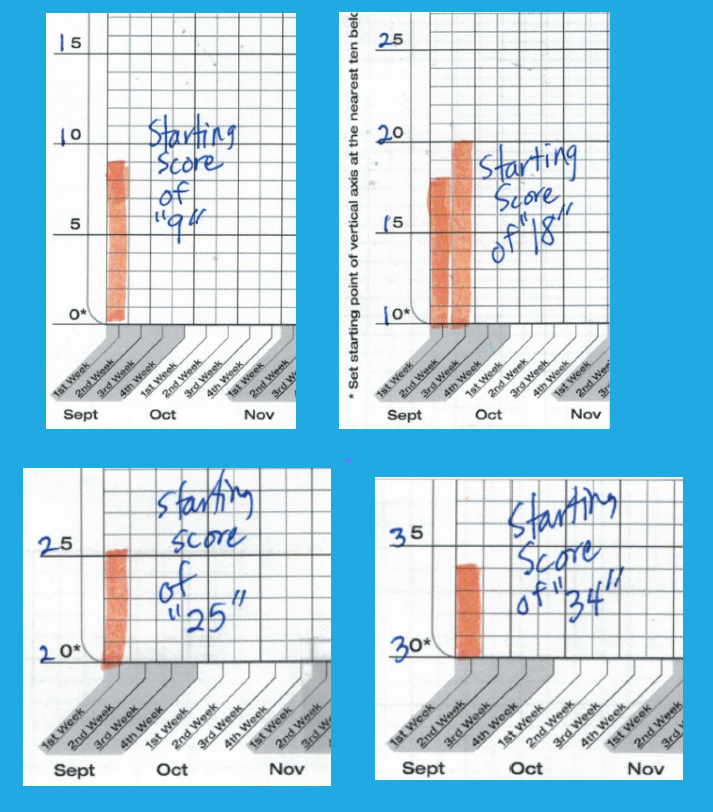
You will have to label the vertical axis individually for each student AFTER they complete their first two-minute timing. See four examples in this picture. You set the starting point based on the student’s first timing. Set the starting point at the nearest ten below the student’s score on the student’s first two-minute timing. For example, if the first two-minute timing is 9, set the starting line at zero. If the first two-minute timing is 18, set the starting line at 10. Here’s a video explaining how to set up the Individual Student Graph on You Tube.

As your students progress through the program and learn more facts that they know instantaneously, they will be able to answer more within two minutes. In the beginning they will only “know” a few of the facts and will have to figure out as many as they can in two minutes. [This makes this test different than the One-Minute Daily Timing where they should know all the facts and are not allowed to skip any.  Because the Two-Minute timing includes facts they don’t know, it means you must allow or even encourage students to skip facts they don’t know and move on to the ones they do know, during the Two-Minute timing.] See the blog: “Skipping, when is it OK?”  Eventually some students will instantaneously “know” so many facts that they can answer about 40 per minute, or 80 in two minutes—but only if they can write that quickly. There are enough spaces on the graph for each week in school. Have the students color in the bar with the date closest to the date they took the test.


Y—How do I prepare for monitoring progress through the two-minute timings?

How do I prepare for monitoring progress through the two-minute timings?

You made the folders that we told you to make, right? You made enough copies of the Individual Student Graph for each student in your class? And you stapled the blank graphs inside each student’s folder? Good. Whew, you had us worried there for a second! There are five two-minute timings (cleverly numbered one through five). Remember, we told you that they were at the end of the operation. Why are there five you ask? Well, we gave you five so you can switch it up and keep students from getting too familiar with the order of the problems. All five tests have exactly the same problems — just in a different order. Make enough copies of one of the five for your whole class. Now you are ready!

Z—How do I give the two-minute progress monitoring tests?

How do I give the two-minute progress monitoring tests?

Before you begin, have students look on their Individual Student Graphs and see what their previous best was. Have them write that down as their goal — to meet or beat their previous best. The first day their goal is to do some!

Students should be reminded repeatedly that their goal is simply to improve. You may tell students, “Everyone starts out in different places and we do not want you to compare yourself to anyone else. Just work to get better yourself. Your goal is to meet or beat your previous highest score.” It is good to be overt about this. It might look something like this:


Teacher: “Students, open to your graph for two-minute timings. Put your finger on the number of facts that you answered correctly last week. Your job today is to try to beat that goal. Even if you only get one more correct this week than you got last week, you will have improved. Everybody, if you get one more than you got last week, will you have done a good job?”
Students “Yes!”
Rinse and repeat. (You may have to do this every week. It is important to keep students motivated on these two-minute timings.) Remind them that they are being tested on some facts that they haven’t even practiced yet, so this is hard and if they beat last week’s score, it is a big, huge, monstrous deal!


Whenever any student beats their previous high score recognize them in some manner and make sure they graph their results.

You can have all students do the same number timing, e.g., Timing 3. This will facilitate correcting their timings as well as refilling their folders. Do not provide a practice time, simply have students get ready by putting their pencils in the air and begin. You time while students write.

Please note: Students who must answer orally can be paired. One student checks by looking at the answers while the other says the answers. The students then switch roles, while you conduct a second timing for the oral
students, the others are correcting.

At the end of the timing have students exchange papers to correct the timings. If you have students in different operations you will have to copy off the answer keys so that students can correct each other’s timings using their copy of the answer key. If everyone is on the same operation, then you can have them exchange papers and correct after the timing. (A great way to correct is to have the students read all the problems and say the correct answer together. That will give extra practice! Don’t try this if you were at an especially good party the night before or if you have a headache for another reason. Trust us.)

When students have finished correcting, they should enter the date and record their score (the number of problems they answered correctly) on their Individual Student Graph. Then they get to color in the bar up to the level they have achieved. This coloring activity is their reward—don’t skimp on it. This graph should have been stapled on the front side of each student’s folder back when folders were constructed. Steady yourself. Here comes another reminder to recognize the students who beat their previous best! Make sure that this is a big deal for students and worth striving for.