Addition 0 through 9s Learning Track

List of Learning Tracks Continue to purchase

What do students learn?

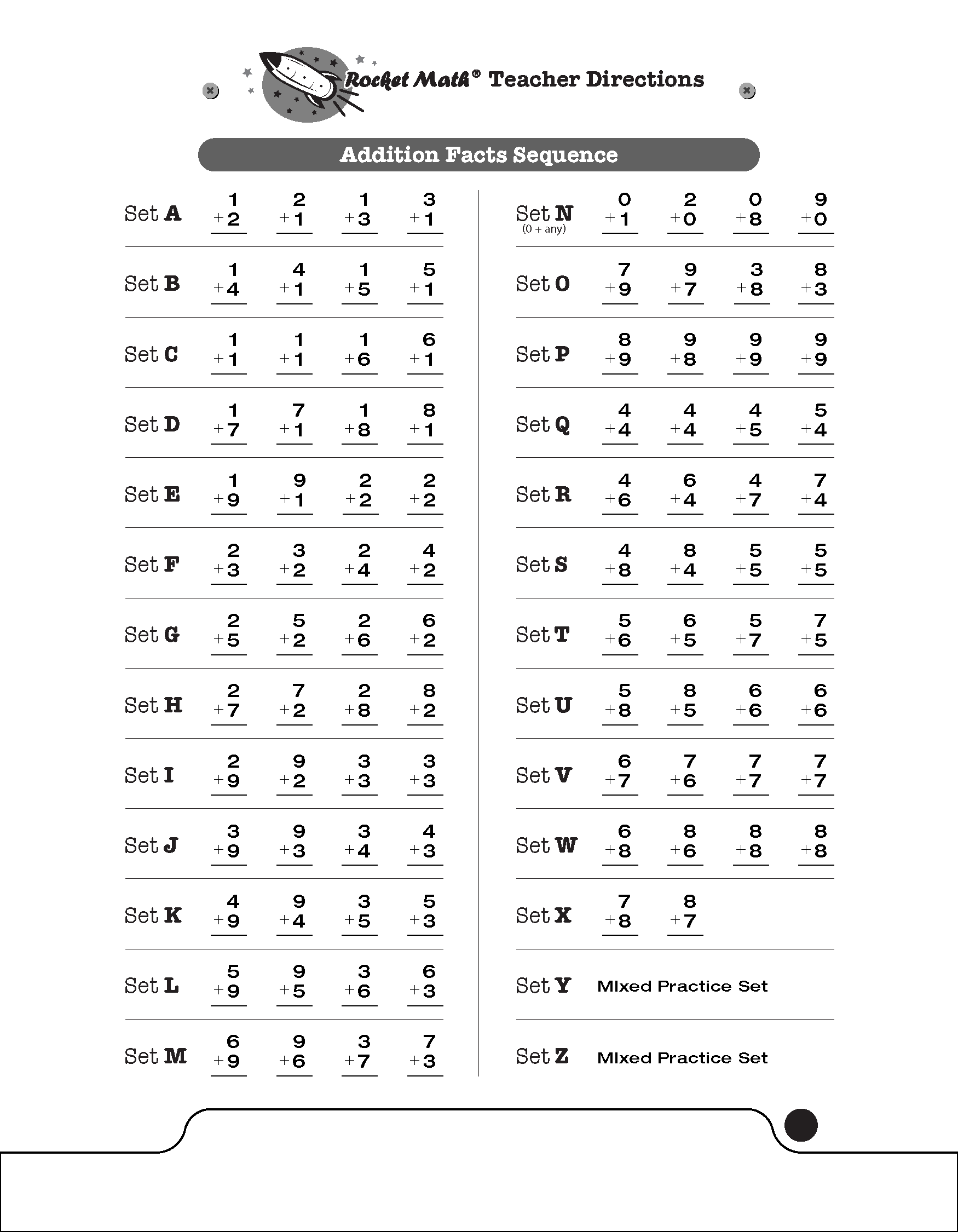
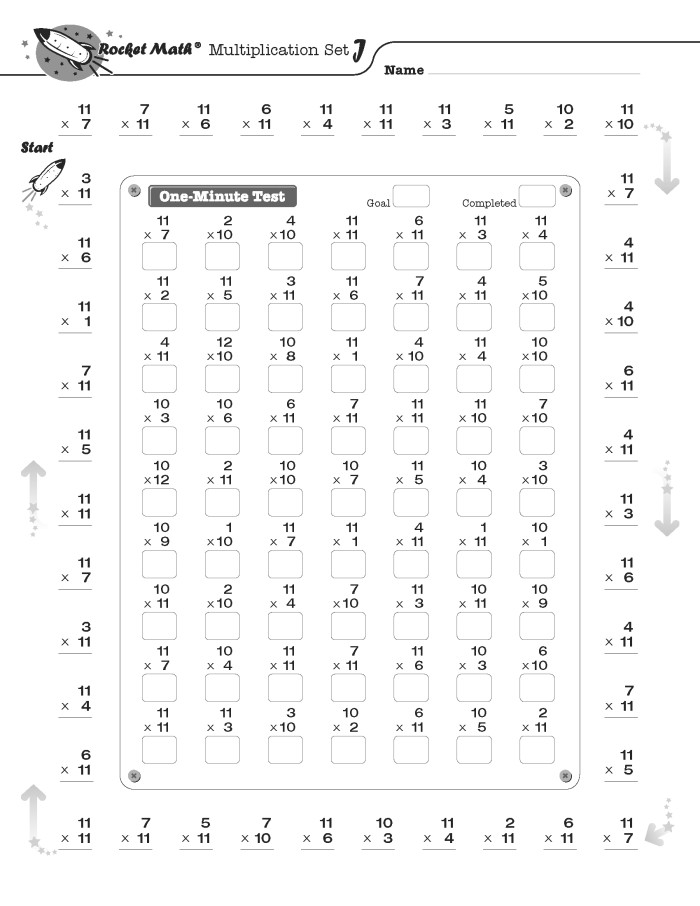
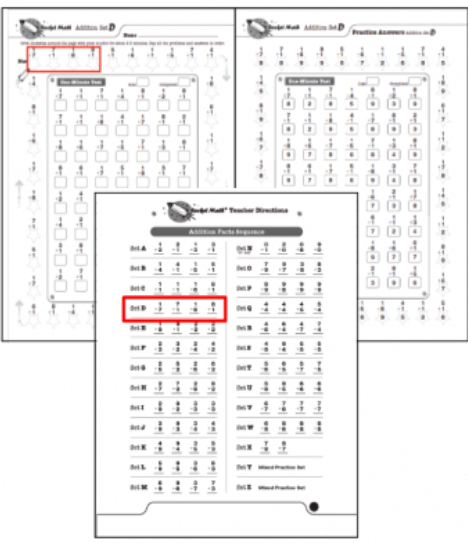
These are the basic single digit Addition facts 0 through 9s. Each of the 26 levels, A through Z, introduces two facts and their reverses.  You can see in the picture above of Set B, we have outlined the new facts in red. Student should already know how to add with fingers or pictures or manipulatives before beginning to memorize these facts.  See the Beginning Numbers and the Conceptual Addition Learning Tracks if you’re not sure.  Students should also be able to write numbers quickly and easily.  If not they need the Rocket Writing for Numerals Learning Track to learn how.

How do students learn?

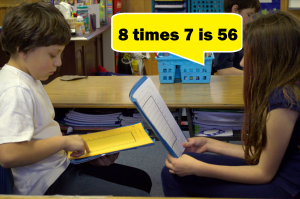
Students practicing their math facts together.Students practice orally with a partner. They read and answer the facts going around the outside of the sheet.  The partner has the answer key.  Then the two students switch roles.  After practice everyone takes a one-minute test on the facts in the box.  The test includes only the facts learned up to this level.  Each student has individual goals based on writing speed.  Students cannot pass a level if there are any errors.   Give the special Writing Speed Test to set individual goals for your students.

Students should be able to pass a level in a week, if they practice the right way.   Below you can see the sequence of facts that will be learned in the Addition 1s-9s program.  The program uses the four forms–that can be found in the forms and information drawer.

The most succinct way to be introduced to this program is this 8-minute video.


Beginning Numerals–Kindergarten counting Learning Track


List of Learning Tracks Continue to purchase


What do students learn?

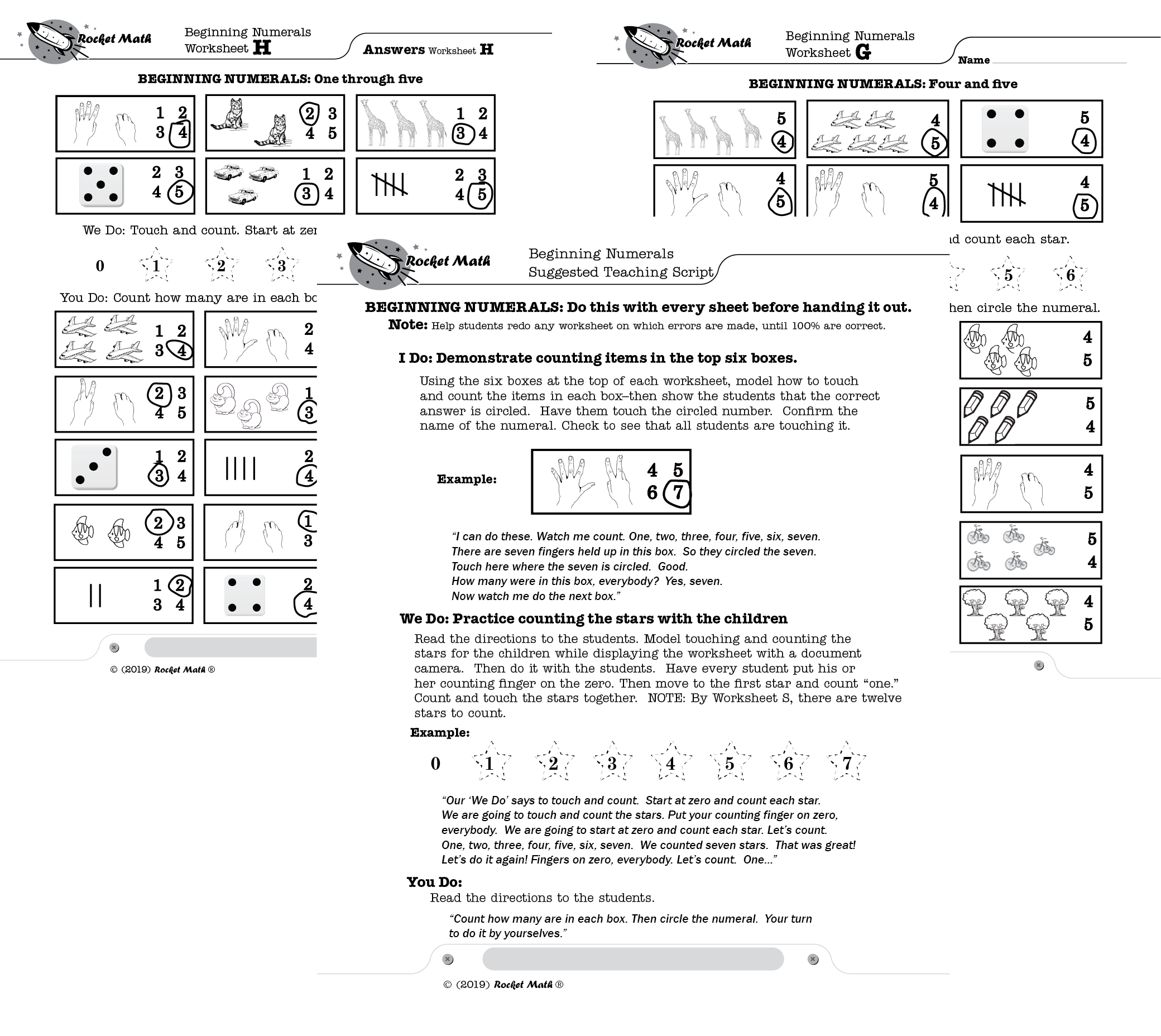
This is a beginning program for kindergarten students.  You are teaching them to count objects aloud and then match the word with the numeralHere is a link to a video explanation of how to teach this learning track.

In this Learning Track students learn through teacher-led instruction.

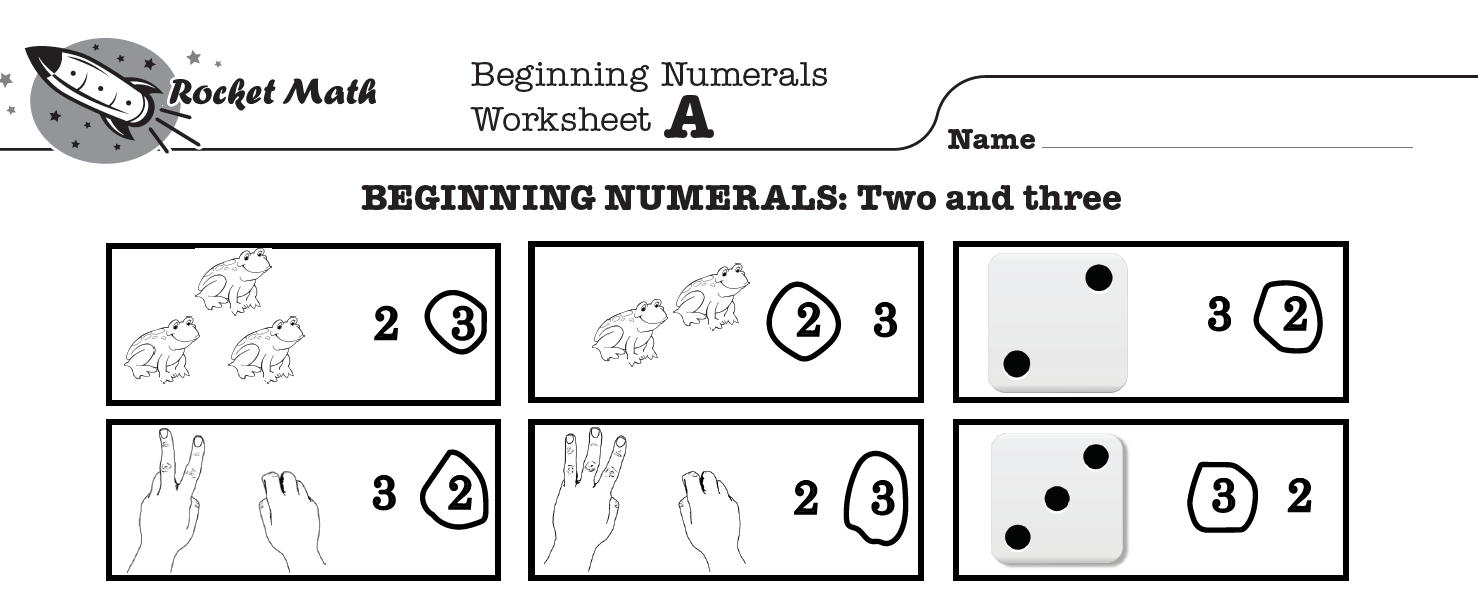
I Do portion–count objects and see the number circled (above picture).

Each worksheet begins with a teacher demonstration of counting objects and circling the numeral that matches.  On Worksheet A there are two and three only to learn.  The teacher demonstrates (best with a document camera so all students can see) how she counts the objects and then points out that the answer is circled.

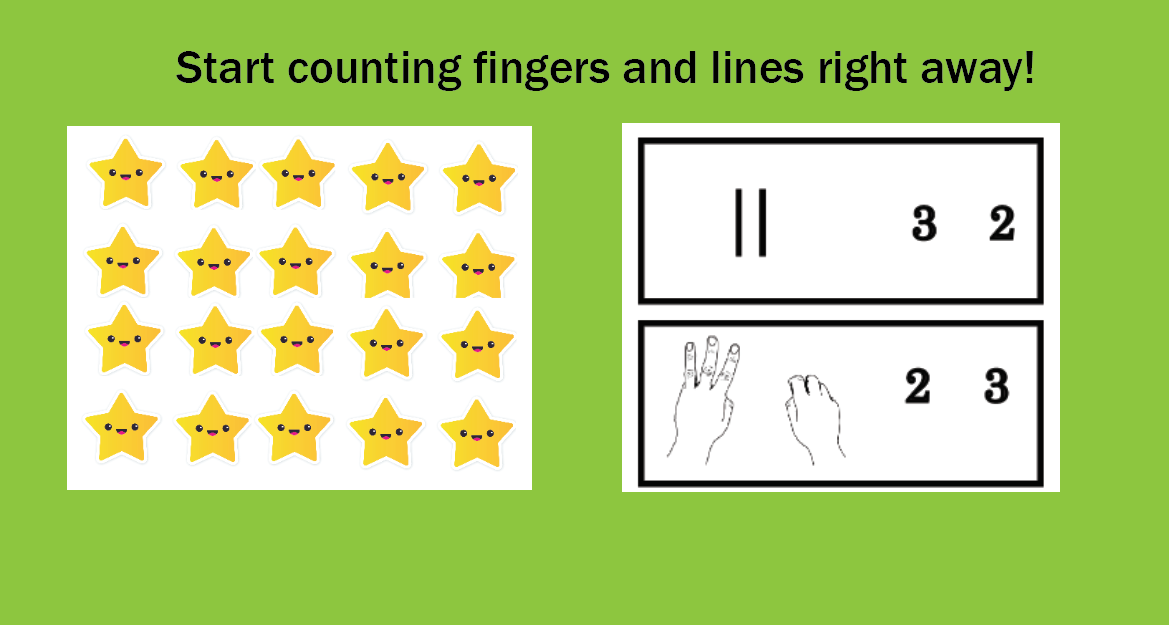
We Do portion–counting stars together (also above picture).

In the “We do” portion of the worksheet the teacher counts the stars first as a demo and then with the students.  Worksheet A you all just count 3 stars.   By Worksheet S the teacher and the students are  counting 12 stars together.


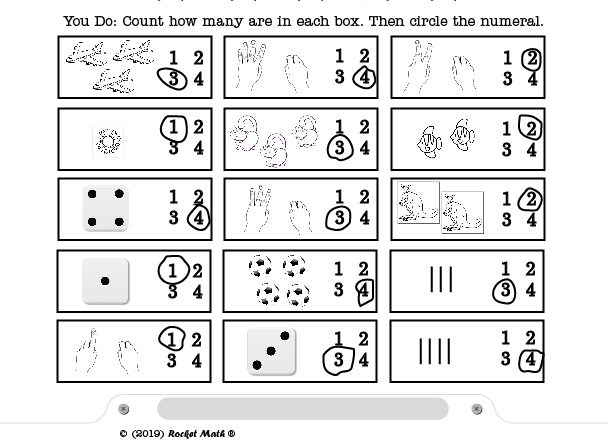
You do portion (above picture).

In the “You do” portion of the worksheet after learning the numerals with the teacher, the students are asked to count the items in each box and circle the correct number.  They are not asked to form the numerals–that’s numeral writing skill.  They just identify the numeral and circle it. Besides cute items there are also dice to count, fingers to count and hash marks to count–so students can learn multiple ways of keeping track of numbers.

Passing a level requires 100% accuracy.  Students who make any errors should be worked with until they can complete the worksheet independently and get all the items correct.  Read an explanation of how to bring a small group to mastery in a program like this one.

This will build strong beginning math skills for kindergarteners learning the meaning of numerals.  Combined with Rocket Writing for Numerals it will set students up for success in elementary math.


Teacher-led instruction for mastery at the kindergarten level

A note about teacher led instruction at the kindergarten level 

Two Learning Tracks in the Rocket Math Worksheet Program, Beginning Numerals and Conceptual Addition, are teacher led instruction. At the kindergarten level teacher led instruction is generally only successful if done in small groups.  Kindergarteners do not pay good attention to whole class instruction, and so will make errors because of inattention to the lesson and directions, rather than confusion about the concepts.  The worksheets in these programs are very straightforward so that students will be able to do them successfully if they are paying attention to the teacher “I do” and “We do” portions of the lesson.  Successful instruction is dependent upon the teacher having the attention of ALL the students while doing the “I do” and “We do” parts of the lesson, which is much easier in small groups.

The goal is that all the students in the group do it 100% correctly. If more than 1/4 of the students in the group make confused errors (wrong answers), the teacher should re-do the sheet as a group the next day.  And keep doing that until fewer than 1/4 make errors.

If fewer than 1/4 of the group are making errors, then the teacher should give those students remedial help and bring them to mastery before moving the whole group on to the next worksheet.  By working with only the confused sub-group, the teacher is better able to make sure they are attending to the instruction.  The teacher should lead instruction and re-do the worksheet with the confused sub-group until they come to mastery too, before reforming the group and moving on.

Ideally, the teacher could work with the confused sub-group immediately after the lesson or later the same day to clarify their misunderstanding quickly.  If not, then work with the smaller sub-group to have them re-do the worksheet at the same time the next day, while the successful students do something else.

Most of the time, if mastery is fully achieved (100% correct doing the independent work independently) then the next worksheet will be able to be brought to mastery without extra sessions.  This is why the 100% criteria for all students is stated at the top.  However, regrouping may be necessary if some students consistently require multiple times through the worksheet to come to mastery (and should be in a different group) while others can do it easily in one session.

Rocket Writing for Numerals Learning Track


List of Learning Tracks Continue to purchase

What do students learn?

Click here for the Rocket Writing for Numerals Teacher Directions.

Students learn to write numerals efficiently, quickly and legibly using the Rocket Writing for Numerals Learning Track.

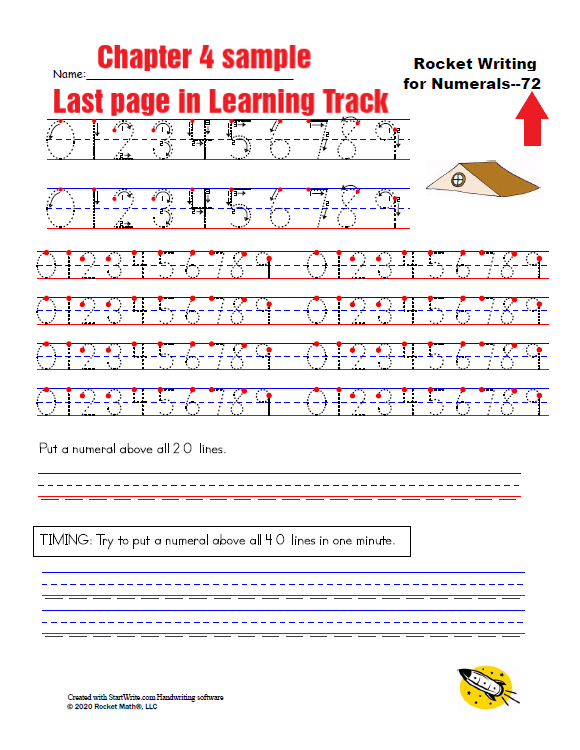
There are 72 pages of practice divided into four chapters (each 18 worksheets long) which gradually increase in difficulty.

Read this blog on “How much practice is enough in Rocket Writing for Numerals?”

Chapter 1 Learn to trace numerals correctly and efficiently.

  • Chapter 1 has students tracing the numerals and learning to form them in the correct manner. The correct manner is from the top down which is the most efficient way to write numerals. Students work through each of the numerals individually.   Then they practice them in concert with other previously learned numerals.  Teacher directions suggest fun ways of teaching numerals by tracing them in the air. Students should stay in this chapter until they habitually form the numerals in the correct manner. (See the chapter 1 sample.)

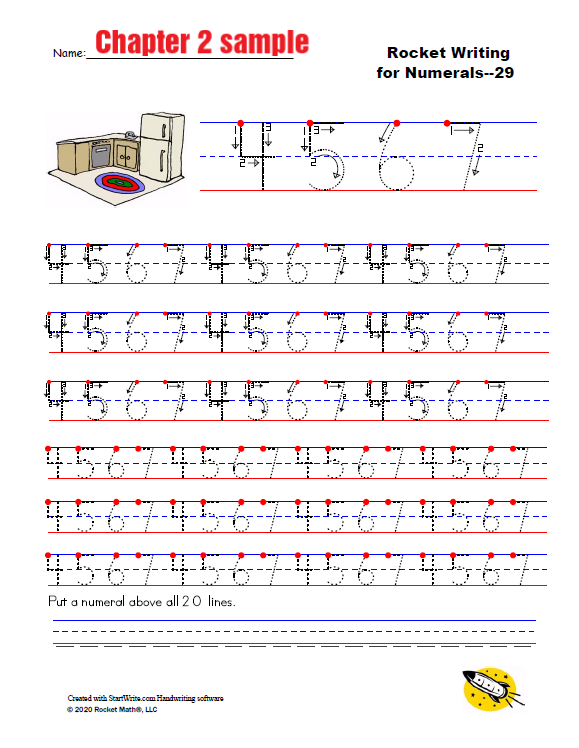
Chapter 2 Learn to write numerals free-hand (without tracing) and smaller.

  • Chapter 2 (see the sample) gives more practice tracing but also requires students to learn to copy smaller examples.  The big challenge is to write the numerals free-hand (without tracing them) and to do so the appropriate size to fit 20 on a line.

Chapter 3 Learn to form numerals fluently (20 per minute).

  • Chapter 3 (see the sample) gives more practice tracing and more practice writing the numerals freehand and to put 20 on a line.  The big challenge is for students to do a one-minute timing to see if they can write 20 digits on a line and in one-minute. There are 18 worksheets in this chapter, so the goal is by the end of the chapter for students to be able to write 20 numerals in one minute. These one-minute timings can be done at the same time as other students who are doing Rocket Math worksheets.

Chapter 4 Learn to form numerals more fluently (40 digits per minute).

  • Chapter 4  gives more practice tracing and writing free-hand with 20 on  a row, but also has students aim for writing 40 digits in one minute. Once they achieve this milestone they are fast enough for Rocket Math. The last page of the program (the end of Chapter 4) is shown at the top of this article.


Get students ready for the times tables with Conceptual Multiplication

Who needs Conceptual Multiplication?

Students need this learning track only if they have NOT been introduced to the concept of multiplication. This is for students who are not able to figure out the answer to any multiplication fact. When you ask them, for example, “What’s seven times eight?” if they can figure out the answer to that question, then they already understand the concept of multiplication.

Teaches the concept of multiplication.

Conceptual Multiplication is based upon practicing skip counting or count-bys.  It will be easiest for students after they finish the “Skip Counting” Learning Track. However, in this Learning Track students can read all of the count-by series except the last number, making this somewhat easier than Skip Counting. Students in fourth grade and above (we are in a hurry, as they are late) should be able to do this Learning Track without doing Skip Counting first. Also, students in fourth grade and above (we’re still in a hurry!) do not need to finish all the way to level Z.  They probably have the concept by the time they finish Set H and can go on into the Multiplication (1s-9s) Learning Track.  Just sayin’ we’re in a hurry!

How do students practice?

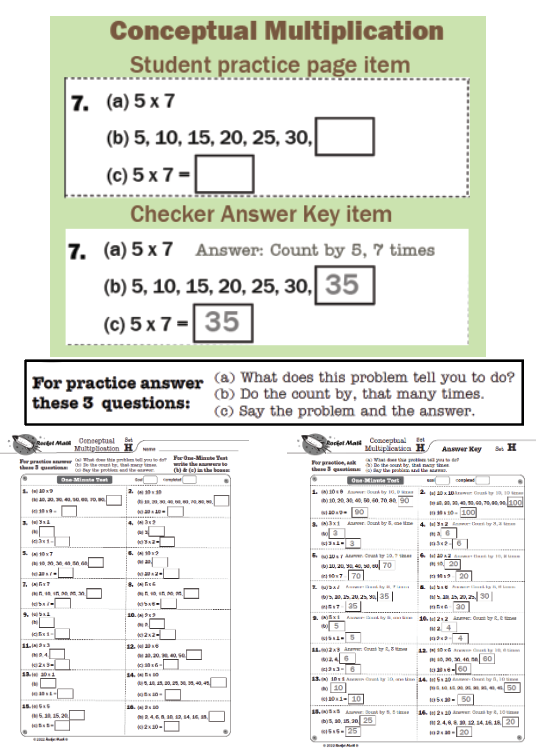
In each box there are 3 items: a, b, and c.

The checker will only need to read the three questions a couple of times until the student knows what is expected at each letter.

(a)  What does this problem tell you to do? (ex: 5 x 7)    Answer: Count by five, seven times.

(b)  Do the count by, that many times. Answer: 5, 10, 15, 20, 25, 30, 35.

(c) Say the problem and the answer. Answer: Five times seven equals 35.

After a time, the student should just say the answers, for example, “Count by 5 seven times. 5, 10, 15, 20, 25, 30, 35.  Five times seven equals 35.” 

For the One-Minute Test students just write the answers in the boxes. In the above example the student would write “35” in both boxes.

Video of how students should practice?

Eliminate test anxiety and timed tests with Rocket Math

Rocket Math without timed tests

Some students have a lot of test anxiety around timed tests.  They become anxious and visibly tense up on timed tests.  They actually get worse instead of better when being timed.  Parents and special education teachers hate to see that and often want to give up on teaching math facts.  Rather than give up, you can use the Rocket Math worksheets without doing any timing.  You don’t have to have your student work against the timer.  If the student is doing everything right during the practice with you, then whatever he or he gets to after six days of practice, will be good enough. Tell your student,

“Stop worrying, we aren’t going to do the timed tests anymore.” 

Your student should continue to practice by saying the facts aloud with the answers while you’re correcting any hesitations.  Corrections consist of you interrupting and saying the fact and the answer aloud, having the student say the fact and the answer aloud three times, backing up three problems and going at it again.  Have your student do that practice until they have gone around the outside twice instead of for a set amount of time.
After practicing around the outside, and before writing on the inside “One-Minute Test,” have your student also practice orally with you for all of the problems in the One Minute test. Use the same correction procedure.

The One-Minute test does not need to be timed.

Then each day, in place of the timed test, do this.  Let your student complete the sheet (the whole page) without working against the timer.  Write the answers as quickly as possible without errors.  Have the student do this, like I said, for six days and then they graduate to the next page. The only point of the timing is to see if the student has mastered all of those facts.  The student will have mastered the facts, if they do the practice correctly every day, so no need for timing at all, really. I have seen students with severe learning problems, who need to do a sheet a dozen times to reach a good level of fluency, but for almost everybody, six days is enough–especially if they will practice both the test and the outside thoroughly and correctly with an adult practice partner who keeps them on task.

If the student wants to do fewer than six days on a set, here’s how.

If your student ever stops being worried during the writing/testing time, you can ask if they’d like to be able to do fewer problems each day.  If so, here’s how to set goals.  You quietly use the timer on your phone and just mark where the student is on the test after one minute. Count how many were done in one minute and record it on the Rocket chart. Still have the student do all the problems, but keep track of how many they answer in the first minute.  By the sixth day you will see that the student has leveled off and hasn’t increased for a couple of days.  After counting what’s done in one minute on the last day of three sets, use whatever number they leveled off at, as the goal, and allow them to pass when they reach that goal.

How to Set Math Fact Fluency IEP Goals (The Easy Way!)

Setting IEP goals and short-term objectives is a snap when you measure growth in fluency. Not only are fluency growth goals easy to write and set, but they are also easy to measure and monitor. You can adjust the intensity of the intervention ensuring the student can achieve the goals and objectives. Finally, you’ll be able to demonstrate growth and improve student achievement.

Child working on his math fact fluency iep goals

What are Math fact fluency IEP goals?

Math fact fluency goals are specifically designed to help students master basic math facts so that they can move on to more advanced topics. These goals should be tailored to each individual student’s level of understanding. They should focus on mastering basic operations such as addition/subtraction or multiplication/division, as well as developing problem-solving skills. In addition, these goals should also focus on increasing the speed at which the student can answer questions correctly in order to improve their overall math performance. 

Why are math fact fluency IEP goals important?

In addition to targeting academic performance, math fact fluency goals can also help improve overall mathematical fluency, which is defined as being able to solve mathematical problems quickly and accurately without relying too heavily on counting strategies or written algorithms. Mathematical fluency is important because it allows students to think critically about numbers and apply strategies learned from one problem type (i.e., fractions) across different contexts (i.e., decimals). Thus, having an IEP goal related to increasing math fact fluency can help foster overall mathematical fluency by providing students with the necessary building blocks for success in more advanced topics.

How to set math fact fluency IEP goals

When setting math fact fluency IEP goals, it is imperative to consider the student’s current abilities when determining the target goal. Each student should have individualized goals based on their specific needs and abilities. A good starting point for setting these goals would be to identify the number of correct responses per minute (RPM) that the student currently achieves and then set incremental increases from there. For example, if a student achieves five correct responses per minute (RPM), this could be the baseline starting point for setting future IEP goals. 

In addition to increasing RPM, other possible goals include mastering certain operations or combinations of operations within a given timeframe or reducing errors in computation tasks. The ultimate goal should be for every student to reach mastery over all four operations by the end of their educational program—which would equate to correctly answering all four operations at 10 RPM without any errors. 

Step1: Test the student’s present level of performance (PLOP) on math fact fluency

evaluation chart for pre-testIt only takes a minute or two to have students take a timed test in an operation to see how well they know their facts. You want to know how many facts the student can answer in that operation in one minute. Test first-grade students in addition and second-graders on subtraction. Starting in 3rd grade and up, multiplication has priority, so test and focus on multiplication facts for your IEP. You can move on to other operations once multiplication facts are fluent. Here is a link to a page with Rocket Math’s one-minute pre-tests in all four basic operations. However, you can’t evaluate whether a given student is fluent until you know how fast they can write. Students who are fluent with facts can answer them about as fast as they can write. But they cannot answer them any faster than they can write.

Step2: Test the student’s writing speed

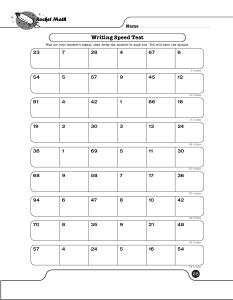
writing speed test for match fact fluency iep goalsYou cannot set achievable goals of how many facts a student should answer in a minute without first knowing how fast they can write. That sets the upper limit. So test their writing speed by having them write a mix of one and two-digit numbers for one minute.  See above, the Rocket Math’s one-minute Writing Speed Test. From the link you can print it out for free. Once you know how fast your student can write you can evaluate their performance on the one-minute fluency tests.

Step 3: Set the progress monitoring measure

If you’re going to test every week with 1-minute timings and you have a bunch of those available, you already have a 1-minute timing starting point.  If you’re using the Rocket Math Worksheet Program as your intervention, it uses 2-minute timings to measure progress weekly, so you’ll want to use one of those for your starting point. (You can’t double the 1-minute score because students don’t usually keep up at the same rate for two minutes.) So give one of the 2-minute timings in the operation you will focus on to set a starting point.

Step 4: Set the math fact fluency goal based on writing speed

Students who have successfully developed math fact fluency in an operation can write answers to math facts almost as fast as they can write. As fast as their fingers can carry them is the most you could expect. You could set a goal at 80% of their writing speed. It would still be rigorous enough. If they met that goal the student would be fluent in math facts.

goal worksheet

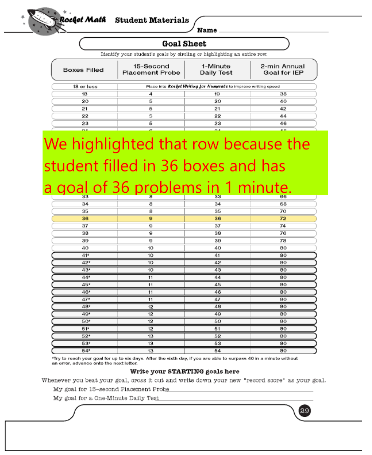
You can do the math yourself from their writing speed test. The Rocket Math Worksheet Program has weekly progress monitoring 2-minute timings. In that case, your student’s goal for the 2-minute timing is on the handy goal sheet ** that you put into each student’s folder. You can see the student shown here filled in 36 boxes on the Writing Speed Test, so his or her goal for 2-minute timings would be 72 for the annual goal for the IEP.

Step 5: Create a graph with an aimline

Now the coolest thing about progress-monitoring a fluency goal is that it is easy to graphically see on a weekly basis if the student is on track to meet the goal. You simply create a graph, with enough spots at the bottom for all the weeks in the year. Next you put in the starting point performance in the first week of the graph (or whenever you tested). Then put in your goal performance at the end of the year. Then draw a line between those two points. That line is called the aimline and is shown in the example below.

iep goals graph with an aimline

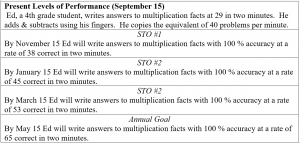
The student, whose aimline is pictured above, began at 29 problems in 2-minutes. Their present level of performance, or PLOP, was 29 problems correct in 2 minutes.  The student had a writing speed of 40 problems in a minute. Therefore 80% of that is 32 problems in a minute or an Annual Goal of answering 64 problems in two minutes by the end of the year. The aimline is simply a straight line between those two. You can see that the first couple of two-minute tests did not meet the aimline, but by the third test the student was right on track for meeting the goal by the end of the year.

Step 6: Document the short term objectives (STOs)

short term objectives worksheetOnce the aimline is drawn, the STOs are found by reading up from the date of the quarterly STO reporting date. Wherever the aimline is on that date, that’s the STO. In the example above the quarter 1 objective looks to be about 38 problems in two minutes. The second quarter looks to be 45 problems in two minutes with the 3rd quarter at 53. Very simple and easy to set and to read and report. Since every student in Rocket Math should have a graph like this, reporting to parents on a quarterly basis would be no more than showing them this graph.

What if the student fails to meet the IEP goals?

child practicing math fact fluency iep goalsSo if a student is not meeting the aimline when we monitor their progress we should re-double our efforts. With Rocket Math that’s quite doable. If the student is falling below the aimline for three weeks in a row, add another practice session each day. The standard ten minutes a day for Rocket Math may not be enough for this student. Arrange for them to get in another practice session each day. Often a daily short trip to the Special Education room for a second quick practice session with the teacher or an aide will do the trick. If two a day at school aren’t enough, maybe you can add one each evening at home. Some students do need more practice to meet these goals. The good news is that you can find out quickly with your graph and get going soon.

**The Rocket Math Goal Sheet was updated in 2021 to reflect the 80% expectation for IEP goals. The update shows that students who can fill in 15 boxes in a minute can go ahead and do Rocket Math, while those who can only fill in 14 boxes are candidates for help with writing numerals in the Rocket Writing for Numerals Learning Track.

Purchase a 60-day trial or a 1-year subscription to Rocket Math Worksheet Program

Motivating Students & Recognizing Effort Keeps Kids Engaged

The Rocket Math Online Game app is a demonstrably effective intervention–meaning if students engage and participate, they will learn and improve achievement. However, assigning an effective intervention will improve achievement only if students are engaged and participate in the intervention. The key is by motivating students to reach higher goals.

In today’s world, many students do not habitually give you their best effort. When you praise and recognize only excellent outcomes, many students are not motivated. They doubt their own abilities and think they are out of the running for achievement awards. Motivating students, ALL students, including low performers to participate is essential. But how to motivate students to learn math? You need to begin by praising and recognizing participation and effort instead of success. A good intervention helps you do that.

Motivate Students by Recognizing Effort Instead of Achievement


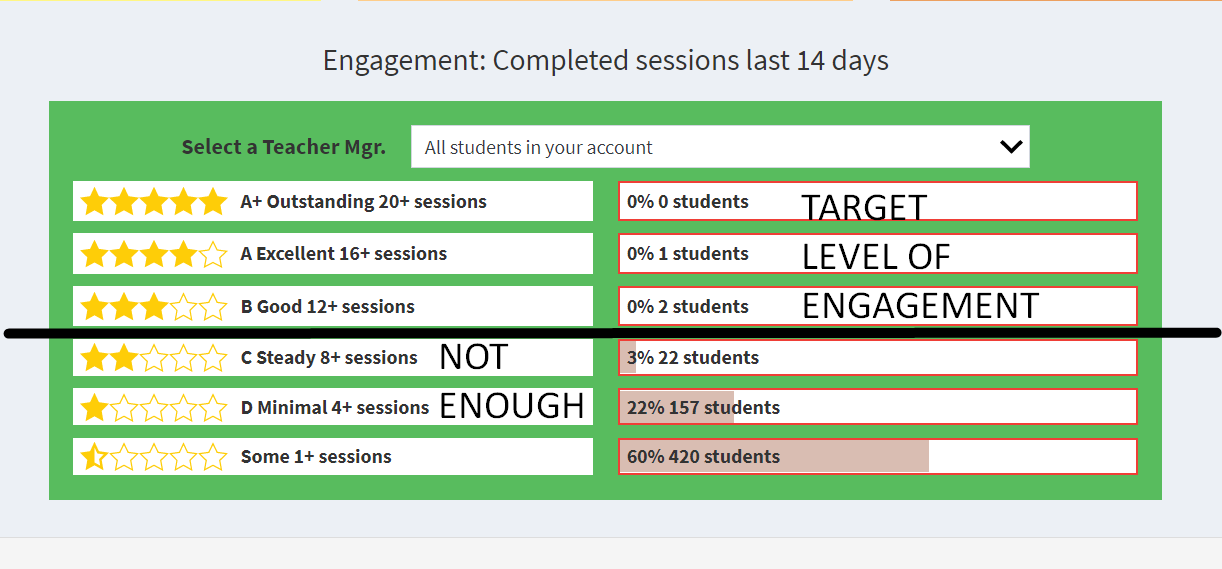
Instead of reporting and recognizing on benchmarks of academic achievement, why not report on benchmarks of effort? The Rocket Math Online Game, gives you data on effort and participation. The Engagement Chart (see above) how many of your students completed how many sessions in the last 14 days. Sessions can be set at five, ten, or fifteen minutes in length. 

Who is working the hardest–recognize them! 

The Engagement chart shows how many students are getting up to the higher levels of engagement.

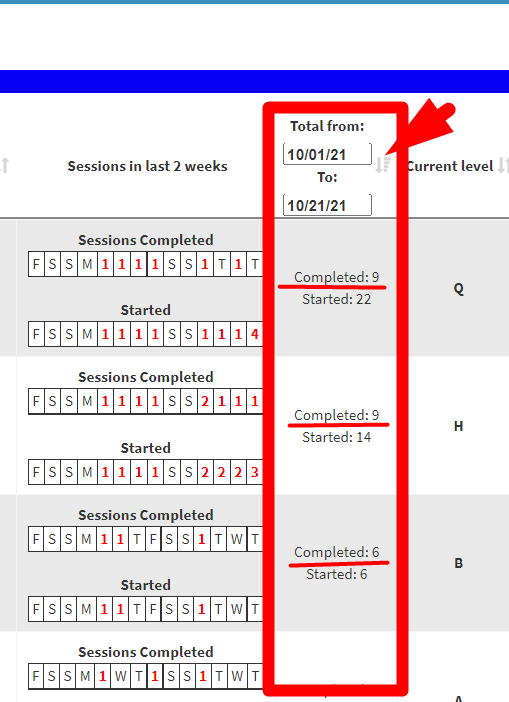
To find the individuals who are working the hardest look further down in the Review Progress page.  Down below the engagement chart there is a “Total” column which shows the number of sessions over the last two weeks.  It is adjustable as to which dates to be covered.  This selection shows from 10/01 to 10/21.   This column will tell you exactly who is working the hardest.  Click at the top of the column to sort it going downward to see which students is logging in the most sessions. The first student shows 22 sessions started and 9 completed (all the way to the end of the session). The second student started 14 sessions, but completed 9. The third student also started 6 sessions, but completed 6. This total data tells us the level of effort students have been putting forth to learn their math facts.  If you monitor this number and recognize students putting forth the most effort, you’ll get more students engagement.  School managers can do this for the whole school.  Teacher managers can do it for their class.  This is key to motivating their learning. 

What is a Good Effort and Participation?

You should expect, at a minimum that students do a complete session each day at school–which is 10 sessions in the last 14 days.  Therefore, 8 to 11 sessions in the last two weeks indicates a good “C” effort.  A good “B” effort would be completing 12 to 15 sessions in two weeks. That many sessions translate into a session every school day and more than one session a day, half the time. Any student with 16 or more sessions in the last two weeks is putting forth a great “A” effort.  Be sure to praise and recognize them and hold them up as an example, no matter what they have accomplished.

Motivating Students with the Award Certificates to Recognize & Reward Effort

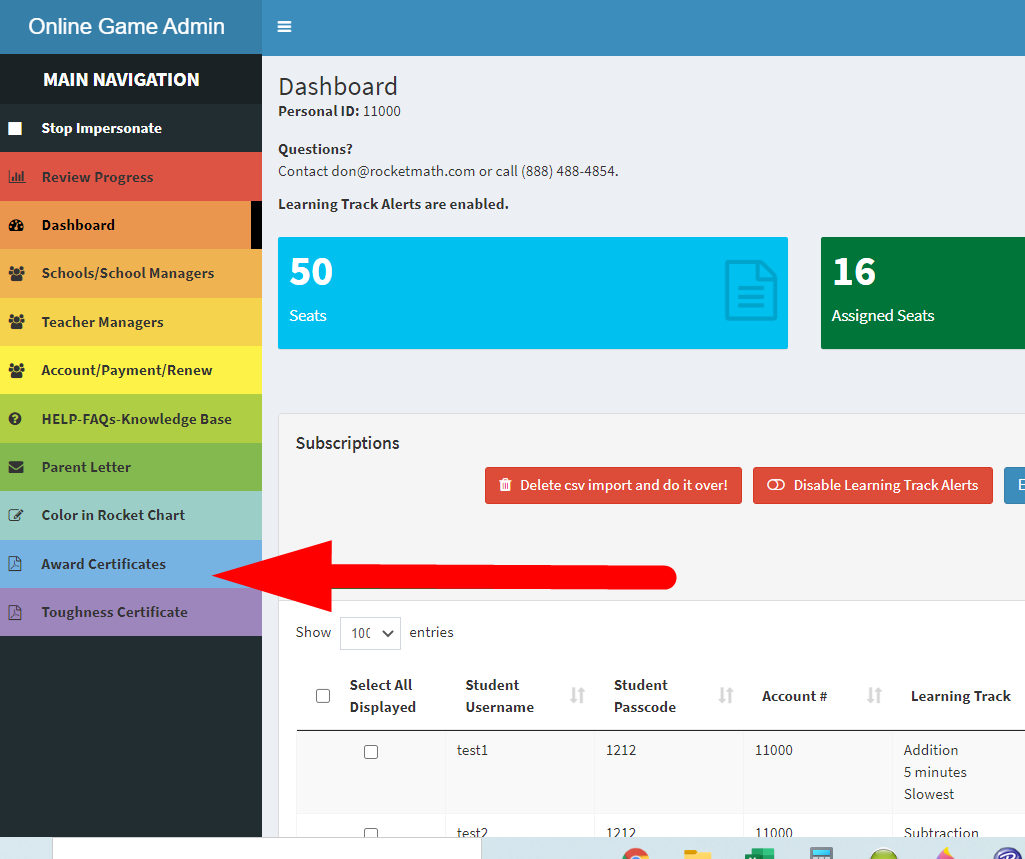
The Rocket Math Online Game has Award Certificates, available to print out. You can find these right from your dashboard. “Award Certificates” are on the blue tab on the left-hand “rainbow” navigation.

Screenshot of Rocket Math's reward cards.
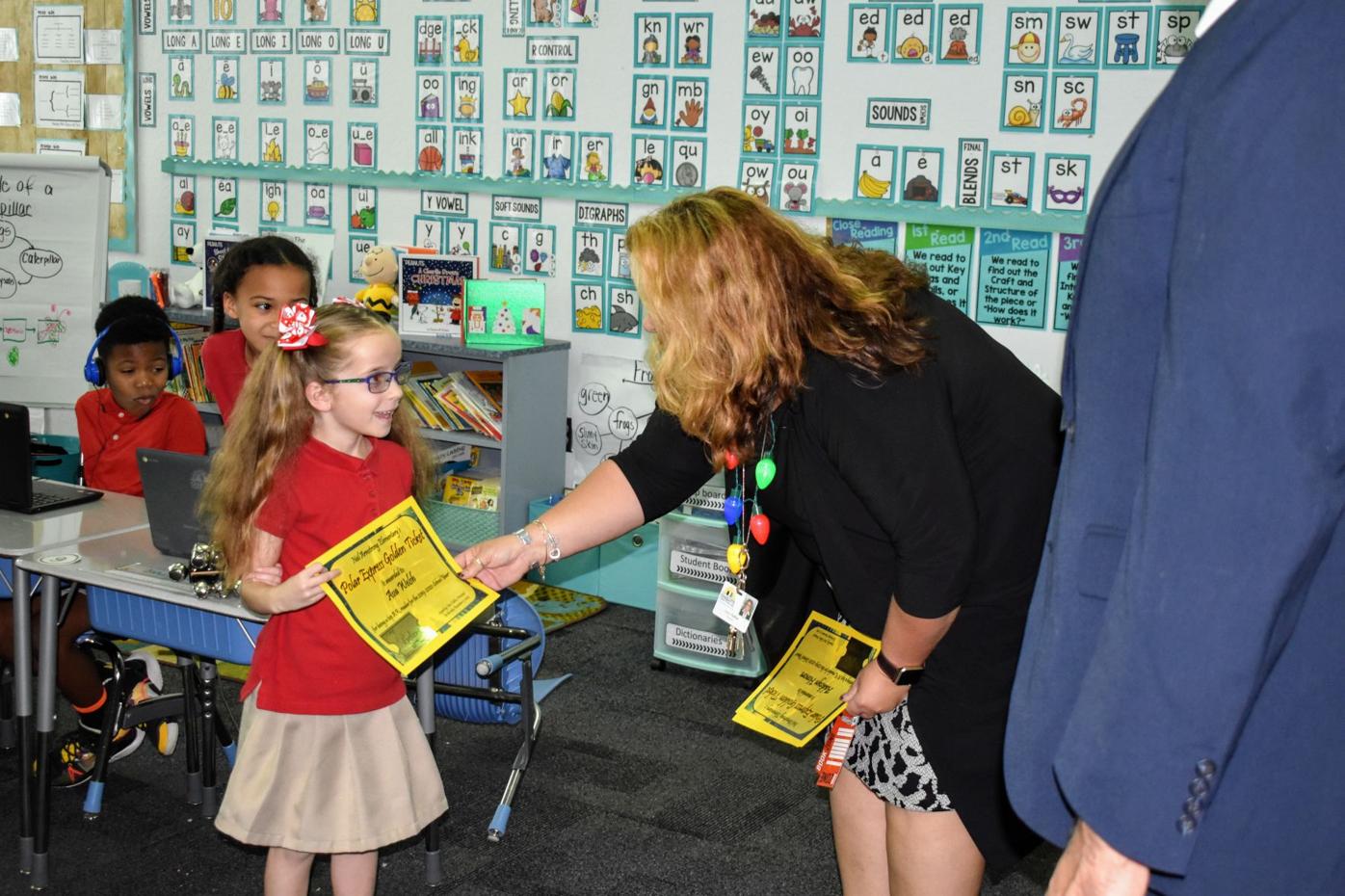
Give out some Award Certificates once every two to four weeks. Give them to the students who are putting forth the most effort in your class. For it to be effective, you have to make it kind of a big deal to get one of these. Sign the awards and then give them out in a little ceremony.

To have a successful ceremony, we recommend these steps:

  1. Having two adults to award the certificates
  2. Calling each student up to the room individually
  3. Handing them the certificate and shake their hand
  4. Having the awarded student stand in a line at the front 
  5. Calling the next student and repeated the first three steps, but adding that they shake hands with their fellow classmates before joining the line beside them


Motivation is most effective for students who don’t get it!

When you reward students for their effort, students who are watching, realize they can do it. They know they can get an award if they try.  The benefit of the motivation is for the ones sitting in their seats watching. If you reward everyone, the ceremony will have no effect. The students watching the ceremony will feel motivated to win the next one. Rocket Math can guarantee you’ll get improved fluency because it is an effective intervention.

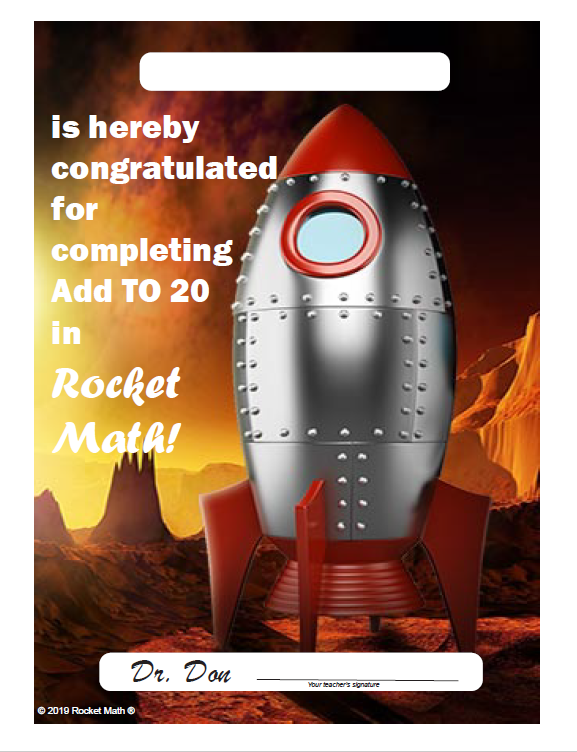
Note, you are not rewarding achievement. You aren’t measuring them on how fast they are. You are noting that they did accomplish the goal of finishing the Learning Track. Rocket Math guarantees they will have improved their fluency. The Learning Track certificates are also available on the Award Certificates tab in the main rainbow navigation bar. The same ceremony you’ve been using for the general awards can include awards for completing Learning Tracks.

We also have sets of these Award certificates on card stock and glossy print available on our supplements store site.

After Effort Improves Accomplishment, Begin Rewarding Accomplishment also

Soon after starting regular awards ceremonies for effort, you’ll see students beginning to complete Learning Tracks. As they work through a Learning Track they develop fluency with the math facts in that Learning Track. So you can start awarding Learning Track certificates for the accomplishment of completing a Learning Track.

This is a powerful process. Rewarding effort first, then rewarding accomplishment, leads to learning. Once you see how well this process works, you can apply this elsewhere. It works in any area of your curriculum where effort will pay off in improved accomplishments. Motivating students only works if they believe they can succeed. That is why it is so important to begin by recognizing “effort,” something that everyone can do.

Rocket Math Knows How to Motivate Students to Excel in Math 

Rocket Math Online Game and Worksheet programs will help students reach each grade level math benchmark while motivating students to reach higher goals with the award certificates. Systematically teaching students to develop math fact fluency will pay off. Students will not only succeed at but learn to enjoy math.

Counting Objects Worksheets for Kindergarten | Do They Work?

Much is made in teacher education classes about the importance of counting real objects vs pictures, but there is little empirical evidence to support this concern. What is much more important is for the counting to be first demonstrated by the teacher. The second most important thing is to be able to ensure that students focus on the right number of objects. These are very hard to do with manipulatives.

How to use counting objects worksheets in the classroom

Worksheets can ensure that students are focused on the right number of objects while the teacher demonstrates the counting exercise. Manipulatives, not so much! I have seen counting exercises (of manipulatives) lead students seriously wrong. Some students have the wrong number of manipulatives in front of them as the counting ensues while others change the amount during the exercise.

Step 1–the “I do” step: Always begin with a teacher demonstration
 

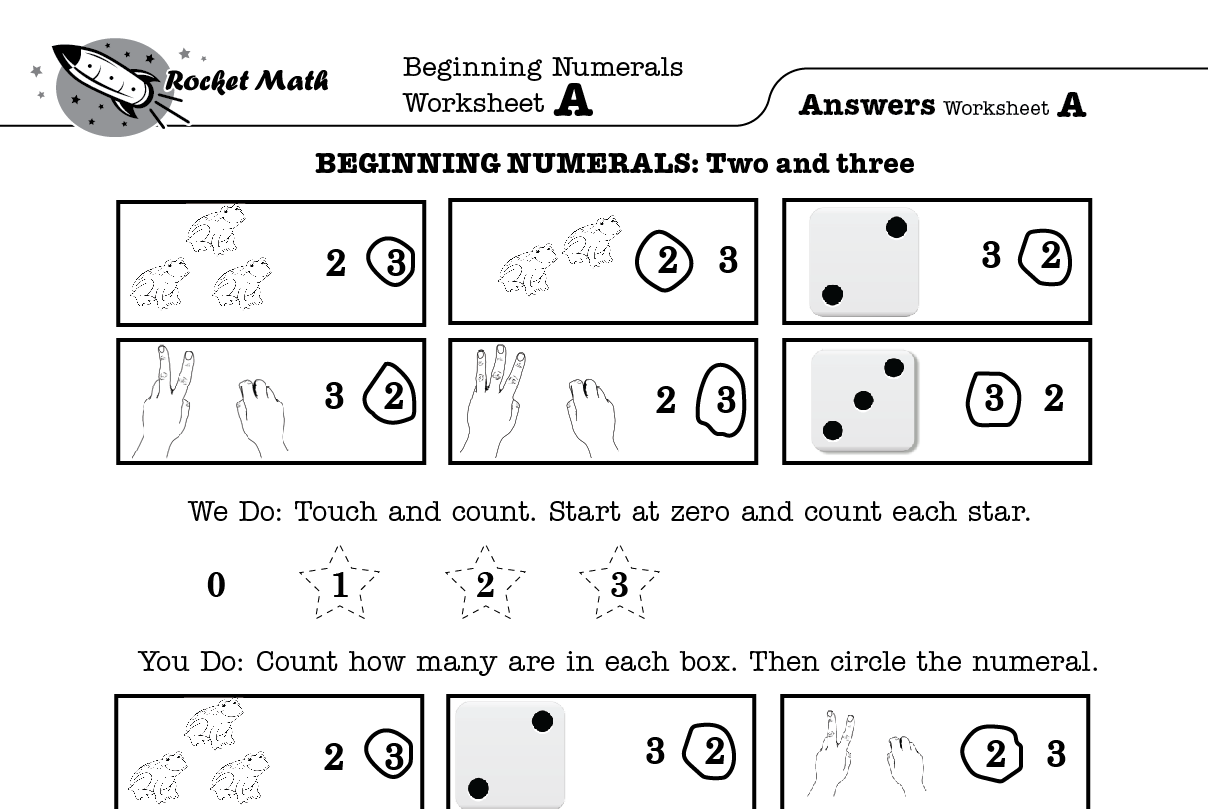
A screenshot of the Beginning Numerals Worksheet A with six boxes with images of frogs, hands, or dice in each.

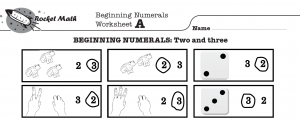
Here is part of the Rocket Math–Beginning Numerals Learning Track: Worksheet A. This shows the top part of the worksheet which is the “I do” or teacher demonstration part of the worksheet. The teaching suggestion for the “I do” step for the teacher reads as follows:

Using the six boxes at the top of each worksheet, model how to touch
and count the items in each box–then show the students that the correct
answer is circled. Have them touch the circled number. Confirm the
name of the numeral. Check to see that all students are touching it.

At a small table for instruction, the teacher could hold the worksheet up on a clipboard, or for a larger group, a document camera would be needed. The teacher gets all eyes on the demonstration and then models touching and counting. Skilled kindergarten teachers know to be quick, perky, and interesting to keep their students attention. Here’s the recommended narration:

I can do this. Watch me count. One, two, three.
There are three frogs in this box. So they circled the three.
Touch here where the three is circled next to the three frogs. Good.
How many were in this box, everybody? Yes, three.
Now watch me do the next box.

Watch me count. One, two,.
There are two frogs in this box. So they circled the two.
Touch here where the two is circled next to the two frogs. Good.
How many were in this box, everybody? Yes, two.
Now watch me do the next box.

Step 2–the “We Do” step: Lead the students to make the correct responses

Once kindergarteners can say the numbers by rote, the hard part is to develop the one-to-one correspondence between the words and the touching. This is much more difficult to do correctly than you might think. For starters, counting to ten by rote may seem like to little ones like a couple of long words, “Onetwothreefourfive sixseveneightnineten.” To teach them to touch each object and say only one word for each, the task must be done together, slowly and correctly, many times.

We Do: Touch and count. Start at zero and count each star

Screenshot of the star system starting with 0 and going up to 3.

We Do: Narration to Count Objects in an Image

Every worksheet in the Rocket Math Beginning Numerals Learning Track has a “We Do” activity of counting stars.  Here’s the recommended narration for the counting star’s activity pictured above entitled “We Do:”

Our ‘We Do’ says to touch and count. Start at zero and count each star.
We are going to touch and count the stars. Put your counting finger on zero,
everybody. We are going to start at zero and count each star. Let’s count.
One, two, three. We counted three stars. That was great!
Let’s do it again! Fingers on zero, everybody. Let’s count. One…

It doesn’t take much imagination to see that students will get this counting exercise right with the teacher’s help. If not on the first pass, by the third time, students will be correctly counting the stars. This counting exercise occurs on every worksheet in this Learning Track and gradually builds to counting up to 12 stars.


Step 3–the “You Do” step: Students demonstrate their learning
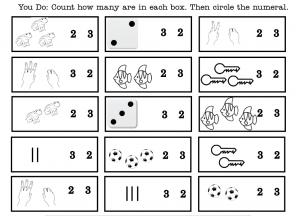
Screenshot of Rocket Math's Counting Objects worksheet showing 15 boxes all with their own images, then two numbers next to the images for students to choose from.

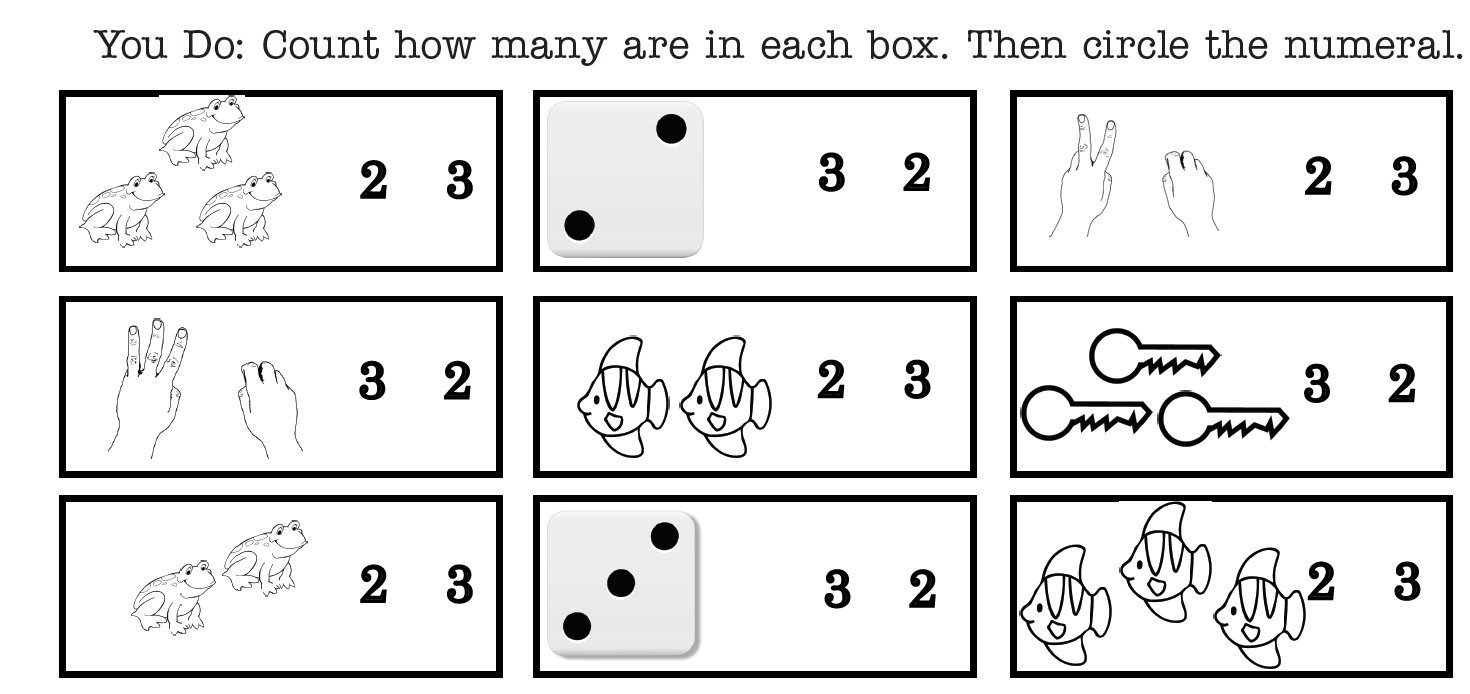
In the “You Do” portion of Worksheet A of the Rocket Math Beginning Numerals Learning Track (see above) it asks students to count the objects and select, rather than produce or write, the correct number for the number of objects they see in the box. This is identical to the teacher demonstration exercise at the top of the worksheet. The teacher has demonstrated how to do this task already. Students just need to remember that from the demonstration a few minutes prior.

Students are asked to make that distinction, to choose between two and three, by circling the right one–as was done in the top six boxes in the teacher demonstration part of the worksheet. The demonstration answers at the top of the worksheet will be available for students to use as a model of the correct answer. Students learn from practicing the correct answer rather than from practicing errors, so error-free work is the goal.

Benefits of using counting objects worksheets for kindergarten

Counting objects worksheets can focus on one thing to learn at a time

In the “I do” worksheet demonstration, the teacher is helping students develop one discrimination and one only.  The task is learning to discriminate between counting two objects vs. counting three objects. The three different pictures demonstrate this; frogs, dice, and fingers. It becomes clear that the job is to get it right, to be able to tell the difference between two and three–that’s all. Students can learn one distinction like this with a high level of success.  The worksheet allows the teacher to move back and forth between two objects and three objects quickly.  Imagine how chaotic that would be to accomplish with manipulatives!

Counting objects worksheets can transition students to fingers and lines
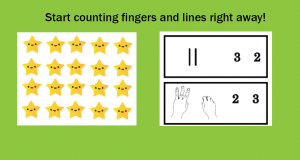
Many lists of objectives include counting objects to 20. While the ability to count things up to 20 is important, that’s a lot of pictures. It is very easy to make a mistake in counting. It is much preferable to transition students to counting fingers, up to 10, and then to lines for numbers up to 20. A good worksheet program should include from the beginning pictures of fingers and lines to count instead of just cute objects. By introducing fingers and lines from the beginning, students will find it easy to transition to using only fingers or lines later.

Worksheets can properly space out the objects to be counted

A common issue in counting objects is to have the objects spaced far enough apart so that students are reliably not touching the same object twice in a row. In the “We do” portion of the worksheet, pictured above, it is clear that students will succeed by beginning with three stars spaced far enough apart that students have to move their fingers to count the next star. They won’t be confused as they can be by counting objects that are too close together.

A worksheet can establish a starting point for fingers before counting begins

Another problem in teaching counting is that students often begin counting by touching one of the objects they are counting. Then to begin counting they move to the second object and count, “One.” The end result will be off by one. Students must be taught to start with their counting finger somewhere else, and then move to the first object to be counted while saying, “One.” The Rocket Math Beginning Numerals (counting objects) worksheets always have students start with their finger on “zero,” which is pretty useful as a starting place. That’s where you start before you begin counting.  I expect the savvy teacher will be saying, as students are getting their fingers ready to count, “We are touching the zero.  Have we counted any stars yet? No!  So we have counted ZERO stars.  That’s why we are touching the zero.”

A worksheet can allow students to choose the correct answer rather than produce it
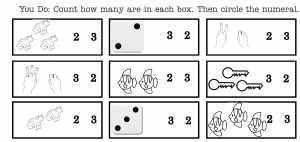
Counting worksheets that begin by requiring students to produce, or write, the numeral of the answer are asking too much of beginning students. When the written answer is wrong the teacher has no way of diagnosing whether the student counted incorrectly or forgot how to write the numeral. Much better to begin by having students select the correct answer from a limited number of choices. Teaching students (1) how to write numerals and then (2) write them from dictation are two different skills that should be taught in different instruction.

Worksheets can limit displays to numbers the students have learned.

Another advantage of worksheets is the ability to limit the examples to numbers of objects that students have already learned. When a teacher allows students to use manipulatives the ability to control the number of objects to count is lost. Instead, as shown in the “You Do” portion of Worksheet A, shown above, students only need to be able to distinguish two objects from three objects.

By having the answers present to choose from, the worksheet limits the distinctions that the students need to make. Many beginning kindergarteners confuse 4 and 5 early on. Therefore that distinction, between 4 and 5, should not be required until 1, 2, 3, and 4 are well established and at mastery. You see here on Worksheet A students are only required to distinguish between 2 and 3 objects. They make the same distinction between several examples of different objects.

Rocket Math Beginning Numerals (counting objects) worksheets will start kindergarten students out successfully

The Beginning Numerals Worksheets is the first of over 25 math worksheet Learning Tracks available as part of the Rocket Math Worksheet Universal Level Subscription. See all the other Learning Tracks available in the Worksheet Program. Go here to get a 60-day trial subscription for $15 with a money-back satisfaction guaranteed offer direct from the author, Dr. Don



Instant assessment for basic math fact fluency: Ask ’em!

Teachers and parents often ask, “How do I know if my children need to study math facts?” Here’s an instant math assessment you can do to test them for math fact fluency. Ask a student a “hard one” such as, “What’s 9 times 7?” or if they are in first or second grade, “What’s 8 plus 9?” If they start counting on their fingers or hesitate while puzzling it out, they do not have “math fact fluency.” They need a program of systematic math facts practice until they know them all “by memory,” as the Common Core State Standards (CCSS) say.

Math fact fluency means instant recall

A student thinks through an equation by recalling their math facts.Some teachers and schools teach “tricks” for remembering facts that are supposed to help children. However, they should at most be a temporary crutch. Such techniques need to be replaced with instant recall. The student shown here is using the commonly-taught “doubles plus one” trick for figuring out the answer to, “What’s 8 plus 9?” This is not fluency. He needs practice in math facts so they become “automatic” in recall. If he is still having to do this in fourth or fifth grade, he’ll find math work slow-going and drudgery. He’ll also find it hard to follow a math lesson when he has to stop and puzzle out simple facts like this.

Math fact fluency makes math easy

Students who know the math facts instantly can fly through their math assignments. They enjoy the exercise and feel good about their math abilities. On the other hand, students who have to count on their fingers, or use a number line or a times tables chart to do their math assignments come to hate math. It is so-o-o-o-o slow. I’m sad to say that when I taught elementary and middle school remedial students I knew they hated math because they had to puzzle out most of the facts. What else could I do but assign lots of math fact practice that they hated?
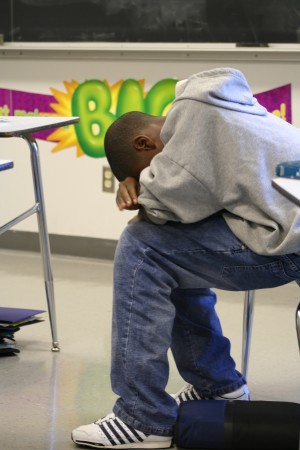
In graduate school, I learned how to design a math facts practice program in a way that every student can succeed in memorizing the facts. I put a paper-and-pencil program together back in the ‘90s and have been sharing it with people ever since. I called it Mastering Math facts, but everyone else just called it Rocket Math. That became its official name in 2007.
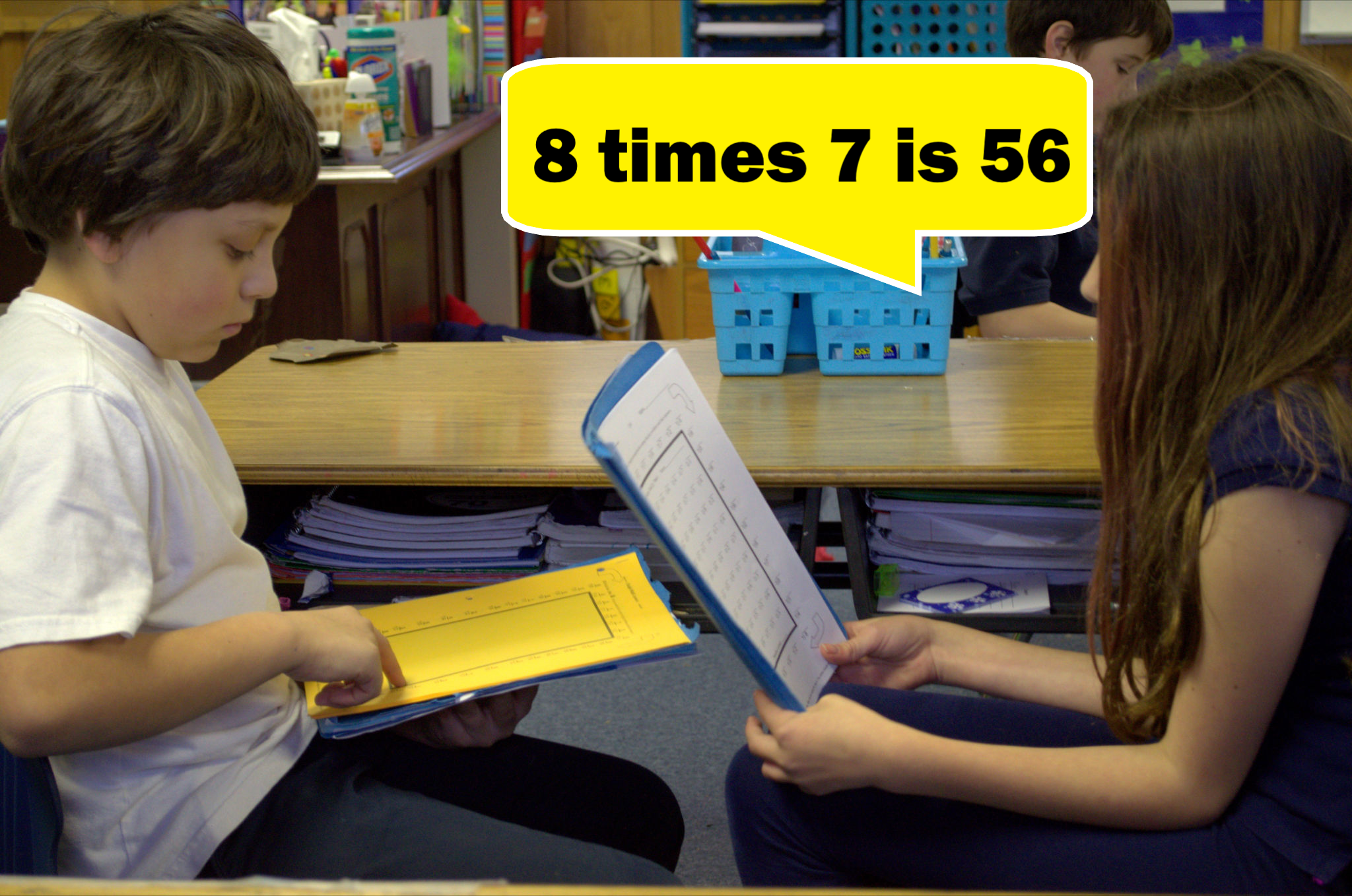
Teachers have been successfully using my nearly secret curriculum with wild success for decades. Oddly enough, students actually enjoy the Rocket Math Worksheet program. They enjoy the paired practice with a partner, and can actually see themselves learning and getting better.

Two students participating in one of Rocket Math's math fluency programs

How to assess students in math

Before you start Rocket Math’s Online Game or Worksheet Program, it’s a good idea to find out which operations your student needs to practice most. Rocket Math offers a few tests to identify where your student should start their Rocket Math journey.


Writing Speed Test

Many students aren’t able to write the answers to 40 problems in one minute, which is normal and doesn’t affect their math fact knowledge. Before administering the Operation Pretests, evaluate your student’s writing speed to make sure the results reflect your student’s true proficiency, and that they are not held back by their writing speed. 

Get the One-Minute Rocket Math Writing Speed Test.


Operation Pretests

Once your student has completed the Writing Speed Test, give them a pretest in one or more of the four basic operations. 


Evaluate Results 

For students in 3rd grade and above, test multiplication first and then division. If students struggle with either of those two operations, they should start learning those operations. For 3rd graders and above who don’t struggle with multiplication and division, test addition and subtraction to assess any weakness. For students in 1st and 2nd grade, test addition first and then subtraction. 

Evaluate your student’s results based on their individual writing speed with the Evaluation Chart for Pretests. Use their writing speed to determine if their performance on the Pretest is weak and shows a real need for work on math facts, or is good but could use some help, or strong and no practice is needed. 

Free Online Game subscription as long as you need to decide

There is no reason for students to be bogged down and discouraged by math, especially by lack of math fact fluency. This doesn’t need to happen to children. Every student is capable of memorizing basic math facts with a little effort and a carefully sequenced curriculum, like the Rocket Math Worksheet Program.

Or if a paper-and-pencil curriculum like the Rocket Math Worksheet Program involves standing at the copy machine, is not what you are looking for, Rocket Math is now online. The Online Game app starts with a complimentary initial subscription of 14 days. You can learn more about it at that link. Or you can just go ahead and register an account and start it on this link


Send an email to me at don at rocketmath.com and I’ll extend the complimentary subscription as long as you need to decide.** If you need one to ten seats it is a whopping $4.50 a seat for a year. Twenty or more seats are $2.50 each for the year and per-seat prices go down from there. Really there’s no reason to leave kids counting on their fingers.