“Knowing” means never having to figure it out

Most people, for example, know their name, by memory.

In a previous blog I discussed  What does CCSS mean by “know from memory?”    

A reader asked the following question:

This topic of “know from memory” is something I have been digging into as a special educator. I wonder what your thoughts are about whether certain accommodations from these “know from memory” standards would actually be modifying the curriculum?

For example, if we used “extra time to respond” and the student had to use their fingers or some other method to count, would they then not be doing the standard?

This relates to where I’m at in middle school math, but I think that it’s reflected in the continuum of the common core maths.

Thanks.

Dr. Don’s response: 

Actually, your example is very clear that it is not “knowing from memory.” You are describing “deriving from a strategy” or what I call, “figuring it out.” When you know it from memory, when you recall the answer, then you stop having to “figure it out.”

Knowing from memory and figuring something out are two very different things. I used to ask workshop participants to imagine sitting next to me in a bar and asking me for my name. What if, instead of saying, “Hi, my name is Don,” something different happened?  What if, like the man pictured above, I was puzzled and said, “Wait a second, I have it here on my driver’s license.” Most people would likely turn their attention elsewhere while wondering what kind of traumatic brain injury I had sustained! They would very likely say to themselves, “OMG, that man doesn’t know his own name.”

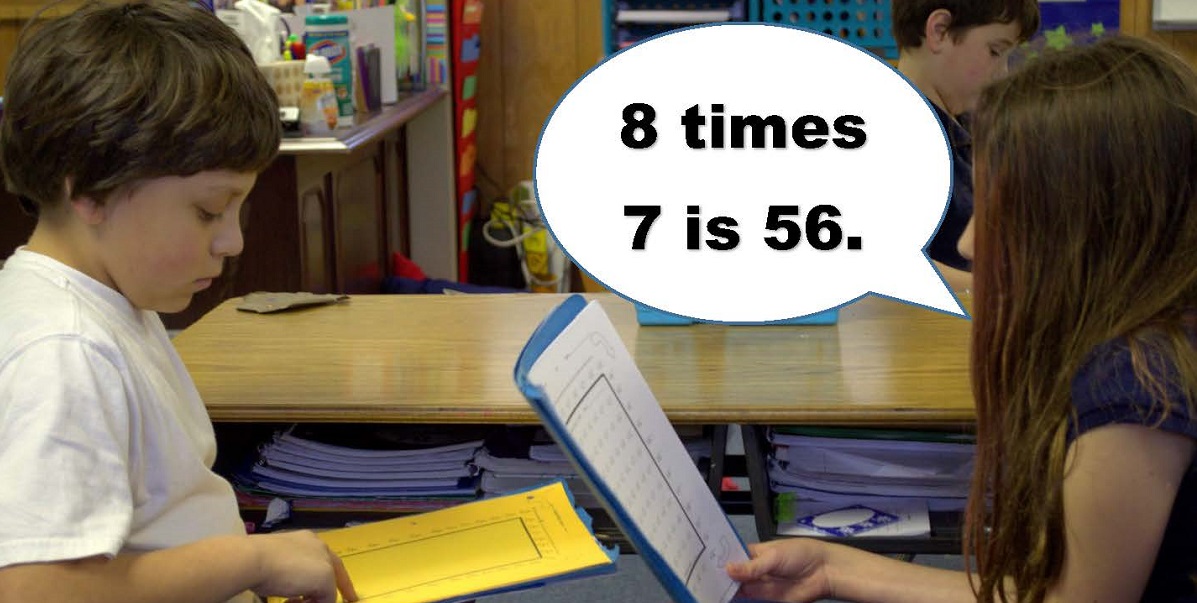
The purpose of the verbal rehearsal that is a daily part of Rocket Math is to cement these basic facts in memory. Then when a student says to themselves, “8 times 7 is,” the answer pops into their mind with no effort. It takes quite a bit of practice to achieve that. However, the ability to instantly recall the answers to basic math facts makes doing mathematical computation a relative breeze. It make seeing relationships among numbers very obvious. It makes reducing fractions and finding common denominators easy. That’s why the Common Core thinks “knowing from memory” is so worthwhile. It’s why I began promoting Rocket Math in the first place.

Do you know the active ingredient in Rocket Math?

Timed tests are not the important part of Rocket Math.

The “active ingredient” in the Rocket Math prescription, the thing that makes it work, is not timed tests.  Timed tests don’t actually teach and often don’t really help students develop fluency.  The usual timed tests of a random selection of all the facts can assess fluency in math–but they don’t work to develop it!

The “active ingredient,” the thing that makes Rocket Math effective, is verbal rehearsal.  When students practice with their partner the students read the facts and RECALL the answers from memory and say them aloud.  That verbal rehearsal is what cements them into memory.  Reading the fact and recalling the answer from memory strengthens the neural connection.

Why do we give the daily tests in Rocket Math?  Not to teach, but only to assess whether the facts introduced thus far have been learned well enough for the student to have new facts added to what they are learning.  Individual students learn at different rates.  Some students need only a couple of days of practice to memorize two new facts while others may need several days.  The purpose of the daily tests is just to see if the student needs more practice time, or is ready to “swallow” some more facts.

As I note in my basic training presentation, “It’s like feeding mush to a baby.  You have to make sure they have swallowed the last mouthful before you give them more.”   See an explanation in this You Tube video in our Rocket Math channel: https://youtu.be/J8cWSDG0Di8

Keeping track of progress in Rocket Math

Which students are progressing as fast as they should be in Rocket Math?

And how fast should they be progressing, anyway?

Over the years of helping teachers and schools implement Rocket Math I have learned that a complete laissez-faire attitude about student progress can mean that some students get stuck for weeks on the same sheet.  Needless to say, students who get stuck, come to hate Rocket Math.  When this happens, those students don’t get through all the operations they should learn.  So we need to intervene, and give them more help.  It turns out that some students need more practice, sometimes two or three times more practice, to learn the facts than their peers.  To get such students through one operation a year means they have to have extra practice sessions scheduled in each day.  Here’s a link to a blog about how to provide extra help.

But which students need extra practice sessions?   Under Resources/Educator Resources I’ve created two versions of a tool that can help.

Whole Class Excel Rocket Math (2 operations in a year) Aimline.  This is pictured to the right.  It is needed for 2nd grade and 4th grade and up when students need to finish one operation and do a second one in a year.  The expectations needed to pass two operations in one year are basically that students should pass two sets each week.  If they have studied some the year before, they will be able to pass sets in the first operation at a quick pace.  For example if they have done much of Rocket Math Addition in first grade, in second grade they should be able to pass those addition sets again in a day or two.  That will put them ahead of the expectations and they should have a plus by their name most of the year.  Conversely, if they are not able to pass sets quickly, (see the students highlighted in yellow) they will get a minus by their name and should start getting extra sessions scheduled daily.

How does the Excel Aimline work?

Please note: The pictured EXAMPLE Rocket Math Excel Aimline is available from the link or in the Resources/Educator Resources page for you to download. 

Take the blank template and save it for next year.  Then fill out one for this year.  Look at a calendar and on row 4 enter the month and on row 5 enter the starting day of each week in the school year.  so each column numbered 1 through 36 will correspond to a week in your school year.  In row 7 you see the green expected set to be passed by the end of that week.  At the end of week 1 we expect that students will have at least passed Set A.   By the end of week 2 they should have passed Set C to be on pace to finish two operations in a year.

Entering student names.  Starting in row 10 you enter the student names in column B.  This class only has ten students, but I’m guessing yours probably has more!   Cool thing about excel is you only have to enter those names once.  And if you’re really good you can freeze that column so you can easily see it later in the year.

Entering weekly information.  Each week grab all the student folders and for each student enter the highest set they have passed.  You can see that from the Rocket Chart on the outside of the folder, so you don’t even have to open the folders.  If the letter they have passed is equal or higher than the green set expected at the top of the column for that week, then put a plus by the letter they have passed.

Look at Alvin Ailey at the top of my class list.  Week 1 he had passed both Set A and B, so I wrote “B” in his square.  I put a plus because it is exceeds the expected level for the first week.  By the second week he had also passed Sets C and D.  Only up to “C” is expected,  so I wrote “D” and also gave him a plus.  Alvin is rocking it!

Look at Cindy Crawford a little further down the class list.  Week 1 she had passed Set A, so I wrote an “A” in her she got a plus because she met the expectation.  But by week 2 she had only passed Set B, when C is expected to be passed, so I wrote “B” in her square, with a minus indicating she is below expectation.  Now I highlighted her square yellow, but that’s kind of advanced so you don’t really have to do that.  Only Excel experts can do that, although it really makes it easy to pick out who needs help.  We can see that Cindy continues to make slow progress and continues to get minuses.  She needs to have extra practice sessions scheduled to finish two operations this year.  That pace is fine for one operation per year, but not two.

Look down at Gary Grummond.  He didn’t pass even Set A by the end of the first week so I wrote “np” in the first square.  He continues to make progress the next few weeks, but not fast enough to complete two operations in a year.

Row 8 Fraction of students meeting expectation.    After entering all the students for the week you can see how you are doing overall in your class.  Make a fraction with the numerator being the number of students who are meeting the expectation over the denominator of the number of students in the class.  You want a high fraction nearer to 1.

If that fraction falls below 70%, meaning more than 30% of your class is not on track, then you should institute a class-wide intervention.  Either add an extra practice session each day, or see if there is room to improve the quality of practice.  See these blogs and posts about how to monitor for the quality of practice.

Whole Class Excel Rocket Math (1 operatipon per year) Aimline.   In grades 1 and 3 where students are expected only to complete one operation in a year, you can use this Excel Aimline.  The expectations needed to pass one operations in a year are basically that students should pass one set each week.   Everything else about how you use the excel form is the same.  Note that if you want students to do two operations in the year (for example both subtraction and multiplication in 3rd grade) then you would use the two operation aimline.

 

The 100-point observation form: How well do you implement Rocket Math?

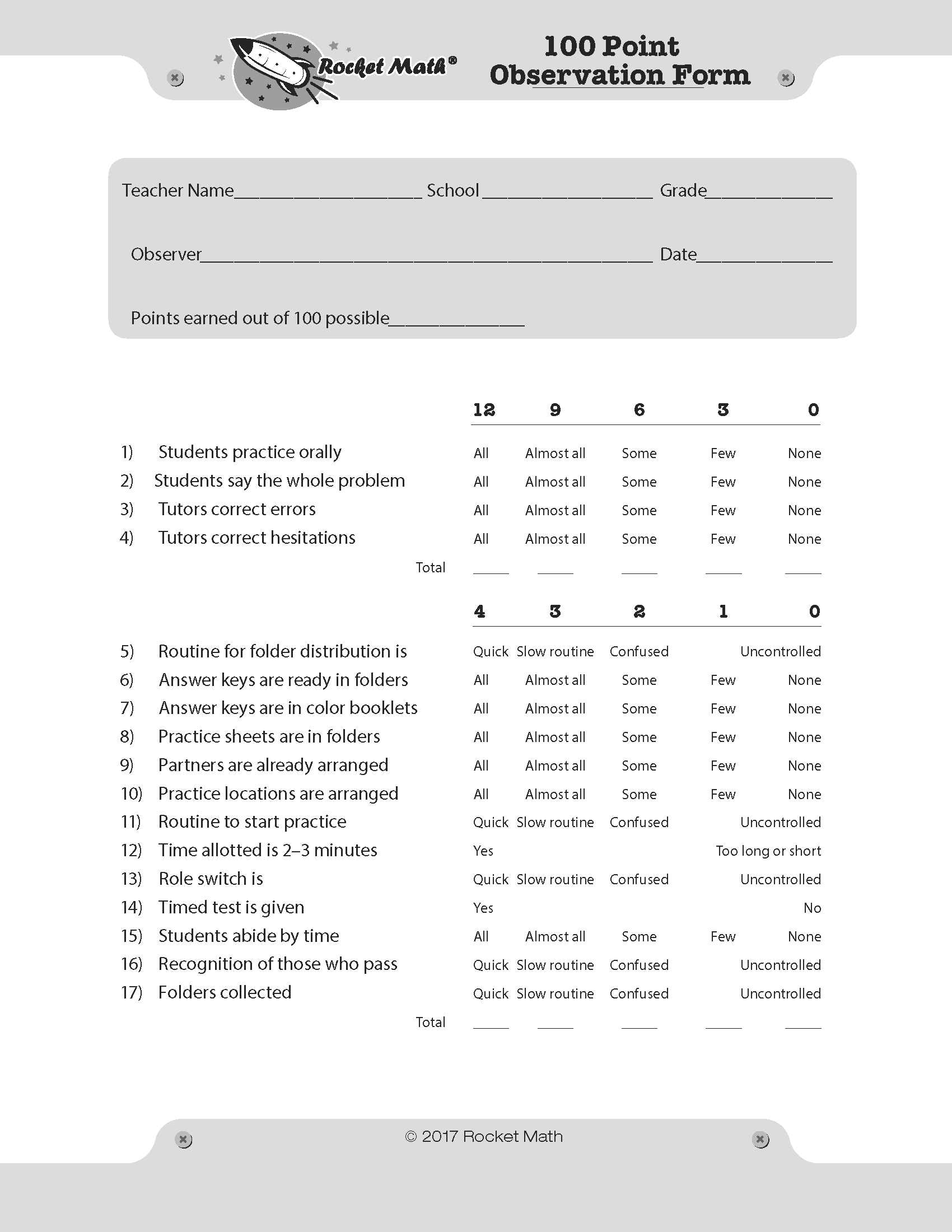
Use the 100-point observation form to evaluate your implementation.

Use the 100-point Rocket Math Observation form to self-evaluate, or have someone observe your class doing Rocket Math and use the form to evaluate you.  The form observes and evaluates seventeen different indicators of the quality of your Rocket Math implementation.

You or your observer begin by looking at four important indicators of the quality of student practice.  The quality of the paired practice of your students provides most of the value of Rocket Math.  Accordingly, these four indicators provide nearly half of the 100 points.  If one or two of these things are not in place (tutors aren’t listening carefully and correcting errors AND hesitations, for example) the implementation will not earn high marks, because students won’t be learning nearly as well as they should or could.

The other thirteen indicators are mostly about the efficiency with which Rocket Math runs.  If it takes more than 15 minutes a day to complete Rocket Math, it won’t happen every day.  If Rocket Math doesn’t happen every day, students do not learn nearly as well as they should or could.

Where can you find the 100-point Observation form?

There are three places you can find this handy form.  (1) It is included in hard copy form in the Administrator and Coach Handbook which we sell and ship to you.

(2) The 100-point Observation form is also available for free on the Resources/Educator’s Resource page on our website where you can find this link to its pdf.

(3) And finally in the Rocket Math subscription filing cabinet, in the Forms and Information drawer, there is a section (pictured on the left) that is devoted to all the information in the Administrator and Coach Handbook and near the bottom you’ll see the 100-point Observation form for you to print out.

5 easy ways to get help running Rocket Math.

Here are 5 ways to get help with the procedures for successful Rocket Math implementation.

1.) Use the ***NEW*** search function.  At the upper left of the blue navigation bar is an icon of a magnifying glass.  Click on that and a search bar opens in the middle of the page.  Click within the search bar and you can type in whatever you are looking for.  It will bring up blogs, parts of the directions, basically anything I’ve written on the subject–which is a lot.  You can get pretty specific very fast, so try this first.  I’m very excited to have added this feature this week, which is why it is top of my list!

2)  FAQs.  Look at the Rocket Math FAQs page.  Click on the linked words to the left, or navigate to it.  The FAQs page is the third Rocket Math Filing cabinet on the webitem under ABOUT in navigation.  The FAQs page displays all of the questions from the teacher directions, and my answers, so you can scroll down to the topic you need quickly.   However, all the FAQs will show up in the search function as well.

2.5) The FAQs are also available in the Rocket Math filing cabinet.  They are in the top drawer, the “Forms and Information” drawer of the filing cabinet.  There are titles of the FAQs so you can open and print any one you wish.  Good for sharing with other staff.

3) Rocket Math YouTube channel. You can go to the Rocket Math YouTube channel.  Click on the linked words to the left, or search for Rocket Math in You Tube.  If you scroll down the page you can click on “View Full Playlist” and then you’ll be able to see all the topics that are available.  Right now there are 37 videos, but that could change if we add some more.

4) DVD training.  Order the Workshop Training DVD (#2004) for $29  This is the whole training from Dr. Don filmed and broken into chapters.  It is over 3 hours and gives a lot of rationale for the procedures we recommend.  Very helpful if Rocket Math is new for your staff.  Really important to do things as recommended.  Having coached this in many schools for many years, I can promise you it will go better if you follow the directions!

5) Contact Dr. Don.  Really.  You can call me (800) 488-4854 during west coast school hours and I’ll probably be able to answer the phone directly.  It’s a joy for me to talk about implementing Rocket Math with teachers, so don’t be shy.  But if you don’t reach me, please send an email to don@rocketmath.com rather than leave your phone number because during the school day teachers are very hard to reach.  I’d rather just write an answer in an email so we don’t miss each other.  And if it is a new question I’ll probably turn my answer into a blog that can be found through the search function.

How long should I allocate for Rocket Math daily?

Jessica asks:

As I am planning my daily schedule I am looking for how long I should set aside for Rocket Math each day.  What do you suggest?

Dr. Don answers: 

If you allocate 15 minutes a day for Rocket Math that will be enough.  You might have trouble meeting finishing that quickly in the beginning before the routine is established.  But once the routine is set there is no need to take more time than that–each partner of the pair is practicing for 2 to 3 minutes and the test takes only one minute.  Don’t try to have everyone correct their partners papers as that will take too long.  Making sure that students practice every day with their partner is critical to success, so anything that makes you feel “we don’t have time for Rocket Math today” is harmful to student learning.

The other key is to be sure to teach students how to practice with each other.  If you can train your students to correct hesitations you will accomplish a lot with your Rocket Math practicing time.  Please take a look at my video on “How to teach students how to practice.”   Take the time allocated to Rocket Math for the first several days of school and follow this teaching procedure.  It will pay off for you all year long in improved learning during Rocket Math time.

Why is a gifted student having trouble with Rocket Math?

Question: Hi, Dr. Don! Just had a question recently from a parent of a gifted child whose son is having a lot of difficulty doing Rocket Math! He understands almost everything conceptually in math (in the 99% on national testing) but he is not being successful working with a partner on his math facts. Have you had this problem in other places? I’m not sure if the problem is he really can’t focus on the facts, he’s stubborn and doesn’t like details (big picture thinker), etc. He’s a very social kid so the partnering doesn’t seem to be the problem. I would greatly appreciate any suggestions you might have that I could give this mother. She says that he is fine at home doing his facts with her without a timer. But I don’t like the idea of excusing any student from doing this valuable practice. Thanks for your thoughts. Linda

Answer: I’ve blogged a bit on some of these issues elsewhere on the Rocket Math website, but let me try to be more specific here. First, gifted kids are stunned to find out that they have to work hard to memorize math facts. They probably need three or four days of practice—which to them seems like failure.  They are like an athletic kid who excels easily at every sport but finds he needs to work out with weights as much as a klutz to get to be able to lift heavy weights—his natural talent doesn’t help in this instance. So kids who’ve never had to work to learn things before, really are annoyed by having to practice several days in a row.  But it is really good for them!

How is mom practicing with him at home? Can she video him doing the test “untimed?”  If the child is “writing facts” and “without a timer” then he may be figuring out facts over and over—but is not getting to instant recall. That’s why the oral peer practice is so critical—if there is even a slight hesitation the child is to repeat the fact three times, back up three problems and come at it again—until the answer comes with no hesitation. There is a fundamental difference between instant recall of facts from memory and strategies to come to the answer by thinking it through. My parent letter addresses how to practice.  On the other hand, if the student is able to write the answers to math facts at a fast enough rate to complete 40 problems in a minute, but only when he thinks he is not being “timed” then he needs to learn how to do the same thing when he is being timed.

If he is not learning with the daily practice, we have to ask, “Why not?”  Social kids sometimes socialize instead of practicing. Social kids also can convince their partner not to do the correction procedure. Or they just say the answers instead of the whole problem and the answer. Any of those things would result in not successfully learning the facts. The teacher would need to monitor the quality of the practice. My experience has been that when students are “stuck” or “having difficulty” even just one session of practice done the right way rigorously (with me) and they suddenly improve enough to pass or to recognize they can pass the next day with another session of rigorous practice.

Last of all, sometimes the writing goals are off because of some glitch in how you gave the writing speed test.  So the student might know the facts well enough but not be able to write them fast enough to pass the tests.  If the student can answer 40 facts in a minute in the current set (just saying the answers without having to say the problems) then the facts are learned to automaticity—and the goal in writing should be lowered to whatever the student has done to this point.

Hope this helps. You are right not to excuse this student from learning math facts to automaticity. He might be a stellar mathematician someday if he learns his facts well enough that math computation is always easy for him. If math computation remains slow or laborious he won’t like it enough to pursue it as a career.

Without the directions you may get lost!

What happens when teachers don’t have a copy of the Rocket Math Teacher Directions?  Bad things!  

When teachers don’t have the written directions to Rocket Math, the essence of the program usually gets lost.  Procedures get modified and modified over the years until they are not even close to what should be occurring. Sometimes we have found schools that are not even providing daily oral practice.  Other schools don’t give the answer keys to the peer tutors.  Other schools don’t give the writing speed test and make up impossible-to-reach goals for students.  We often see teachers implementing the “Rocket Math” program incorrectly and wondering why it doesn’t work.  We ask them if they have read the teacher directions, and they say they didn’t know there were any.  When teachers have never seen the directions, is it any wonder they don’t know what they are supposed to be doing?  Hear-say directions handed down over the years from one teacher to another just don’t convey all the important details.  Teachers need the directions!

This is why I’d like you to have my complete directions for free. Even if you purchased Rocket Math ten years ago and haven’t gotten the updated versions since then, you can have these directions for free.  I have them in three places.  I have the directions broken out into FAQs on their own web page here.  That’s easy for quick reference.

The second place I have the Teacher Directions is as a downloadable booklet you can print out and distribute.  The Rocket Math Teacher Directions for the worksheet program booklet is here.   Please print this out and give to your teachers, especially in schools that began implementing several years back.  Read them and have a discussion at a professional development time.  You will be astounded at how much your implementation differs.

The third place I have the Teacher Directions is in the “filing cabinet on the web” for those of you who have the subscription. In the “Forms and Information” drawer we have the booklet and the FAQs which can be opened and printed out.

In school-wide implementations of Rocket Math, principals or math coaches need to take a leadership role.  The Administrator and Coach Handbook gives you forms with what to “look-for” in a Rocket Math implementation.  If you use that to observe Rocket Math in your classrooms you’ll quickly see whether or not things are going the way they should.   If you have a subscription to Rocket Math you’ll find all of the chapters of the Administrator and Coach Handbook in the “Forms and Information” drawer of our filing cabinet on the web.

Please take the time to see that you or your teachers are implementing Rocket Math according to the directions.  Trust me, it works SO MUCH BETTER if you do.  I wouldn’t steer you wrong!


Rush help to those who need it with an aimline

The sooner you provide extra help, the easier it will be to catch them up.  

How can you know when students need help to meet expectations?  Use the graph above, which is available from the Educator’s Resources page or here: One Semester Aimline.  It is also available in the basic subscription site, Forms and Information Drawer as an optional form. It is an “aimline” for finishing an operation (Sets A-Z) in one semester.  Schools that don’t start Rocket Math in first grade need students to finish addition in the first semester of 2nd grade and subtraction in the second semester.  This means that students who get stuck on a level for even a week need to be helped.

How an aimline works

If you indicate on this graph the week in which the student finishes each set in Rocket Math you can tell if the student is making enough progress, or if he/she needs to be getting extra practice sessions each day. If the student is working on a set above the line of gray boxes or on the line then progress is adequate–they are on track to finish the operation by the end of 18 weeks of the semester.  But if the student is working on a set that is below the line that means he/she needs intervention.

In the example above the student whose progress is shown in red is above the aimline.  That student has been passing at a rate that means he or she will finish the operation by completing Level Z by the end of the semester.  That student does not need any extra intervention.  In the example above the student in blue is falling behind.  By the fourth week that student has only passed Level C and so he needs to have extra help.

Intervene with better practice or with more practice

The first step would be to ensure this student has a good partner and is practicing the right way.  Sometimes students don’t stay on task or do not listen and correct their partner.  If the checker allows hesitations (while the student figures out the answer) and does not correct them immediately, the student will not improve.  The quality of practice is essential.  Fix the practice in class first and see if the rate of passing improves and the student starts to get up to the aimline.

The second step is to include this student in a group of students who get a second practice session each day.  They would work in pairs and do another Rocket Math session each day.  Whether or not they take tests is unimportant.  What is important is that they do the oral practice with a partner who corrects their hesitations as well as their errors.  This could be done by a Title One teacher or assistant or a special education teacher or assistant.  It should only take ten minutes.

Assigning a Practice session as homework can make the difference

Another step is to involve parents if that’s possible.  Another practice session (or two) at home each evening would make a big difference.  Parents will need to know how to correct hesitations, but there’s a parent letter in the Forms and Information drawer for that.  Also note that siblings can do this practice as well, as long as they have an answer key.

You will be pleasantly surprised at how an extra few minutes a day of good quality practice can help students progress much faster at Rocket Math.  The sooner you intervene, the easier it will be for the student to catch up.

NOTE: There is an aimline for finishing one operation in a year.  It is also in the Forms and Information drawer and on the Educator’s Resources page of our website.  If you follow recommendations and do addition in first grade, subtraction in second, and multiplication in third you can use that aimline.  It won’t require intervening on so many students.


What about students who can’t pass in 6 tries?

A teacher writes:

Help! I’m feeling bogged down in Rocket Math. I have some students who have been working on the same sheet for over 10 times and are no closer to passing. What am I doing wrong?

Dr. Don answers:

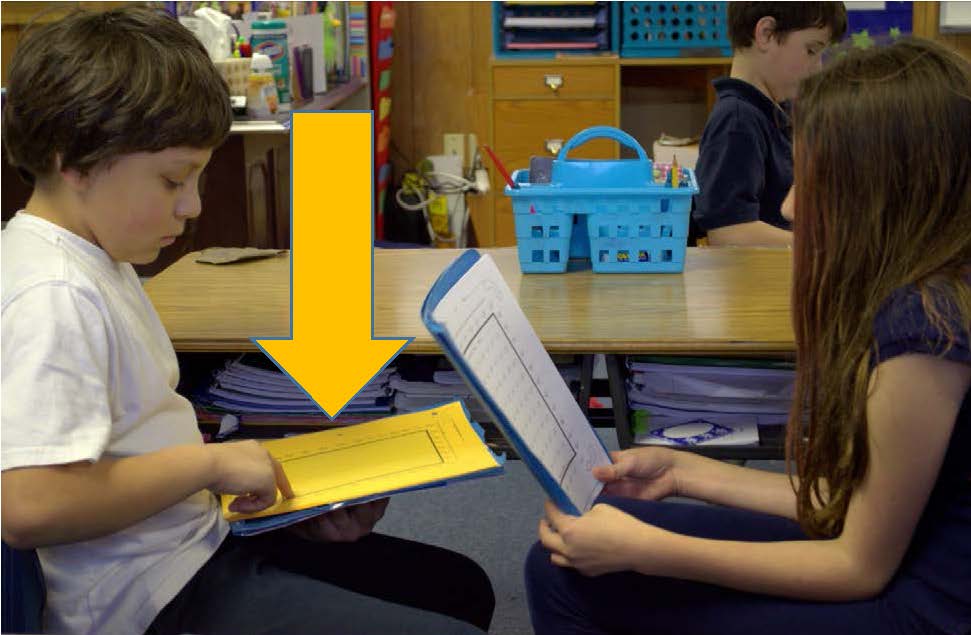
The problem could be one of several things.  You have to diagnose what it could be.  I am assuming you have students practicing orally in pairs, with answer keys, for at least two minutes per partner every day (as shown in the picture above).  I am assuming you already have students, who do not pass, take home the sheet on which they didn’t pass and finish it as homework and practice with someone at home.  The extra practice session at home each day can be a big help and the students should be motivated to do that.   If this is the case and you still have a problem, below are two possible things that may be needed.

(#1) Need to improve practicing procedures.  Pick one of the students who is stuck and be that student’s partner while they practice orally.  Make sure they are saying the whole problem and the answer aloud so you can hear what they are saying.  Correct even any hesitations, not just errors.  Correct the student by saying the correct problem and answer, having them repeat the correct problem and the answer three times, then back up three problems and move forward again.

Diagnosis.  If, after practicing with you, the student does much better on the one minute timing and passes or nearly passes (this is what I usually found) then you know the problem is poor practicing procedures.  If your work with the student makes no difference (they don’t do better on the one-minute timing) and they seem equally slow on all the problems then it is not practicing procedures at fault.  Try #2

Solution:  Monitor your students closely during oral practice to see if they are all following the correct practice procedures.  If you have quite a few students who aren’t practicing well you may need to re-teach your class how to practice.  [Note: Even if they know how to do it but aren’t doing it right, treat it as if they just don’t know how to to do it correctly.]  Stop them and re-do the modeling of how to practice and how to correct for several days before allowing them to practice again.  If your students haven’t been practicing the right way, they won’t be passing frequently, and they will be unmotivated.  You have to get them practicing the right way so they can be successful and so they can be motivated by their success.

Solution:  If you have poor practicing with only a handful of students you might assign them to more responsible partners and explain to them that they need to practice correctly. During oral practice monitor them more carefully the next few days to be sure they are practicing better and passing more frequently.

(#2) Need to review test problems also.  The problems practiced around the outside are the recently introduced facts.  The problems inside the test box are an even mix of all the problems taught so far.  If there has been a break for a week or more, or if the student has been stuck for a couple of weeks, the student may have forgotten some of the facts from earlier and may need a review of the test problems.

Diagnosis.  Have the student practice orally on the test problems inside the box with you.  If the student hesitates on several of the problems that aren’t on the outside practice, then the student needs to review the test items.

Solution. If you have this problem with quite a few students (for example after Christmas break) then have the whole class do this solution.  For the next three or four days, after practicing around the outside, instead of taking the 1 minute test in writing, have students practice the test problems orally with each other.  Use the same procedures as during the practice—two minutes with answer keys for the test, saying the problem and the answer aloud, correction procedures for hesitations, correct by saying the problem and answer three times, then going back—then switch roles.   Do this for three or four days and then give the one-minute test.   Just about everyone should pass at that point.

Solution.  If you have this problem with a handful of students, find a time during the day for them to practice the test problems orally in pairs.  If the practice occurs before doing Rocket Math so much the better, but it will work if done after as well.  They should keep doing this until they pass a couple of levels within six days.

If neither the first or the second solutions seem to work, write to me again and I’ll give you some more ideas.