Use Rocket Math Worksheet Program or Online Tutor or both for math fact fluency?

Rocket Math now has added an Online Tutor to its tried-and-true Worksheet Program.  Customers ask, “Which should I use?  Should I use both?”

Dr. Don’s answer is “Yes, I do recommend using both.  As that opinion may appear self-serving, here’s why.”

1) Online Tutor is an easier route to math fact fluency.
Most students begin passing levels in the Online Tutor right away.  They find it quicker and easier and can sometimes pass more than one level in a day.  This gives the students a taste of success.  The Online Tutor helps them realize they can learn facts and make progress almost from the first day.  Students are then more willing to do the Worksheet Program as well.  Rarely, there are a few younger students who cannot input answers within 3 seconds.  They won’t be able to pass levels and will have to start over many times on the Online Tutor.  When monitoring them in the Online Tutor, such students will have difficulty scores over 3.  If that’s the case, the Worksheet Program is more flexible, and they may prefer that.  But for most students with difficulty scores below 2 in the Online Tutor, they will require a lot less practice to pass levels with the Online Tutor than in the Worksheet Program. That means it will be easier and quicker to learn the facts.

2) The Online Tutor is easier for teachers to implement.
The Online Tutor is easier for teachers to get started using.  Teachers don’t have to print out worksheets, maintain files or organize student pairs, or manage their practice.  It is, therefore, easier to implement.  Less than enthusiastic teachers, who might not start the worksheets, will at least start doing the Online Tutor. After they see the success of the Online Tutor and the students’ enthusiasm, they will be more willing to do the Worksheet Program.

3) The Online Tutor provides consistent quality of practice.

The Worksheet Program is dependent upon the quality of practice in each classroom. Quality of practice is dependent upon the skill of the teacher in teaching routines and getting compliance from the students in following procedures. Therefore, the quality of learning varies, whereas with the Online Tutor the quality of practice is consistent.  I have had teachers report that they are seeing, in daily lessons, better fluency in facts than they saw previously with the Worksheet Program.  The teachers who say that, are telling me they did not get students to practice well in their classroom.  With less skilled teachers the Online Tutor is definitely better.  The only variable with the Online Tutor is whether teachers give students the time to practice and if they can effectively assign homework.  Both of those are issues with the Worksheet Program as well.

4) The Online Tutor checks every single fact for speed of response.
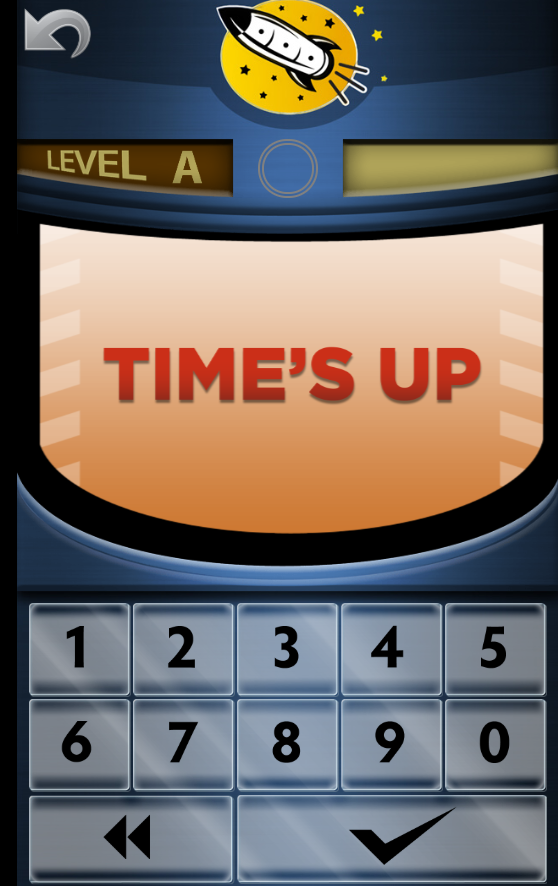
The Worksheet Program bases individual goals upon writing speed, so we are basically demanding that students write answers to math facts as fast as they can.  That’s a high bar and requires a lot of practice.  The bar is not as high with the Online Tutor–as everyone has the same 3 second expectation for a one digit answer, and 4 seconds for a two digit answer. If students are using a touch screen and are 8 years old, that’s not as demanding as it could be. That’s why they go through the levels faster. However, every single fact is checked for time, which we can’t do with the Worksheet Program. Because the Online Tutor checks the speed of response to every single fact, it’s more rigorous that way.

5) The Online Tutor is easier for parents to support.

Both Worksheet Program and Online Tutor can (and should!) be done at home.  The Worksheet Program’s homework component is for students to bring home the worksheet they tested that day and practice with a parent or sibling, the same way they practiced in school.  That takes someone’s time.  The Online Tutor only requires access to a device (Rocket Math works well on parents’ phones!), and once the student logs in, the computer does the correcting and rewarding.  The Online Tutor is easier for parents to support and gets a foot in the door.  Once they see their child’s success and enthusiasm, parents are more willing to do the Worksheet Program. Which will provide more and better learning.

6) Worksheet Program has higher demands for math fact fluency.
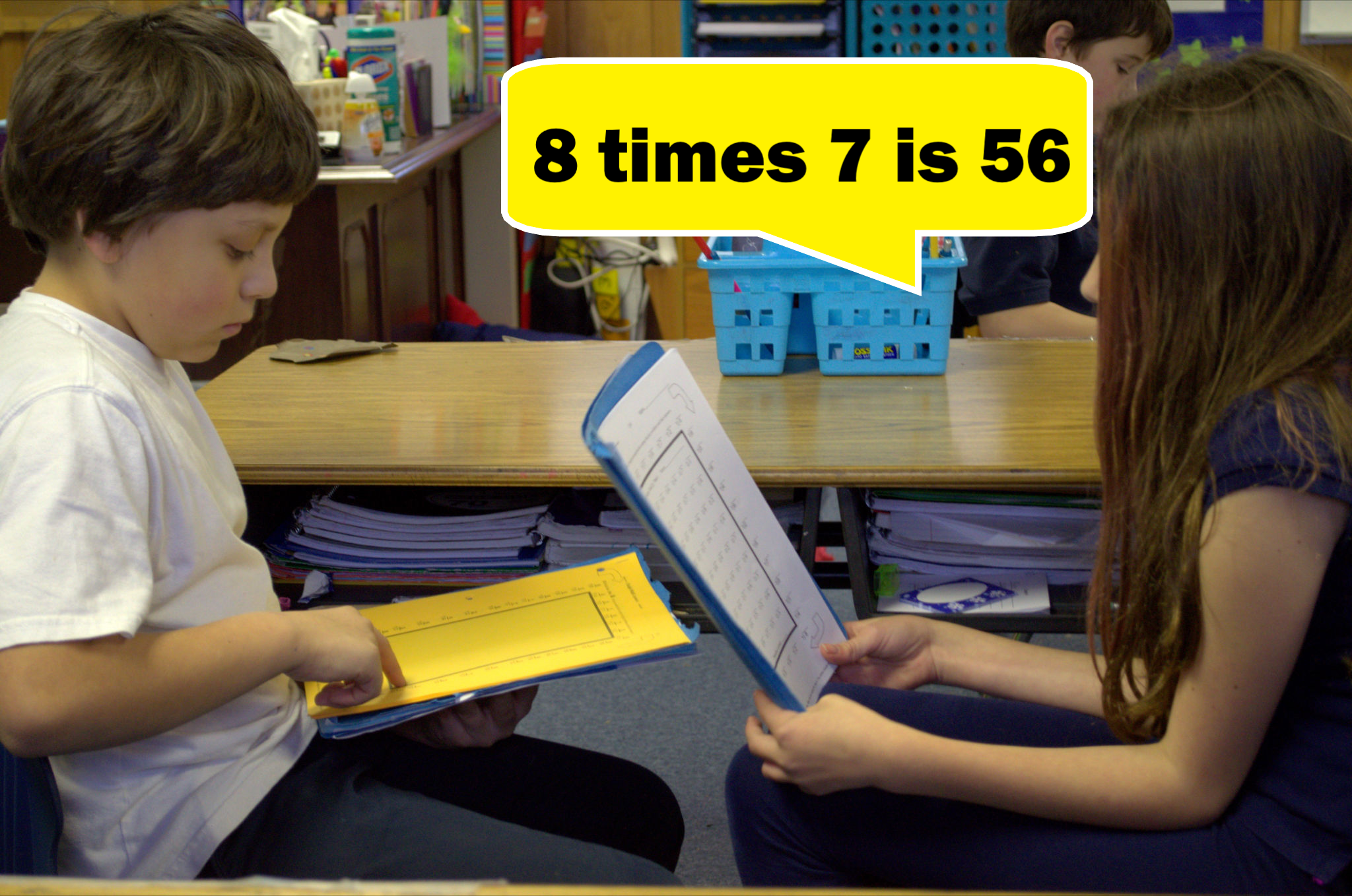
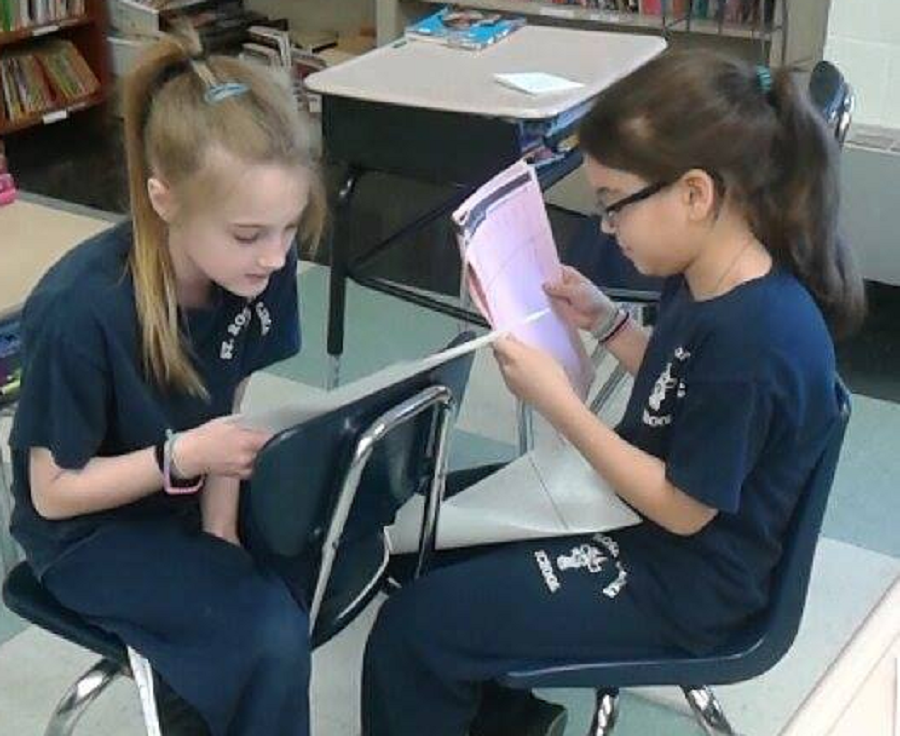
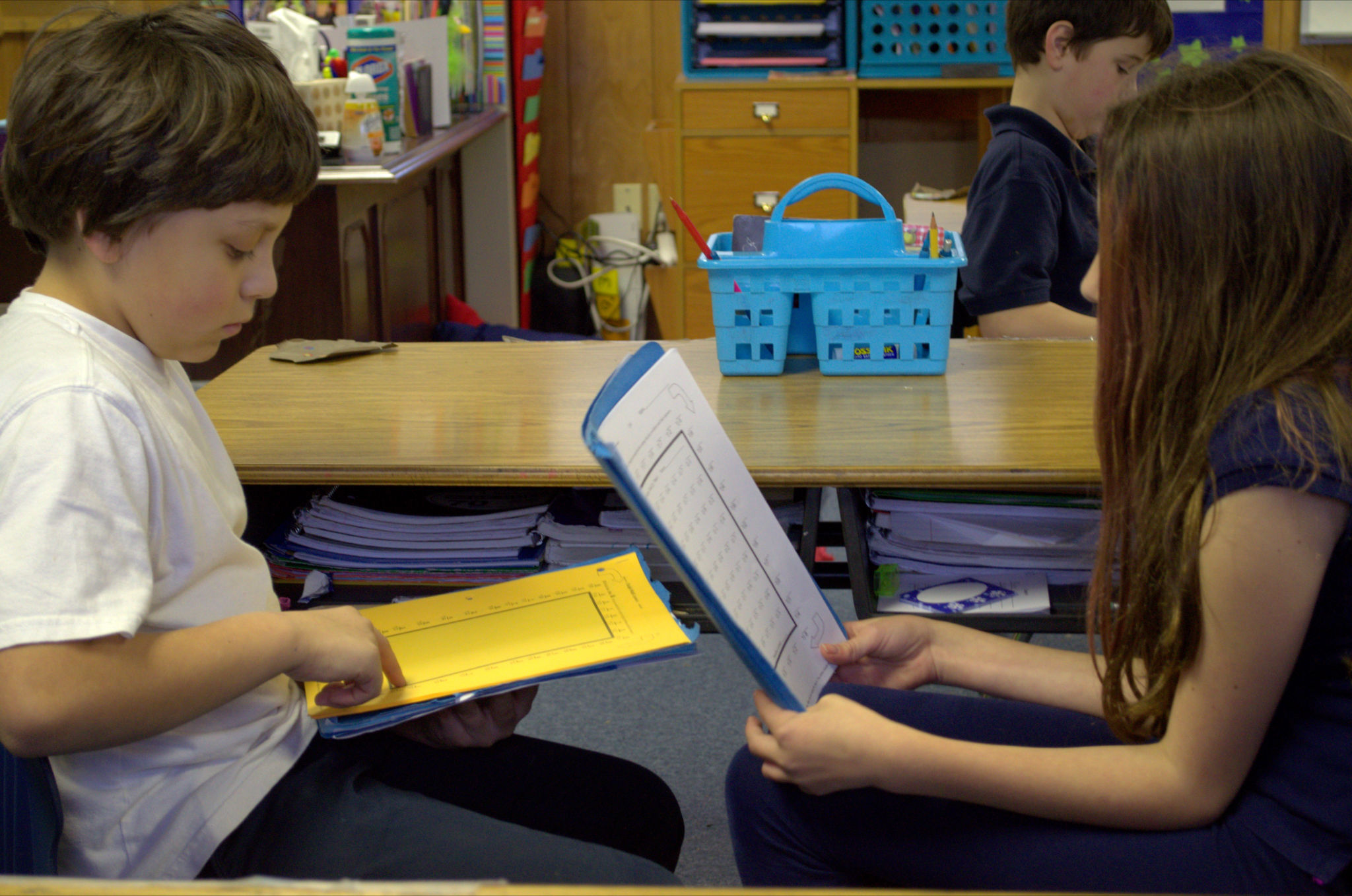
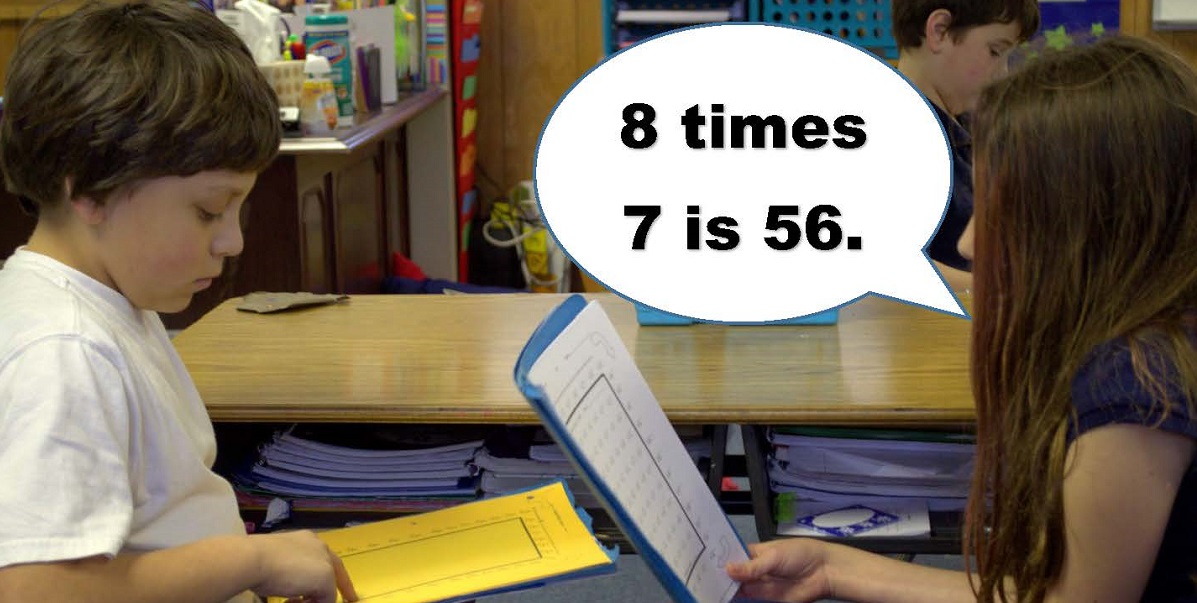
Two students participating in one of Rocket Math's math fluency programsCompared to the Online Tutor, the Worksheet Program is a bit harder to pass a level.  By basing individual goals on the Writing Speed Test, we can be sure that students are answering a large number of facts as fast as they can write. This is a high bar. Generally, we see that students have to practice with their partners more time before they pass they pass a level, so students learn facts better with it. They are more solid in their knowledge of facts when they are done with an operation like multiplication in the Worksheet Program than they are if they just run through multiplication in the Online Tutor.  This is a reason not to do the Online Tutor only.  Of course, students are even stronger in their facts when they practice with both.

7) Saying the facts aloud in the Worksheet Program develops an important learning channel.

The purpose of learning math facts is to make it easier for students to learn and do basic computation. The Worksheet program develops verbal memory for facts.   In the Worksheet Program students practice by saying the facts aloud along with the answer, without hesitation.  For example, “Nine times seven is sixty-three.”  Repeating these over and over day after day, creates a verbal chain in memory. Because of this verbal chain, once the fact is learned, forever after, when saying the fact to oneself, “Nine times seven is….” the answer, “Sixty-three,” pops into mind, unbidden.  That’s automaticity and that’s the goal.  This is another channel other than what is developed in the Online Tutor.

8) Writing the facts daily in the Worksheet Program will generalize to written computation more readily.

Math work is written, so the Worksheet Program (which is also written) is closer to how math facts will be used.  Each day students get into the habit of doing math as quickly as they can.  They develop the expectation that they should do math quickly.  That means this program will generalize better to computation assignments.  It will take longer to pass a Learning Track, but when they are done, you will see a bigger benefit to students doing math assignments when they finish the Worksheet Program than with the Online Tutor.  Which is yet another reason to do both programs.

9) The Worksheet Program provides computation practice to maintain fluency.
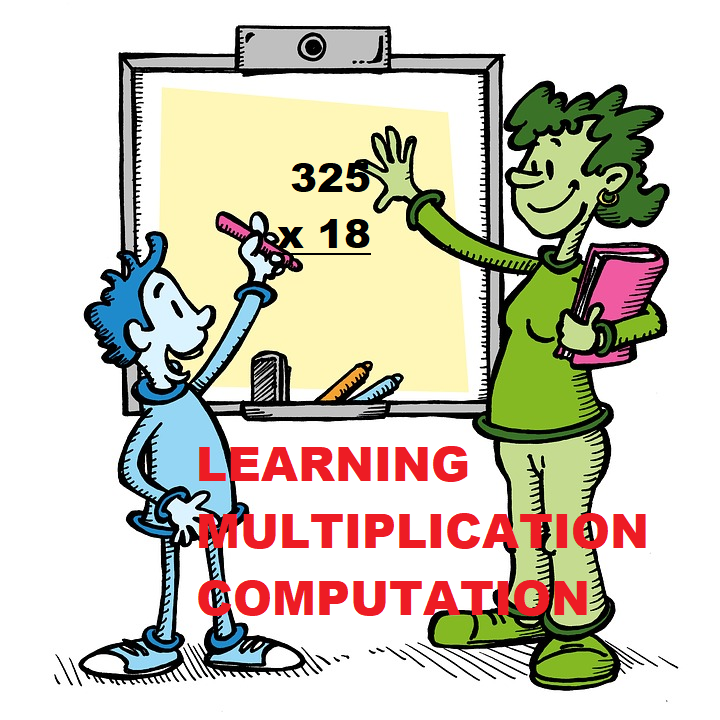
After students learn the facts, the most important thing is to provide students with practice using the facts in computation.  Many of today’s math programs have very little to no computation practice built into the program.  The Rocket Math Worksheet Program has learning tracks that provide short 3-minute daily practice assignments in computation.  The Learning Computation tracks have assessment so students can be placed at the right level and can gradually improve their computation skills as well as cement in those math facts so they can maintain fluency.

10) Using both the Worksheet Program & Online Tutor develops math fact fluency twice.

Because students are moving through the two programs at different rates, they will get two passes at learning the facts.  That means they are getting twice as much learning.  The facts will be known better and more readily called to mind during computation when both programs are used.

In What Order Should Students Learn Fast Math Facts?

Basic, Optional, and Alternative—there are a lot of different Rocket Math programs. But which program should you use first? And in what order should you teach fast math facts? Well, it all depends on the grade you teach and the fast math facts your students have already memorized.

An overview of Rocket Math’s fast math fact programs

Rocket Math offers multiple programs because their are several ways to teach fast math facts. Here’s a link to a printable version of the different Rocket Math programs shown here.

The Basic Program

Rocket Math’s basic program includes Addition, Subtraction, Multiplication, and Division (1s-9s). The basic program must be mastered by all students.

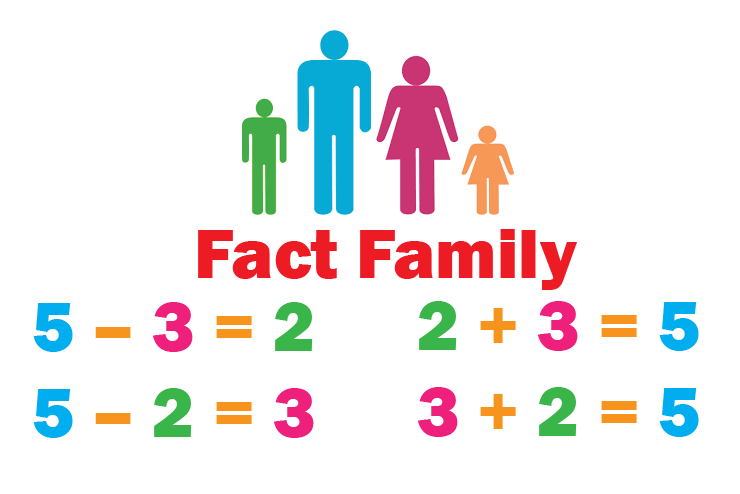
A chart that shows the set of math fact family 5, 3, and 2 in Addition and Subtraction.The Alternative Program: Fact Families

There is another way to learn facts, which is called Fact Family math.  Instead of learning all Addition facts, students can learn Addition and Subtraction facts at the same time.  A fact family consists of four related facts, for example: 3+2 = 5, 2 + 3 = 5, 5 – 3 = 2, 5 – 2 = 3.  As an alternative to using the Basic Program, students can learn fact families up to 10 in first grade.  Then students can move on to the upper fact families 11 to 18 in second grade.  There is no clear evidence that this way is better or the separate operations way is better.  That’s why we offer both options.

Optional Programs

The rest of the fast math facts programs like Rocket Writing for Numerals or Skip Counting are optional. You should only offer these programs to students once they have memorized the fast math facts through the Basic Program or the Alternative Program.

The only exception would be in a school where Kindergarten students did not get a chance to learn how to quickly and easily write numerals. In that case, you might take the first two months of the first grade year to run students through Rocket Writing for Numerals before beginning Addition (1s-9s).

Let’s take a closer look at how to implement each program in different grade levels.

First grade math facts: Learn Addition

Rocket Math fast math facts programs for first graders include:

  • The Basic Program
    • (1s-9s) Addition
  • The Alternative Program
    • Fact Families (1-10) Add & Subtract
  • Optional Programs
    • Rocket Writing for Numerals
    • Add to 20

If first grade students are taking all year to get through sets A-Z in Addition in the Basic Program, they need some extra help.  You should intervene to help students who take more than a week to pass a level.  Often they need to practice better or practice with a better partner.  Some may need to practice a second time during the day or at home in the evening.  First grade students who finish the 1s-9s can move on to the Add to 20 Optional Program for the remainder of the year.

Likewise, if you choose to teach Fact Families (1-10) Add & Subtract from the Alternative Program instead of using the Basic Program, your students can use the Optional Programs for supplemental learning purposes.

Second grade math facts: Learn Addition and Subtraction

Rocket Math fast math facts programs for second graders include:

  • The Basic Program
    • (1s-9s) Addition
    • (1s-9s) Subtraction
  • The Alternative Program
    • Fact Families (1-10) Add & Subtract
    • Fact Families Part Two (11-18) Add & Subtract
  • Optional Programs
    • Subtract from 20
    • Skip Counting

Second grade students must have completed Addition before starting on Subtraction (1s-9s).  They can also test out of Addition through the Placement Probes.  Second graders who cannot test out of Addition in first grade or didn’t complete it in first grade must focus on Addition.  Only after getting through Set Z of Addition should they move into Subtraction.

You can substitute the Basic Program’s (1s-9s) Addition and (1s-9s) Subtraction for the Alternative Program’s Fact Families (1-10) Add & Subtract and Fact Families Part Two (11-18) Add & Subtract.

Second grade students who complete Addition and Subtraction 1s-9s (or the Alternative Program) can move on to Subtract from 20.  Students who finish Subtract from 20 can do Skip Counting, which does a great job of preparing students to learn Multiplication facts.

Third grade math facts: Learn Multiplication

There aren’t any Alternative Programs available for third graders from Rocket Math. There are only Basic and Optional Programs. These include:

  • The Basic Program
    • (1s-9s) Multiplication (priority)
    • (1s-9s) Addition
    • (1s-9s) Subtraction
  • Optional Programs
    • 10s, 11s, 12s Multiplication
    • Factors

In third grade, Multiplication has priority—even if students have not mastered Addition and Subtraction.  Multiplication facts are so integral to the rest of higher math that students are even more crippled without Multiplication facts than they are having to count Addition and Subtraction problems on their fingers.  So do Multiplication first. Then, if there’s time, students who need to do so can go back and master Addition and Subtraction.  Once all three of these basic operations are under their belts, students can go on to 10s, 11s, 12s in Multiplication (one of the Optional Programs).  If students successfully progress through each program and there is enough time left in the school year, introduce the Factors program next.

Fourth grade math facts: Learn Multiplication and Division

Like the programs for third graders, there aren’t any Alternative Programs available for fourth graders. There are only Basic and Optional Programs, which include:

  • The Basic Program
    • (1s-9s) Multiplication (priority)
    • (1s-9s) Division (second priority)
  • Optional Programs
    • 10s, 11s, 12s Multiplication
    • Factors

In fourth grade, students need to have completed Multiplication before going on to Division. If they complete Division, they can go on to 10s, 11s, 12s Division, followed by Factors, and then equivalent fractions (shown in the fifth grade section below).

Fifth grade math facts: Learn all basic operations first, then they can branch out

By fifth grade, students should have completed all four basic operations (1s-9s) within the Basic Program (or the Alternative Program for grades one and two).  If students have not completed these basics (and cannot test out of them with the Placement Probes) then the sequence they should follow is Multiplication, followed by Division, then go back and complete Addition followed by Subtraction.  The same recommendations hold for students in any grade after fifth.

Once students have mastered the basics (1s-9s add, subtract, multiply, divide), the supplemental pre-algebra programs are recommended.  These will help more than learning the 10s, 11s, 12s facts.  I would recommend this order:

  1. Factors
  2. Equivalent Fractions
  3. Learning to Add Integers
  4. Learning to Subtract Integers or Mixed Integers

Math Fact Apps: Do they help – Or Waste Time?

Just doing math is not enough to develop math fact fluency.

Math leaning head against chalk board

If you want to help your kid succeed in golf, you must first help them develop a good drive. Before they can successfully go out and play a game of golf, they will have to spend some time on the driving range. Right? The same thing goes for math. To help your kid succeed in math, you must first help them develop math fact fluency. Math facts are single-digit problems like 5 +9 or 6 x 8. The times tables are math facts in multiplication. Math facts are the fundamental units of all math problems. They are the drivers, if you will, of doing math. Children who struggle to remember basic math facts will find learning math and doing math difficult. We know what that looks like, right? On the other hand, students who can easily answer all math facts, who can answer math facts with fluency, find math a breeze and are successful and confident in math. Math fact apps can be a great way to help with learning math facts and improving math fact fluency. 

Not all math apps build math fact fluency.

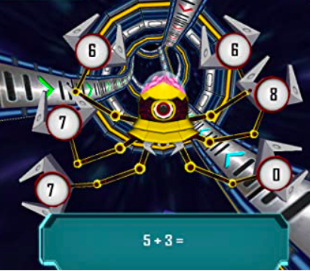
screenshot of Rocketmath's math fact apps game

There are a lot of apps out there that look like they would help your child learn math fact fluency. If they have to answer math facts, won’t that work? Not really. Just playing a game that asks you to answer facts won’t help you learn new facts. In fact, most apps for practicing facts discourage students who don’t know their facts well. Why? Because most of the people designing the app don’t have any experience teaching or knowledge of instructional design. A teacher with expertise in instructional design, like the Rocket Math Online Game App creator, knows how to effectively teach a student new math facts (or any facts) and knows an effective math app from an ineffective one.

Three essential features of an effective math fact app.

There are plenty of ineffective math apps. Some apps don’t give the answers when a student doesn’t know them. Some apps just fill in the answer for the student and then move on. When the student doesn’t know the answer, the app has to teach it. To teach a math fact that the student doesn’t know, the app has to do these three things:

  1. Tell the problem and the answer to the student, if needed.
  2. Ask the student to give the correct answer to the problem from memory.
  3. After a short delay, ask the problem again a couple of times, to be sure the student can remember the answer.

The key job in developing math fact fluency is learning new facts. By doing these three things, the app will be able to teach the student new facts, and the student will develop fluency beyond what they already have.

An effective math app will only teach a few math facts at a time.

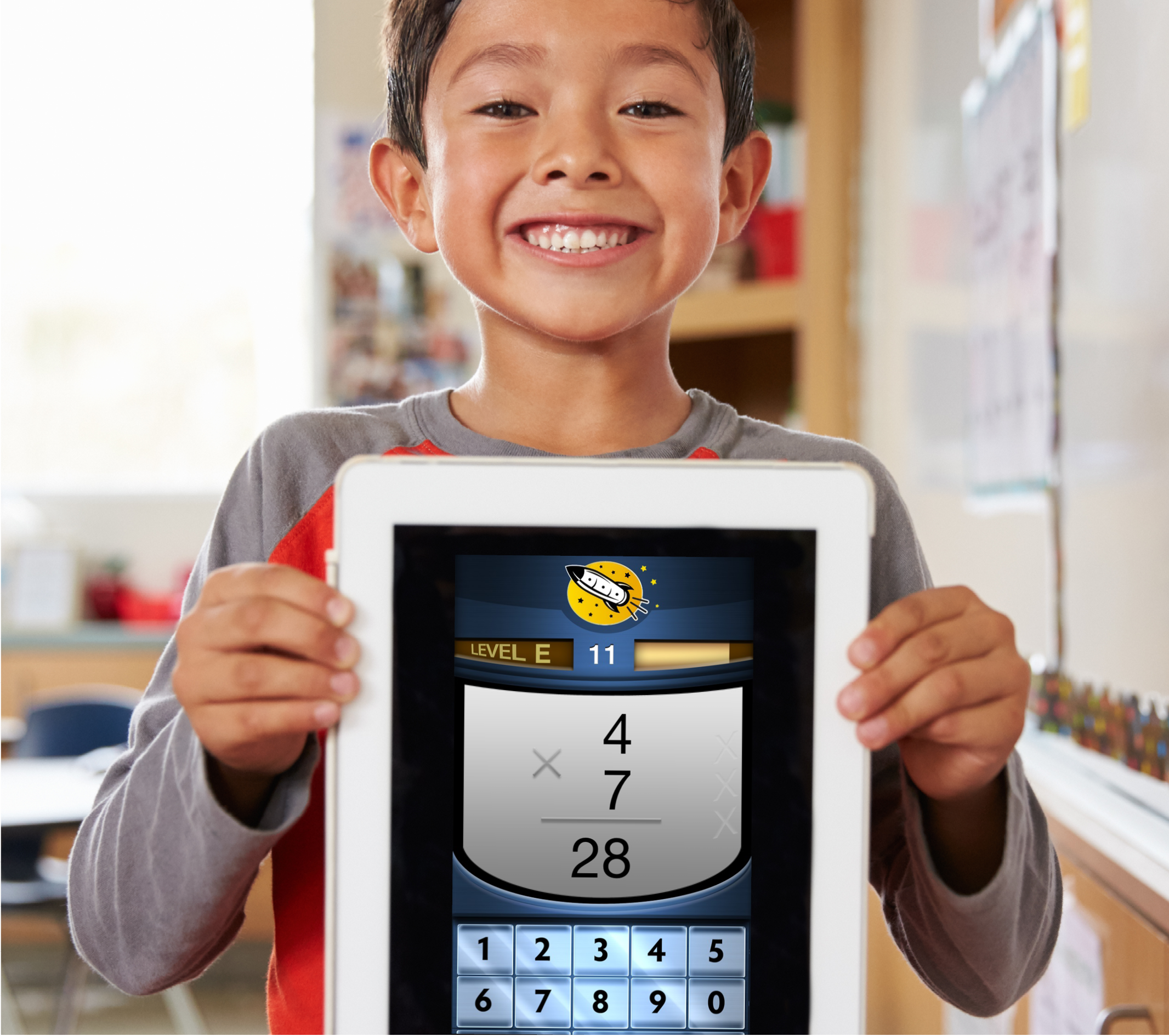
a kid holding up a tablet with the RocketMath math fact apps on it.

Math facts are all very similar, which is what makes them hard to remember. No one can learn a bunch of new and similar things all at the same time. A person can only learn two, three, or four facts at a time, and you cannot expect to learn more at one time. That’s enough for one session. The student has to practice those facts a lot of times to commit them to memory. Once or twice is not enough. It also won’t help to practice the same fact over and over. Proper math fact fluency practice intermingles new math facts along with facts the learner has already memorized. No more than two to four facts should be introduced at a time. If a student has to answer a lot of random untaught math facts, you will have a very frustrated learner.

How to build math fact fluency by practicing

kid counting on fingersSome students learn to solve addition problems by counting on their fingers. That’s a good beginner strategy, but students need to get past that stage. They need to be able to simply and quickly recall the answers to math facts. An app is good for developing recall. But the app has to ask students to answer the facts quickly, faster than they can count on their fingers. The app has to distinguish when a student recalls the fact (which is quick) from figuring out the fact (which is slow). Second, the app must repeatedly ask the learned facts in a random order, so students recall them. But the app should only throw in new facts once all the facts are mastered and can be answered quickly.

Introduce new facts only when old facts are mastered!

The trick to effectively teaching math facts is to introduce new math facts at an appropriate pace. If you wait too long to introduce math facts, it gets boring and wastes time. If you go too fast, students become confused. Before introducing new facts, students need to master everything you’ve given them. An effective app will test whether students have mastered the current batch of math facts before introducing more facts. And it will also introduce math facts at a pace based on student mastery. That’s the final piece of the puzzle to ensure students learn math facts from an app.

Rocket Math Online Game App–try it for 30 days for free

You probably guessed that we know of an app that meets all these criteria, the Rocket Math Online Game. It is like a driving range for math–it will develop math fact fluency. But don’t take our word for it. Try it for free for 30 days. If your child or students use it daily for 30 days, you’ll know they are learning and becoming more fluent with math facts. Keep it going, and they will become confident and successful in math. And that’s the point, isn’t it?

*The Rocket Math Online Game App focuses on two facts and their reverses at a time, such as 3+4=7, 4+3=7, 3+5=8 and 5+3=8.

How to Grade 1-Minute Math Fluency Practice Tests

Katy L from Wilson Elementary asks: How can I keep up with everyday Rocket Math grading? Do you teach students to grade their own 1-minute math fluency practice tests?

Dr. Don answers:

Only grade 1-minute math fluency practice tests if students pass

An integral part of the Rocket Math Worksheet Program is the 1-minute math fluency practice test. One-minute fluency practice tests are administered every day, to the whole class, and only after students practice in pairs for two to three minutes each. Check out the FAQs page to learn more about conducting 1-minute math fluency practice tests in class.

Teachers do NOT need to grade, score, or check daily Rocket Math 1-minute math fluency practice tests unless the student has met their goal. Students do NOT need to grade their own daily Rocket Math fact fluency tests either.

Why grading each math test is not important

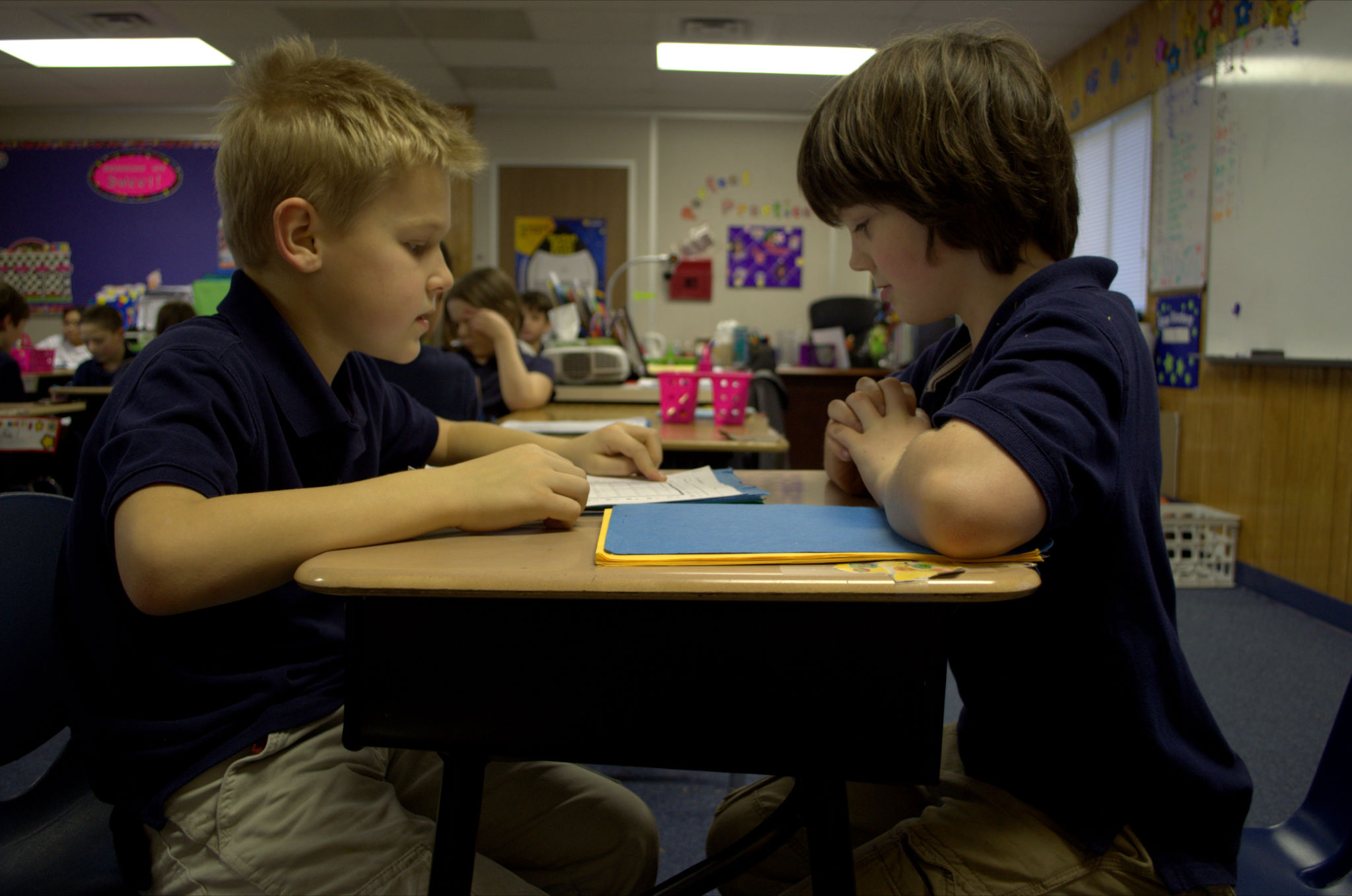
The important part of math fluency practice is the oral practice with the partner before the test–what’s going on in this picture. Because the students are orally practicing every day and getting corrections from their partners, there should be VERY FEW errors on the 1-minute math fluency written tests.  

Correcting written tests doesn’t help students learn anyway. Corrections are only helpful if they are immediate, the student has to acknowledge the correct answer, and remember it for a few seconds–all of which is part of the oral correction procedure. “Correcting” what’s on the paper takes a lot of time and does not help students learn more, so it shouldn’t be done. But you have to check them before declaring that the student has passed a level.

How do you know if a student passes?

Students should have a packet of 6 sheets math fact fluency sheets at their level. Each Rocket Math student has an individual goal. For example, if a student has a goal of 32 (based on their Writing Speed Test) and they only do 31, they know they did not pass. If the student does 32 or more, they pass!

What to do when a student beats their goal (passes)

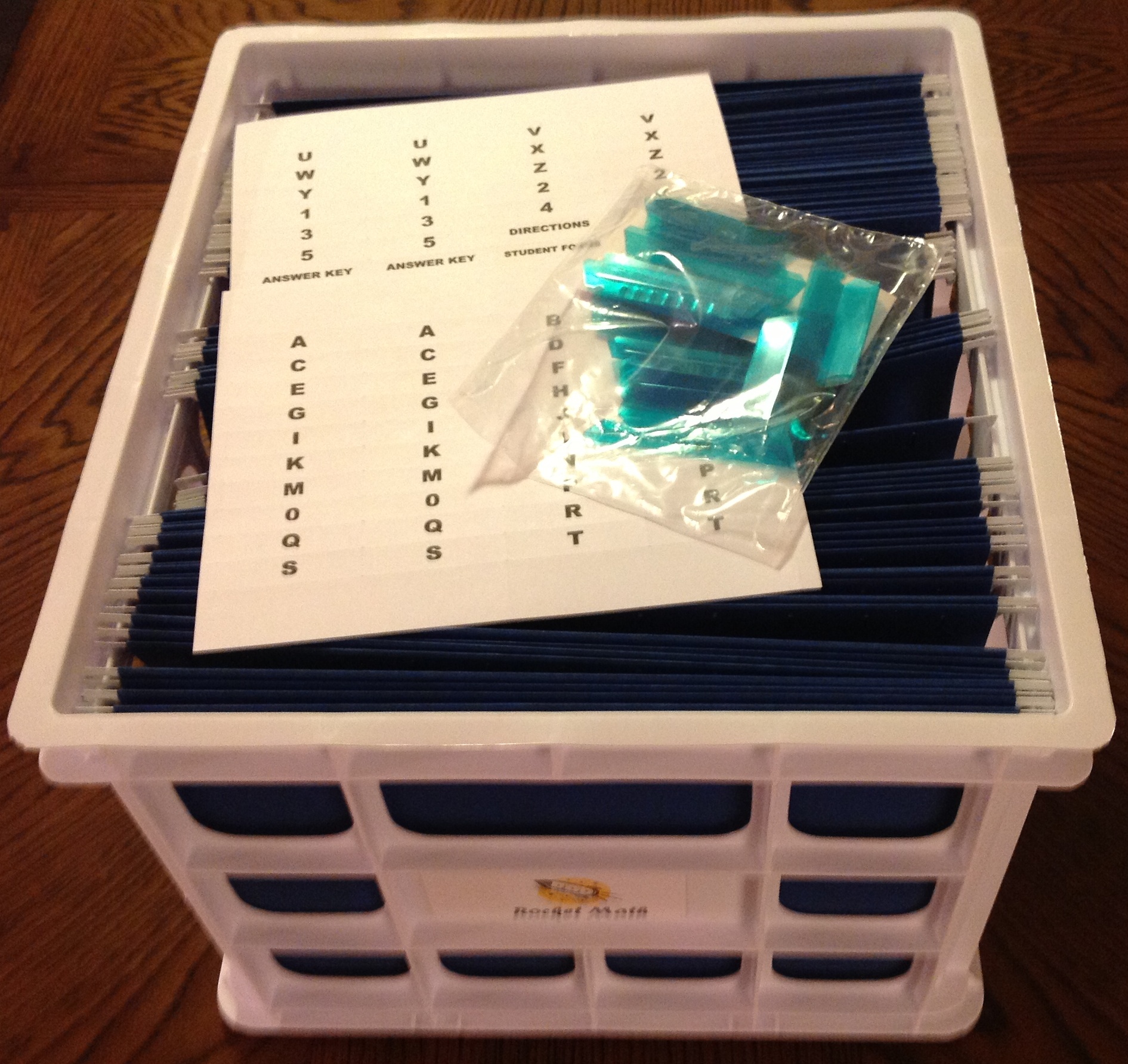
If a student meets or beats their goal, then have them stand up, take a bow, and then turn their folder into a place where you check to see that all problems were answered correctly. When YOU check (after school?), make sure all of the completed problems were correct and the student met their goal. If so, then you put the unused sheets in that packet back into the filing crate and re-fill the student’s folder with a packet of 6 worksheets at the next level and hand the folder back the next day.

When students receive the new packet of worksheets, they know to color in another letter on the Rocket Chart (and maybe put a star on the Wall Chart).

What to do if a student doesn’t pass?

Students who don’t meet their goals, don’t pass. These students should put the non-passing sheet into their backpacks and take the sheet home for more practice.

The next day they will use the next sheet in their packet of 6. If you want to give them points, do that the next day after they bring back their worksheet where they did a session at home (signature of helper should be there) and all items on the test are completed. If that’s done, they get full points.

Sometimes you’ll catch errors on sheets that students turn in as “passes.” If you see an error, the student doesn’t pass. As a result, the student keeps the old packet and has to continue with that same level worksheet.

For more information about conducting 1-minute math fluency practice tests in class and how to implement the Rocket Math worksheet program, visit the FAQs page.

Math Teaching Strategy #1: Help students memorize math facts

Once students know the procedure, they should stop counting and memorize!

When it comes to math facts like 9 plus 7 or 8 times 6 there are only two things to know.  1) A procedure to figure it out, which shows that you understand the “concept.”  2) What’s the answer?

It is important for students to understand the concept and to have a reliable procedure to figure out the answer to a math fact.  But there is no need for them to be required to use the laborious counting process over and over and over again!  Really, if you think about it, even though this student is doing his math “work” he is not learning anything. 

Math teaching strategy:  Go ahead and memorize those facts.

(It won’t hurt them a bit.  They’ll like it actually.)

Once students know the procedure for figuring out a basic fact, then they should stop figuring it out and just memorize the answer.  Unlike capitals and countries in the world, math facts are never going to change.  Once you memorize that 9 plus 7 is 16, it’s good for a lifetime.  Memorizing math facts makes doing arithmetic MUCH easier and faster.  Hence our tagline

Rocket Math: Because going fast is more fun!

Memorizing facts is the lowest level of learning.  It’s as easy as it gets.  But memorizing ALL the facts, which are similar, is kind of a long slog.  Some kids just naturally absorb the facts and memorize them.

Math teaching strategy: Find a systematic way for students to memorize.

A lot of students don’t learn the facts and keep counting them out over and over again.  They just need a systematic way of learning the facts.  Students need to spend as much time as necessary on each small set of facts to get them fully mastered.  If the facts are introduced too fast, they start to get confused, and it all breaks down.  Each student should learn at their own pace and learn each set of facts until it is automatic–answered without hesitation and without having to think about it.  This can be accomplished by everyone, if practice is carefully and systematically set up.  It should be done, because the rest of math is either hard or easy depending on knowing those facts.  And don’t get me started about why equivalent fractions are hard!


Rocket Math: Can students really learn this way? (It seems too easy.)

At first, it may seem like the way Rocket Math presents the same simple facts over and over, is so easy it must be a waste of time.

       But like anything you learn, you have to start where it seems easy and then build up to where it is hard.  Rocket Math has been effective helping students learn their math facts for over 20 years.  It is designed according to scientifically designed learning principles, which is why it works, if students will work it.  Rocket Math carefully and slowly introduces facts to learn in such a way that students can achieve fluency with each set of facts as they progress through the alphabet A through Z.  Let me explain.
         Set A begins with two facts and their reverses, e.g., 2+1, 1+2, 3+1 and 1+3.  Dead simple, huh?  But in answering those the student learns what it is like to instantly “know” an answer rather than having to figure it out.  The student says to himself or herself, “Well, I know that one.”  The student learns he or she can answer a fact instantly with no hesitation every time based on recall and not figuring it out.  The game requires the student to answer the problems at a fast rate, proving that he or she knows those facts.  Once that level is passed the game adds two more facts and their reverses,.  The same process of answering them (and still remembering Set A) instantly with no hesitation every time.  When that is achieved, the game moves the student on to Set C, two more facts and their reverses.  Eventually, every student gets to a fact on which they hesitate (maybe one they have to count on their fingers), meaning they can’t answer within the 3 seconds allowed.  Mission Control then says the problem and the correct answer, has the student answer that problem, then gives two different facts to answer and goes back to check on the fact the student hesitated on again.  If the student answers within 3 seconds then the game moves on.
 
     In the Take-Off phase the student is introduced to the two new facts and their reverses.  That’s all the student has to answer.  But the student has to answer each one instantly.  If the student is hesitant on any of those facts (or makes an error) then they have to Start Over and do the Take-Off phase over again.  They have to do 12 in a row without an error or a hesitation.  Once the Take-Off phase is passed the student goes into the Orbit phase, where there is a mix of recently introduced facts along with the new facts.  The student has to answer up to 30 facts, and is allowed only two errors or hesitations. After the third error or hesitation the student has to Start Over on the Orbit Phase.  Once the Orbit phase is passed, the student goes on to the Universe phase, which mixes up all the facts learned so far and presents them randomly.  Again the student has to do up to 30 problems and can only hesitate on 2 or them or he or she has to start over.  But once the student proves that all of those facts can be answered without hesitation, the game moves on to the next level, introducing two more facts and their reverses.
      In the Worksheet Program, students practice with a partner.  In the Online Game the student practices with the computer.  In both versions of Rocket Math the students follow the same careful sequence and slowly, but successfully build mastery of all of the facts in an operation.  It’s hard work and takes a while, but we try to make it fun along the way.  It will work for everybody, but not everybody is willing to do the work.  At least, now you understand how Rocket Math is designed so it can teach mastery of math facts.

Fact Families (+ & -) for 1st and 2nd grade

Learn Fact Families to fluency with Rocket Math!

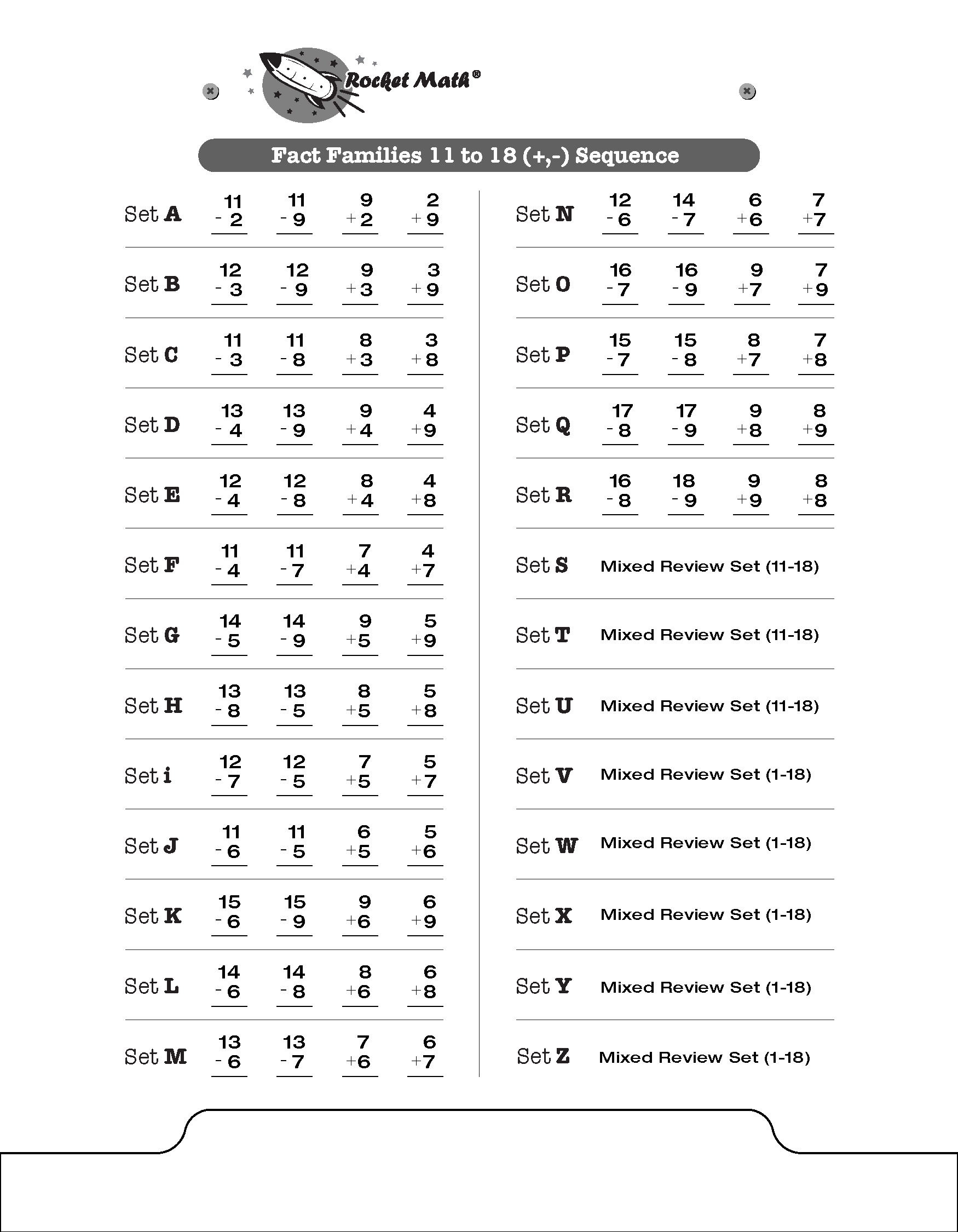
Fact Families Part Two  11 to 18 (add & subtract).  A fact family includes both addition and subtraction facts. This program is Part 2 of Fact Families, coming after Fact Families 1 to 10. You can see to the left the 18 examples of fact families taught in this program starting with Set A; 11-2, 11-9, 9+2, & 2+9.  The sheet shows the sequence of learning facts in the new Rocket Math  program Fact Families Part Two 11 to 18 (+, -).  Each set that students learn from A to R adds just one fact family to be learned, so it isn’t too hard to remember.  (That’s the Rocket Math secret ingredient!) 

Learning math facts in families, is gaining in popularity these days.  Logic suggests that this would be an easier way to learn.  However, the research is not definitive that this is easier or a faster way to learn facts than separating the operations and learning all addition facts first and then learning all subtraction facts.  But learning in fact families is a viable option, and I wanted to have it available for Rocket Math customers.

Part Two is a Best fit for second grade.  These facts come after the facts in 1 to 10, typically learned in first grade, so these are best for second grade.  The 25 fact families in 1s through 10s facts are just enough for one Rocket Math program.  It is a good and sufficient accomplishment for first grade.  With the 11 to 18 in Par Two for second grade there will be a lot of review.  In fact sets S through Z are all review. I have heard that some first grades prefer to keep the numbers small but to learn both addition and subtraction–so this program accomplishes that.

I added Fact Families Part Two 11 to 18 (+, -) to the Universal subscription in August of 2018 bringing the total number of programs in the Universal subscription to 19 (the basic four operations and 15 more!).  As always, new programs are added to the Universal subscription without additional cost as soon as they are available.

I most sincerely want students to be successful and to enjoy (as much as possible) the necessary chore of learning math facts to automaticity. Please give me feedback when you use this new program, Fact Families 11 to 18 (+, -),  as to how it goes for the students.

What if teachers won’t do Rocket Math?

Don’t argue, just prove it works! 

Joyce asks: 

How can we encourage the teacher who refuses rocket math and administration does not reinforce (or enforce) the program’s use?

Dr. Don’s response:

  Joyce,

     This is a great question.  Frankly, one of the most annoying things I found during my time as a teacher were the constant “new” fads.  I got sick and tired of being told to do things I knew would not work.  I don’t blame people for being skeptical or an administration that won’t go to bat for a new curriculum.  I think it is the responsible thing to do. Which is why schools should test everything for themselves, which isn’t that hard to do.  Prove to yourself it works with your students in your school with your staff.  Then you know it is worth doing.  Only then do you have a responsibility to reinforce the program’s use, only after it is proven.
In one of the first schools to use Rocket Math we had a veteran teacher who said she did not think Rocket Math would be any better than the things she had been doing to help her students learn math facts for years.  The principal wisely allowed as how that might be possible, but asked if she would be willing to test her assertion.  Rocket Math has 2-minute timings of all the facts which the students take every couple of weeks.  The principal asked if she would give that test to her students at the beginning and the end of the year and compare her results with that of other classes.  She agreed.  At the end of year the Rocket Math students were far higher in their fluency than her students, even though at the beginning of the year her students had been more fluent than the other students.  At that point she said, “Well this proves it to me.  I’ll be using Rocket Math next year.”
   Just use those 2-minute timings as pre and post tests and see if there is anything that will beat Rocket Math.  Any teacher worth their salt should want to use a curriculum that is effective and helps students learn.
I have the following standing offer on my website.  If any school will conduct research comparing Rocket Math to some other method of practicing math facts and share your results–I will refund half of the purchase price of the curriculum.  If a school finds some other method is more effective, I will refund 100% of your purchase price.

Intervention Tip: Have students practice test

Sometimes students need to review test problems also.

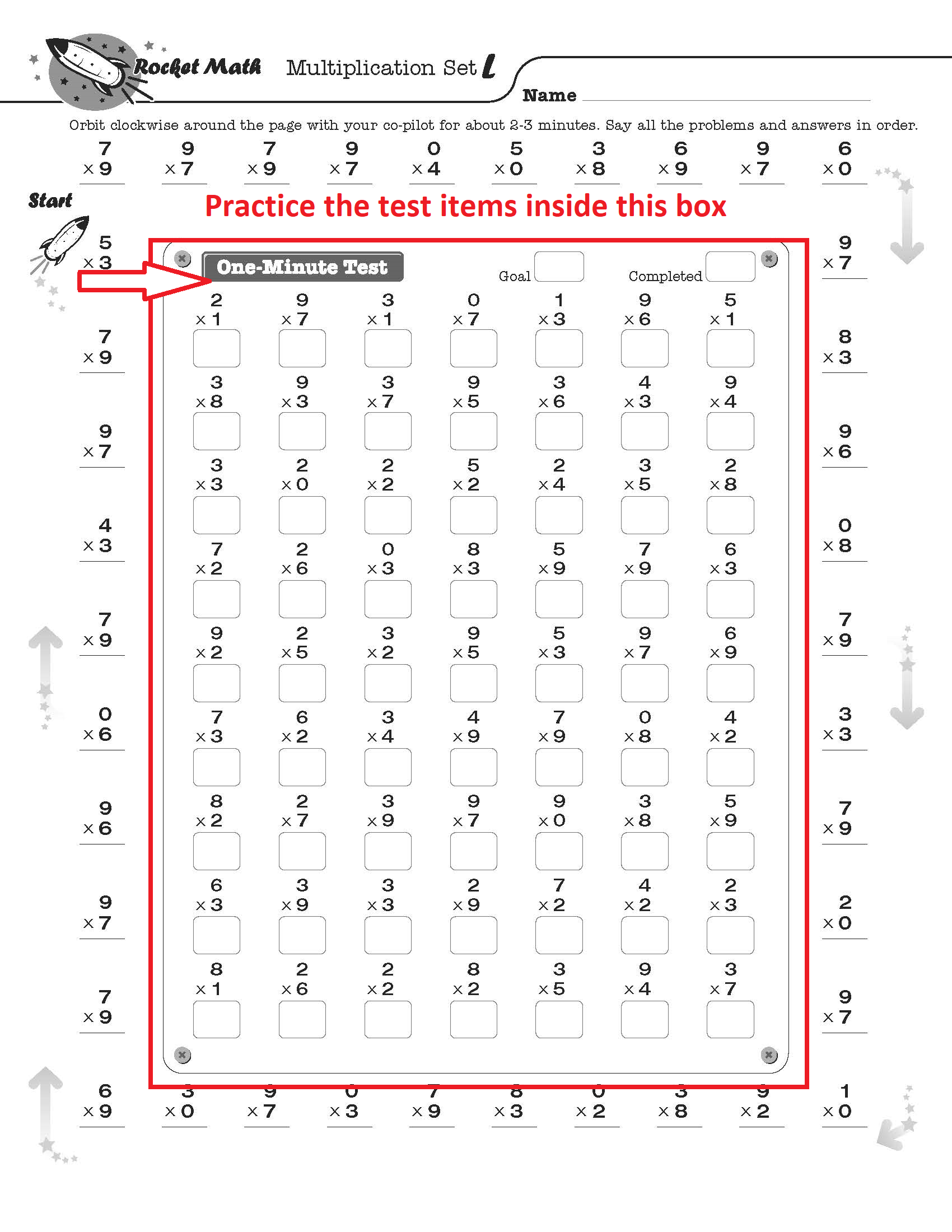
You know that there is a difference between the test problems and the practice problems, right?  The problems practiced around the outside are the recently introduced facts.  The problems inside the test box are an even mix of all the problems taught so far.  Sometimes students have forgotten some of the older facts.  For example, if there has been a break for a week or more, or if the student has been stuck for a couple of weeks, the student may have forgotten some of the facts from earlier and may need a review of the test problems.

How you could diagnose for this problem.  Have the student practice orally on the test problems inside the box with you.  If the student hesitates on several of the problems that aren’t on the outside practice, then the student needs to review the test items.

Solution. If you have this problem with quite a few students (for example after summer break or after Christmas break) then have the whole class do this solution.  For the next week, after practicing around the outside, instead of taking the 1 minute test in writing, have students practice the test problems orally with each other.  Use the same procedures as during the practice—two or three minutes with answer keys for the test, saying the problem and the answer aloud, correction procedures for hesitations, correct by saying the problem and answer three times, then going back—then switch roles.   Do this for a week and then give the one-minute test.   Just about everyone should pass at that point.

Solution.  If you have this problem with a handful of students, find a time during the day for them to practice the test problems orally in pairs.  If the practice occurs before doing Rocket Math so much the better, but it will work if done after as well.  They should keep doing this until they pass a couple of levels within six days.

If neither the first or the second solutions seem to work, write to me again and I’ll give you some more ideas.

Why give the Two-Minute timings in Rocket Math?

To prove whether students are making progress in learning math facts.

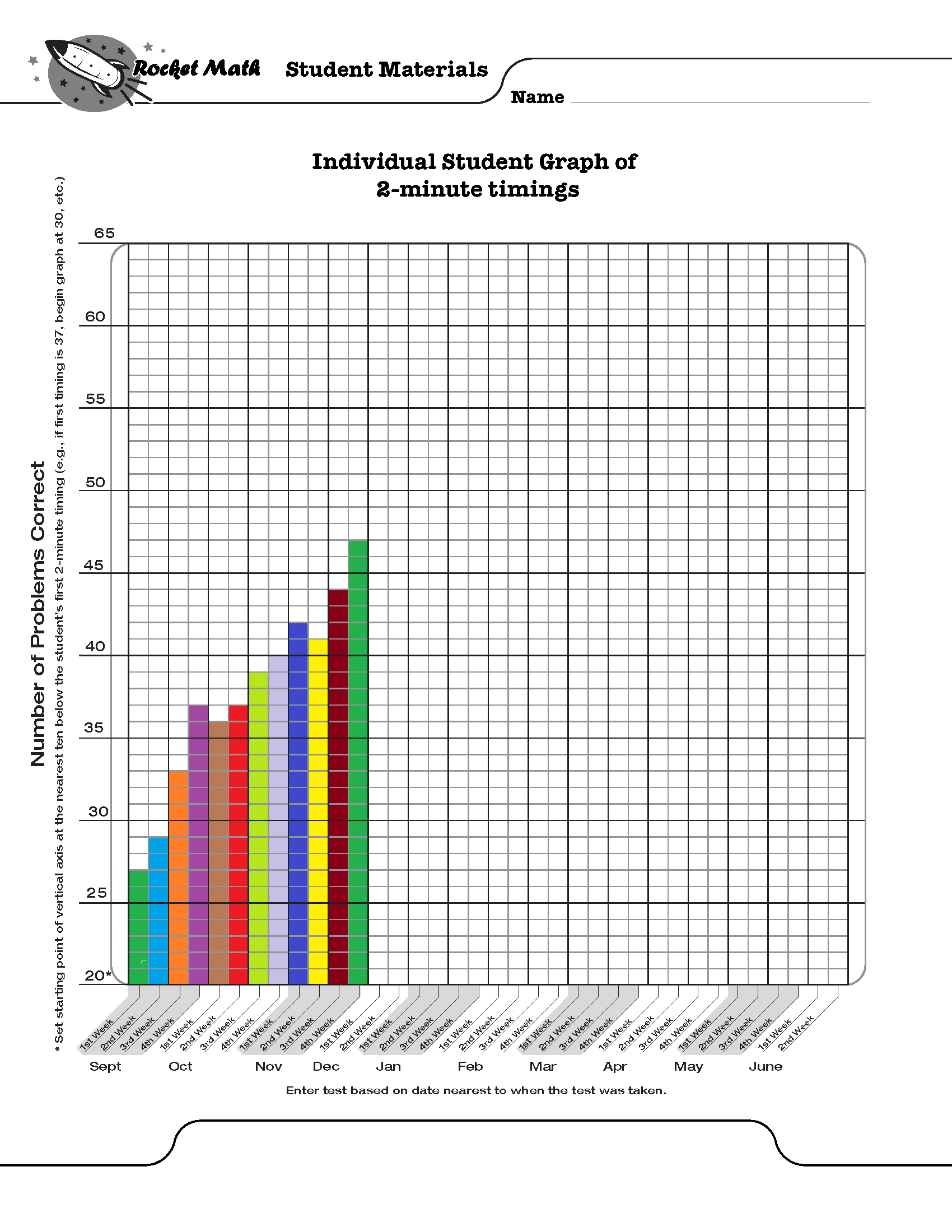
First of all, understand that the two-minute timings are NOT a teaching tool.  They are an assessment tool only.  Giving a two-minute timing of all the facts in an operation every week or two allows you to graph student performance.  You graph student performance to see if it is improving.  If the graph is going up, as in the picture above, then the student is learning.   If the graph is flat, then the student is not really learning.

The individual graphs should be colored in by students allowing them to savor the evidence of their learning.  The graphs should be shared with parents at conference time to prove that students are learning.  

Progress monitoring with two-minute tests are a curriculum-free method of evaluating a curriculum.  If you use the same tests you can compare two methods of learning facts to see which one causes faster growth.  This makes for a valid research study.

This kind of progress monitoring over time is also used in IEPs.  You can draw an aimline from the starting performance on the two-minute timing to the level you expect the student to achieve by the end of the year.  (Note the writing speed test gave you goals for the two-minute timing which you could use for your end-of-year goal.) The aimline on the graph, when it crosses the ending date of each quarter, will provide quarterly objectives that will enable quarterly evaluation of progress–required for an IEP.

These two minute timings are a scientifically valid method of proving whether students are learning math facts, in the same way that tests of oral reading fluency prove whether students are learning to read.  They can be used to prove to a principal or a curriculum director, for example, that Rocket Math is working and is worth the time, paper and money it requires.