Multiplication–Learning Computation–Learning Track

List of Learning Tracks Continue to purchase

Teach how to do (compute) multi-step multiplication problems

After becoming fluent with multiplication facts, the best way for students to retain the knowledge of those facts is by doing multiplication computation.  If students have not been taught multiplication computation, this program breaks it down into small, easy-to-learn steps that are numbered in a teaching sequence that leaves nothing to chance.

Assess to find where to begin instruction

Included in the Learning Track is an assessment to help you find out where to start instruction in the sequence. Test the student and begin teaching with the first skill on which they have difficulty.

Skills taught in this Learning Track

Note that the number for each skill gives the grade level as well as indicating the teaching sequence.  Skill 3b is a 3rd grade skill and after skill 3e is learned the next in the sequence is skill 4a.  The sequence of skills is drawn from M. Stein, D. Kinder, J. Silbert, and D. W. Carnine, (2006) Designing Effective Mathematics Instruction: A Direct Instruction Approach (4th Edition) Pearson Education: Columbus, OH.

(3b) Multiplying 1-digit times 2-digit; no renaming

(3c) Multiplying 1-digit times 2-digit; carrying

(3d) Multiplying 1-digit times 2-digit, written horizontally.

(3e) Reading and writing thousands numbers, using commas.

(4a) Multiplying 1-digit times 3-digit

(4b) Multiplying 1-digit times 3-digit; zero in tens column

(4c) Multiplying 1 digit times 3 digit, written horizontally

(4d) Multiplying 2-digits times 2-digits.

(4e) Multiplying 2-digits times 3-digits.

(5a) Multiplying 3-digits times 3-digits.

(5b) Multiplying 3-digits times 3-digits; zero in tens column of multiplier.


How to teach this Learning Track

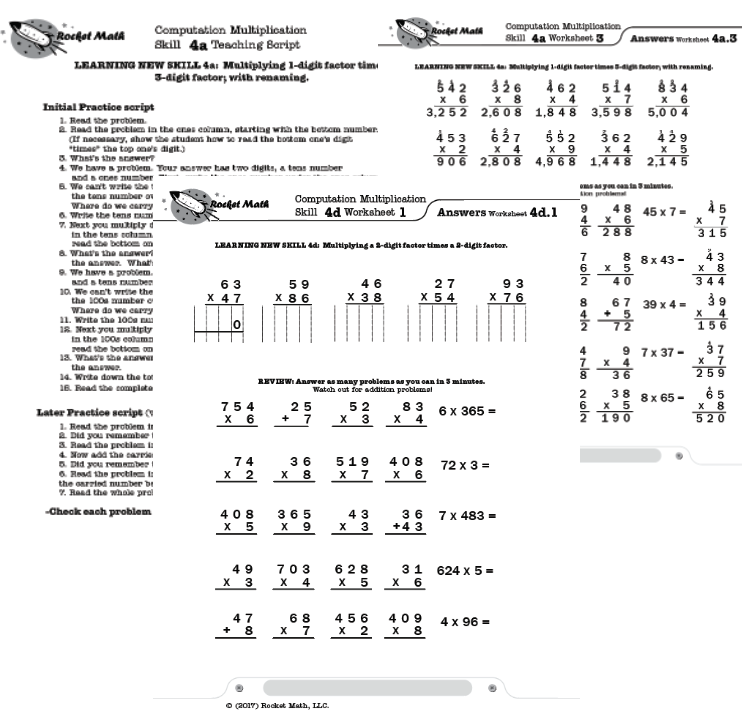
For each skill there is a suggested Teaching Script giving the teacher/tutor/parent consistent (across all the skills we use the same explanation) language of instruction on how to do the skill.  The script helps walk the student through the computation process.  For the teacher, in addition to the script, there are answer keys for the five worksheets provided for each skill.

Each worksheet is composed of two parts.  The top has examples of the skill being learned that can be worked by following the script.  After working through those examples with the teacher the student is then asked to work some review problems of addition problems that are already known.  The student is asked to do as many as possible in 3 minutes—a kind of sprint.  If all is well the student should be able to do all the problems or nearly all of them, but finishing is not required.  Three minutes of review is sufficient for one day.

There are five worksheets for each skill.  Gradually as the student learns the skill the teacher/tutor/parent can provide progressively less help and the student should be able to do the problems without any guidance by the end of the five worksheets.  There are suggestions for how to give less help in the teaching scripts.
Subtraction–Learning Computation–Learning Track


List of Learning Tracks Continue to purchase

Teach how to do (compute) multi-step subtraction problems

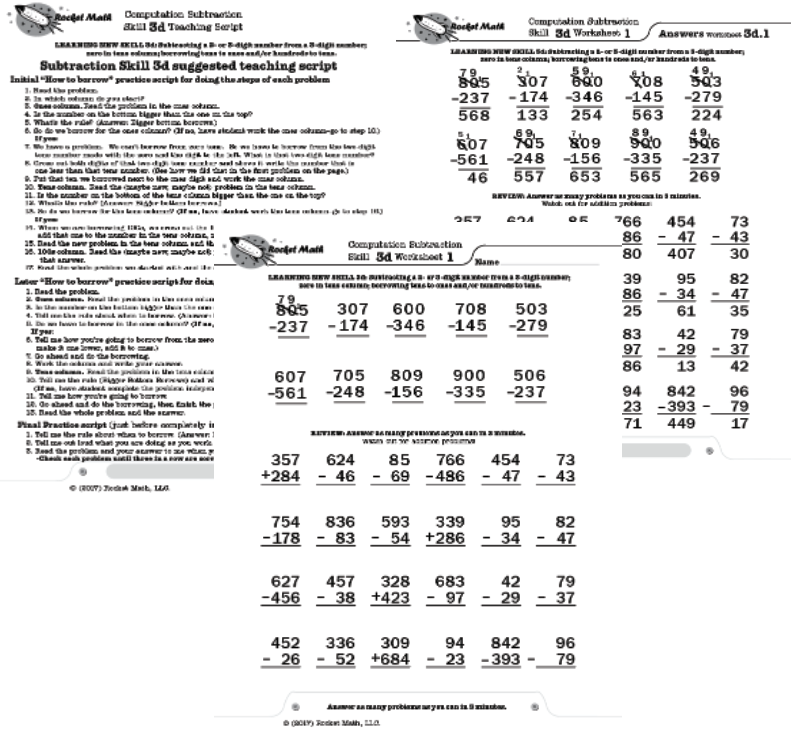
After becoming fluent with subtraction facts, the best way for students to retain the knowledge of those facts is by doing subtraction computation.  If students have not been taught subtraction computation, Subtraction–Learning Computation breaks it down into 18 small, easy-to-learn steps that are numbered in a teaching sequence that leaves nothing to chance. 

Find out where to begin instruction

Even better the instructional materials include an assessment of all the skills in subtraction computation in order, so you can test the knowledge of the student(s) before beginning instruction to see where to start. You can use this assessment to find very specific “holes” in student skills and then have the exact problems and explanation to fill that hole.

Skills taught in this Learning Track

Note that the number for each skill gives the grade level as well as indicating the teaching sequence.  Skill 3b is a 3rd grade skill and after skill 3g is learned the next in the sequence, skill 4a is best taught in fourth grade.  Minor changes have been made, but for the most part, the sequence of skills is drawn from M. Stein, D. Kinder, J. Silbert, and D. W. Carnine, (2006) Designing Effective Mathematics Instruction: A Direct Instruction Approach (4th Edition) Pearson Education: Columbus, OH.

(1b) Subtract from 2 digits; no renaming.

(2a) Subtract from 2digits; renaming required.

(2b) Subtract from 3 digits; borrow from 10s.

(3a) Subtract from 3 digits; borrow from 100s.

(3b) Subtract from 3 digits; borrow either place.

(3c) Subtract tens minus one facts.

(3d) Subtract from 3 digits; zero in 10s; borrow 10s or 100s.

(3e) Read and write thousands numbers, use commas.

(3f) Subtract from 4 digits; borrow from 1000s.

(3g) Subtract from 4 digits; borrow once or more.

(4a) Subtract from 4 digits; zero in 10s or 100s column

(4b) Subtract from 4 digits; zero in 10s column, 1 in 100s.

(4c) Subtract hundreds minus one facts.

(4d) Subtract from 4 digits; zero in 10s and 100s column.

(4e) Subtract 1, 2, or 3 digits from 1,000.

(4f) Subtract 5 and 6 digits with borrowing.

(5a) Subtract thousands minus one facts.

(5b) Subtract from a number with four zeroes.

How to teach this Learning Track

For each skill there is a suggested Teaching Script giving the teacher/tutor/parent consistent (across all the skills we use the same explanation) language of instruction on how to do the skill.  My favorite part is the rule students are taught for when to borrow (often confusing for students): Bigger bottom borrows.  Simple, easy-to-remember and consistently correct.  The script helps walk the student through the computation process.  For the teacher, in addition to the script, there are answer keys for the five worksheets provided for each skill.

Each worksheet is composed of two parts.  The top has examples of the skill being learned that can be worked by following the script.  After working through those examples with the teacher the student is then asked to work some review problems of addition problems that are already known.  The student is asked to do as many as possible in 3 minutes—a kind of sprint.  If all is well the student should be able to do all the problems or nearly all of them, but finishing is not required.  Three minutes of review is sufficient for one day.

There are five worksheets for each skill.  Gradually as the student learns the skill the teacher/tutor/parent can provide progressively less help and the student should be able to do the problems without any guidance by the end of the five worksheets.  There are suggestions for how to give less help in the teaching scripts.
Addition–Learning Computation–Learning Track


List of Learning Tracks Continue to purchase

How to do (compute) multi-step addition problems

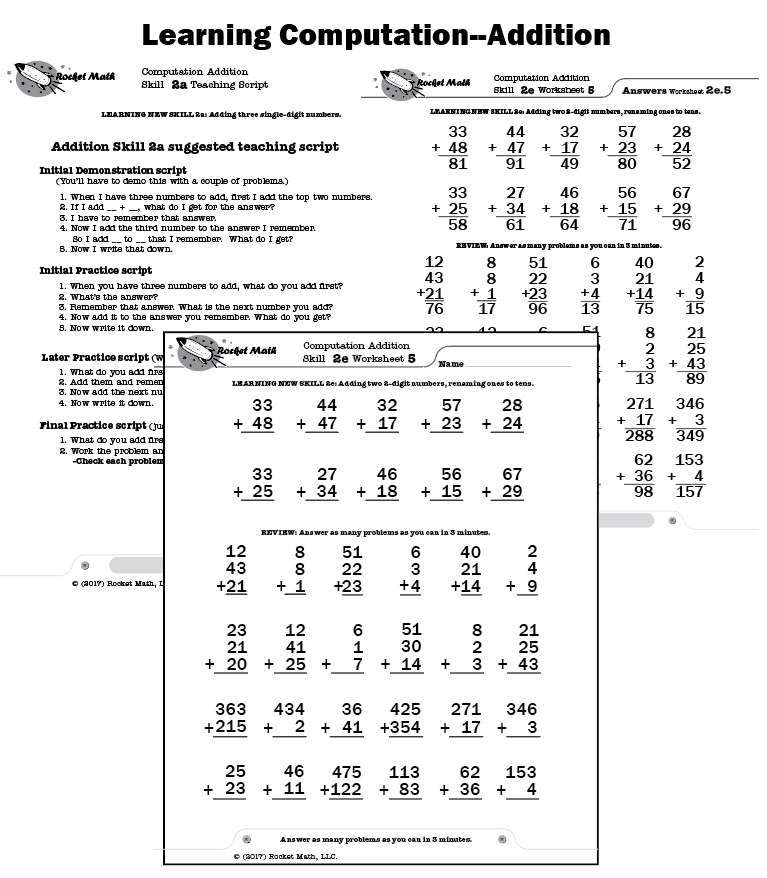
After becoming fluent with addition facts, the best way for students to retain the knowledge of those facts is by doing addition computation.  If students have not been taught addition computation, this program breaks it down into small, easy-to-learn steps that are numbered in a teaching sequence that leaves nothing to chance.

Easily assess where to begin instruction

An assessment is provided to test each of the skills in the sequence below. They go in order. Test the student and begin teaching wherever the student begins to have difficulty.

Skills taught in this Learning Track

Note that the number for each skill gives the grade level as well as indicating the teaching sequence.  Skill 2a is a 2nd grade skill and after skill 2f is learned the next in the sequence is skill 3a.  The sequence of skills is drawn from M. Stein, D. Kinder, J. Silbert, and D. W. Carnine, (2006) Designing Effective Mathematics Instruction: A Direct Instruction Approach (4th Edition) Pearson Education: Columbus, OH.

(1b) Adding 1-, or 2-digit numbers; no renaming

(2a) Adding three single-digit numbers

(2b-c) Adding 3-digit numbers; no renaming

(2c) Adding 3-digits to 1 or more digits; no renaming

(2d) Adding three 1- or 2-digit numbers; no renaming

(2e) Adding two 2-digit numbers, renaming 1s to 10s

(2f) Adding 3-digit numbers, renaming 1s to 10s

(3a) Adding a 1-digit number to a teen number, under 20

(3b) Adding two 2- or 3-digit numbers; renaming 10s to 100s

(3c) Adding 3-digit numbers; renaming twice

(3d) Adding three 2-digit numbers; renaming sums under 20

(3e) Adding four multi-digit numbers; renaming, sums under 20

(4a) Adding a 1-digit number to a teen number, over 20

(4b) Adding three 2-digit numbers, sums over 20

(4c) Adding four or five multi-digit numbers, sums over 20

How to teach this Learning Track

For each skill there is a suggested Teaching Script giving the teacher/tutor/parent consistent (across all the skills we use the same explanation) language of instruction on how to do the skill.  The script helps walk the student through the computation process.  For the teacher, in addition to the script, there are answer keys for the five worksheets provided for each skill.

Each worksheet is composed of two parts.  The top has examples of the skill being learned that can be worked by following the script.  After working through those examples with the teacher the student is then asked to work some review problems of addition problems that are already known.  The student is asked to do as many as possible in 3 minutes—a kind of sprint.  If all is well the student should be able to do all the problems or nearly all of them, but finishing is not required.  Three minutes of review is sufficient for one day.

There are five worksheets for each skill.  Gradually as the student learns the skill the teacher/tutor/parent can provide progressively less help and the student should be able to do the problems without any guidance by the end of the five worksheets.  There are suggestions for how to give less help in the teaching scripts.
Mult-Division Fact Families to 20 Learning Track


List of Learning Tracks Continue to purchase

Why learn in Fact Families?

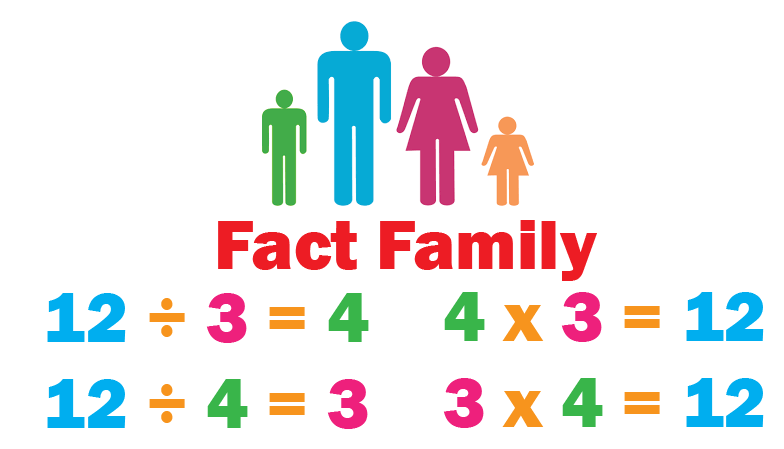
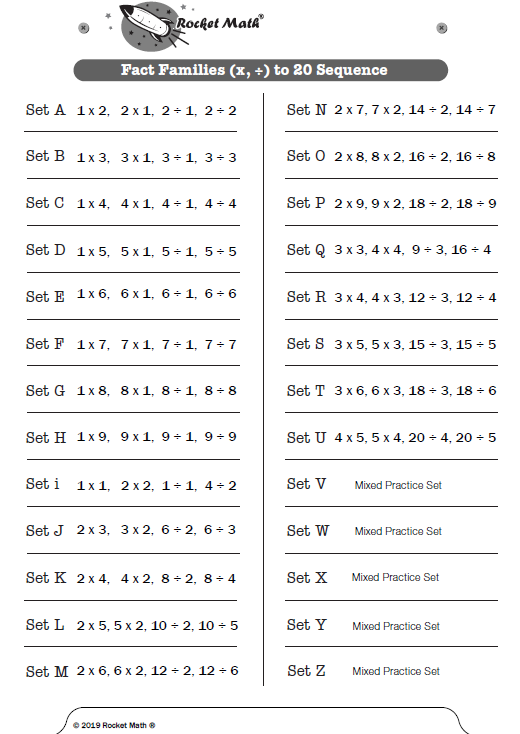
Fact Families are another way to learn multiplication and division facts, or to review them once learned. 2 x 1, 1 x 2, 2 ÷ 1, and 2 ÷ 2 make up such a family.  Fact families are divided into two parts.  This is the first part and includes facts up to 4 x 5 = 20.  The second part goes on from 21 with 7 x 3 = 21 and larger facts.

How do students learn?

Students practice orally with a partner, reading and answering the facts going around the outside of the sheet.  The partner has the answer key.  Then the two students switch roles.  After practice everyone takes a one minute test on the facts in the box–which are only the facts learned up to this level.  Each student has individual goals based on writing speed, but no one can pass a level if there are any errors.   You must give the special Writing Speed Test to set individual goals for your students.

Students should be able to pass a level in a week, if they practice the right way.   Below you can see the sequence of facts that will be learned in the Mult & Division Fact Families to 20 program.  The program uses the four forms–that can be found in the forms and information drawer.

The most succinct way to be introduced to this program is this 8 minute video.

Fact Families make an excellent review

If students have learned the 0 to 9s multiplication and division facts, this makes an excellent review.  Students will find this first part very easy, but the second part will really help them build up their fluency.


Mult-Division Fact Families from 21 Learning Track


List of Learning Tracks Continue to purchase

Why learn in Fact Families?

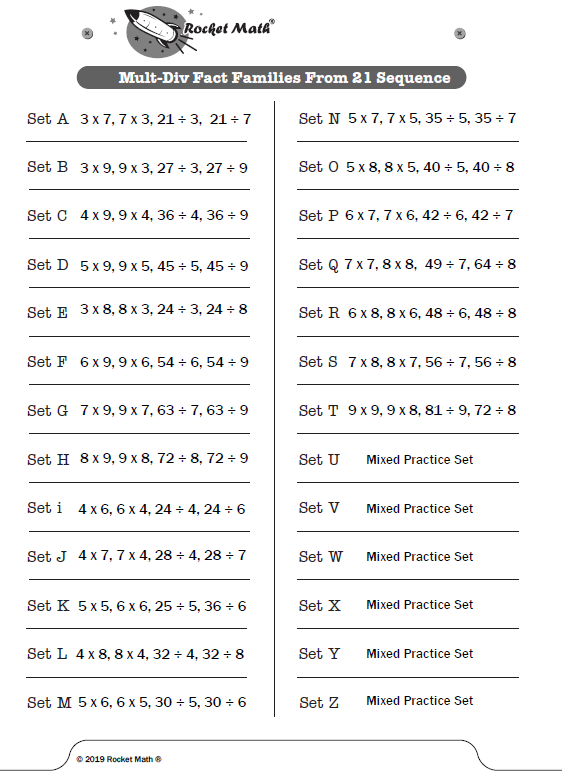
Fact Families are another way to learn multiplication and division facts, or to review them once learned. 7 x 3, 3 x 7, 21 ÷ 7, and 21 ÷ 3 make up such a family.  Fact families are divided into two Learning Tracks.  This Learning Track is the second one, which goes on from 21 with 7 x 3 = 21 and larger facts.

How do students learn?

Students practice orally with a partner, reading and answering the facts going around the outside of the sheet.  The partner has the answer key.  Then the two students switch roles.  After practice everyone takes a one-minute test on the facts in the box–which are only the facts learned up to this level.  Each student has individual goals based on writing speed, but no one can pass a level if there are any errors.   You must give the special Writing Speed Test to set individual goals for your students.

Students should be able to pass a level in a week, if they practice the right way.   Below you can see the sequence of facts that will be learned in the Mult & Division Fact Families from 21 program.  The program uses the four forms–that can be found in the forms and information drawer.

The most succinct way to be introduced to this program are these three videos.

Subtraction 0 through 9s Learning Track

List of Learning Tracks Continue to purchase

After 0-9s addition facts are learned, these are next.

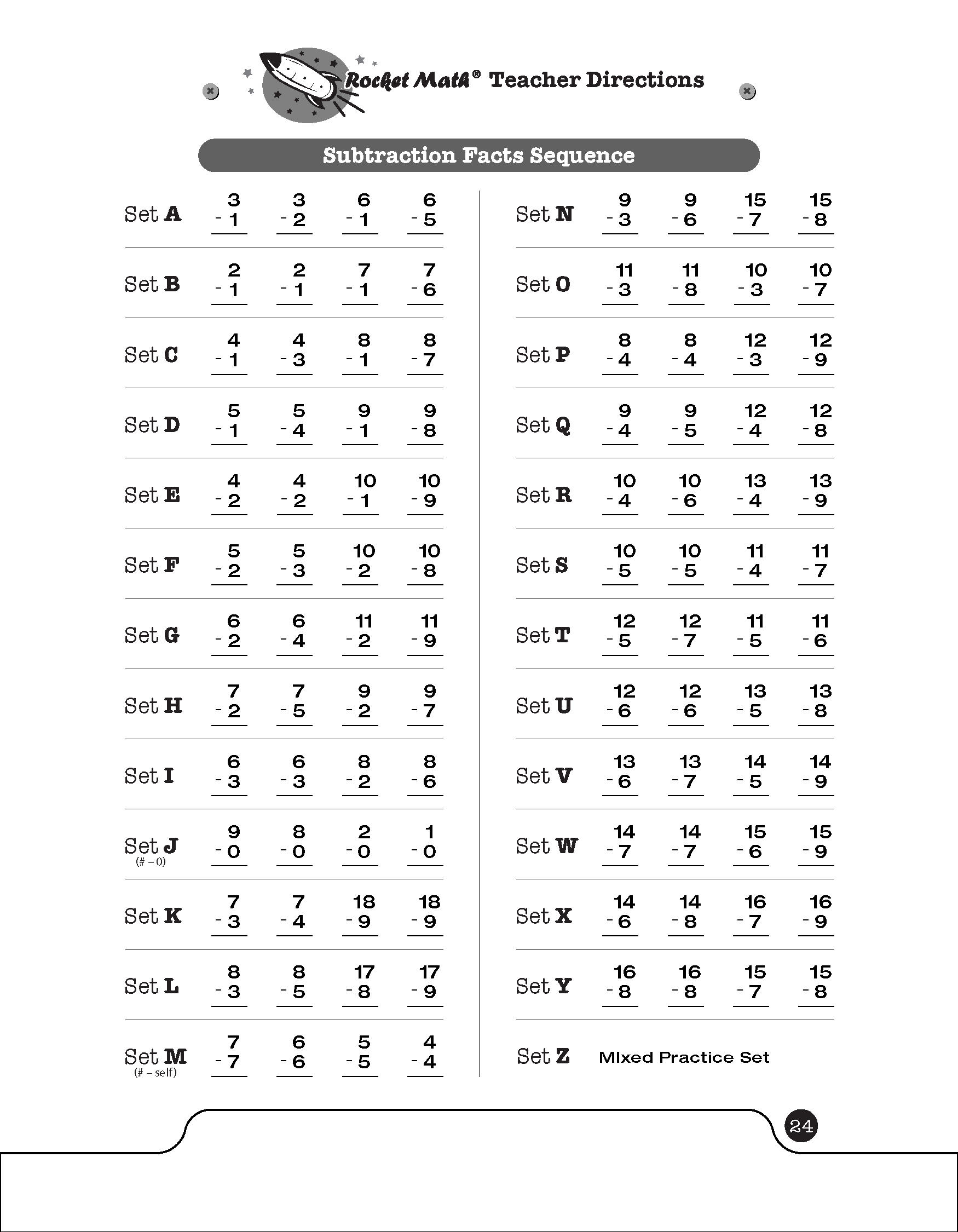
These are the basic single digit Subtraction facts 0 through 9s. Each of the 26 levels, A through Z, introduces two facts and their reverses.  You can see in the picture above of Set E, I have outlined the new facts in red.

How do students learn these facts?

Students practice orally with a partner, reading and answering the facts going around the outside of the sheet.  The partner has the answer key.  Then the two students switch roles.  After practice everyone takes a one-minute test on the facts in the box–which are only the facts learned up to this level.  Each student has individual goals based on writing speed, but no one can pass a level if there are any errors.   You must give the special Writing Speed Test to set individual goals for your students.

Students should be able to pass a level in a week, if they practice the right way.   Below you can see the sequence of facts that will be learned in the Subtraction 0-9s program.  The program uses the four forms–that can be found in the forms and information drawer.

The most succinct way to be introduced to this program is this 8-minute video.


Multiplication 0 through 9s Learning Track

List of Learning Tracks Continue to purchase

What do students learn in this Learning Track?

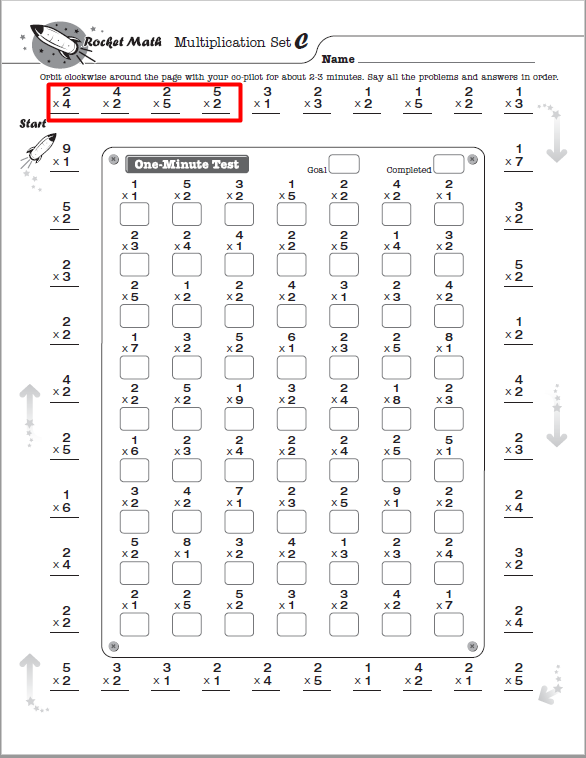
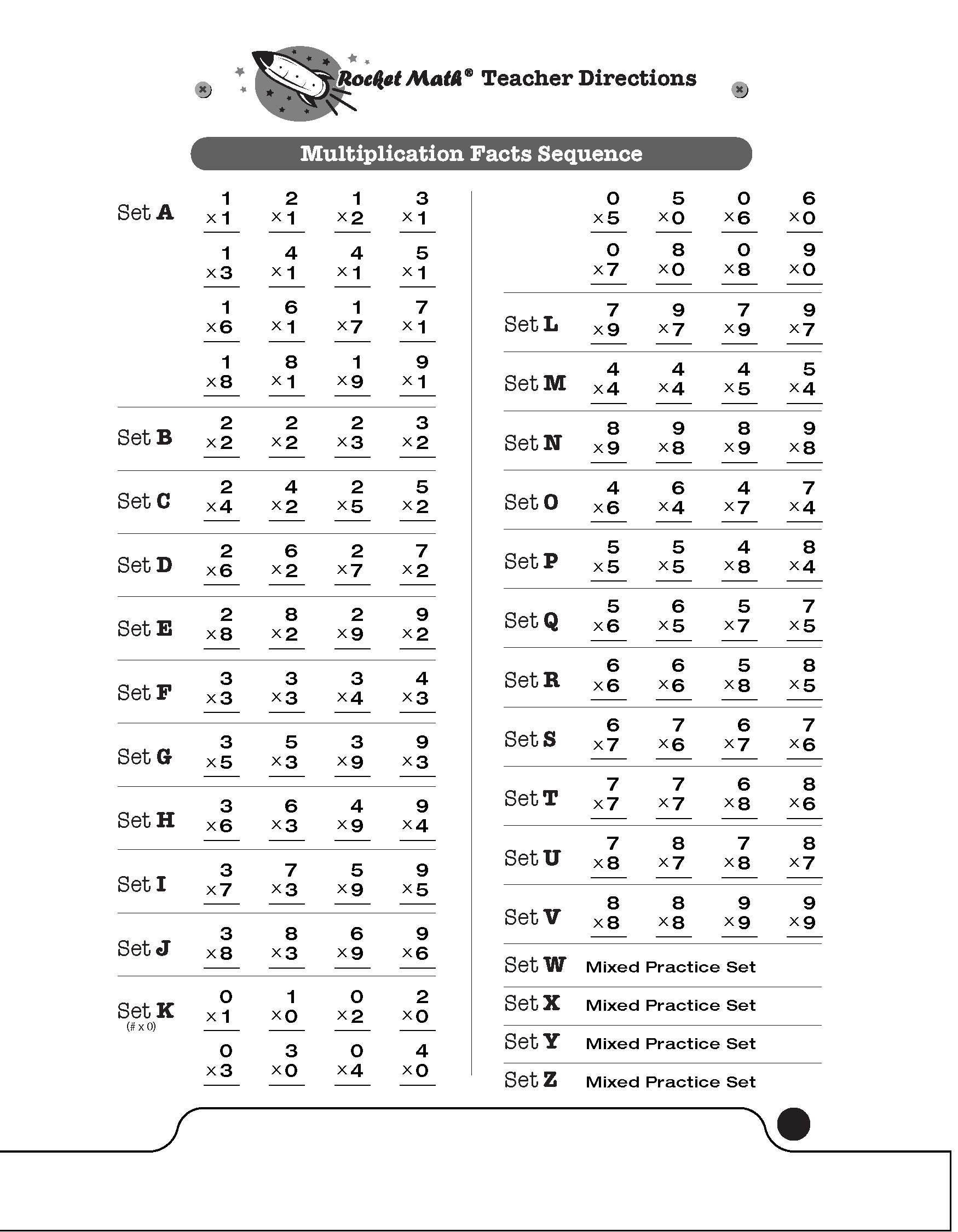
Students commit to memory the single digit Multiplication facts 0 through 9s. Each of the 26 levels, A through Z, introduces two facts and their reverses.  You can see in the picture above of Set C, we have outlined the four new facts in red. The facts taught and the sequence in which they are learned are shown below.

How do students learn these facts?

Students practice orally with a partner, reading and answering the facts going around the outside of the sheet.  The partner has the answer key.  Then the two students switch roles.  After practice everyone takes a one-minute test on the facts in the box–which are only the facts learned up to this level.  Each student has individual goals based on writing speed, but no one can pass a level if there are any errors.   You must give the special Writing Speed Test to set individual goals for your students.

Students should be able to pass a level in a week, if they practice the right way.   To the right you can see the sequence of facts that will be learned in the Multiplication 1s-9s program.  The program uses the four forms–that can be found in the forms and information drawer.

The most succinct way to be introduced to this program is this 8-minute video.


Identifying Fractions Learning Track

List of Learning Tracks Continue to purchase

What do students learn in the Identifying Fractions Learning Track?

Identifying Fractions is a Learning Track to ensure that students have a firm and correct understanding of fractions.  This will prepare them well for all subsequent work in fractions.

Students will learn the essential rule about what the numerator and denominator mean, although they won’t be working with those terms.  They just learn through examples, practiced over and over.  The numerator, called simply the number on the top, tells how many parts are shaded.  The denominator, simply called the number on the bottom, indicates the number of parts in a whole.  If a whole is not divided into parts, it is a whole number.

Learning proper and improper fractions and mixed numbers.

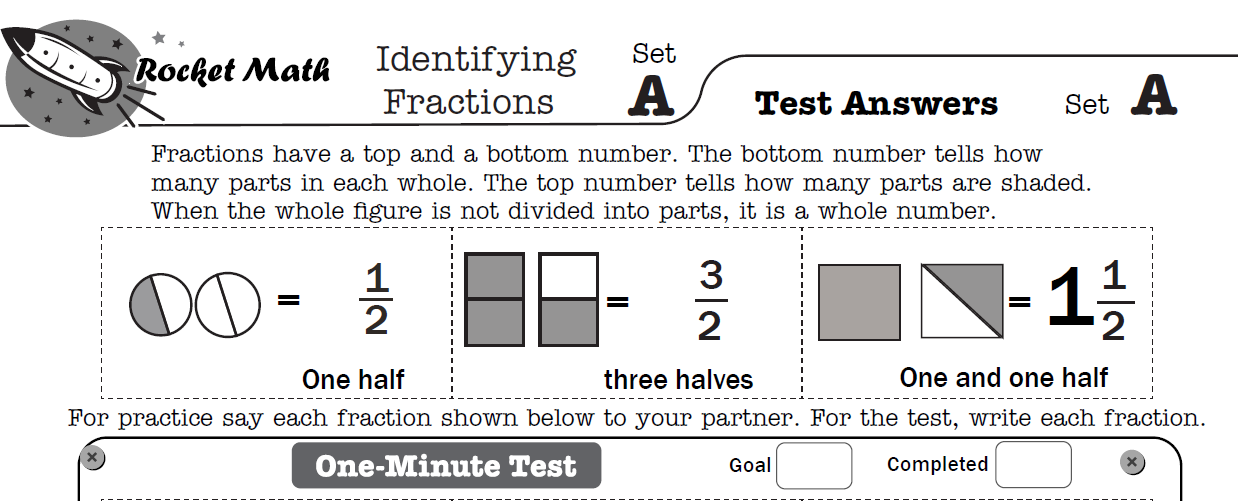
Right from the beginning of Set A students will encounter improper fractions and mixed numbers. (See the illustration above).  They will see examples of every fraction first at the top of the page before they are asked to identify it on their own. You see that students see the fraction, see the words for how we say it and they see the fraction they are to write.

Unlike other Rocket Math programs, the test and the practice items are the same.  Of course, the students have a page without the answers, while their partner holds the answer key. Students practice by saying aloud to their partner the fractions shown in the test.  Then they take the test on those same items but write the answer.


Halves, thirds, fourths, fifths, sixths, eighths, tenths, and twelfths.


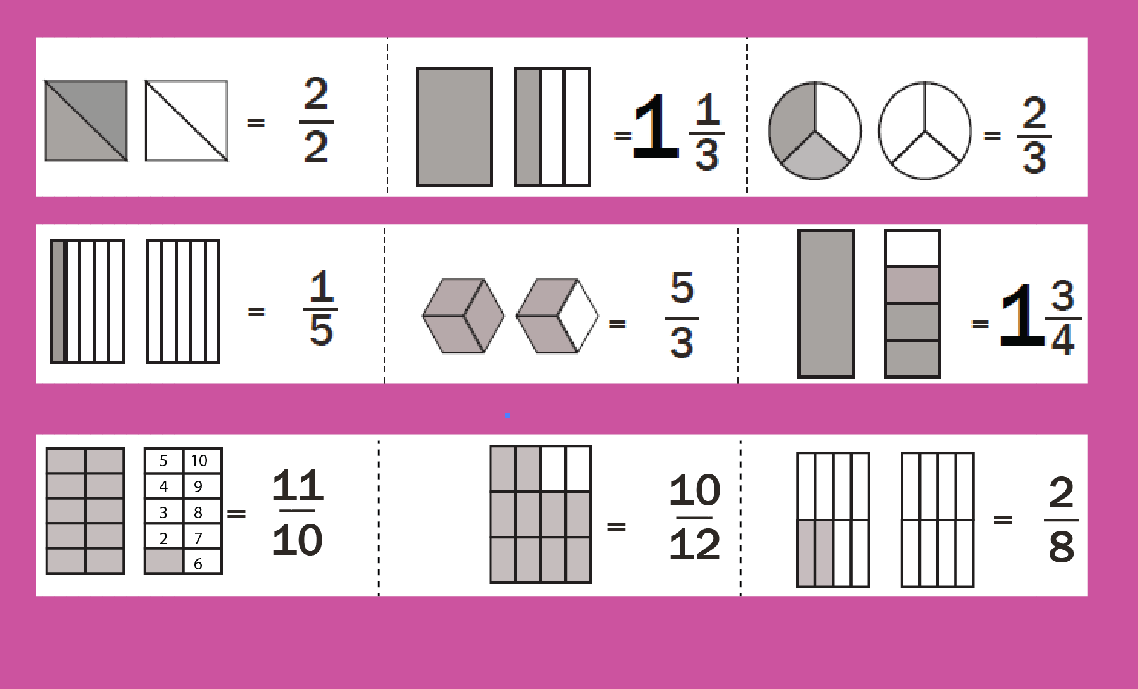
The fractions that students become familiar with include, halves, thirds, quarters, fifths, sixths, eighths, tenths and twelfths.  They see improper fractions and mixed number with every denominator.  In the beginning with the smaller denominators students see a variety of shapes for each denominator, so they learn that the identity of a fraction only has to do with the number of parts in a whole, not the shape of the display.  You can see thirds as cubes and as circles and as rectangles in the examples to the right.

When students are eventually introduced to eighths, tenths and twelfths we don’t want to slow them down by having to laboriously count the number of parts in each figure.

  • Eighths are always displayed as two sets of four rectangles on top of each other.
  • Tenths are displayed as two columns of five blocks with little numbers in them.
  • Twelfths are always displayed as three sets of four rectangles on each other.

Students should notice these conventions so they can quickly identify the number of parts in those figures without having to count them.

Be sure to do the Identifying Fractions writing speed test.

Identifying fractions has its own writing speed test, to be sure that student goals are individualized to their writing speed.  By the time students complete Set Z in this program they will have a strong understanding of fractions and they will be fluent.  There are even 2-minute timings you can give every week or two for them to chart their progress as they get faster.  This is a great program for students of any grade from second grade on up who have finished the basics for their grade level.  It will really put them in good shape when dealing with fractions in later years.

Division 0 through 9s Learning Track

List of Learning Tracks Continue to purchase

What do students learn?

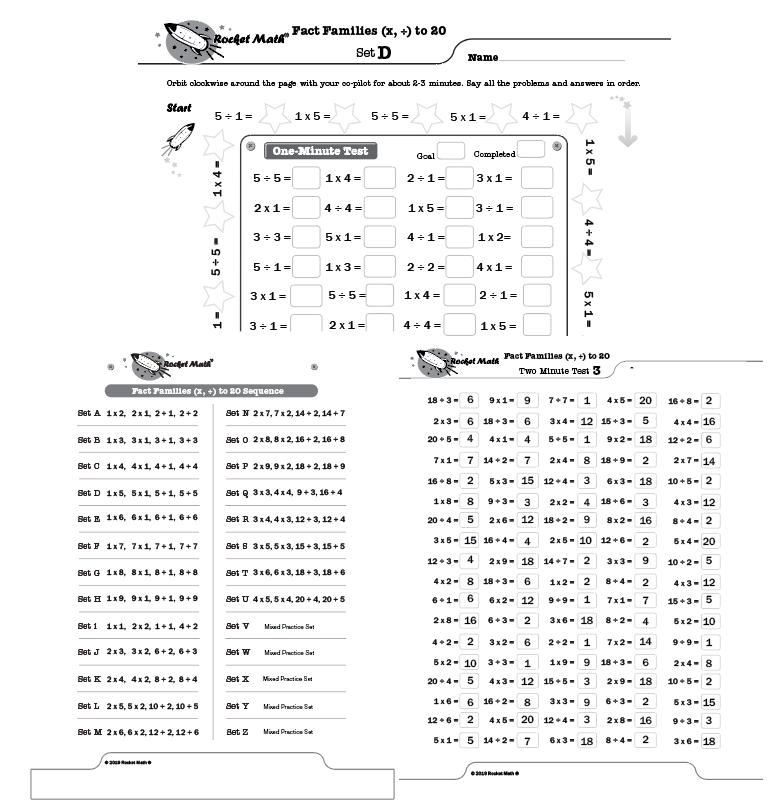
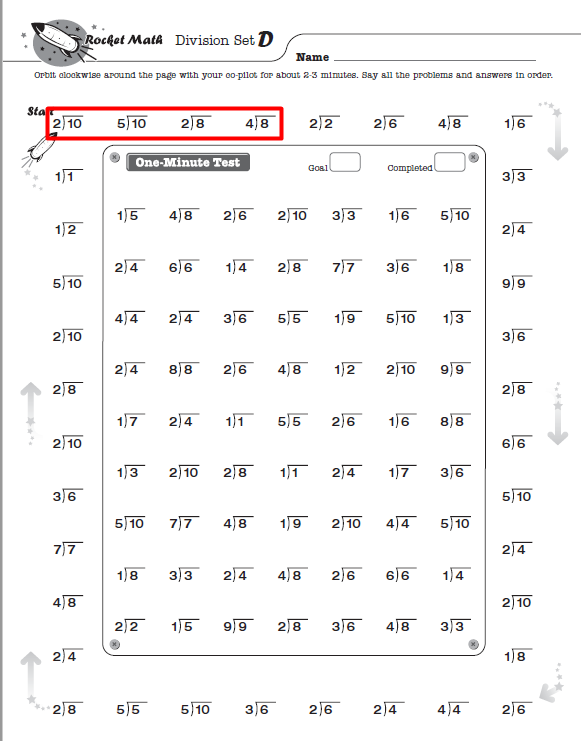
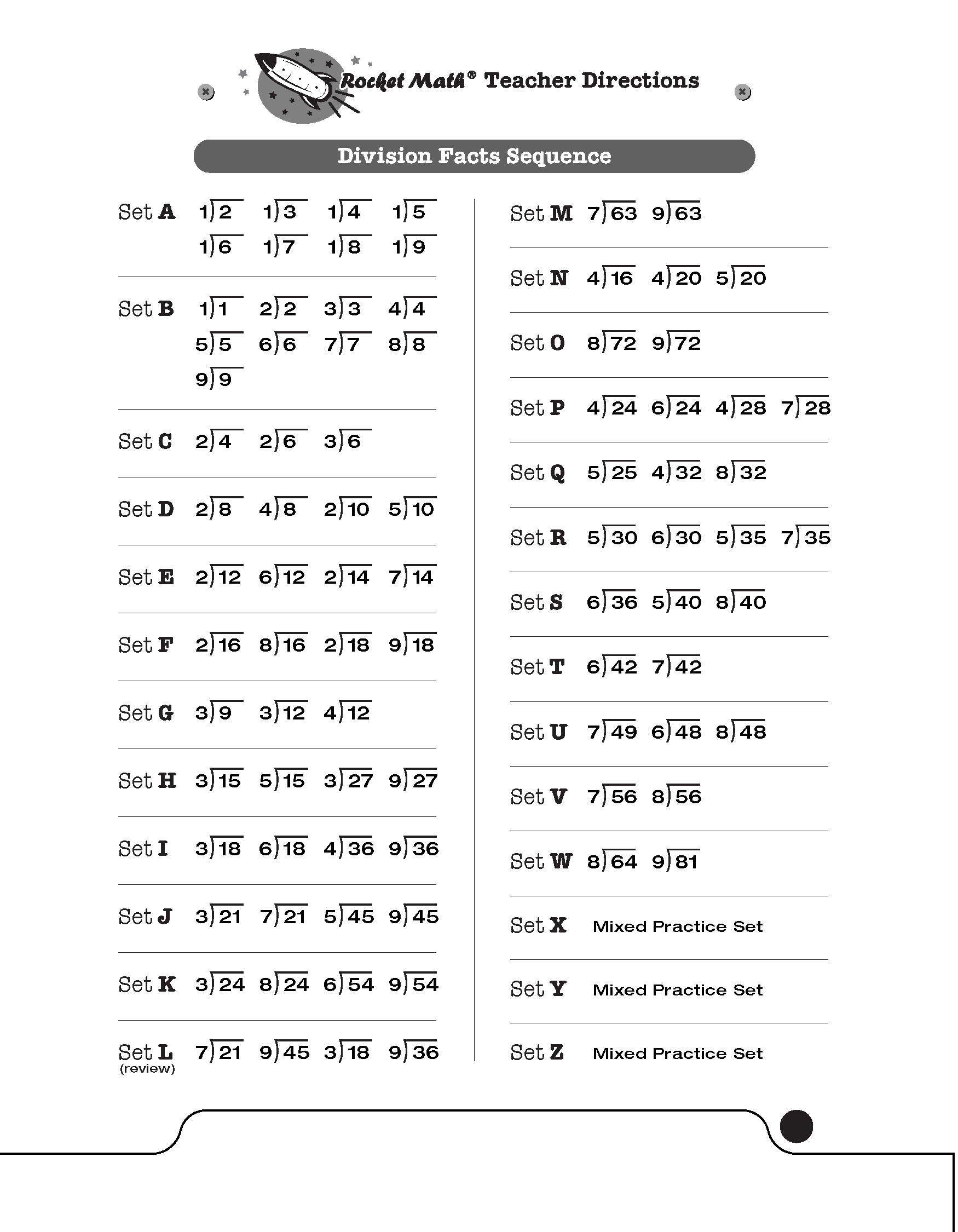
These are the basic single digit Division facts 0 through 9s. Each of the 26 levels, A through Z, introduces two facts and their reverses.  You can see in the picture above of Set D, we have outlined the new facts in red.  Below you can see the sequence of facts that will be learned in the Division 0-9s program.  The program uses the four forms–that can be found in the forms and information drawer.

How do students learn?

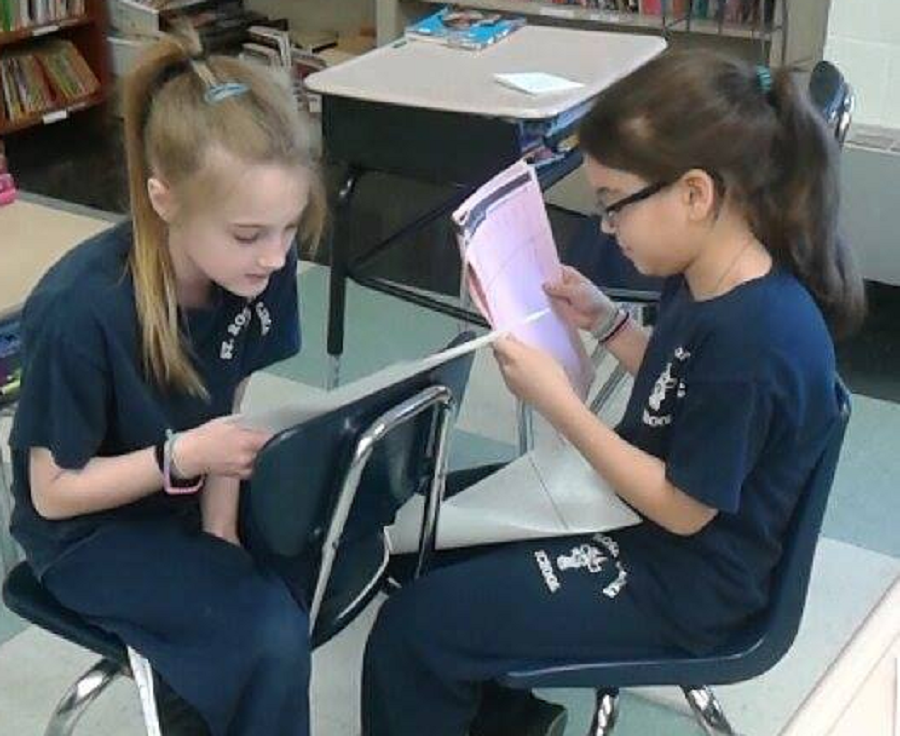
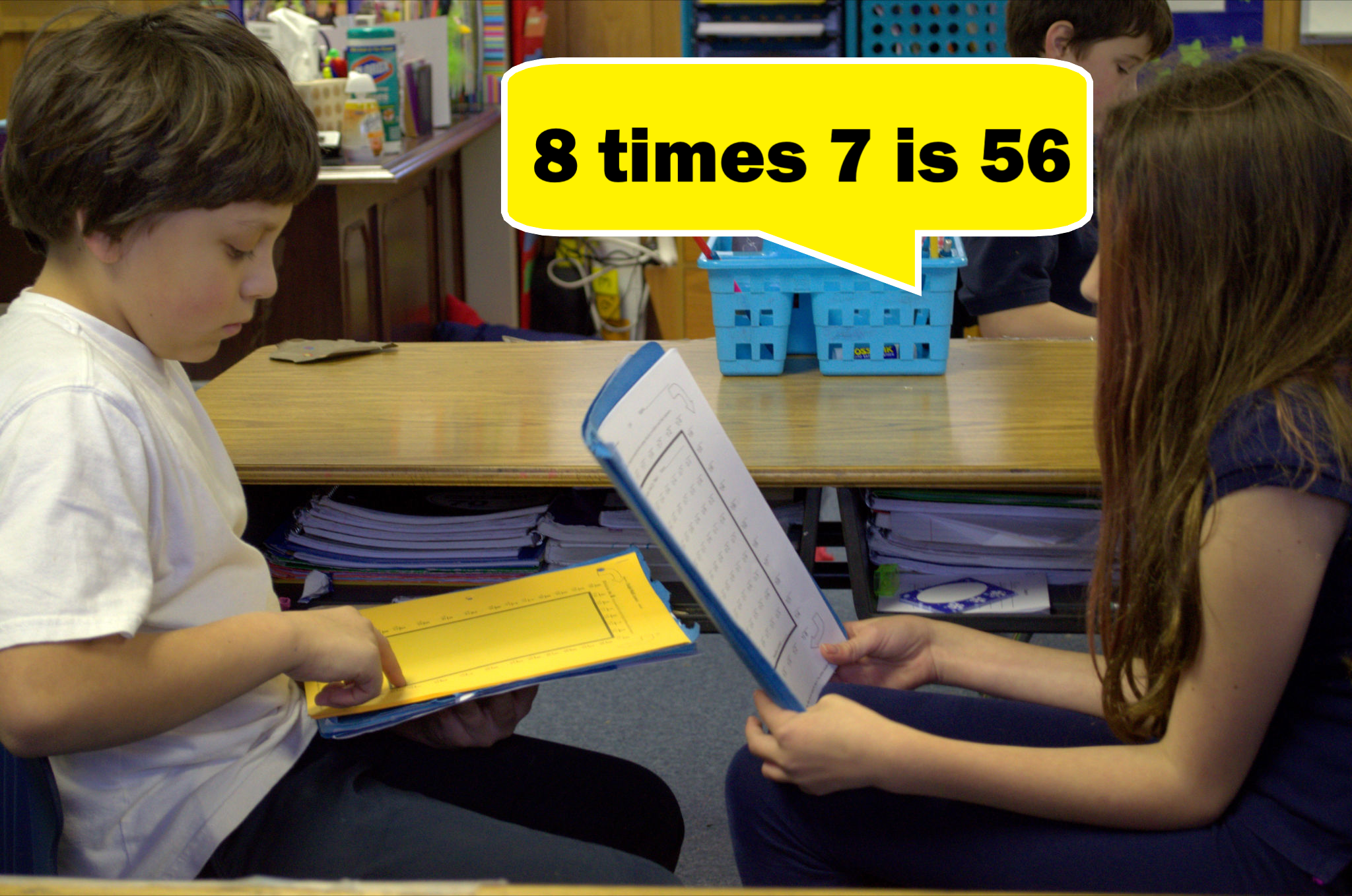
Two students use Rocket Math Worksheets to practice their math facts.Students practice orally with a partner, reading and answering the facts going around the outside of the sheet.  The partner has the answer key.  Then the two students switch roles.  After practice everyone takes a one minute test on the facts in the box–which are only the facts learned up to this level.  Each student has individual goals based on writing speed, but no one can pass a level if there are any errors.   You must give the special Writing Speed Test to set individual goals for your students.

Students should be able to pass a level in a week, if they practice the right way.   The most succinct way to be introduced to this program are through these three videos.

Conceptual Addition (counting-on) Kindergarten Learning Track


List of Learning Tracks Continue to purchase

Conceptual Addition (counting-on) Kindergarten

Conceptual Addition is a beginning program for kindergarten students. It comes after they finish “Beginning Numerals.” You are teaching them the concept of addition.  They should also know how to write the numerals to 20 by memory or from dictation before starting.  We recommend using our “Rocket Writing for Numerals” to teach numeral writing.

Teacher-led instruction, not peer practice.

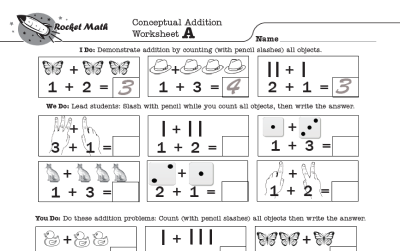
This is teacher-led instruction, rather than peer practice.  Each worksheet begins with an “I Do” portion that is a teacher modeled demonstration. That is followed by a “We Do” portion where the teacher leads the students in doing the problems together.  The last portion is called “You Do” which students should be able to do independently following the teacher modeling and leading on several items.

Begin by counting objects in both groups

For the first four worksheets you count all the objects in two groups to find the sum. When modeling slash the objects with a pencil as you count.  Teach the children to do the same.  The answer keys show the objects slashed.

“I can do this problem. I can add the butterflies by counting ALL the butterflies.
Watch me slash and count ALL the butterflies. [Slash while counting.]
One, two, three. There are three butterflies in all. One butterfly plus two butterflies equals three butterflies.
So they wrote three in the box. Touch here where the three is written as the answer. Good.
One butterfly plus two butterflies is how many butterflies, everybody? __________ Yes, three butterflies.
Now watch me do the next box.”

Later, begin with a number and count-on from there.

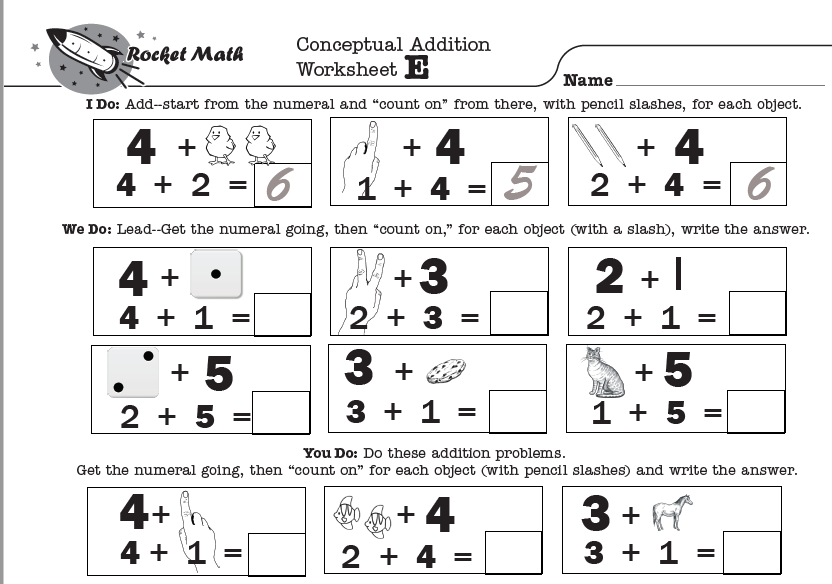
Starting in Set E you get the larger of the two numbers “going” and then slash and “count on” from there.

“I can do this problem. I can add two chicks plus four by counting on from four. Watch me get four going and
then slash and count the two chicks. F-f-o-o-u-u-r-r, [Slash while counting.] five, six. Four plus two equals six.
So they wrote six in the box. Touch here where the six is written as the answer. Good.
Two plus four is how many, everybody? __________ Yes, six.
Now watch me do the next box.”

In each worksheet, the students are asked to add the number and the items in each box and write the correct number. The teacher models and students are required to count by slashing the items shown.  Slashing ensures the count is correct. Besides cute items there are also dice to count, fingers to count and hash marks to count–so students can learn multiple ways of keeping track of numbers.

Passing a level requires 100% accuracy.  Students who make any errors should be worked with until they can complete the worksheet independently and get all the items correct.

This will prepare kindergarteners for learning the concept of addition.  Combined with Rocket Writing for Numerals it will set students up for success in elementary math.