
The Ultimate Guide to Math Fact Fluency

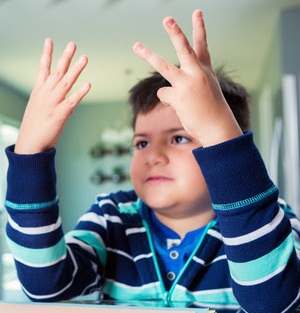
Students counting on their fingers is a sure-tell sign that they didn’t acquire math fact fluency. It is sad to see students, ashamed of the only thing they know, counting on their fingers under their desks. Our elementary educational mission is failing students who haven’t developed math fact fluency, which is the foundation to more advanced math skills.

Developing math fact fluency takes structure, organization, and work on the part of both teachers and students. In this article, I will share everything you need to know about developing math fact fluency.

What is Math Fact Fluency
Math facts are single-digit problems such as 7+9 or 6×8 or 14-5, and so on. A common name for all the multiplication math facts is the “multiplication table.” Math fact fluency is the ability to answer all math fact questions instantly from recall without having to think through the problem.

Students should be able to recall math facts instantly without having to count on their fingers or hesitate to think about the answer. This may seem like a high bar, but our brains are great at recalling an unbelievable amount of information daily, and with practice, math facts can be recalled the same way.

Three Reasons Why Math Fact Fluency is Important
tools to build math fact fluency

Math fact fluency is critical because it is a “tool skill.” Meaning it is a tool used in the process of doing other math problems. Developing this tool skill makes learning math easier as concepts get more complicated. This tool skill needs to be automatic in the student’s brain to save precious short-term memory resources.

Math fact fluency can be compared to reading. Students must recognize words automatically to comprehend the author’s meaning. Otherwise, they will spend too much time decoding individual words.

When students are fluent in math facts, they are focused on the math process as a whole rather than stopping to puzzle out the facts. This is important for three reasons: 

1. Students with math fact fluency make fewer errors

Students who lack math fact fluency often make careless errors doing arithmetic computations. If they devote too much energy to deriving math facts, they lose sight of the problem at hand and make mistakes that would otherwise be obvious. Those who can effortlessly recall math facts can concentrate on what they are doing and ultimately make fewer errors.

2. Math fact fluency makes learning math easier

When a new math procedure is introduced, students who have math fact fluency can easily follow the thread of instruction. Without this fluency, students fall behind instruction or demonstrations as they try working out math facts. This distraction takes away from a student absorbing all of the details necessary to successfully learn new math processes.

The first teacher to use Rocket Math to teach subtraction facts to her second graders realized the benefit first hand. She told me that with Rocket Math, she was able to teach regrouping in subtraction in just three days.

Her students mastered the math facts, and the outcome was extraordinary. The teacher shared that since these students had developed fluency in subtraction facts, they were able to learn other procedures easily.

3. Students who have developed math fact fluency enjoy math and always complete their work

Having to count on your fingers or look up facts on a timetable is slow and onerous. When students can’t work quickly, math problems become a dreaded drudgery. Students are motivated by mastering new skills, which will help them work faster and build confidence. Those who can quickly recall math facts will complete their work with ease and enjoy the feeling of accomplishment.

How to Build and Improve Math Fact Fluency

steep climb to math fact fluencyBuilding and improving math fact fluency requires a systematic effort over the elementary years. It is a long climb to achieve mastery and there are no short-cuts.

Consistent daily practice throughout elementary school is important for retention. Slow and steady wins the race when building math fact fluency.

Math fact practice should be structured in such a way that students are learning a small number of facts at a time. These small groups of facts should be practiced daily until students have reached mastery. As time goes on, more groups of math facts are introduced systematically in small amounts for students to master.

Learning the 0 through 9s facts in the four basic operations will take elementary students months to master. Worksheets and game applications are two of the best ways to teach fact fluency over time. Combining structured math fact learning, practice, and evaluation with fun math fact games helps students develop number sense and understand complex numerical relationships.

Teaching Math Fact Fluency with Worksheets

Worksheets are popular tools that teachers reach for when teaching math facts, but sadly, they often fall short for the majority of students. A few select students will begin memorizing the facts on their own accord in order to make the worksheets easier, but most students will continue to slowly work out the facts either on their fingers or in their heads. These students may never develop a strong recall of the facts and become flustered when asked to answer problems on the spot.

Fortunately, there are specific worksheets that are effective in building fact fluency. The key is having worksheets that are structured, systematic, and sequenced. Each worksheet should only have two to four facts to be learned. 

By working on only two to four facts, these worksheets help teach memorization for a strong recall, rather than reinforcing working out problems slowly. Students will then be able to remember these small groups of facts easier, and by the end of the worksheet will be writing answers from memory.

Teaching Math Fact Fluency with The Rocket Math Worksheet Program
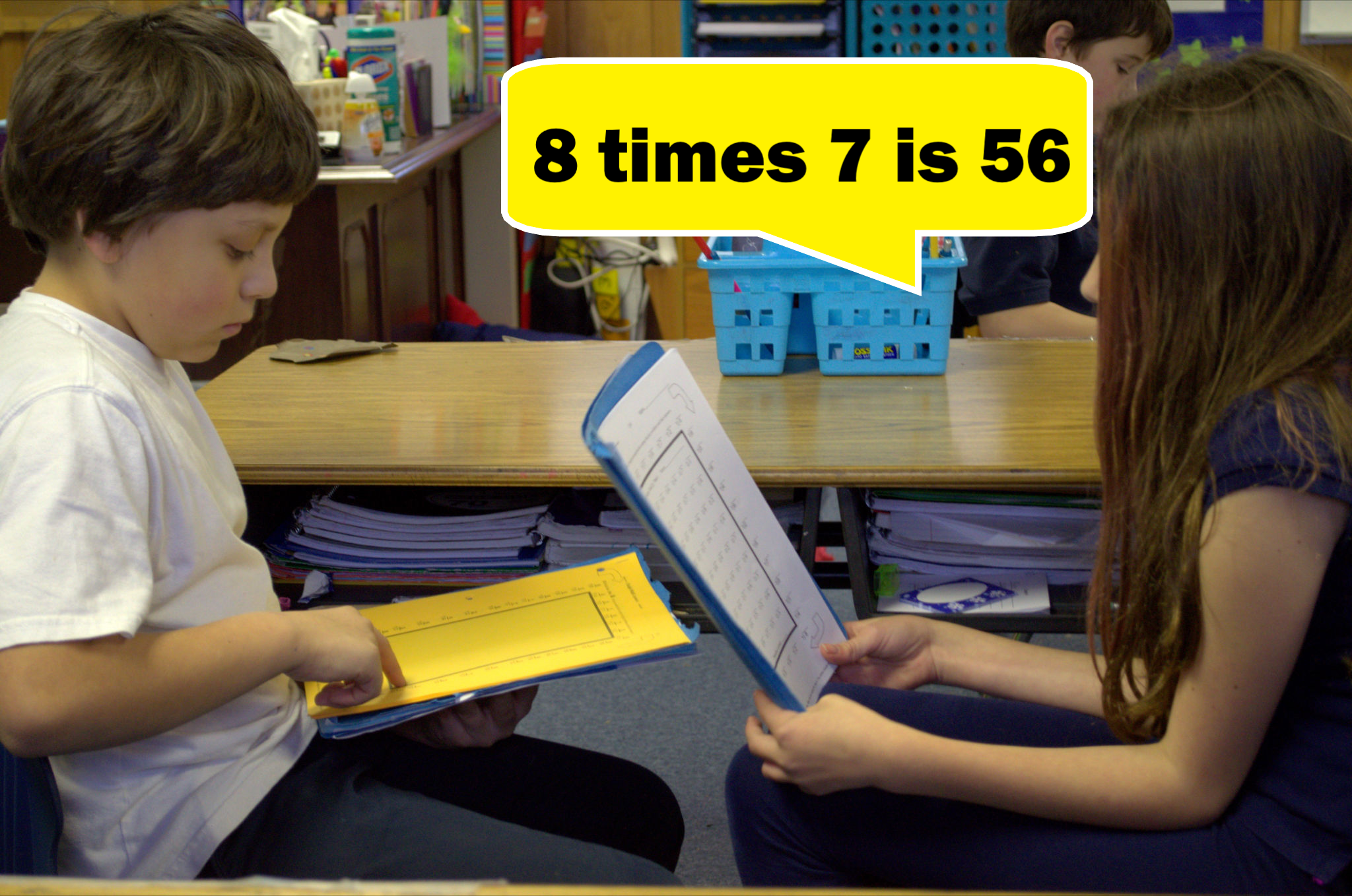
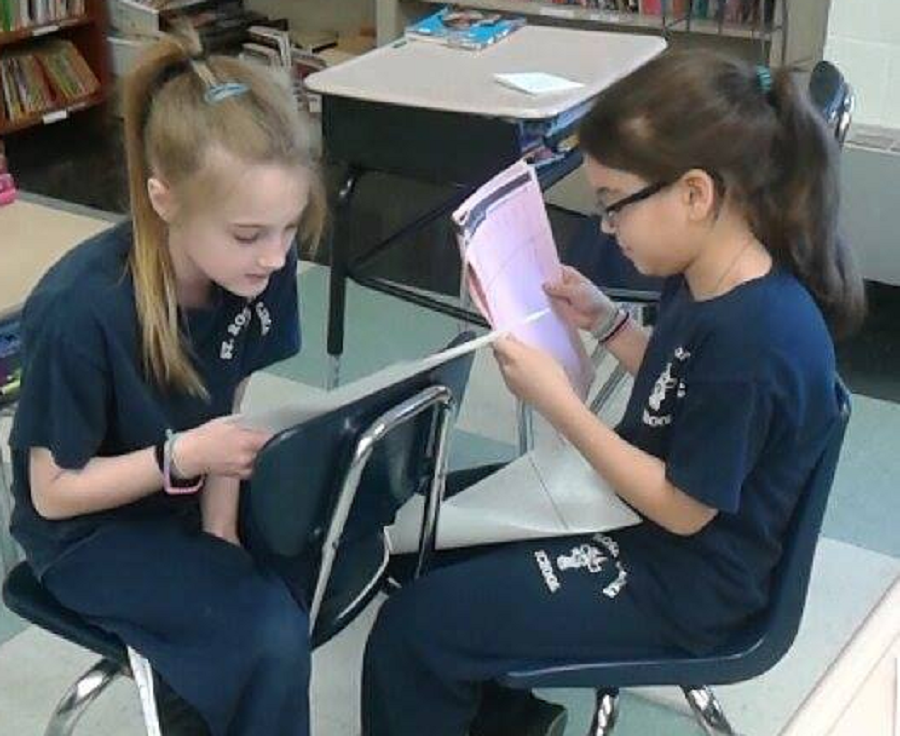
Two students participating in one of Rocket Math's math fluency programs

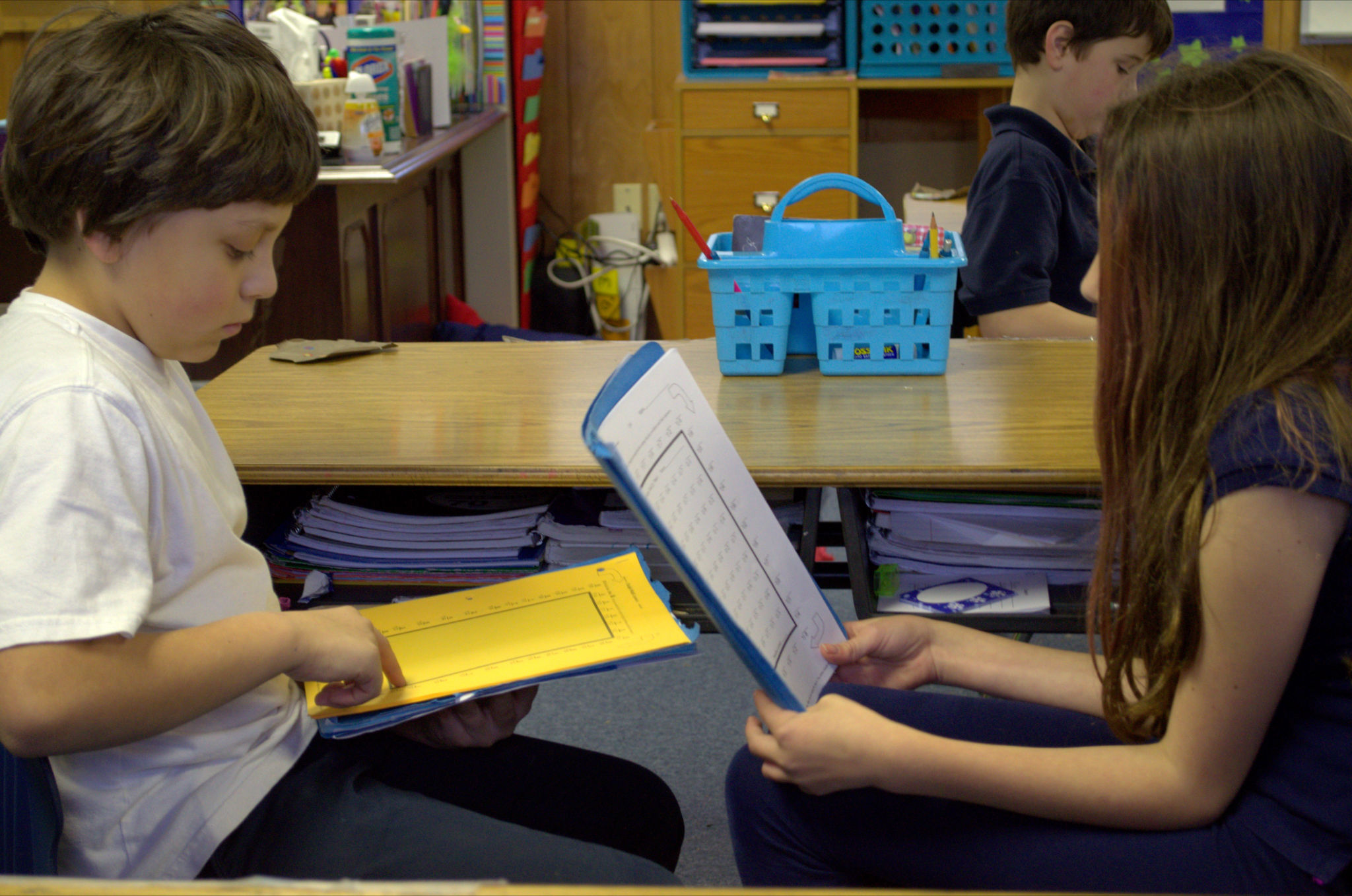
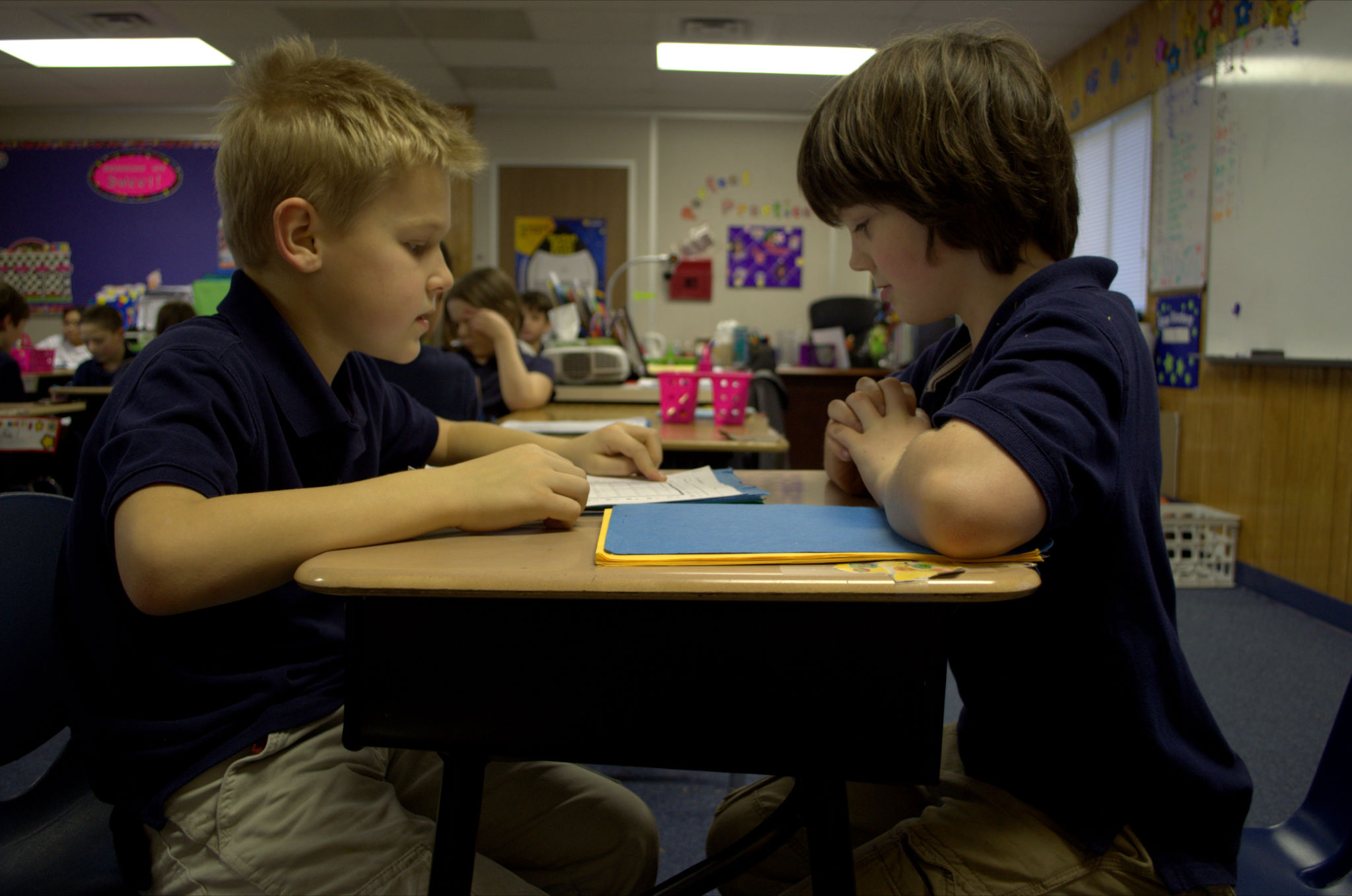
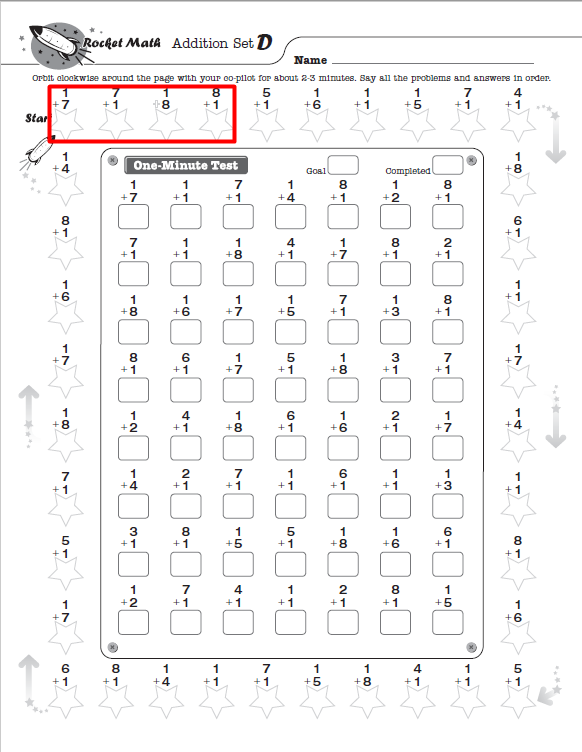
The Rocket Math Worksheet Program improves upon this concept by using paired practice and saying facts aloud. Students partner up and practice quickly recalling facts together. One student asks the questions and watches for when their partner hesitates to answer. He or she then gives his or her partner more opportunities to practice any fact that isn’t coming to mind instantly.

The students switch roles, and after both have answered questions, they then take a one minute test on the facts that they have learned so far. If students are answering as fast as their fingers will carry them, then they pass the level and move on to the next worksheet in the sequence.

Ten minutes of practice every day gets the job done, especially when paired with using these facts in higher level math problems.

Teaching Math Fact Fluency with Games
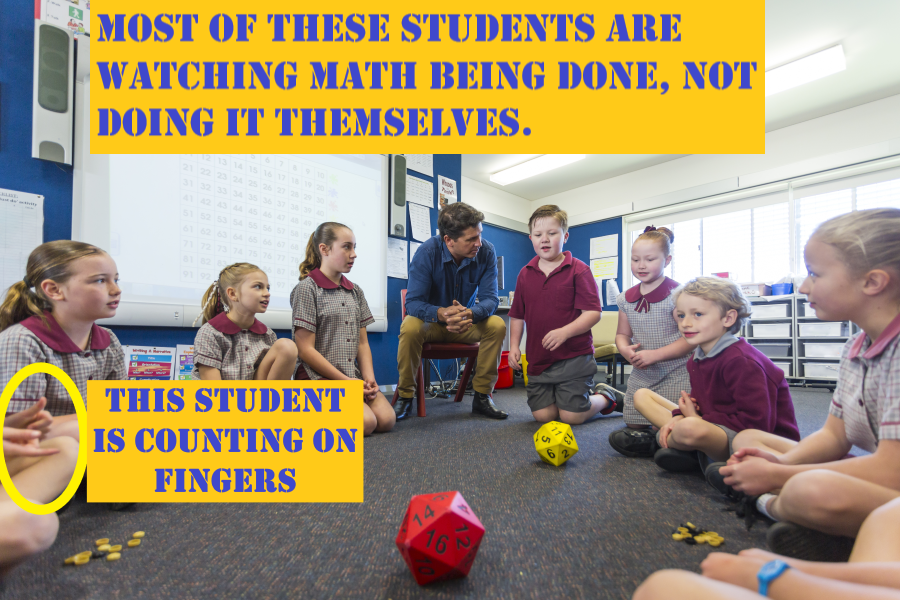
Students and teacher playing multiplication games with dice sitting in a circle in a classroom

In addition to worksheets, schools of education tell teachers to use games to “teach” math facts. Unfortunately, most games and fun activities do not actually help individual students learning math facts to the level of fluency. These games, such as bingo or dice, have several fallouts:

  • Students spend most of their time waiting for their turn rather than practicing facts.
  • The games do not focus on teaching a small group of facts in a manner that helps students commit them to memory.
  • The games do not adjust to an individual student’s level of fluency.
  • Students can pace the game slowly enough to have time to figure out facts rather than requiring recall.
  • It is difficult to keep every student engaged, as those who are behind are less likely to participate.

Using the Rocket Math Online Game as an Effective Way to Teach Math Fact Fluency
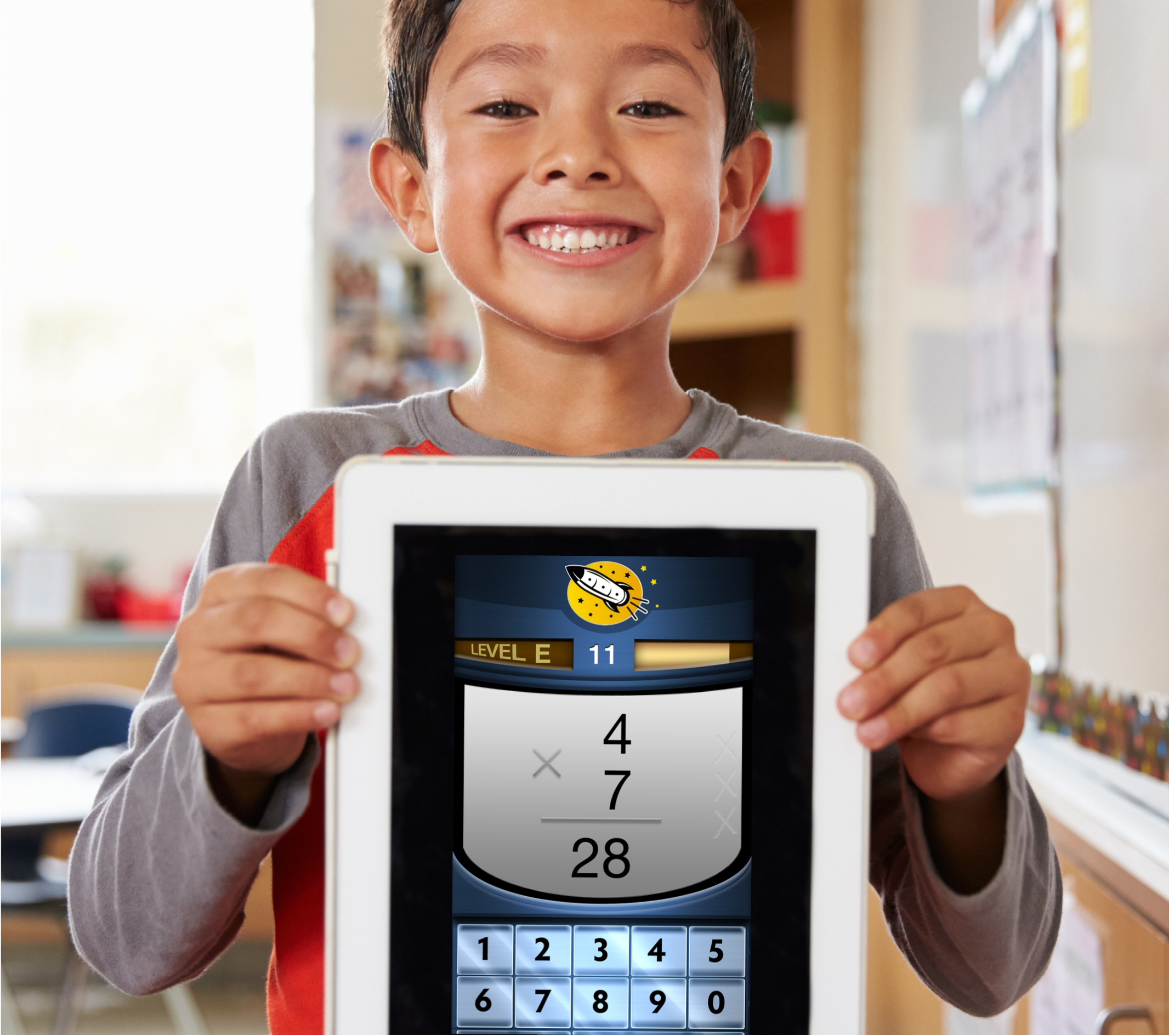
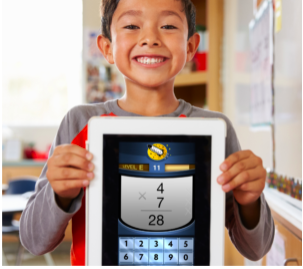
asian child holding tablet with a math fact fluency app by Rocket Math

There are games that are very effective at building math fact fluency. Games such as the Rocket Math Online Game have several important features that make a big difference.

  1. Every student is engaged in answering math facts—not waiting for a turn.
  2. Students learn only a few new facts at a time so that they can remember them.
  3. The game provides lots of focused practice on each set of facts. 
  4. The game requires students to answer quickly, which guarantees the students recall the answer rather than “figuring it out” over and over.
  5. The game gives an immediate correction and extra practice on any facts that students cannot answer quickly and correctly.
  6. The game only introduces new facts once students demonstrate mastery of facts learned so far.
  7. The game gives students explicit feedback so they have a sense of accomplishment as they work their way through an operation.

Math Fact Fluency Benchmarks

The following benchmarks are reasonable expectations for a school that has an effective math fluency program in place. Of course, a student cannot write math facts any faster than they can normally write, so take that into account when looking at fluency benchmarks. Adjust the benchmarks for students who do not write quickly.

Kindergarten Numeral Writing Fluency Benchmarks (digits)

Start of Year Mid-Year End of Year
  20 digits per minute 40 digits per minute
 

First Grade Numeral Writing Fluency Benchmarks (digits)

Start of Year Mid-Year End of Year
40 digits per minute 60 digits per minute 60 digits per minute
 

First Grade Math Fact Fluency Benchmarks (problems per minute)

Start of Year Mid-Year End of Year
Addition: 12 per minute Addition: 25 per minute Addition: 25 per minute
 

Second Grade Math Fact Fluency (problems per minute)

Start of Year Mid-Year End of Year
Addition: 25 per minute                      Addition: 30 per minute                      Addition: 30 per minute
  Subtraction: 12 per minute Subtraction: 25 per minute
 

Third Grade Math Fact Fluency Benchmarks (problems per minute)

Start of Year Mid-Year End of Year
Addition: 30 per minute Addition: 30 per minute Addition: 30 per minute
Subtraction: 30 per minute Subtraction: 30 per minute Subtraction: 30 per minute
  Multiplication: 30 per minute Multiplication: 30 per minute
 

Fourth Grade Math Fact Fluency Benchmarks (problems per minute)

Start of Year Mid-Year End of Year
Addition: 35 per minute Addition: 35 per minute Addition: 35 per minute
Subtraction: 35 per minute Subtraction: 35 per minute Subtraction: 35 per minute
Multiplication: 35 per minute Multiplication: 35 per minute Multiplication: 35 per minute
  Division: 20 per minute Division: 35 per minute
 

Fifth Grade Math Fact Fluency Benchmarks (problems per minute)

Start of Year Mid-Year End of Year
Addition: 35 per minute Addition: 40 per minute Addition: 40 per minute
Subtraction: 35 per minute Subtraction: 40 per minute Subtraction: 40 per minute
Multiplication: 35 per minute Multiplication: 40 per minute Multiplication: 40 per minute
Division: 35 per minute Division: 40 per minute Division: 40 per minute

Math Fact Fluency Assessment

Use this printable packet of free math fact fluency assessments to test your students’ skill levels relative to  the above benchmarks. This will give you a clear idea of your students’ fluency and where there is room for opportunity.

Rocket Math’s assessment packet includes a writing speed test, which helps create realistic expectations for individual students. Using the goal sheet ensures you will evaluate the individual student math fact fluency in light of their writing speed.

Rate students as:

  1. Weak, needs fact work
  2. Good, but fact work could help
  3. Strong, fact work not needed

Special triage priority: if you have fourth-grade students and above, start with multiplication facts. Multiplication facts are essential to future success in math above fourth grade. Even if fourth graders are counting on their fingers for addition and subtraction, teach multiplication mastery first. If fourth graders move to the next grade without strong multiplication fact fluency, they will have a hard time successfully progressing through math.

The Best Tools for Developing Math Fact Fluency
With the right tools, any student can develop math fact fluency and have fun while doing it! Students use Rocket Math’s Subscription Worksheet Program to practice with partners, then take timed tests. Rocket Math also offers math facts practice online through the Rocket Math Online Game. Students can log in and play from any device, anywhere, any time of day! Start a free trial today. 

Both the worksheet program and the online game help students master addition, subtraction, multiplication, and division math facts for a lifetime of success in math.




Rocket Math Teaches Math Facts Fast!

Do your students struggle to complete their timed math worksheets? Is your classroom a sea of finger-counting during fast math facts practice?

Your students aren’t the problem. It’s your teaching technique that’s hindering progress.

Help your students learn math facts quickly and gain confidence in their skills with Rocket Math’s research-based program. The program works because it teaches memorization through multiple, evidence-based techniques that work for all types of learners.

Why Faster Is Better

learn math facts fastLearning math facts at a young age plays a key role in a student’s ability to succeed throughout their education as well as out in the real world.

Not only does math fact memorization serve as a foundation to other math skills, but it also plays a part in motivating student. Most children will feel a sense of pride and excitement when they recognize their ability to quickly recall math facts.

Once a student develops instant recall, math assignments become easy and fast. It enables students to easily recognize many things about numbers that teachers call “number sense.” It gives them confidence. And frankly, they like going fast much better. This makes teaching and learning math far more enjoyable!

Fortunately, almost every child is capable of memorizing math facts in such a way that allows them to call upon them instantly and painlessly. The problem is, many traditional forms of teaching math facts are not effective.

The Problem with Traditional Teaching Techniques

When I was a teacher, I found myself frustrated with the ineffectiveness of traditional teaching tools – specifically when it came to teaching math facts. Repetition, counting, and endless worksheets seemed to leave students discouraged. These old techniques were not taking into account a few simple facts about memorization.

A More Effective Approach to Teaching Fast Math Facts

To help your students memorize math facts effectively, you need to consider five things:

  1. How many math facts to introduce in one session
  2. How fast a student can answer individual math facts
  3. How fast a student can answer multiple math facts
  4. When to introduce new math facts
  5. How often a student practices

1. Introduce a small number of math facts in one session

In grad school, I learned a simple fact about memorization that changed the way I look at teaching math facts: the brain can only process a handful of facts at a time. This fact has shaped a foundational part of Rocket Math, the math fact program I developed to help students effectively learn their math facts.

learn math facts on bite at a timeWhen students are presented with too many facts – perhaps on a worksheet – the brain will not even begin to attempt remembering. Instead, it has been found that when small groups of facts are presented and practiced, the brain can easily absorb the new information.

Rocket Math uses this knowledge to help students learn much faster and gain confidence in their math skills. Rocket Math only presents two math facts and their reverse facts at a time. This simple trick makes a world of difference. As the saying goes: “How do you eat an elephant? One bite at a time . . .”.


2. Help Students Quickly Recall Individual Math Facts

There is a common misconception among teachers and parents that struggling to remember an answer is valuable. Picture the child scratching his head as he racks his brain for the right answer. Unfortunately, this is not an effective way to teach math. In order to strengthen the neural connections that are involved in memorization, recalling the correct answer quickly is key.

When students are forced to rework the problem in their head multiple times, it does nothing for their recall abilities. That is why rather than having the student guess multiple times, Rocket Math uses a correction tool that immediately reminds students of the right answer if at first, they answer either slowly or incorrectly. This helps to build the memory as they are reminded over and over of the right answer.

3. Practice a Series of Math Facts Quickly for Easy Recall

child learning math facts with memorizationOnce a child has practiced calling to mind a handful of math facts, it is time to practicing recalling them, making sure they can do so quickly. Recalling facts can be done at a high speed, whereas figuring out math facts you can’t recall can take a long time.  That is why practicing fast recall is important. Repeatedly recalling fact will strengthen a student’s memory while offering a fun challenge. If the student can’t recall the math facts quickly they may need extra help from the teacher to learn the facts before continuing with quick recall practice.

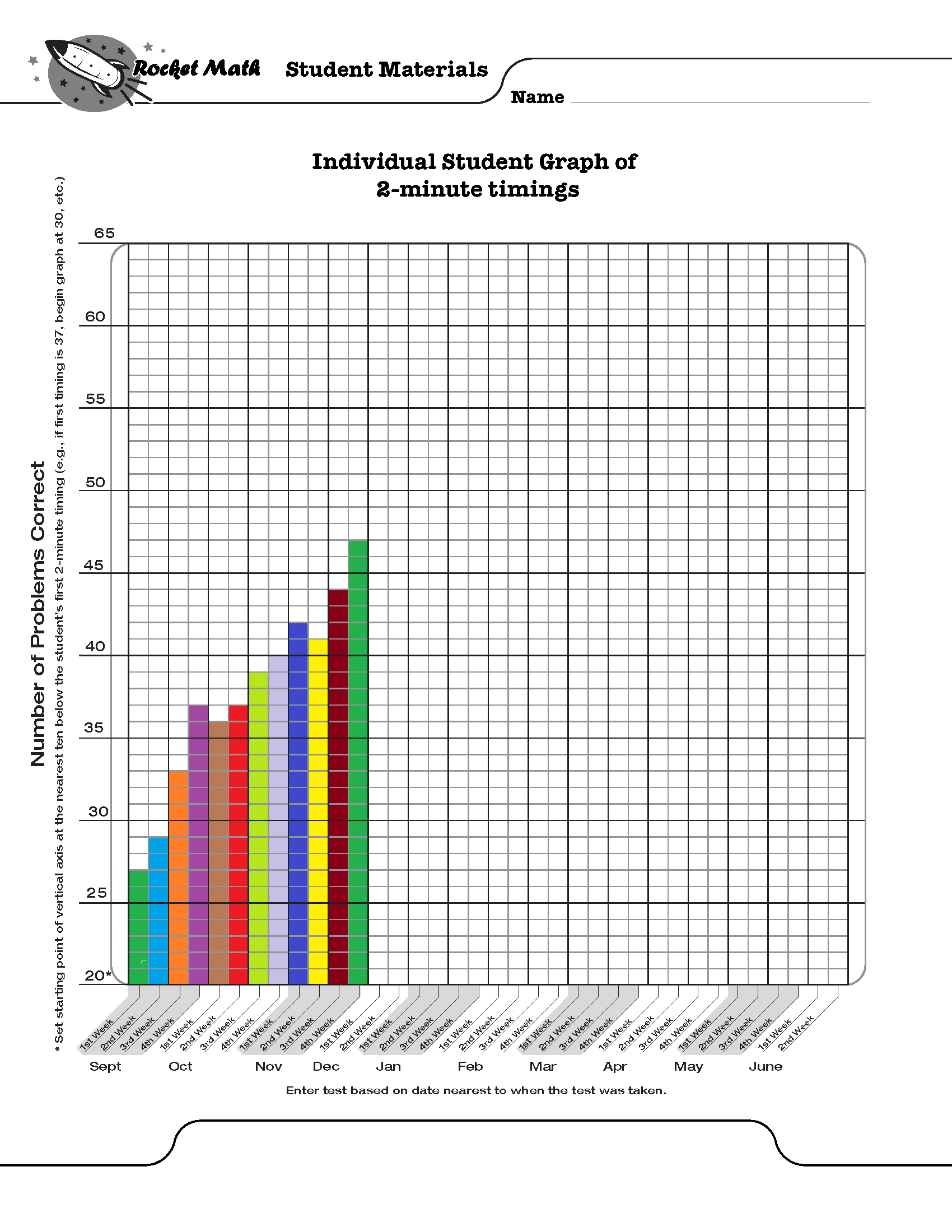
Rocket Math only has students practice for a few minutes at a time, as that is all is needed when quickly recalling math facts. To measure progress, Rocket Math utilizes 2-minute timing exercises every couple of weeks to see how well students are able to recall math facts. Our free fluency tests are also a great assessment tool for testing student knowledge. 

4. Carefully Build Math Fact Fluency

Teachers should be thoughtful of the rate at which they introduce new math facts. Before adding more groups of facts, previously learned facts should be well mastered. A student is ready for another handful of facts when they can recall their current set without hesitation. At first, it may seem like this approach will take longer, but because of the efficiency of memorization, students will move quickly through lessons and build math fact fluency with ease.

5. Practice Math Facts Daily for Long-Lasting Fluency

Because there are so many math facts to learn it is important to start children early and to practice daily. This gives students a chance to learn all of the math facts within all four operations. Spreading facts out over time and including daily practice throughout elementary school years will greatly improve a student’s foundational math skills.

Rocket Math: A Modern Approach to Teaching Math Facts

Rocket Math’s research-based program incorporates these modern teaching techniques to help young learners master math facts fast. With the program, recalling math facts becomes easy and enjoyable. It also sets students up for continued success throughout their education.

Learn more about using Rocket Math’s subscription worksheet program in the classroom and the online math fact game.

Math Worksheets for Kindergarten, 1st, 2nd, 3rd, 4th grade+

Rocket Math worksheets are a great way to teach math facts to children of all ages – starting as early as kindergarten when students begin learning how to count and read and write numbers. The many learning tracks available in the Worksheet Program are designed for daily practice to build a solid foundation of basic math skills.

The learning tracks of the Universal Level Worksheet Program follow a simple structure and routine to help students progress at an appropriate rate throughout their different grade levels. Throughout the sequence, students learn the underlying skills necessary to be successful in any math curriculum throughout elementary and middle school. While Rocket Math Worksheets are not a complete math curriculum, they develop all the skills that are assumed, but seldom taught well in elementary math curricula. 

If you have students behind for their grade level, our worksheet program makes it easy for you to revisit previous lessons that will reinforce the concepts necessary to move forward. Likewise, plenty of learning tracks within the program keep advanced students engaged.

Kindergarten Math Worksheets

Beginning Numerals (Counting) Learning Track

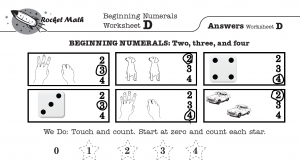
Rocket Math kindergarten math worksheets beginning numerals Worksheet DThis is a beginning program for kindergarten students.  It teaches them to count objects aloud and then match the word with the numeral. Please note: Unlike most math worksheets learning tracks, this program is teacher-directed rather than peer teaching. 

Each worksheet begins with a demonstration of counting objects and circling the numeral that matches. On Worksheet A, students only need to learn numbers two and three. First, the teacher demonstrates (best with a document camera so all students can see) how to count the objects and then points out that the answer has a circle around it.  In the “We do” portion of the worksheet, the teacher counts the stars first as a demo and then with the students. For Worksheet A, just count 3 stars. By Worksheet S, the teacher and the students are counting 12 stars together. In the “You do” portion, the students independently complete tasks like the ones demonstrated by the teacher at the top of the worksheet.  By the end of this learning track, kindergarteners can consistently count objects, lines, dots, and fingers up to 12 and identify the corresponding numeral.

Conceptual Addition (Counting On) Learning Track

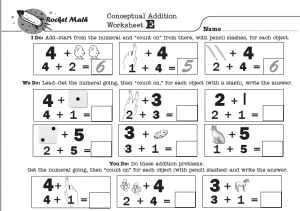
Rocket Math kindergarten worksheets Conceptual Addition (Counting On) Worksheet

Conceptual Addition is a teacher-led exercise, rather than peer teaching. Each worksheet begins with an “I Do” portion that is a teacher-modeled demonstration. “I Do” is followed by a “We Do” portion where the teacher leads the students in doing the problems together. The last portion is called “You Do,” which students should be able to complete independently following teacher instruction and modeling.

For the first four worksheets, the objective is to count all the objects in two groups to find the sum. When modeling, teachers should slash the objects with a pencil while counting. Students should do the same. The answer keys show the objects slashed. Starting in Set E, counting exercises no longer begin at one nor progress one by one. Students learn the concept of “counting on.” “Counting on” means to start with a number such as “4” and “count on” from there (five, six, and so on). Students also learn the concept of adding two to four by starting with four and “counting on” two more.

Rocket Writing for Numerals Learning Track

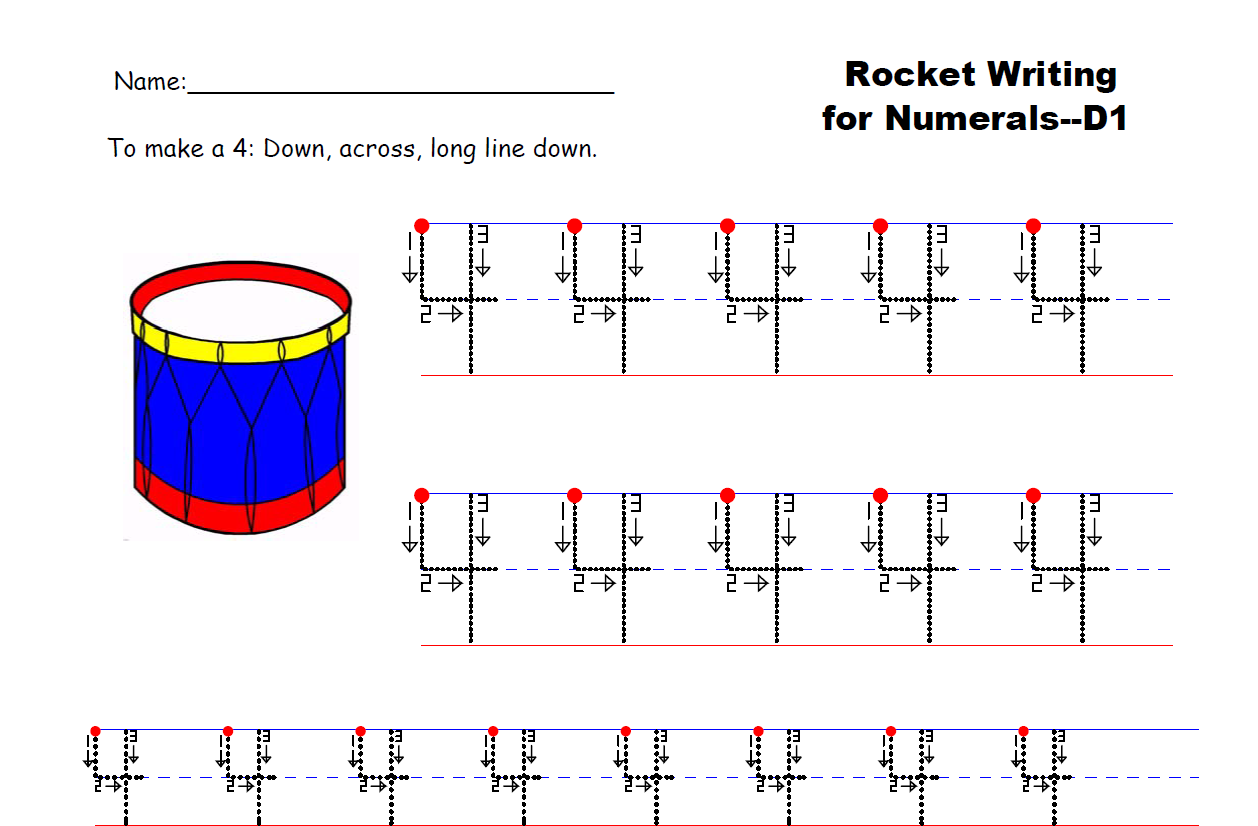
Rocket Math kindergarten math worksheets Rocket Writing for Numerals

One of the most important math-related skills for kindergarteners is to learn how to write numerals properly. It is important for children to learn the most efficient way to write numerals. This skill is the first building block to learning math.  

Rocket Writing for Numerals is a 72-page learning track for students to learn how to write the numerals efficiently. This program begins with how to write numerals and continues until students can write 40 digits in a minute. It is part of the Rocket Math Universal Worksheet Program and is designed to be practiced on a daily basis.

1st Grade Math Worksheets

If students in first grade cannot write numerals legibly and efficiently, they should begin the year with Rocket Writing for Numerals. If students have not learned the concept of what it means to add in kindergarten with the Conceptual Addition learning track, that is recommended. Once they understand the concept of addition, first graders are ready to begin memorizing addition facts.  

Addition 0 through 9s Learning Track

Rocket Math 1st grade math worksheets Addition 0 through 9s


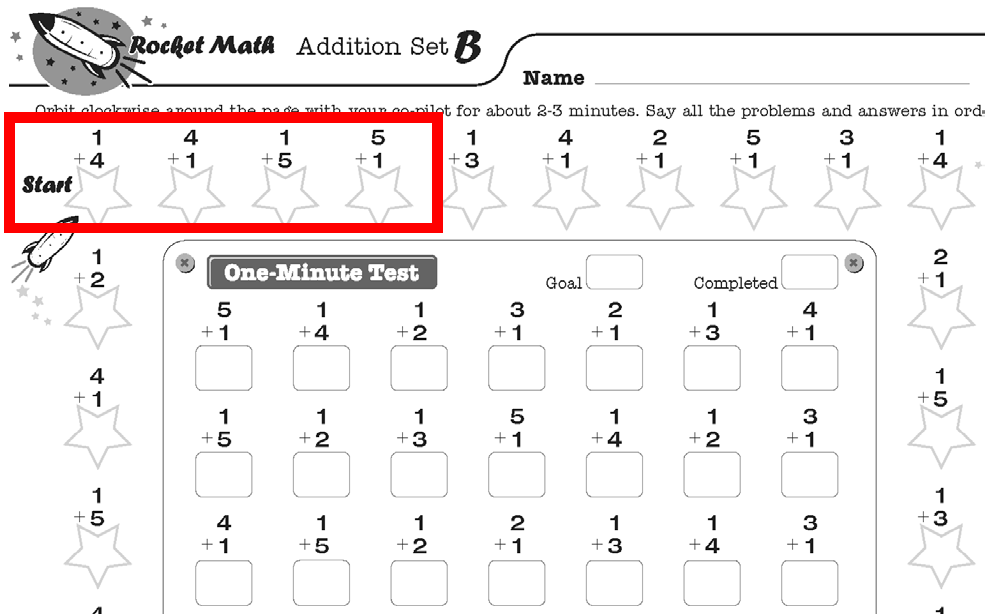
The Rocket Math Worksheet Program includes Addition 0 through 9s. Students work through 26 levels (A to Z) learning two facts and their reverses on each level. For this learning track, like most of the learning tracks, students practice orally for 2 minutes with a partner who corrects any hesitations or errors.  The students then switch roles and practice again, followed by a 1-minute daily test to see if they are ready to move on to the next worksheet. For peer teaching like this to be effective, the teacher will need to teach their students how to practice and how to correct errors. Here’s a blog on how to best manage peer teaching.  

Add-Subtract Fact Families to 10 Learning Track

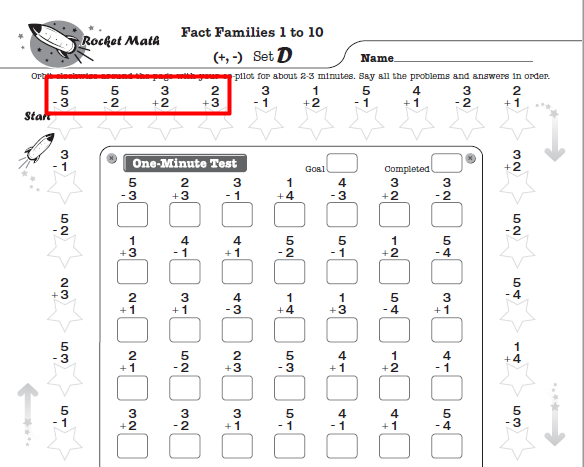
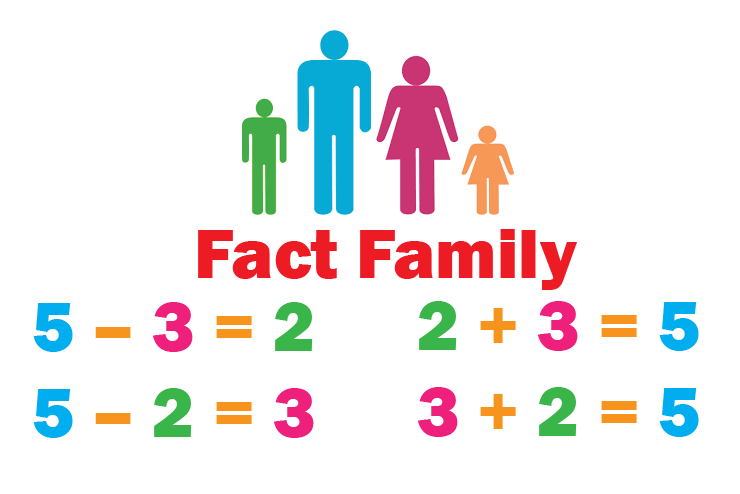
Rocket Math 1st grade math worksheets Fact Families 1 to 10Alternatively, once students have learned the concepts for both addition and subtraction, they can begin to learn fact families. Our Add-Subtract Fact Families to 10 worksheet program begins teaching fact families. For example, Set D of this worksheet (pictured) teaches the four related math facts of a fact family such as 3+2, 2+3, 5-2, and 5-3.
Addition-Learning Computation Learning Track

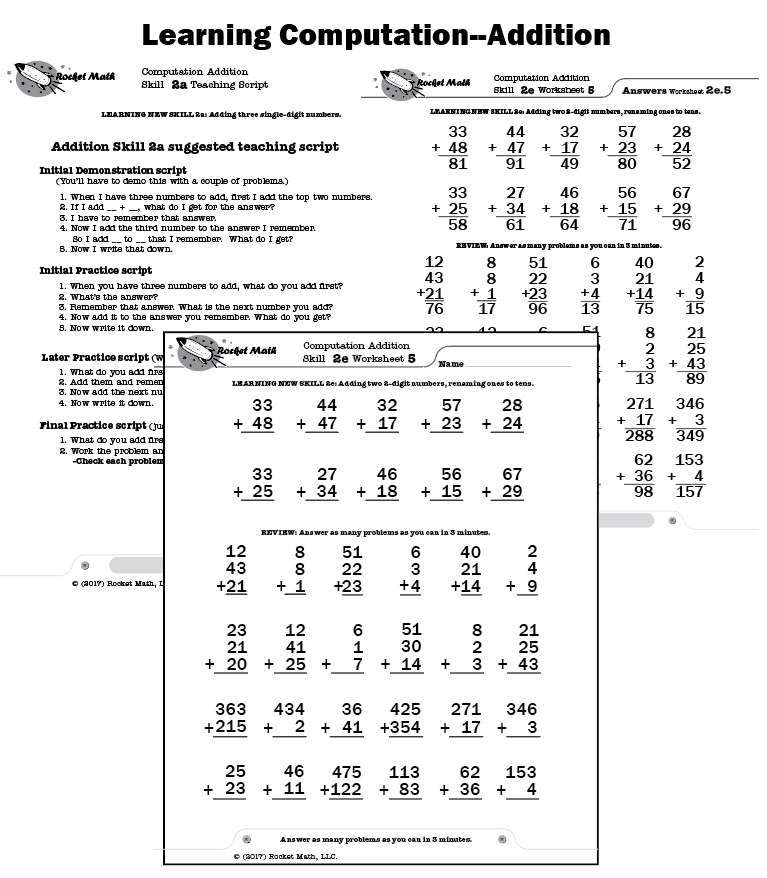
Addition-Learning Computation WorksheetOnce students master addition math facts, they need to learn how to do multi-digit addition problems, such as adding 35 + 48. Teachers can start their students on the Addition-Learning Computation learning track. This learning track extends computational skills in addition up to the 4th grade. It is teacher-directed and includes suggested scripts for tutoring or small group instruction. There is an assessment to determine where to begin, although, for first-grade students, it is at the beginning. 

Add to 20 Learning Track

Common Core suggests that students be fluent with addition math facts up to 20, such as 13+6=19. Rocket Math’s Universal subscription includes an Add to 20 learning track.

2nd Grade Math Worksheets

Upon starting second grade, students should have mastered all of the addition math facts. If they have not mastered those facts, teachers should have students start with the first-grade worksheets until they are ready to move forward.

Subtraction 0 through 9s Learning Track

Rocket Math 2nd grade math worksheets Subtraction 0 through 9s

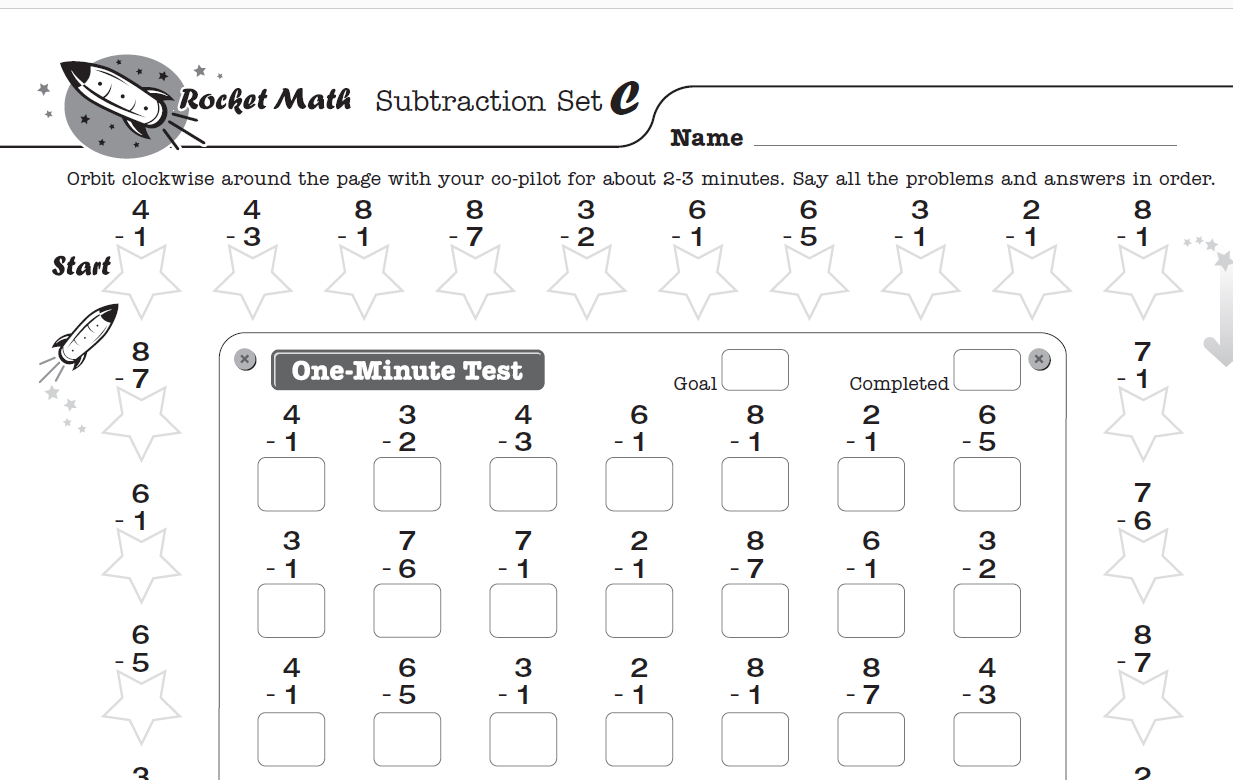
Once students master the first-grade level learning tracks, second-grade students go on to memorize subtraction facts in the Subtraction 0 through 9s learning track. For this learning track, like most of the learning tracks, students practice orally for 2 minutes with a partner who corrects any hesitations or errors.  The students then switch roles and practice again, followed by a 1-minute daily test to see if they are ready to move on to the next worksheet. For peer teaching like this to be effective, the teacher will need to teach their students how to practice and how to correct errors. Here’s a blog on how to best manage peer teaching.  

Subtraction-Learning Computation Learning Track

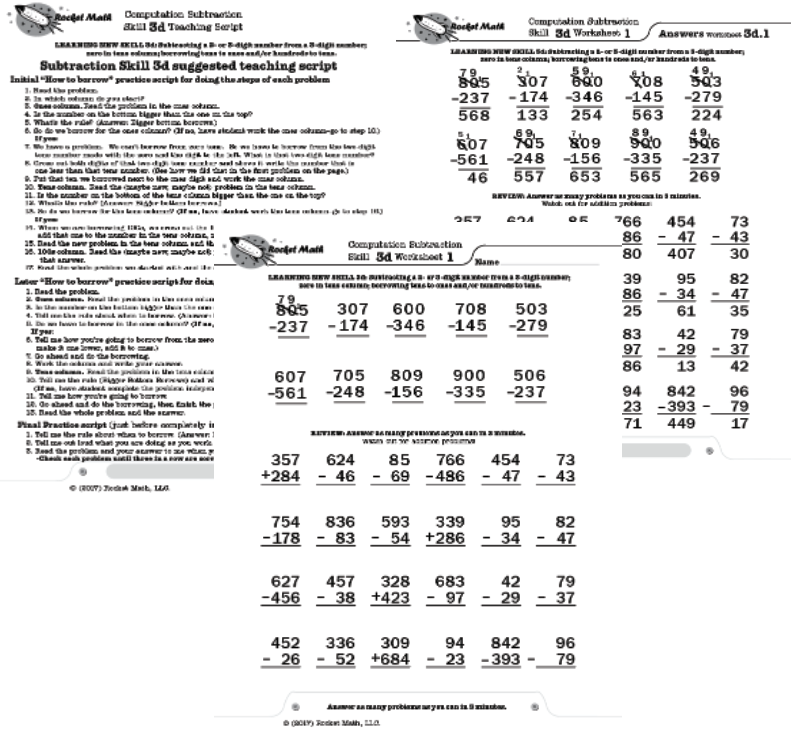
Subtraction-Learning Computation WorksheetTypically, second graders should be proficient in subtraction and addition by the end of the year. Once students master subtraction math facts, students need to learn how to do multi-digit subtraction problems such as 62 – 48. Teachers can start their students on the Subtraction-Learning Computation learning track. The program helps students learn re-grouping (a.k.a. “borrowing”). This learning track extends computational skills in subtraction up to the 4th grade. It is teacher-directed and includes suggested scripts for tutoring or small group instruction. There is an assessment to determine where to begin, although, for second-grade students, it is at the beginning. 

Add-Subtract Fact Families 11 to 18 Learning Track

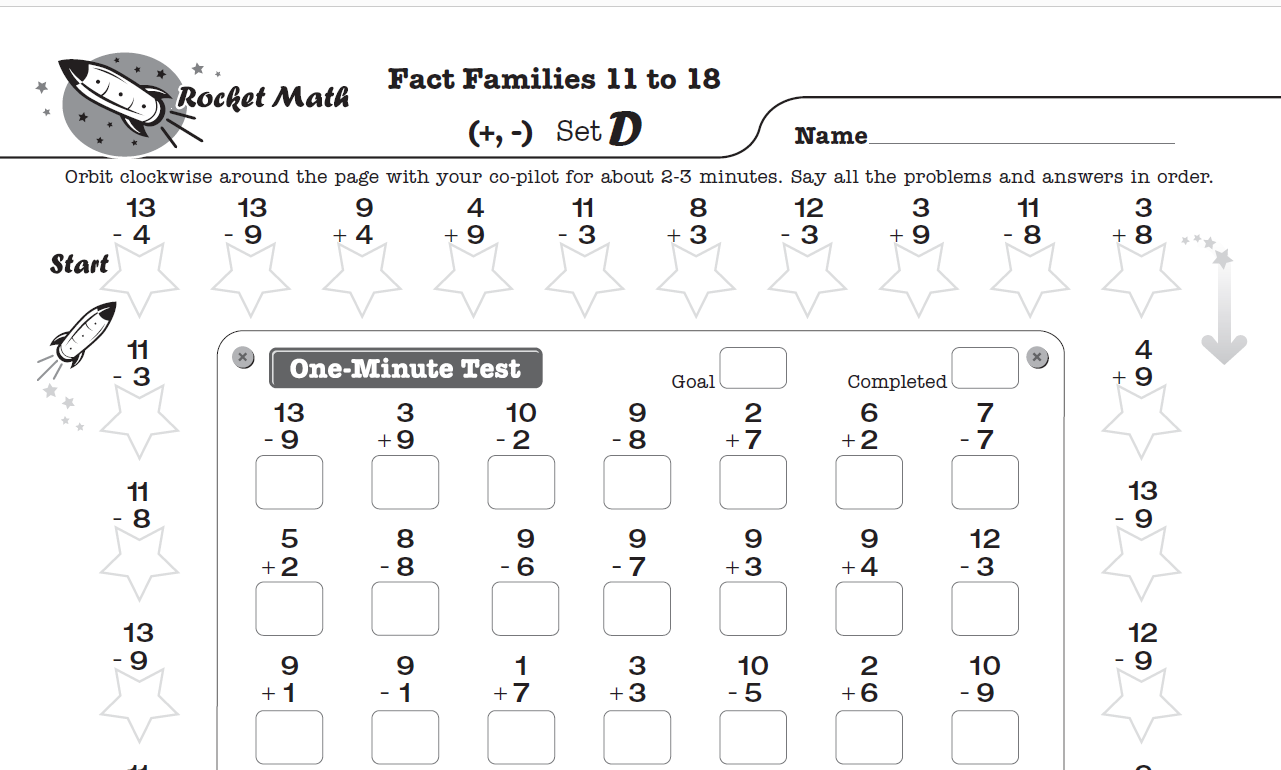
Rocket Math 2nd grade math worksheets Fact Families 11 to 18

If students have been using the Fact Families Program in first grade, it is best to continue using that sequence. Second graders should be ready for Add-Subtract Fact Families 11 to 18. The last ten levels of this program review all the fact families, allowing students to master addition and subtraction by the time they reach Level Z.

Subtract from 20 Learning Track

Common Core suggests that students be fluent with subtraction facts up to 20, such as 19-6=13. Rocket Math has made available a program, Subtract from 20, so students can practice these facts.

 3rd Grade Math Worksheets

The priority for third grade is to learn the concept of multiplication and then memorize those facts. Textbooks typically begin teaching the concept of multiplication from very early in 3rd grade.

Conceptual Multiplication Math Learning Track

Rocket Math 3rd grade math worksheets Conceptual Multiplication

Conceptual Multiplication is a learning track to teach the concept of multiplication. It is based on skip counting or count-bys. However, in this learning track, students can read all the count-by series except the last number, making it unnecessary for students to have memorized the skip counting sequences to do this learning track.

For this learning track, like most of the learning tracks, students practice orally for 2 minutes with a partner who corrects any hesitations or errors.  The students then switch roles and practice again, followed by a 1-minute daily test to see if they are ready to move on to the next worksheet. For peer teaching like this to be effective, the teacher will need to teach their students how to practice and how to correct errors. Here’s a blog on how to best manage peer teaching.  

Conceptual Multiplication is essential for students who have not been introduced to multiplication in their regular math curriculum but are otherwise ready to start memorizing multiplication facts. Students do NOT need this learning track if they can determine the answer to any multiplication fact when you ask them, for example, “What’s seven times eight?” If they can figure out the answer to that question, they already understand the concept of multiplication and can go on to memorizing.

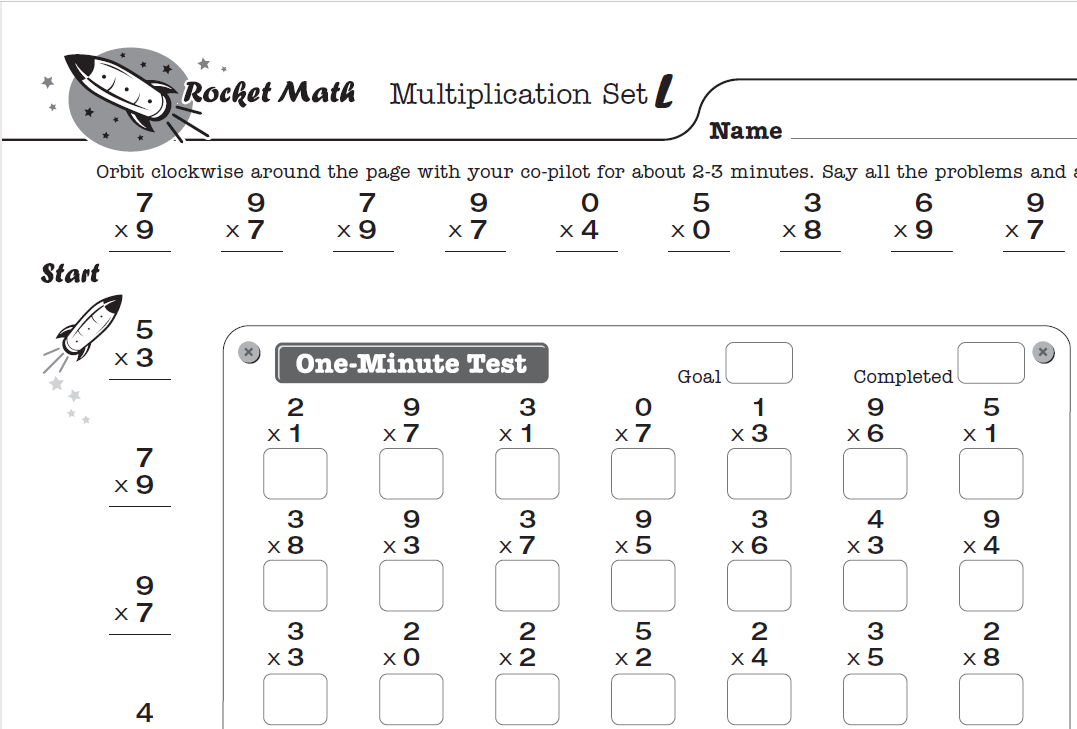
Rocket Math 3rd grade math worksheets Multiplication Worksheet

Multiplication (0 through 9s) Learning Track

The Rocket Math Multiplication (0 through 9s) Learning Track builds strong multiplication fact fluency and recall. This learning track prevents the problem of students having to look up facts in times tables repeatedly. 

Achieving mastery of multiplication facts is the only way for students to keep up in math throughout elementary and middle school. Even if students come to you without having a solid foundation in addition and subtraction facts, your top priority must be to help students develop fluency in multiplication facts before they leave you.

Multiply-Divide Fact Families to 20 Learning Track

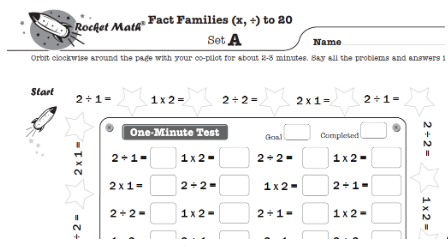
Fact Families to 20 WorksheetAlternatively, once students have learned the concepts for both multiplication and division, they can begin to learn fact families. Our Multiply-Divide Fact Families to 20 worksheet program begins teaching multiplication and division fact families. For example, Set A of this worksheet (pictured) teaches the four related math facts of a family:  2÷1=2, 1×2=2, 2÷2=1, and 2×1=2.
Identifying Fractions Learning Track

Identifying Fractions Worksheet

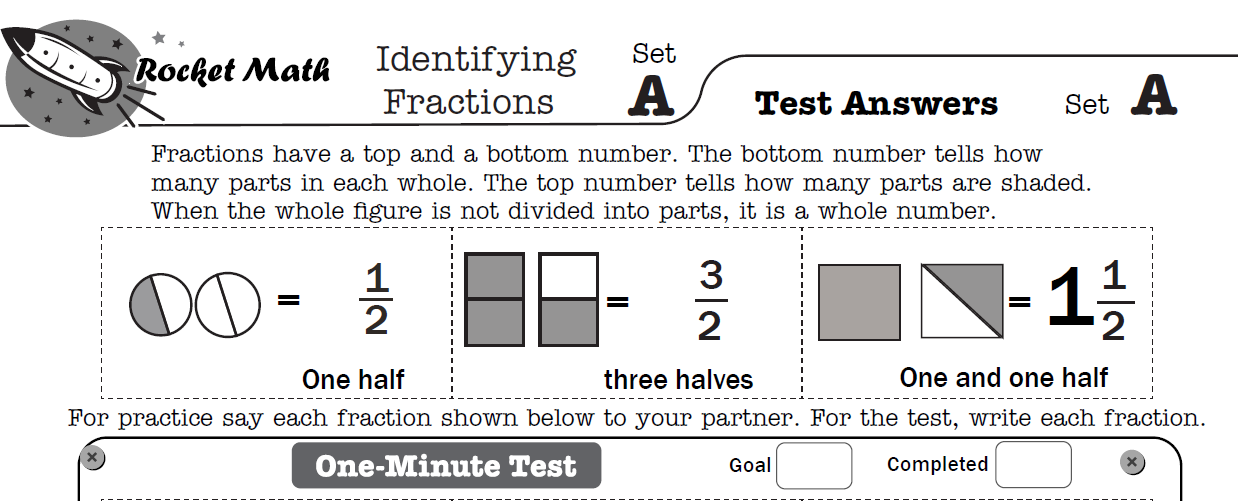
For quick-learning students, who get through the basic learning track before the end of the year, an excellent supplemental Rocket Math Worksheet Program is the Identifying Fractions learning track. This is appropriate any time from third grade up through fifth.  This learning track teaches students how to identify proper fractions, improper fractions and mixed numbers as you can see in the example above from Set A. It teaches fractions with denominators up to twelfths.  This learning track prevents  the most common misunderstandings about fractions by teaching with carefully selected examples that demonstrate the correct understanding of fractions.

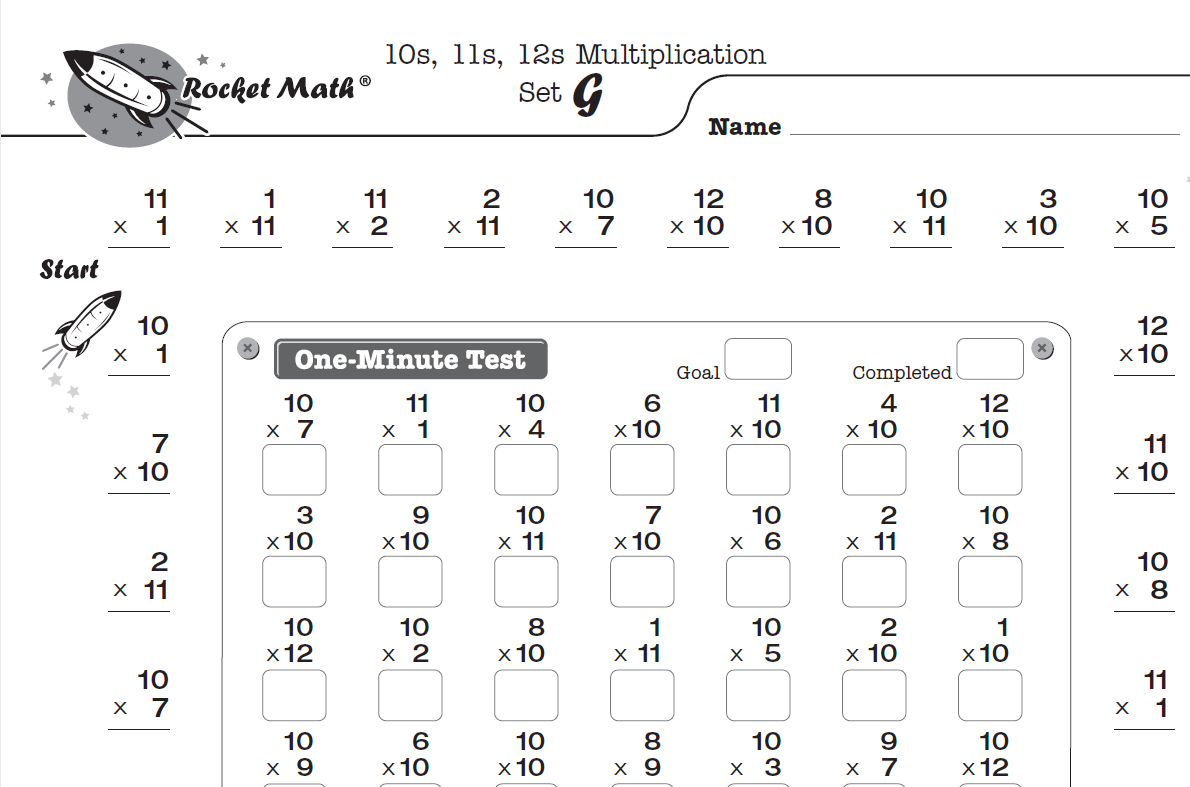
Multiplication 10s, 11s,12s Learning TrackMultiplication 10s, 11s, 12s Worksheet

Multiplication 10s, 11s, 12s. Building upon the facts from Multiplication 1s to 9s, students progress quickly through this next set of facts. And, of course, students consider it a badge of honor to be members of the “tens, elevens, and twelves” club!

Multiplication-Learning Computation Learning Track

Multiplication-Learning Computation WorksheetOnce students master multiplication math facts, they need to learn how to do multi-digit multiplication problems such as multiplying 6 x 37. Teachers can start their students on the Multiplication-Learning Computation learning track. This learning track extends computational skills in multiplication up to the 5th grade. It is teacher-directed and includes suggested scripts for tutoring or small group instruction. There is an assessment to determine where to begin, although, for third-grade students, it is at the beginning. 

 4th Grade Math Worksheets

Upon starting fourth grade, students should have mastered all of the multiplication math facts. If they have not mastered those facts, teachers should have students start with the multiplication worksheets until they are ready to move forward into division. While division facts derive from multiplication, it is valuable for students to learn the division facts explicitly.  

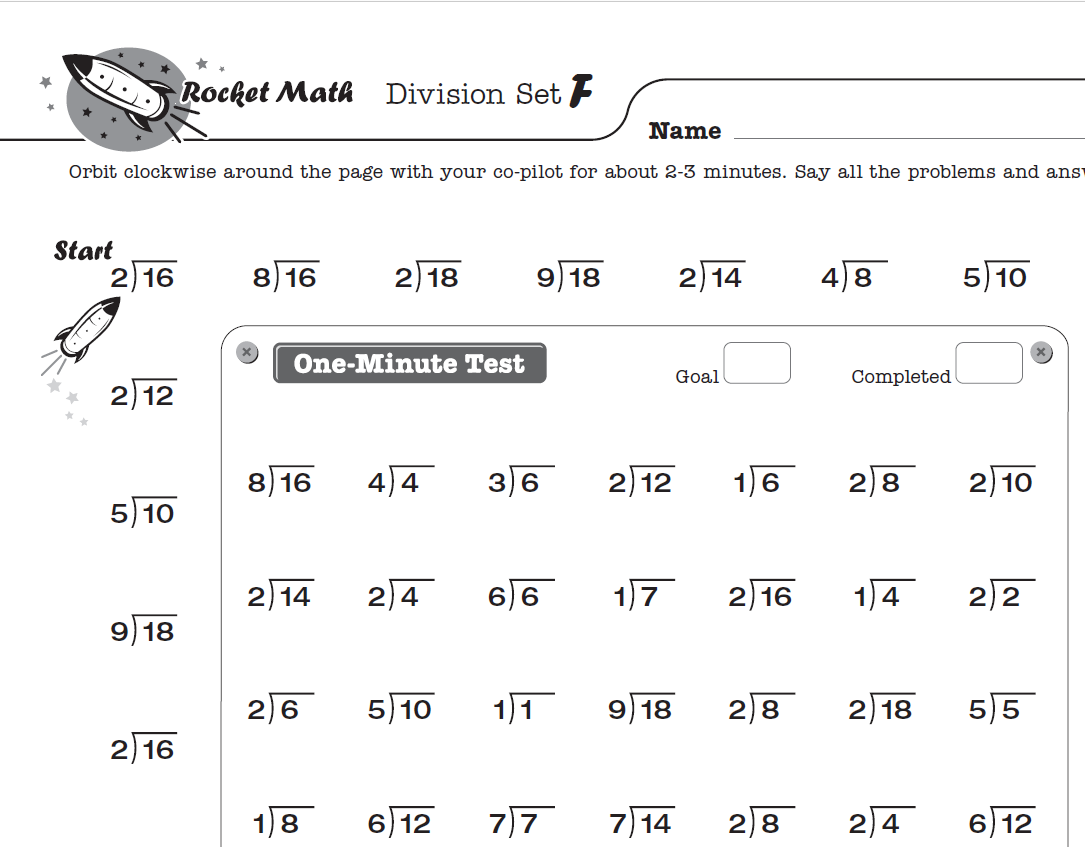
Division 0-9 Learning Track

Division 0-9 Worksheet

Long division comes much easier for students who have learned division facts. Fourth graders should be using the Division 0 through 9s worksheet to learn division facts. By the end of fourth grade, students should have learned all four basic operations of math facts.  

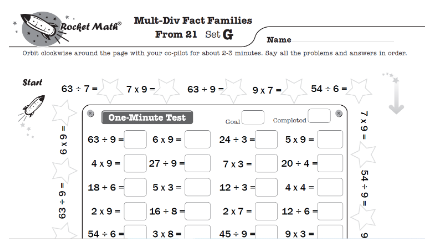
Multiply-Divide Fact Families from 21 Learning Track

Multiply-Divide Fact Families from 21 Worksheet

If students have been using the Multiplication-Division Fact Families Program in third grade, it is best to continue using that sequence. Fourth graders should be ready for Multiply-Divide Subtract Fact Families from 21. The last several levels of this program review all the fact families, allowing students to master all multiplication and division facts by the time they reach Level Z. 

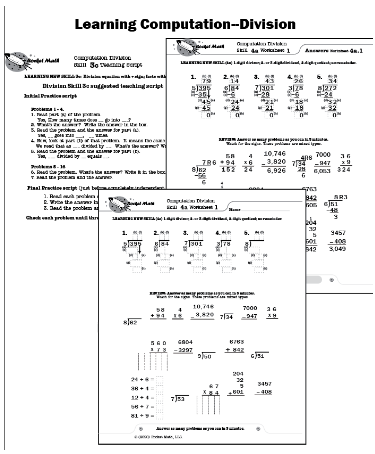
Division-Learning Computation Learning Track

Division-Learning Computation WorksheetOnce students master division math facts, they need to learn how to do multi-digit division problems such as dividing 5 into 395.  Teachers can start their students on the Division-Learning Computation learning track.   This learning track extends computational skills in multiplication up to the 4th grade. It is teacher-directed and includes suggested scripts for tutoring or small group instruction. There is an assessment to determine where to begin. 

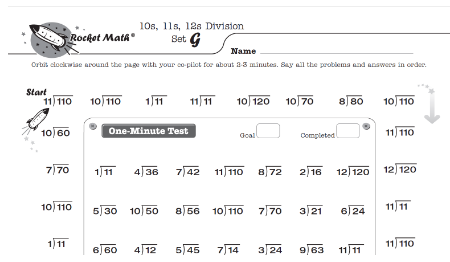
Division 10s, 11s, 12s Learning Track

Division 10s, 11s, 12s Worksheet

There is a supplemental program for students who get through Level Z in basic division: Division 10s, 11s, 12s.  It builds upon and reviews facts from Division 0 to 9s while keeping learning fun for students who learn faster.

 Math Worksheets for 5th grade and up

Students who have been learning math facts since kindergarten have built a great foundation by the time they reach fifth grade. Unfortunately, this is not the case for many students, which makes it difficult for teachers to create lessons suitable for everyone’s level.

Rocket Math provides an easy solution for these teachers. Utilize the worksheet program for ten minutes daily to teach the four basic operations. While these students are catching up, the remaining students can also do Rocket Math!

We offer five learning tracks that teach more advanced pre-algebra math skills that follow the same structure and routine. Each of these five learning tracks includes video lessons that teach students how to use the program and how to do the skill. If students have not done the learning track Identifying Fractions [presented above in grade 3 Worksheet options], we recommend students do that first, before beginning the Pre-Algebra Learning Tracks.  

Pre-Algebra Learning Tracks for Advanced students

advanced math worksheet

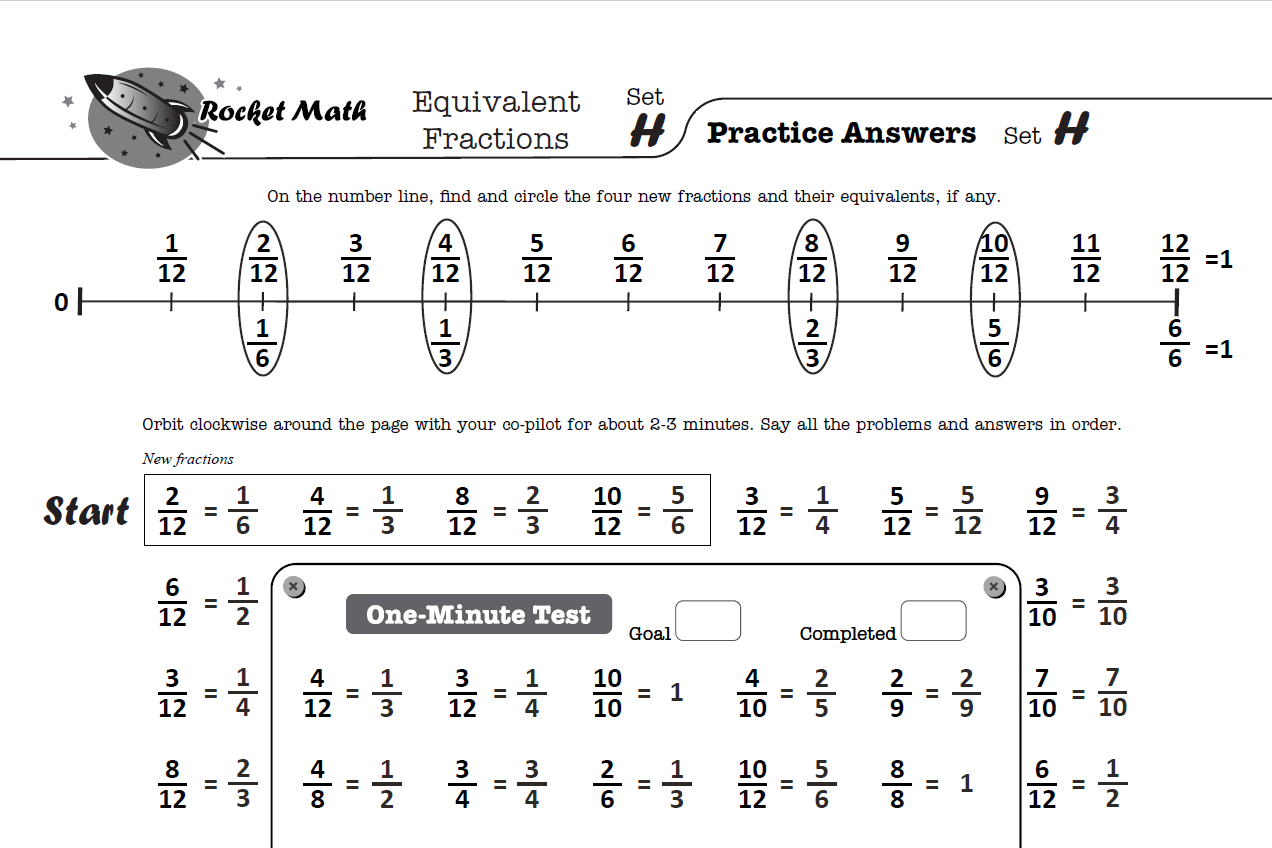
1) Equivalent Fractions

2) Factors

3) Learning to Add Integers (positive and negative numbers)

4) Learning to Subtract Integers (positive and negative numbers)

math worksheet for fast learners

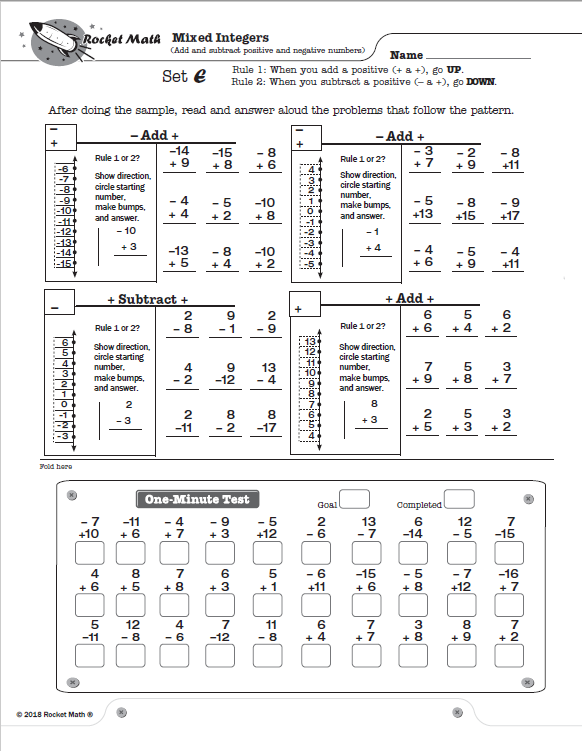
5) Mixed Integers (adding and subtracting positive and negative numbers)

Sign Up for Rocket Math’s Worksheet Program

Rocket Math’s goal is to make learning fun for everyone–students and teachers. By following the Worksheet Program, even students who have struggled in the past can begin gaining confidence in their math skills.

Because the Rocket Math Worksheet program follows a sequence and routine, it is easy for students to continue working together even when studying different programs or levels.

With the right underlying skills, students can enjoy learning math, and teachers can relax knowing that a strong foundation is forming. Our FAQs page for Teacher Instructions and How to Implement the Worksheet Program can help answer any questions you might have.

Ready to get started? Subscribe to Rocket Math’s Worksheet program today. It’s available for individual students and entire school districts.

The Ultimate Math Facts Test Online for Kids

You’re probably looking for a math facts test online to evaluate how well your students are learning their math facts. But did you know, it’s more effective to teach and test at the same time? Rocket Math’s online game does exactly that, making it the ultimate math fact online testing app.

Testing without teaching doesn’t work

Too many math facts tests online spend a lot of time asking students facts they don’t know. As a result, students learn inefficient ways to solve math fact problems, like counting on their fingers.  Even puzzling out answers from knowing doubles is tedious. Students will find memorization of math facts difficult if they constantly have to “figure out” math facts. Plus these two methods are slow, setting students up to fail timed math fact tests in class.

So what is the best way to test whether a student can recall math facts?

Teach and test a small number of math facts in tandem

An effective math facts test online will start teaching as soon as the test finds the first math fact that the student can’t answer quickly.

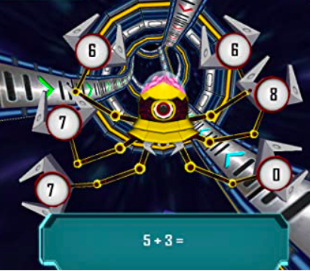
Rocket Math online game app interfaceIt is important to begin teaching immediately for several reasons.

(1) Students think that they will always have to compute math facts on their fingers or with a number line.  They don’t know that they can and should get to a point where they instantly recall the answers to facts.  Helping students memorize a previously unlearned math fact immediately after they miss the problem shows them that they can successfully master any fact.

(2) Students need to know that we do NOT want them endlessly figuring out math facts.  By responding immediately with teaching, we send the message, “Hey, you didn’t know this fact instantly.  That’s not what we want.  Let’s practice this one, right now, so you can learn it.”  Requiring the student to answer the fact again faster reinforces the message.

(3) Teaching a fact works best when the fact is surrounded by facts the student already knows. Therefore, the best time to teach is when a student meets the first math fact they can’t instantly recall. An effective test online will mix the unrecallable math fact with a sea of already mastered material, teach the math fact, and then test it again.

(4) The student learns the difference between memorized and unmemorized facts. This helps the student understand that the goal is to instantly recall that fact.

(5) With a combined teaching and testing approach, a student’s success rate will be high since the student primarily answers facts they already know. As a result, students are motivated to learn more math facts.

Why testing and teaching is the perfect learning paradigm

If your teaching program works carefully in sequence, students will encounter opportunities to practice facts they know (a good thing!).  Gradually, new facts will be introduced, practiced and tested. That is the perfect recipe for successful learning.  Over time, students will be able to master all the facts as the program works through its sequence.  Now you have accomplished the end goal: for students to learn the facts they didn’t know.  By testing and teaching as you go, students remain encouraged, learn the difference between problem-solving and memorization, and reach mastery.

Rocket Math game: the ultimate math fact test online

Dr. Don from Rocket Math watches the first Rocket Math app user complete math facts testThe picture to the right shows me watching the very first kid try out the Rocket Math online game.  As soon as he saw math problems, he said, “I don’t really like math that much.”  But he saw the problem on the screen was 3 + 1 =, so he just typed in 4 because he knew the answer.  Then he saw 2 + 1 = and he says, “Well I know that,” and he typed in that answer.  The reverses (1 + 3 and 1 + 2) came up and he could answer those.  The online math app only introduced those two math facts and their reverses, but he had to answer twelve in a row to pass the test.

Over time, he became faster.  He answered all twelve math facts and received an on-screen congratulations. Mission Control (a fictional character in the math app) told him that he had “taken off with Set A” and could, “try for orbit” if he dared! After finishing the round, he brought the tablet over to me and said he liked it and wanted to play it again as soon as the mandatory 30-minute break was over.

Not only did the Rocket Math app teach and test four math facts in 5 minutes, but the student wanted to continue practicing math facts. That’s the beauty of a combined teaching and testing approach. Kind of a big deal, eh?

In What Order Should Students Learn Fast Math Facts?

Basic, Optional, and Alternative—there are a lot of different Rocket Math programs. But which program should you use first? And in what order should you teach fast math facts? Well, it all depends on the grade you teach and the fast math facts your students have already memorized.

An overview of Rocket Math’s fast math fact programs

Rocket Math offers multiple programs because their are several ways to teach fast math facts. Here’s a link to a printable version of the different Rocket Math programs shown here.

The Basic Program

Rocket Math’s basic program includes Addition, Subtraction, Multiplication, and Division (1s-9s). The basic program must be mastered by all students.

A chart that shows the set of math fact family 5, 3, and 2 in Addition and Subtraction.The Alternative Program: Fact Families

There is another way to learn facts, which is called Fact Family math.  Instead of learning all Addition facts, students can learn Addition and Subtraction facts at the same time.  A fact family consists of four related facts, for example: 3+2 = 5, 2 + 3 = 5, 5 – 3 = 2, 5 – 2 = 3.  As an alternative to using the Basic Program, students can learn fact families up to 10 in first grade.  Then students can move on to the upper fact families 11 to 18 in second grade.  There is no clear evidence that this way is better or the separate operations way is better.  That’s why we offer both options.

Optional Programs

The rest of the fast math facts programs like Rocket Writing for Numerals or Skip Counting are optional. You should only offer these programs to students once they have memorized the fast math facts through the Basic Program or the Alternative Program.

The only exception would be in a school where Kindergarten students did not get a chance to learn how to quickly and easily write numerals. In that case, you might take the first two months of the first grade year to run students through Rocket Writing for Numerals before beginning Addition (1s-9s).

Let’s take a closer look at how to implement each program in different grade levels.

First grade math facts: Learn Addition

Rocket Math fast math facts programs for first graders include:

  • The Basic Program
    • (1s-9s) Addition
  • The Alternative Program
    • Fact Families (1-10) Add & Subtract
  • Optional Programs
    • Rocket Writing for Numerals
    • Add to 20

If first grade students are taking all year to get through sets A-Z in Addition in the Basic Program, they need some extra help.  You should intervene to help students who take more than a week to pass a level.  Often they need to practice better or practice with a better partner.  Some may need to practice a second time during the day or at home in the evening.  First grade students who finish the 1s-9s can move on to the Add to 20 Optional Program for the remainder of the year.

Likewise, if you choose to teach Fact Families (1-10) Add & Subtract from the Alternative Program instead of using the Basic Program, your students can use the Optional Programs for supplemental learning purposes.

Second grade math facts: Learn Addition and Subtraction

Rocket Math fast math facts programs for second graders include:

  • The Basic Program
    • (1s-9s) Addition
    • (1s-9s) Subtraction
  • The Alternative Program
    • Fact Families (1-10) Add & Subtract
    • Fact Families Part Two (11-18) Add & Subtract
  • Optional Programs
    • Subtract from 20
    • Skip Counting

Second grade students must have completed Addition before starting on Subtraction (1s-9s).  They can also test out of Addition through the Placement Probes.  Second graders who cannot test out of Addition in first grade or didn’t complete it in first grade must focus on Addition.  Only after getting through Set Z of Addition should they move into Subtraction.

You can substitute the Basic Program’s (1s-9s) Addition and (1s-9s) Subtraction for the Alternative Program’s Fact Families (1-10) Add & Subtract and Fact Families Part Two (11-18) Add & Subtract.

Second grade students who complete Addition and Subtraction 1s-9s (or the Alternative Program) can move on to Subtract from 20.  Students who finish Subtract from 20 can do Skip Counting, which does a great job of preparing students to learn Multiplication facts.

Third grade math facts: Learn Multiplication

There aren’t any Alternative Programs available for third graders from Rocket Math. There are only Basic and Optional Programs. These include:

  • The Basic Program
    • (1s-9s) Multiplication (priority)
    • (1s-9s) Addition
    • (1s-9s) Subtraction
  • Optional Programs
    • 10s, 11s, 12s Multiplication
    • Factors

In third grade, Multiplication has priority—even if students have not mastered Addition and Subtraction.  Multiplication facts are so integral to the rest of higher math that students are even more crippled without Multiplication facts than they are having to count Addition and Subtraction problems on their fingers.  So do Multiplication first. Then, if there’s time, students who need to do so can go back and master Addition and Subtraction.  Once all three of these basic operations are under their belts, students can go on to 10s, 11s, 12s in Multiplication (one of the Optional Programs).  If students successfully progress through each program and there is enough time left in the school year, introduce the Factors program next.

Fourth grade math facts: Learn Multiplication and Division

Like the programs for third graders, there aren’t any Alternative Programs available for fourth graders. There are only Basic and Optional Programs, which include:

  • The Basic Program
    • (1s-9s) Multiplication (priority)
    • (1s-9s) Division (second priority)
  • Optional Programs
    • 10s, 11s, 12s Multiplication
    • Factors

In fourth grade, students need to have completed Multiplication before going on to Division. If they complete Division, they can go on to 10s, 11s, 12s Division, followed by Factors, and then equivalent fractions (shown in the fifth grade section below).

Fifth grade math facts: Learn all basic operations first, then they can branch out

By fifth grade, students should have completed all four basic operations (1s-9s) within the Basic Program (or the Alternative Program for grades one and two).  If students have not completed these basics (and cannot test out of them with the Placement Probes) then the sequence they should follow is Multiplication, followed by Division, then go back and complete Addition followed by Subtraction.  The same recommendations hold for students in any grade after fifth.

Once students have mastered the basics (1s-9s add, subtract, multiply, divide), the supplemental pre-algebra programs are recommended.  These will help more than learning the 10s, 11s, 12s facts.  I would recommend this order:

  1. Factors
  2. Equivalent Fractions
  3. Learning to Add Integers
  4. Learning to Subtract Integers or Mixed Integers

How School Math Fluency Programs Work

Math Fluency Programs should be part of on-going elementary school routines

Most elementary teachers do some activities to promote math fluency.  Yet many elementary children are not fluent with math facts by the time they hit upper elementary or middle school.  A hit-or-miss approach allows too many students, especially the most vulnerable, to slip through the cracks.   Math fluency programs, like Rocket Math’s Worksheet Program, need to be part of your elementary school’s routine.  Effective math fluency programs should be properly structured and every math teacher should be on board, every year.

Math fact fluency enables students to develop number sense

Many teachers learn in their training programs about the importance of “number sense.”  Students who have “number sense” can easily and flexibly understand relations between numbers.  They can recombine numbers in various ways and see the components of numbers.  Students with number sense can intuit the fact that addition and subtraction are different ways of looking at the same relations.

What is not taught in most schools of education is that developing fluency with the basic math facts ENABLES the development of number sense much better than anything else.  Once students memorize facts, they are available for students to call upon to understand alternate configurations of numbers. Students find it much easier to see the various combinations when they when they can easily recall math facts.  Once students master the basic facts, math games that give flexibility to thinking about numbers become much easier.

It may be hard for new teachers, straight from indoctrination in the schools of education, to imagine this is true.  However, if they land in an elementary school with a strong math fact fluency program they will see the beneficial effect of memorization.

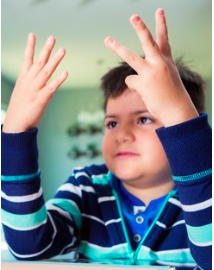
young boy wearing a blue striped shirt counting to seven on his fingersWhy is math fact fluency important

In the primary grades, students who have not developed fluency in math facts will have a harder time learning basic computation.

Students who are not fluent with math facts find the worksheets in the primary grades to be laborious work.  They finish fewer of them and may begin to dislike math for this reason.

By the time students reach upper elementary, if they have not memorized the math facts, they find it very difficult to complete math assignments at their grade level.  They find themselves unable to estimate or do mental math for problem-solving.  The need to figure out math facts will continue to distract non-fluent students while they are learning new math procedures like algorithms.

In the upper grades, their inability to figure out multiplication facts becomes a huge stumbling block.  Manipulations of fractions, decimals, and percentages will not make intuitive sense to students because they haven’t memorized those facts.  Without math fact fluency, students rarely succeed in pre-algebra and may be prevented from learning algebra and college-level math entirely.

Math fact fluency must be assured through regular monitoring

Some students will need up to ten times more practice to develop math fluency than other students.  Therefore, monitoring student success in memorizing the facts is critical. Teachers can assume that what is “enough practice” for some students is NOT going to be enough practice for all students.  Effective math fluency programs must have a progress monitoring component built in.  Progress monitoring gives comparable timed tests of all the facts at intervals during the year.  Teachers look at the results of these timed tests to check on two things:

1. Are students gradually improving their fluency with all the facts gradually over the year? 

In other words, are students able to answer more facts in the same amount of time?  If they aren’t improving, then the instructional procedures aren’t working and need to be modified or replaced.  Math fluency programs like Rocket Math’s Worksheet Program have two minute timings of all the facts in each operation that can be given and the results graphed to see if there is steady improvement.

2. Are all students reaching expected levels of performance at each grade level each year?

Proper math fluency programs identify students who are not meeting expectations and give them more intensive interventions.  Ultimately, by the end of fourth grade all students should be able to fluently answer basic 1s – 9s fact problems from memory in the four operations of add, subtract, multiply and divide. Fluent performance is generally assumed to be 40 problems per minute, unless students cannot write that quickly.

Expectations vary by grade level and the sequence with which schools teach facts can vary.  While it is great to achieve all that the Common Core suggests, it is critical only to assure that students master and gain fluency in 1s through 9s facts.  Some schools in some neighborhoods may find that waiting until second grade to begin math facts may not provide enough time for all students to achieve fluency.  When to begin fact fluency and how much to expect each year should be based on experience rather than some outside dictates.

Successful math fluency programs must have these 3 features


  1. Sequences of small sets

    No one can memorize ten similar things, like the 2s facts, all at once. Students easily master math facts when they can learn and memorize small amounts of facts at one time. Effective math fluency programs define math fact sequences, which students memorize at their pace before moving onto new math facts. Rocket Math’s fluency program uses only two facts and their reverses in each set from A through Z.

  2. Self-paced progress

    Even if you only introduce small sets of math facts, some students need more time to memorize than others.  If you introduce the facts too fast, students will begin to jumble them together and progress will be lost. The pace of introducing facts must be based on mastery—not some pre-defined pace.  This is why doing all the multiplication facts as a class in the first six weeks of third grade does not work.  It is just too fast for some students.  Once they fall behind it all becomes a blur.

  3.  Effective practice and corrections

    When students are practicing facts, they will come to ones they have forgotten or can’t recall immediately.  Those are the facts on which they need more practice.  Allowing students to stop and figure out the facts they don’t know while practicing, does not help the student commit them to memory.  Instead, students need to IMMEDIATELY receive the fact and the answer, repeat it and try to remember it.  Then they need to attempt that fact again in a few seconds, after doing another couple of problems.  If they have remembered the fact and can recall it, then they are on their way to fluency.  But students must practice the next day to cement in that learning.

Math fluency programs like Rocket Math’s Worksheet Program teach students math facts in small sets, allow students to progress at their own pace, and support effective practice and error correction. Each Rocket Math Worksheet program has 26 (A to Z) worksheets specially designed to help kids gradually (and successfully) master math skills. Gain access to all of them with a Universal Subscription or just the four basics (add, subtract, multiply, divide–1s to 9s) with a Basic Subscription.


Math Fact Apps: Do they help – Or Waste Time?

Just doing math is not enough to develop math fact fluency.

Math leaning head against chalk board

If you want to help your kid succeed in golf, you must first help them develop a good drive. Before they can successfully go out and play a game of golf, they will have to spend some time on the driving range. Right? The same thing goes for math. To help your kid succeed in math, you must first help them develop math fact fluency. Math facts are single-digit problems like 5 +9 or 6 x 8. The times tables are math facts in multiplication. Math facts are the fundamental units of all math problems. They are the drivers, if you will, of doing math. Children who struggle to remember basic math facts will find learning math and doing math difficult. We know what that looks like, right? On the other hand, students who can easily answer all math facts, who can answer math facts with fluency, find math a breeze and are successful and confident in math. Math fact apps can be a great way to help with learning math facts and improving math fact fluency. 

Not all math apps build math fact fluency.

screenshot of Rocketmath's math fact apps game

There are a lot of apps out there that look like they would help your child learn math fact fluency. If they have to answer math facts, won’t that work? Not really. Just playing a game that asks you to answer facts won’t help you learn new facts. In fact, most apps for practicing facts discourage students who don’t know their facts well. Why? Because most of the people designing the app don’t have any experience teaching or knowledge of instructional design. A teacher with expertise in instructional design, like the Rocket Math Online Game App creator, knows how to effectively teach a student new math facts (or any facts) and knows an effective math app from an ineffective one.

Three essential features of an effective math fact app.

There are plenty of ineffective math apps. Some apps don’t give the answers when a student doesn’t know them. Some apps just fill in the answer for the student and then move on. When the student doesn’t know the answer, the app has to teach it. To teach a math fact that the student doesn’t know, the app has to do these three things:

  1. Tell the problem and the answer to the student, if needed.
  2. Ask the student to give the correct answer to the problem from memory.
  3. After a short delay, ask the problem again a couple of times, to be sure the student can remember the answer.

The key job in developing math fact fluency is learning new facts. By doing these three things, the app will be able to teach the student new facts, and the student will develop fluency beyond what they already have.

An effective math app will only teach a few math facts at a time.

a kid holding up a tablet with the RocketMath math fact apps on it.

Math facts are all very similar, which is what makes them hard to remember. No one can learn a bunch of new and similar things all at the same time. A person can only learn two, three, or four facts at a time, and you cannot expect to learn more at one time. That’s enough for one session. The student has to practice those facts a lot of times to commit them to memory. Once or twice is not enough. It also won’t help to practice the same fact over and over. Proper math fact fluency practice intermingles new math facts along with facts the learner has already memorized. No more than two to four facts should be introduced at a time. If a student has to answer a lot of random untaught math facts, you will have a very frustrated learner.

How to build math fact fluency by practicing

kid counting on fingersSome students learn to solve addition problems by counting on their fingers. That’s a good beginner strategy, but students need to get past that stage. They need to be able to simply and quickly recall the answers to math facts. An app is good for developing recall. But the app has to ask students to answer the facts quickly, faster than they can count on their fingers. The app has to distinguish when a student recalls the fact (which is quick) from figuring out the fact (which is slow). Second, the app must repeatedly ask the learned facts in a random order, so students recall them. But the app should only throw in new facts once all the facts are mastered and can be answered quickly.

Introduce new facts only when old facts are mastered!

The trick to effectively teaching math facts is to introduce new math facts at an appropriate pace. If you wait too long to introduce math facts, it gets boring and wastes time. If you go too fast, students become confused. Before introducing new facts, students need to master everything you’ve given them. An effective app will test whether students have mastered the current batch of math facts before introducing more facts. And it will also introduce math facts at a pace based on student mastery. That’s the final piece of the puzzle to ensure students learn math facts from an app.

Rocket Math Online Game App–try it for 30 days for free

You probably guessed that we know of an app that meets all these criteria, the Rocket Math Online Game. It is like a driving range for math–it will develop math fact fluency. But don’t take our word for it. Try it for free for 30 days. If your child or students use it daily for 30 days, you’ll know they are learning and becoming more fluent with math facts. Keep it going, and they will become confident and successful in math. And that’s the point, isn’t it?

*The Rocket Math Online Game App focuses on two facts and their reverses at a time, such as 3+4=7, 4+3=7, 3+5=8 and 5+3=8.

Why Multiplication Games Are Awful & What to Do About It

As a university supervisor of pre-service teachers, I’ve seen my share of bad lessons.  Among the most painful were when student teachers would try to liven up their lessons to impress me by having the students do a math game.  My student teachers wanted their students to learn math facts and to do so in a fun way.  The picture above is typical of what I would see.  Here are the reasons that most multiplication games that the student teachers implemented were awful.

(For multiplication games that work in and out of the classroom, check out Rocket Math’s Worksheet Program and Online Game.)

Waiting for your turn at a multiplication game is not learning!

As you can see in the picture above, all but one of the students are just waiting for their turn.  They aren’t doing math.  The students are just watching the student who is playing.  No one likes waiting, and your students are no exception.  Any game that has turn-taking among more than two students wastes time.

Make sure your multiplication games are structured so all or most students are engaged and playing all the time.  You want students to have as much engaging practice as possible while practicing math facts at speed.  If everyone can be doing that at the same time, that’s optimal.  No more than two students should be taking turns at a time.

A multiplication game that allows using a known strategy to figure out facts (like finger counting) is not learning!

Learning math facts involves memorizing these facts so that students know them by memory, by recall.  Committing facts to memory is why there is a need for lots of practice.  If the game allows time for students to count on their fingers or use some other strategy for figuring out the answer to facts, then there is no incentive for students to get better.

In the lower left corner of the picture you can see one student counting on their fingers—which is better than just watching—but is not learning the facts, it is just figuring them out.  The most able students in an elementary school are able to memorize facts on their own when they tire of figuring them out day in and day out.  But the rest of the students will just do their work patiently year after year without memorizing if you don’t create the conditions for them to memorize facts.

Make sure that your multiplication games reward remembering facts quickly rather than just figuring them out.  Speed should be the main factor after accuracy.  Fast-paced games are more fun and the point should be that the more facts you learn the better you’ll do.

Multiplication games that randomly present ALL the facts make learning impossible.

It is a basic fact of learning that no one can memorize a bunch of similar things all at once.  To memorize information, like math facts, the learner must work on a few, two to four facts, at a time.  With sufficient practice, every learner can memorize a small number of math facts. Once learners master a set of math facts, they can learn another batch.  But if a whole lot are presented all at once, it is impossible for the learner to memorize them.

Make sure your multiplication games are structured so that each student is presented with only facts they know.  A good game presents only a few facts at a time.  As students learn some of the math facts, more can be added, but at a pace that allows the learner to keep up.  The optimal learning conditions are for the learner to have a few things to learn in a sea of already mastered material.

Rocket Math Multiplication Games

We designed Rocket Math games to help kids gradually (and successfully) master math skills. Students use Rocket Math’s Worksheet Program to practice with partners, then take timings. Students can also individually develop math fact fluency—from any device, anywhere, any time of day—with Rocket Math’s Online Game.

How to Grade 1-Minute Math Fluency Practice Tests

Katy L from Wilson Elementary asks: How can I keep up with everyday Rocket Math grading? Do you teach students to grade their own 1-minute math fluency practice tests?

Dr. Don answers:

Only grade 1-minute math fluency practice tests if students pass

An integral part of the Rocket Math Worksheet Program is the 1-minute math fluency practice test. One-minute fluency practice tests are administered every day, to the whole class, and only after students practice in pairs for two to three minutes each. Check out the FAQs page to learn more about conducting 1-minute math fluency practice tests in class.

Teachers do NOT need to grade, score, or check daily Rocket Math 1-minute math fluency practice tests unless the student has met their goal. Students do NOT need to grade their own daily Rocket Math fact fluency tests either.

Why grading each math test is not important

The important part of math fluency practice is the oral practice with the partner before the test–what’s going on in this picture. Because the students are orally practicing every day and getting corrections from their partners, there should be VERY FEW errors on the 1-minute math fluency written tests.  

Correcting written tests doesn’t help students learn anyway. Corrections are only helpful if they are immediate, the student has to acknowledge the correct answer, and remember it for a few seconds–all of which is part of the oral correction procedure. “Correcting” what’s on the paper takes a lot of time and does not help students learn more, so it shouldn’t be done. But you have to check them before declaring that the student has passed a level.

How do you know if a student passes?

Students should have a packet of 6 sheets math fact fluency sheets at their level. Each Rocket Math student has an individual goal. For example, if a student has a goal of 32 (based on their Writing Speed Test) and they only do 31, they know they did not pass. If the student does 32 or more, they pass!

What to do when a student beats their goal (passes)

If a student meets or beats their goal, then have them stand up, take a bow, and then turn their folder into a place where you check to see that all problems were answered correctly. When YOU check (after school?), make sure all of the completed problems were correct and the student met their goal. If so, then you put the unused sheets in that packet back into the filing crate and re-fill the student’s folder with a packet of 6 worksheets at the next level and hand the folder back the next day.

When students receive the new packet of worksheets, they know to color in another letter on the Rocket Chart (and maybe put a star on the Wall Chart).

What to do if a student doesn’t pass?

Students who don’t meet their goals, don’t pass. These students should put the non-passing sheet into their backpacks and take the sheet home for more practice.

The next day they will use the next sheet in their packet of 6. If you want to give them points, do that the next day after they bring back their worksheet where they did a session at home (signature of helper should be there) and all items on the test are completed. If that’s done, they get full points.

Sometimes you’ll catch errors on sheets that students turn in as “passes.” If you see an error, the student doesn’t pass. As a result, the student keeps the old packet and has to continue with that same level worksheet.

For more information about conducting 1-minute math fluency practice tests in class and how to implement the Rocket Math worksheet program, visit the FAQs page.

Facts practice: does it belong in middle school math?

It sure does, if you’re seeing this happen in your class!

Most middle school math teachers confide to me that their classrooms are negatively impacted by the number of students who stop to count out facts on their fingers.  Their issue was always what to do during facts practice with the other students who do know their facts.  It has taken a couple of years but I have put together a package of pre-algebra skills that are worth middle school students’ time practicing which are available in the Universal Subscription. Because the routine of Rocket Math is the same whether the students are practicing basic multiplication facts or learning equivalent fractions you’ll be able to manage all these different levels during the same ten-minute session.

Teachers know it is imperative that finger-counting middle schoolers get practice learning their facts.  Rocket Math is an excellent way to do that.  They will develop fluency and automaticity with the basic facts in an operation in a semester and from then on your lessons will be much easier.  Not only that, but a much higher proportion of the students will be finishing assignments.  There is a “Placement Probe” that can identify students who know their facts in about one minute. The students who know the basic facts of multiplication and division can be placed into the pre-algebra practice programs.

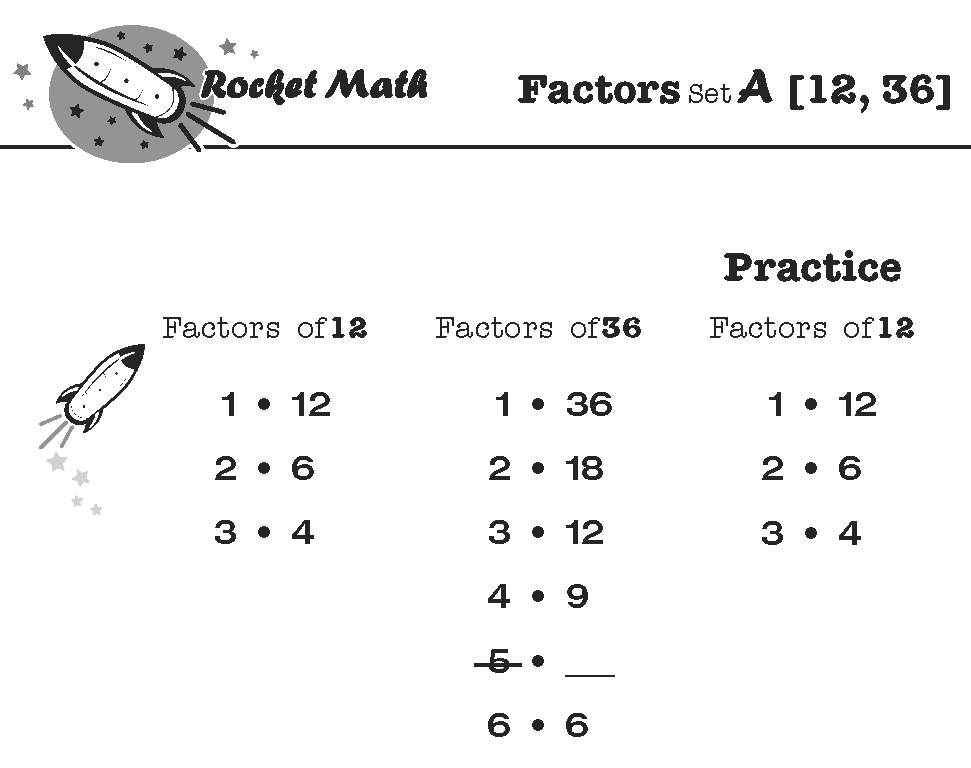
Factors Answers AFACTORS. Students probably ought to begin with the Factors program. What are the factors of 24? Answer: 1 and 24, 2 and 12, 3 and 8, 4 and 6. This is what students learn by memory from doing this program. Students practice with a partner, take a daily one minute timing, fill in a Rocket Chart, just like regular Rocket Math. Students learn all the factors for these numbers in this sequence: 12, 36, 24, 48, 18, 32, 16, 64, 10, 40, 20, 72, 8, 25, 50, 6, 21, 30, 60, 15, 45, and 100.


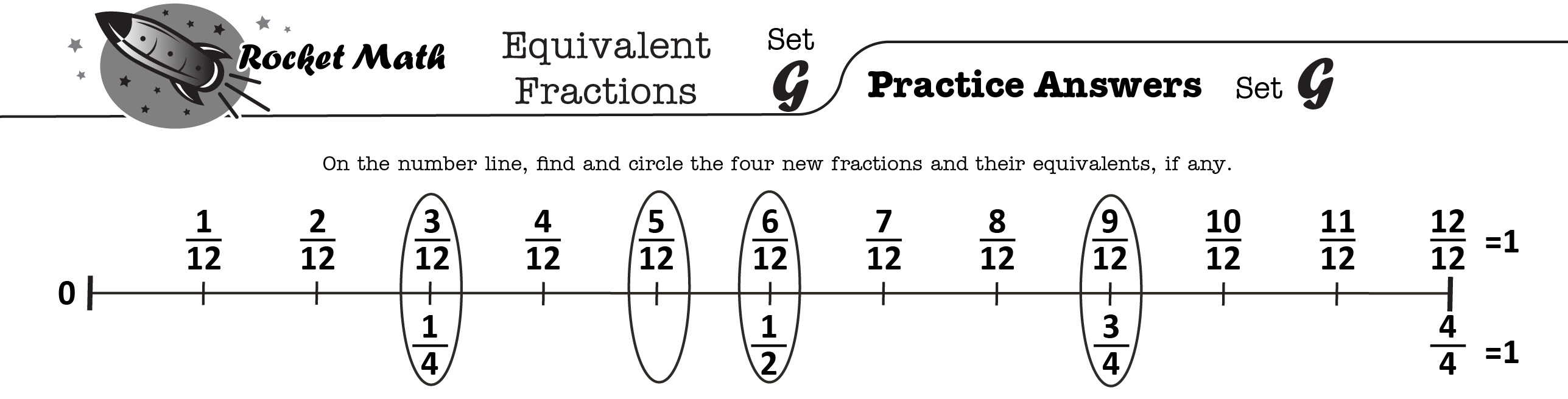
Fraction Number Line GEQUIVALENT FRACTIONS.  Students need to know that six-eighths is equivalent to three-fourths and that four-twelfths is equivalent to one-third.  While they can calculate these, it is very helpful to know the most common equivalent fractions by memory.  One of the most common problems students have in fractions is not “reducing their answers to simplest form.”  Equivalent fractions will help students commit 100 common equivalent fractions to memory.  Each set (A through Z) has four fractions which are displayed on a fraction number line.  Students frequently learn fractions equivalent to one,such as ten-tenths, as well as fractions that can’t be reduced, for example three-fourths is equivalent to three-fourths.  Using the fraction number line will help with student understanding of why those fractions are equivalent.

Integers ArrowsINTEGERS (Adding and subtracting positive and negative numbers).  Integers displays problems on a vertical number line and then teaches students two rules about how to solve problems that add or subtract positive and negative numbers.

Rule 1: Go up when you add a positive number OR subtract a negative number.
Rule 2: Go down when you subtract a positive number OR add a negative number.

Students gradually learn several variations of all four types of problems.  They practice with the number line on each page and then have a chance to build fluency on the top half of the page as they work with their partner.  You will probably not be surprised that there is a one-minute test on each set.  The goals are slightly different than before.  Students are to be 100% accurate and to complete at least 80% of their rate at answering simple addition and subtraction problems.

10s, 11s, 12s Multiplication and 10s, 11s, 12s Division facts are also available in the Universal Subscription.  If you have students who think they know the basic facts, but need review, putting them into either of these programs will review the 1s through 9s facts, teach them new ones and allow them to save face.

Among these five programs there are good things for ALL middle school math students to learn, even the more advanced students.  This will enable a math teacher to devote ten minutes a day to fact practice without holding anyone back.  Everyone will have something meaningful to practice during that time.  I think this could be a huge step forward for a lot of middle school MATH classrooms.